Tuesday, November 17, 2009

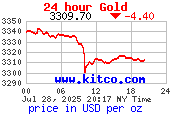
Mark Faber : "Gold Won't Go Below $1,000" & "Gold A Better Buy Than At $300/oz. "

Hearing quotes like this i sometimes have the feeling that i´m one of the more bearish GOLD-BUGS out there.... ;-)

Muß allerdings gestehen das ich bei solchen Zitaten so langsam als einer der pessimitischeren GOLD-BUGS durchgehe... ;-)

H/T Expected Returns for the videos & Tim from The Mess That Greenspan Made for digging out the following quote and analyzing it perfectly....

Dank an Expected Returns für die Videos und Tim von The Mess That Greenspan Made der nachfolgendes Zitat hervorgehoben hat und dies dann mehr als treffend analysiert hat.....

Faber : Maybe, gold at this level is a better buy than it was at $300 per ounce in 2001.

Tim: At first glance, the idea that gold priced at over $1,100 an ounce is "a better buy" than when the metal traded at about a quarter of that price seems reposterous. But, when you think about it just a little bit (i.e., what constitutes a "better buy" and how the fundamental factors have now swung so decidedly in gold's favor), maybe it isn't a crazy idea at all.

I wouldn't be surprised if, in another eight years - in 2017 - the yellow metal fetches $5,000 an ounce or more which, by my math, would make it a better buy. Gold may not rise as much against other currencies, but, after almost a decade of trillion dollar deficits, that almost seems like a slam dunk when the measuring stick is the U.S. dollar.


Compare yesterdays quotes from Yellen, Kohn & Bernanke with what Faber said.....In the context of these remarlks i just couldn´t resist to post the following video "highlighting" Bernanke´s past track record in seeing the obvious.... Gold is a not the way to get rich but is a wonderful way to PROTECT your "puchasing power" with a very long track record ( 750 Years Of Real Gold Prices )

Vergleicht die Zitate von Yellen, Kohn & natürlich Bernanke vom Vortag mit dem was Faber gesagt hat..... Konnte in diesem Zusammenhang nicht verkneifen das nachfolgende Video mit einigen von Bernankes vergangenen "Glanzleistungen" zu bringen wenn es darum geht einen gewissen "Überschwang" zu "sichten"......... Gold ist sicher nicht geeignet um zu spekulieren aber die Historie ( 750 Years Of Real Gold Prices ) zeigt das es sich bei Gold zumindest um eine der weinigen Möglichkeiten handelt die nachweisbar zumindest die KAUFKRAFT ERHALTEN......


Geithner Blames Collapse On Previous Admin Even As Tim Was President Of FRBNY Under Bush; Resignation Time H/T Zero Hedge


Dylan Grice / Societe Generale ZH

Of course, any gold bull, gold "bug" or otherwise, faces some serious competition, in the face of none other than Goldman Sachs' most recent partner in philanthropic, TARP subsidized ( disturbing table / diese Übersicht "entzaubert" Buffet zumindest als den "guten" Amerikaner, er bleibt ein guter Investor... mehr aber auch nicht....! ) deeds, Warren Buffett.

“Gold gets dug out of the ground in Africa, or someplace. Then we melt it down, dig another hole, bury it again and pay people to stand around guarding it. It as no utility. Anyone watching from Mars would be scratching their head.”

Warren Buffett
At least the quote is funny but after taking a look at the following link "Our Governments Are Insolvent" it is easy to see why Buffet is wrong. Wouldn´t be the first time.....At least one quote where he is not talking his book .... ;-) This Chart is clearly telling what is going on.......I´m still thinking that the Dow/Goldratio reached in 1980 is not "unrealistic" over time......

Immerhin ein witziges Zitat von Buffet das aber gerade wenn man die Grafik in "Our Governments Are Insolvent" ansieht wohl zu den weniger ruhmreichen Einschätzungen von Buffet gehören wird.....Dieser Chart spricht zumindest momentan eine eindeutige Sprache.....Bin mehr denn je der Meinung das ein Dow/Goldratio vergleichbar mit dem Jahr 1980 in den nächsten Jahren nicht "unrealistisch" ist....

UPDATE:

Gold: Short-Term and Long-Term Outlook Expected Returns

The Fed is sending gold higher Rolfe Winkler

Wells Fargo Needs TARP Money More Than It Admits: Jonathan Weil "Buffet Watch....."

Labels: , , , ,

Saturday, November 18, 2006

Derivatives Trading Soars to $370 Trillion / buffets "weapon of mass destruction"

as is wrote before. i´m waiting for the first real stresstest. i think that the derivatives are like buffet said "financial weapons of mass destruction". watch this stat and i have problems with the generall thinking that the counterpart always pays for the (false) "security"

.....wie ich schon vorher beschrieben habe warte ich auf den ersten realen stresstst. ich teile die meinung von buffet das es sich hier um "massenvernichtungswaffen" handelt. guckt euch die folgende statistik an und fragt euch ob sichergestellt ist das in panikzeiten diese versicherung nicht ne leere versprechung ist.(weil z.b. der hedgefonds untergeht).

Here we learn that hedge funds account for 32 percent of credit-default swap sellers and 28 percent of buyers, up from 15 percent and 16 percent in 2004, according to a British Bankers' Association report last month


it is also scray that the derivates exceeds often the amount of underlying assets like gold, stocks, bonds etc.


Credit-default swaps also are used by money managers as a cheaper and quicker alternative to buying and selling bonds. When Delphi Corp. filed for bankruptcy on Oct. 8, there were $20 billion of credit-default swaps related to its $2 billion of bonds (10xlarger!)


more on derivatives/derivaten

http://immobilienblasen.blogspot.com/2006/09/shadows-of-debt-economist.html
http://immobilienblasen.blogspot.com/search?q=creditinnovation
http://immobilienblasen.blogspot.com/2006/08/credit-default-swap-chaos.html
http://immobilienblasen.blogspot.com/search?q=hedgefunds+derivatives

dank an mish und sein http://www.markettradersforum.com/forum1/

http://tinyurl.com/yctych
Nov. 17 (Bloomberg) -- The use of derivatives grew at the fastest pace in eight years during the first half of 2006, boosting earnings at securities firms and reducing costs for investors.

The face value of derivatives based on corporate bonds, currencies, interest rates, commodities and stocks jumped 24 percent to $370 trillion, according to the Bank for International Settlements. It was the biggest percentage rise since the bank began keeping records in 1998.

Trading in credit-default swaps, the fastest-growing derivatives market, helped spur record earnings for banks including New York-based Morgan Stanley and Goldman Sachs Group Inc. At London-based Barclays Capital derivatives accounted for more than 60 percent of revenue and profit, Chief Executive Officer Bob Diamond said in May. http://immobilienblasen.blogspot.com/search?q=hedgefunds+derivatives

``The pace of growth is going to have continued unabated in the second half of the year,'' ....

The amount of outstanding credit-default swap contracts jumped to $20.3 trillion from $13.9 trillion at the end of last year, ....... The securities are financial instruments based on bonds and loans that are used to bet on an increase or decrease in indebtedness.

Investors who buy the contracts are paid the face value of the underlying debt in exchange for the defaulted notes should the company fail to adhere to debt agreements. A decline in the cost of the contracts indicates an improvement in the perception of credit quality; an increase signals deterioration.

Contracts Cheaper
Banks and hedge funds say it's cheaper and easier to use the contracts than buying or selling the underlying securities
. ....

Within the credit derivatives market, trading on indexes based on groups of companies soared as much as 86 percent, the report said.

``Greater standardization, deeper liquidity and more efficient pricing'' is helping to boost trading, said Sunil Hirani, chief executive officer of New York-based Creditex Group Inc., one of the brokers that matches buyers and sellers in the market. ``The number of participants will continue to grow.''

Greenspan Comments
Alan Greenspan, the former chairman of the Federal Reserve, has been saying since 2002 that derivatives reduce risks by making financial markets resilient to shocks. In May he told a Bond Market Association gathering in New York that derivatives are the most significant change on Wall Street ``in decades.'' make sure you read the other insights from alan g! (about housing, hedge funds, savingsrate etc..) and you know why i´m with buffet......
http://immobilienblasen.blogspot.com/search?q=interview+alan+greenspan


picture: thank to tim http://themessthatgreenspanmade.blogspot.com/

The rapid growth of derivatives is also raising concerns that their ease of use may lead to market abuse such as insider trading related to leveraged buyouts, after unusual price changes occurred prior to the announcement of takeovers in the U.S.

.....Trading in derivatives overall grew 24 percent in the first six months, compared with 5 percent in the second half of 2005, the BIS said.

Interest-rate swaps, which make up 70 percent of the derivatives market, rose the most in Europe, growing 27 percent in the first half compared with 18 percent in the U.S., the report said.

The outstanding amounts of derivatives (All numbers in $trillion).
End-June 2005 End-Dec 2005 End-June 2006
Interest rates 204.7 211.97 262.3
Credit 10.2 13.9 20.3
Equity 4.5 5.7 6.7
Commodities 2.9 5.4 6.4
Foreign Exchange 31 31.3 38.1
Unallocated 27.9 29.1 36

make sure oyu read the credit bubble bulletin from the great doug noland http://tinyurl.com/wymb6

scroll down to the last part Derivatives “Insurance”:

Labels: , ,

Monday, September 14, 2009

"Today I Think Of Myself As A Government Contractor......"

When you here this kind of quote in context with the mortgage business it should be clear that in the not so distant future another not so "insignificant" bailout is already in the cards..... Looks like the Phony Mae & Fraudie Mac pain wasn´t enough.......

Wenn mal soclche Sätze im Zusammenhang mit dem Hypothekengeschäft hört ist der nächste "nicht unwesentliche" Bailout nicht weit.... Sieht ganz so aus als wenn der Phony Mae & Fraudie Mac Schaden doch noch nicht hoch genug war....... Da geht noch was......

[No Easy Exit for Government as Housing Market's Savior]

No Easy Exit for Government as Housing Market's Savior WSJ

After a year of extraordinary interventions in the economy, the federal government is starting to pare its support for the private sector. It doesn't look that way to Peter Lansing, president of mortgage firm Universal Lending.

The Denver home lender sees every day how dependent the housing market has become on the government. At the height of the boom, just 20% of Universal's mortgages were backed by the Federal Housing Administration, an arm of the government that guarantees loans to borrowers who can't afford big down payments. Today, the FHA accounts for more than 80% of his business. For Mr. Lansing, this represents a new way of life -- more government, more paperwork, but also a lot of sales that wouldn't have happened otherwise.

"Over 29 years in business, we've always thought of ourselves as being in the free-enterprise system. Today I think of myself as a government contractor,"
Over the past year, the government has intervened heavily at essentially every stage of the home-buying process. In fact, more than 80% of the new residential mortgage loans made this year benefited from some form of government support, according to the trade publication Inside Mortgage Finance.

Speaking of CHUZPAH....... Make sure you compare this comment with the last update at the end of the post....Same CEO ......

Einigen Bänkern sind selbstredend auch die 80% noch zu wenig...... Vergleicht den nachfolgenden Kommentar mit dem vom Update am Ende des Posting.... Handelt sich um den selben CEO....

Wells Fargo urges US to boost mortgage market

The US government should help revive the moribund market for big mortgages by getting Fannie Mae and Freddie Mac to buy large home loans from banks, the chief executive of the lender Wells Fargo urged in an interview with the FT on Tuesday. John Stumpf, whose bank originates a quarter of all US mortgages, called for an increase in the size of loans purchased by Fannie and Freddie, the troubled finance groups controlled by the authorities.

Buffet will be proud ......

Buffet wird es freuen.....

Behind FHA Strains, a Push to Lift Housing WSJ

[Broad Exposure chart]

The FHA insures loans secured with down payments as low as 3.5%. But values in many markets in which it has been increasing its activity have fallen far more than that in the past year. The result: A growing number of homeowners with FHA-backed loans owe more than their homes are worth and are more likely to default.

At the end of June, some 7.8% of FHA-backed loans were 90 days late or more, or in foreclosure, according to the Mortgage Bankers Association, up from 5.4% a year ago.

In July, California accounted for 13% of the FHA's mortgages, up from 1.5% in 2006.

Mounting losses have eaten into the FHA's cash cushion. Federal law says the FHA must maintain, after expected losses, reserves equal to at least 2% of the loans insured by the agency. The ratio last year was around 3%, down from 6.4% in 2007.
UPDATE: WaPo: FHA Cash Reserves Will Drop Below Requirement

The Next Fannie Mae : Ginnie Mae and FHA are becoming $1 trillion subprime guarantors WSJ

[1fha]

Only last week, Ginnie announced that it issued a monthly record of $43 billion in mortgage-backed securities in June. Ginnie Mae President Joseph Murin sounded almost giddy as he cheered this “phenomenal growth.” Ginnie Mae’s mortgage exposure is expected to top $1 trillion by the end of next year—or far more than double the dollar amount of 2007. (See the nearby table.) Earlier this summer, Reuters quoted Anthony Medici of the Housing Department’s Inspector General’s office as saying, “Who would have predicted that Ginnie Mae and Fannie Mae would have swapped positions” in loan volume?

Ginnie’s mission is to bundle, guarantee and then sell mortgages insured by the Federal Housing Administration, which is Uncle Sam’s home mortgage shop. Ginnie’s growth is a by-product of the FHA’s spectacular growth. The FHA now insures $560 billion of mortgages—quadruple the amount in 2006. Among the FHA, Ginnie, Fannie and Freddie, nearly nine of every 10 new mortgages in America now carry a federal taxpayer guarantee.
Banks Load Up on Mortgages, in New Way WSJ

[ginnie mae]

Banks have been silent partners in the meteoric rise of the Federal Housing Administration.

In the past year, the nation's financial institutions have snapped up securities backed by Ginnie Mae, a government-owned agency that guarantees payments on mortgages backed by the FHA. That helped drive demand for Ginnie securities and created an outlet for billions of dollars of FHA-backed loans made to borrowers who in many cases couldn't afford big down payments.

As of June 30, the roughly 8,500 federally insured banks and thrifts were holding $113.5 billion of Ginnie securities, compared with just $41 billion a year earlier, according to a Wall Street Journal analysis of bank financial disclosures. It is the largest amount that banks have reported holding since at least 1994.

Banks, sometimes with the blessing of federal regulators, have been loading up on Ginnie securities for one main reason: They make their balance sheets look healthier. Since the securities are guaranteed by the government, federal banking regulators have deemed them risk-free, meaning that adding them to a bank's investment portfolio, or replacing assets deemed riskier, lowers the overall risk of the portfolio in the eyes of regulators.

Some banks have used government cash infusions under the Troubled Asset Relief Program to buy Ginnie Mae bonds.

Holding Ginnie bonds help banks look better because federal bank-capital guidelines give the Ginnie securities a "risk weighting" of 0%. That means banks don't have to hold any cash in reserve to protect against losses. By contrast, securities backed by Fannie Mae and Freddie Mac, the two mortgage giants seized by the government, carry a 20% risk weightin
g, meaning some cash needs to be set aside to hold them, even though most banks and investors think there is scant risk of Fannie or Freddie securities defaulting. Privately issued mortgage-backed securities can receive risk weightings of 50%, while many other types of debt carry 100%.

Because of the different risk weightings, bankers say they are selling relatively safe assets like Fannie securities and replacing them with Ginnie securities. The move doesn't shrink banks' balance sheets or remove their troubled assets. But it reduces their total assets on a risk-weighted basis. That is important because risk-weighted assets are the denominator in some key ratios of bank capital.

Like some peers, First State bankrolled those purchases partly with taxpayer dollars that were intended to stabilize the banking industry and jump-start lending. The 32-branch bank used a "significant portion" of the $20 million it received through TARP to buy Ginnie securities, Mr. Clark said.

Mr. Clark credits the strategy with helping First State preserve its capital ratios even as loan defaults swelled to $9.5 million on June 30 from $1.6 million a year earlier. During the same period, its total risk-based capital ratio climbed to 11.3% from 10.7%. That gave First State some breathing room above the 10% ratio regulators require for banks to be deemed "well capitalized."

Ms. Keeling acknowledged that the strategy doesn't ease the bank's underlying problems. "The whole capital ratio can be manipulated ... in many ways to make it appear better or worse," she said.

In St. Augustine, Fla., Prosperity Bank increased its holdings of Ginnie securities tenfold over the past year. The lender, with 20 branches and $1.2 billion in assets, simultaneously dumped most of its Fannie and Freddie securities, even though they seemed safe.

"There's no more risk in Fannie and Freddie securities than in a Ginnie security," despite the different capital treatments, said CEO Eddie Creamer.

Ginnie and the FHA, units of the U.S. Department of Housing and Urban Development, have become two of the most powerful mortgage financiers in the U.S. When banks make home loans, the FHA insures them against default. Then the mortgages are pooled together and packaged into mortgage-backed securities. Ginnie guarantees that buyers of those securities -- including banks and other investors -- will continue to receive interest and principal payments on the debt, even if borrowers start to default.
Rolfe Winkler nails it!

Rolfe Winkler formuliert es perfekt!

"It’s equally likely the agency will continue to be a conduit through which the Obama administration funnels cash to the housing market"

Over $600 billion of loans backed by the end of this year — many very risky due to very low downpayments — but no chief risk officer….

A canary in the coal mine was the raid on Taylor Bean & Whitaker, a multi-billion dollar lender that had seen its FHA lending business expand very quickly over the past year. But TBW’s underwriting was terrible so FHA suspended them from issuing its loans. By the end, TBW’s business had grown to $100m-$150m worth of loans per day. The suspension put TBW out of business overnight.
Karl Denninger is also "passionate" when it comes to the FHA topic..... ;-)

Wer die etwas "deftigere" Sprache bevorzugt dem empfehle ich die FHA Sichtweise von Karl Denninger.... ;-)

Uncle Sam Bets the House on Mortgages WSJ

Right now, housing remains on government life support. Treasury-backed entities are guaranteeing about 85% of new mortgages, while the Fed buys 80% of the securities into which these taxpayer-backed mortgages are packaged

Rather than trying to implement change, the government appears to be reinforcing a system in which it provides subsidies to an asset that periodically goes through highly leveraged speculative booms.

Despite the bust, conforming mortgages that qualify for government backing remain mispriced. That can be seen in the fact that banks have no desire to keep the most common mortgage on their books.

Wells's chief executive, John Stumpf, recently said: "We're not putting on 30-year [fixed-rate] mortgages at these rates."

So why should the taxpayer take them?

Stuffing Sam Sudden Debt
In financial market parlance "getting stuffed" is being left with a losing position in a trade because the counterparty to the transaction claims to not recognize it (also known as DK, or Don't Know). It's equivalent to someone dropping their trash on your doorstep and walking away, claiming it's not theirs.....

The following chart gives the breakdown in the 1Q2009; a massive 41% of all mortgages outstanding are now directly owned or guaranteed by Uncle Sam, since Fannie and Freddie have been placed into federal conservatorship.
[who2.JPG]

Labels: , , , , , , ,

Thursday, March 01, 2007

sears fineprint / swap losses

looks like eddie´s transformation from sears to a second "berkshire/buffet" has taken a hit....... too bad that the core business is also weak..... here is a former take on shld http://immobilienblasen.blogspot.com/2006/11/hedge-funds-sears-shld.html#links

eddie lampert wird im allgemeinen als der zweite buffet bezeichnet. dieses quartal hat es nicht so ganz hingehauen. blöderweise kommt hier noch das schwächelnde kerngeschäft hinzu. man könnte die situation am ehesten damit vergleichen das karstadt/middelhof plötzlich massiv in derivaten spekulieren würden. kling unglaublich? ´sears und eddie sind der lebende gegenbeweis......


Total return swap income (loss) (27 mio$) vs 0$ in 06. (full year 06 74 mio$ plus)

The Company, from time to time, invests its surplus cash in various securities and financial instruments, including total return swaps, which are derivative contracts that synthetically replicate the economic return characteristics of one or more underlying marketable equity securities.

In exchange for receiving the return tied to the position underlying a total return swap, the Company pays a floating rate of interest tied to LIBOR on the notional amount of the contract. The fair value of a total return swap is based on the quoted market price of the underlying position and changes in fair value of the total return swaps are recognized currently in earnings.

During fiscal 2006, the Company entered into total return swaps and recognized $74 million of pre-tax investment income.

At February 3, 2007, the total return swaps had an aggregate notional amount of $375 million and a fair value of $5 million.

These investments are highly concentrated and involve substantial risks. Accordingly, the Company's financial position and quarterly and annual results of operations may be positively or negatively materially affected based on the timing, magnitude and performance of these investments

Labels: ,

Tuesday, December 02, 2008

I Want My Buyback Back......" Sears / Eddie Lampert Edition"

This is even worse than Daimler ( see How Daimler Wasted € 7 Billion On Buybacks In Just 15 Months...... ). Unbelievable that only 24 month ago Eddie "the Eagle" Lampert was viewed as the next Warren Buffet and was the paid hedge funds guy...... But with his current holdings ( see ESL Holdings i´ll bet that he will be out of business very soon.......

Dieses Beispiel schafft es sogar Daimler vom Sockel ( siehe How Daimler Wasted € 7 Billion On Buybacks In Just 15 Months...... ) zu stossen. Unfassbar das Eddie "the Eagle" Lampert noch vor 24 Monaten als der nächste Warren Buffet gefeiert worden ist und als einer der bestbezahlten Hedgefondsmanager gegolten hat...... Wenn man einen Blick auf seine aktuellen Beteilgungen wirft ( siehe ESL Holdings ) dürfte klar sein das dieser Typ demnächst ausgezockt hat..... Bin mir ziemlich sicher das die Rubrik "I Want My Buyback Back" demnächst das Potential hat täglich für "Betroffenheit" zu sorgen.....

Since the third quarter of fiscal 2005, when our repurchase plan was first approved, we have repurchased approximately 41.4 million of our common shares at a total cost of $4.9 billion pursuant to the program. As of November 28, 2008, we had approximately 123.6 million common shares outstanding.

> You do the math........ My calculator shows something close to $ 117........ To put things into perspective......Todays marketcap is just 4.5 billion........

> Wer nachrechnen möchte dürfte wie ich auf ne Summe nahe von 117 $ kommen...... Um das ganze besser ins Verhältnis zu setzen sollte man wissen das die Marktkapitalisierung heute knapp 4,5 Mrd $ beträgt......

[Chart]

> More "healthy" news from the latest Sears release

> Mehr "gesunde" Details der letzten Sears Veröffentlichung.......

During the first three quarters of 2008, significant uses of cash included share repurchases of $558 million (as discussed further below), capital expenditures of $395 million, pension contributions of $204 million, net long-term debt repayments of $196 million and payments on commercial paper borrowings of $129 million. These amounts were offset by a $1.9 billion increase in short-term borrowings, primarily through borrowing on our $4 billion credit facility. Had $94 million of our short-term investment in The Reserve Primary Fund been available short-term borrowings would have increased by $1.8 billion.

Our domestic comparable store sales declined 8.7% during the month of November 2008. This decline includes a decline in comparable store sales of 7.8% at Sears Domestic and 10.0% at Kmart. The month of November 2008 includes two days of the holiday shopping season compared to the month of November 2007 which included nine days due to a one-week shift in the Thanksgiving holiday.

The Company also announced today that its Board of Directors has approved the repurchase of up to an additional $500 million of the Company's common shares. This authorization is in addition to the $72 million worth of shares that currently remain available for repurchase under the Company's existing repurchase program

Bruce Johnson ( probably the 3rd ceo/cfo since Lampert took over / der gefühlte 3. oder 4. CEO/CFO seit Lampert das Zepter übernommen hat ) commented, "
After careful consideration and a review of the company's valuation, prospects, cash flow and liquidity, we believe that our shares represent an attractive investment for our shareholders
Given the difficult retail environment and its effect on our free cash flow, we have reduced our rate of repurchases throughout 2008 as we worked to retain flexibility to pursue opportunities and address contingencies. With significant assets and cash flow, we believe Sears Holdings has the flexibility to continue to invest in our business, repay debt, and consider acquisitions opportunities as well."

Have heard similar "wisdoms" before ( see Eddie Lampert Is Averaging Down.....)

Habe ähnliche Weisheiten schon zuvor gehört ( siehe Eddie Lampert Is Averaging Down..... )

March 2007
We allocate capital to initiatives that we believe will provide the greatest returns and create the most value for our shareholders. 2006 was no different, as we deployed capital to repurchase shares,......., as follows: $816 million used for share repurchases (we repurchased over 6 million shares in the year at an average price of about $133 per share);
> Definitley a new quality of the phrase " provide greatest return & most value for shareholders".........

> Definitiv ein neue ganz neue Bedeutung der Begriffe "greatest return & sharholdervalue"....

August 2007
The company repurchased 9.6 million of its shares for a total of $1.5 billion during the second quarter ( $ 156,25 )
November 2007
We repurchased 6.7 million common shares at a total cost of $0.9billion (or $131.72 per share) under our share repurchase program duringthe third quarter of fiscal 2007
Jan 2008
During the ten weeks ended January 11, 2008, we repurchased 4.9 million common shares at a total cost of $513 million (or $105.46 per share) under our share repurchase program.
> Too bad that Sears isn´t important enough for a bailout......... :-)

> Zu dumm das Sears für einen Bailout zu unbedeutend ist......... :-)

AddThis Feed Button

Labels: , , ,

Wednesday, August 29, 2007

Cheyne May Liquidate Commercial Paper Plan on Losses, S&P Says

Too bad that Cheyne didn´t have a larger parent bank or the German taxpayer to bail them out. Will be interesting to see at what levels the markets will step in and place the bids. Needless to say that the downgrade from AAA to A- (six levels) is "amusing". I´m pretty sure that the business model from the rating agencies won´t look the same in the year 2008. The chart from Moody´s is giving a clear signal. Hard to see how Buffet ( largest shareholder) sees value in Moody´s

Schon dumm wenn man keine Mutterbank oder besser noch den deutschen Steuerzahler hat der einen "raushaut". Es dürfte sehr spannend werden zu welchen Preisen diese Papiere einen Abnehmer finden werden. Das die Ratingagenturen über Nacht festgestellt haben das AAA auf einmal A- bedeutet ist schon fast wieder komisch. Ich bin mir ziemlich sicher das deren Geschäftsmodell und deren Struktur im Jahr 2008 nicht mehr mit den heutigen zu vergleichen sein werden. Der Chart spricht Bände. Verwunderlich das Buffet (größter Aktionär) hier immer noch als Valueplayer engagiert ist.

S&P had said this two weeks before......

In Standard & Poor’s Ratings Services’ view, SIV managers recognize the importance of managing price volatility in the asset pool. These investment vehicles have weathered the difficult credit conditions of 1990-1991, the Long-Term Capital Management collapse, and the Sept. 11, 2001, terrorist attacks. SIVs responded to each event by diversifying into multiple funding markets, such as Europe and the U.S., and by having access to the best available liquidity sources, including banks and easily traded assets. SIVs also maintained access to the CP and MTN markets through each crisis during those 19 years

position SIVs to manage very differently than, for example, mutual funds or traditional CDOs. The market value tests and related assumptions penalize less-liquid, less-transparent, and less-understood asset selection. The tests encourage diversification, best-of-class asset selection, and defensive leverage management….As markets go through volatile periods, such as the current one, SIVs are not immune to eventually failing a test. However, SIVs are generally structured to have incentives to maintain asset portfolio and liability profiles that would help them in the face of volatile markets.

Aug. 29 (Bloomberg) -- Cheyne Capital Management Ltd., a London-based hedge fund, may be forced to liquidate $6 billion in assets backing a commercial paper program after the global credit rout reduced the value of the securities, Standard & Poor's said.


The Cheyne Finance LLC fund, which can hold as many as $20 billion in assets, breached a test based on losses in the portfolio, S&P said in a statement. Cheyne Capital also runs Queen's Walk Investment Ltd., a fund that invested in mortgages and which reported in June a loss of 67.7 million euros ($92 million) in the year ended March 31.

``Even though you are a well-regarded investment vehicle, if you can't roll over your paper and the market is concerned about the asset value of rolling over that paper, investors are not going to refinance you in this environment,'' said Craig Saalmann, credit strategist at JPMorgan Chase & Co. in Sydney.

Commercial paper conduits have faced funding shortages as investors balk at buying asset-backed, short-term debt after losses on U.S. home loans to risky borrowers caused turmoil in global credit markets. The retreat has caused commercial paper yields to soar to five-year highs.
Profits Cut
Structured investment vehicles like Cheyne Finance purchase long-term securities on money raised from short- and medium-term debt. The profit typically delivered from this strategy is being cut by rising yields.

HBOS Plc, the U.K's largest mortgage lender, said last week that it would step in to repay about $35 billion of commercial paper owed by its Grampian Funding LLC unit as contagion from the subprime slump drove up the cost of borrowing.

Cheyne Capital may begin liquidating assets and by Aug. 30 will estimate expected proceeds from future asset sales, S&P said. ....

There are about $385 billion outstanding in structured investment vehicles and 23 percent of their assets are mortgage securities or collateralized debt obligations that often hold mortgages, according to an Aug. 9 report by Bear Stearns Cos.

The Cheyne portfolio is primarily invested in ``real estate securitizations'' and none of the assets have had downgrades, S&P said. Structured investment vehicles often aren't backed by credit lines from banks like asset-backed commercial paper programs, of which there are $1.05 trillion outstanding.

S&P lowered the credit rating on the commercial paper issued by Cheyne Finance by two levels to A-2 from A-1+. The rating on senior debt was cut six levels to A- from AAA, the highest rating.

The average yield on the highest rated asset-backed commercial paper with one-day maturity has risen 0.71 percentage point this month to 6.04 percent as investors have fled funding linked to subprime mortgages, according to Bloomberg data.
Securities of subprime mortgages to people with poor credit or high debt have lost value because of the highest delinquency rate in four years. Commercial paper is debt due in 270 days or less.

> Here is the Cheyne Letter to clients via the FT

> Hier der Brief an die momentan wohl ziemlich aufgebrachten Cheyne Investoren via der FT

AddThis Feed Button

Labels: , , , , , ,

Wednesday, November 07, 2007

Dollar Slumps to Record on China's Plans to Diversify Reserves

After Rogers, Faber, Gross, Buffet & Giselle now China. Don´t know what will get the most press in the US....... I assume that they will soon find a CPI formula to back out the increased costs that will come sooner or later from the weakening $ . Maybe Bernanke shouldn´t run the Fed via the applause meter ( Fleckenstein ) from Wall Street ........ It will be interesting to see how the "vilgilant" (LOL!) bond market will react to the news... And i expect at least one speech from Paulson & Co that the "strong $ policy is still in place" LOL!

Nach Rogers , Faber, Gross, Buffet & Giselle nun China. Bin mir nicht sicher was in den USA mehr Presse bekommen wird..... Höchste Zeit für die Verantwortichen eine CPI Formel zu finden die getsiegene Importpriese aus den Inflationszahlen herausrechnen...... Evtl. wäre es eine gute Idee wenn Bernanke sich mal nicht von Wall Street diktieren läßt was er zu tun hat...... Bin gespannt wie der angeblich so wachsame Bondmarkt (LOL) auf die Neuigkeiten reagiert. Ich erwarte mindestens eine Rede von Paulson & CO das die "Politik des starken $ " weiter bestand hat.... Slapstick pur!

This cover seems to be timeless..... Dieses Titelbild scheint Zeitlos zu sein........

Introducing the Xera:

Thanks to the suggestion put forth by a reader of my daily column, I have come up with the new name for our currency. Henceforth, it shall be called the xera. That's a combination of Xerox, for the piece of Xerox paper that it is; lira, which in the past was one of the world's chronically weak currencies; and, most importantly, the fact that it sounds like zero. That is ultimately where the xera is headed.

via Fleckenstein ( see Blogroll )

Dollar Slumps to Record on China's Plans to Diversify Reserves
Nov. 7 (Bloomberg) -- The dollar slumped to a record low against the euro after a Chinese official said the government will buy better-performing currencies as it diversifies $1.43 trillion of foreign-exchange reserves.

``We will favor stronger currencies over weaker ones, and will readjust accordingly,'' Cheng Siwei, vice chairman of China's National People's Congress, told a conference in Beijing. The dollar is losing its status among the world's currencies, Xu Jian, a central bank vice director, said at the same meeting.

The dollar fell against 14 of the 16 most-active currencies, declining to the weakest versus the Canadian dollar since the end of fixed exchange rates in 1950, a 26-year low against the pound and a 23-year low to the Australian dollar.

China's Reserves
Chinese investors have reduced their holdings of U.S. Treasuries by 5 percent to $400 billion in the five months to August. China Investment Corp., which manages the nation's $200 billion sovereign wealth fund, said last month it may get more of the nation's reserves to invest to improve returns.

``The world's currency structure has changed,'' Xu from the People's Bank of China said at the conference. ``The dollar has been depreciating.'' Cheng, speaking to reporters after his speech, said his comments don't mean China will buy more euros.

The dollar’s slide: 1/3 down and falling faster / FT

  • The US dollar has now lost more than a third of its value (-35%) against a basket of major currencies since Feb 2002.
  • The decline is accelerating. The USD has shed -12.5% of its value in the last year, -3.5% in the last month, and -1.5% in the last week alone.

    439.jpg

``Cheng has a history of speaking out on a range of financial market and economic developments, and his comments are not always accurate,'' said Glenn Maguire, chief Asia economist at Societe Generale SA in Hong Kong.

Cheng's remarks on Jan. 30 that China's stock rally was a ``bubble'' caused the benchmark index to fall the most in almost two years on Jan. 31. The Shanghai and Shenzhen 300 Index, then over 2,500 points, has since climbed above 5,300.

The dollar's decline helped drive the price of crude oil to a record and gold to a 27-year high, encouraging investors to buy assets in commodity-producing nations. The dollar's 9.8 percent drop against the euro this year boosted the competitiveness of U.S. exports, helping shrink the nation's trade deficit to $57.6 billion in August, the smallest since January.

`Asset Story'
Against the pound, the dollar declined to $2.0955, the lowest since May 1981. It fell to $1.1010 per Canadian dollar. The currency slid against the Australian dollar to 93.89 U.S. cents, the lowest since April 1984 from 92.87 U.S. cents. The U.S. currency also fell to as low as 1.1347 against the Swiss franc, the lowest since December 2004.

``This is an asset story and shows sentiment for the dollar continues to be quite negative,'' said David Forrester, currency economist at Barclays Capital in Singapore.

The Australian dollar gained after the country's central bank raised its benchmark borrowing cost to 6.75 percent today. Governor Glenn Stevens, announcing today's quarter-point rate increase, said inflation will exceed his target.

> Gold is up over 15 bucks to 835$!

Janszen from iTulip on Gold

Thanks Eric!

AddThis Feed Button

Labels: , , , , , , ,

Monday, April 20, 2009

With A 0.86 % Reserve Coverage Ratio In Their Commercial Loan Book I Hope GE Is Right About Their "Strong Asset Quality"

I have now listened to the last 4 or 5 conference calls ( including the GE Capital Special Presentation ) from GE and i must admit that the management still hasn´t convinced me about their earnings and balance sheet quality. Despite their AA+ rating..... :-)

You just have to look at the following slides from last weeks presentation ( well worth a look ) about their loan loss reserves/recovery assumptions for their commercial exposure ( incluidng all kinds of collateral like corporate jets etc )...........

Ich habe im Laufe der letzten 9 Monate bestimmt die 4-5 GE Analystenveranstultungen mitgehört ( vor allem auch die Sonderpräsentation von GE Capital ) und ich muß gestehen das trotz aller Versuche Transparenz zu verbreiten mein Vertrauen in die Gewinn und Bilanzqualität nicht größer geworden ist . Trotz des immer noch erstaunlichen AA+ Ratings..... :-)

Warum das so ist? Ich verweise mal exemplarisch auf die nachfolgenden Slides der letztwöchigen Ergebnispräsentation ( mehr als nur einen Blick wert ) die ausweist mit welchen Annahmen ( Rückstellungen, Wertansetzungen der Sicherheiten und tatsächlichen Kreditverlusten ) GE im gewerblichen Kreditbuch ( mit allen möglichen Sicherheiten wie z.B. Firmenjets usw...... ) kalkuliert.
All this with a commercial loan & lease book well over $ 200 billion.......

Die o.g. Grafik der Vorsorge deckt ein gewerbliches Leasing/Kreditbuch von deutlich über 200 Mrd $ ab......

Here is the math behind behind the number........ With their assumtions on recovery, cure & collateral rates one really has to hope that their "world class" asset quality is indeed "well collateralized"......

Hier die Berechnung hinter der o.g. Zahl...... Wenn man sich die einzelnen Positionen genauer ansieht bleibt zu hoffen das die wie von GE permanent betonte "überragende Qualität der Assets" sowie die gute Absicherungsposition solch niedrige Risikovorsorgen rechtfertigen.......

The trend is definitly not GE´s friend.......

Der Trend der Problemkredite ist sicher nicht wenig erfreulich und ich kann keinen Grund erkennen warum sich das in absehbarer Zeit ändern sollte......

"Imagination at work"......... During the past year GE´s inftastructure segment ( along with Buffet ) was able to bail their financial arm out..... Lets hope their new equipment orders will at least stabilize ( now down 21 % yoy from high level & with hope of a rebound thanks to the numerous stimulus programms worldwide)... Nevertheless nice to hear that GE & the rating agencies predict no need for more capital...... UPDATE: The Earnings Bomb Inside GE Capital (GE)

Der GE Leitspruch "Imagination at work" ( Imaginantion = Vorstellungskraft ) bekommt hier ne ganz neue Bedeutung...... Im letzten Jahr mußte der "gesunde" GE Teil ( Infrastruktur ) sowie Buffet herhalten um GE Capital mit etlichen Mrd zu stützen . Da jetzt aber auch hier die neuen Orders momentan mit 21% gen Süden krachen ( wenn auch von einem hohen Level und mit der Hoffnung auf die Konjunkturprogramme ) bin ich mir nicht sicher ob dies zukünftig auch noch möglich sein wird. Trotzdem schön zu hören das GE und die Ratingagneturen davon ausgehen das kein neues Kapital benötigt wird.... Update: The Earnings Bomb Inside GE Capital (GE)

AddThis Feed Button

Labels: , , , ,

Monday, October 01, 2007

Fineprint Citigroup Warning

This story fits perfect with the latest news from the UBS (and more to come probably on a weekly basis...). Make sure you also read this from Minyanville A Look Inside Citigroup's Writedowns & No Kidding.... More Off Balance Sheet Vehicles For Citigroup . A must read!

Das ganze paßt hervorragend zu den heutigen Neuigkeiten die aus der Schweiz von der UBS (und zukünftig auf Wochenbasis von rund um den Globus) kommen. Zudem solltet Ihr Euch das A Look Inside Citigroup's Writedowns via Minyanville & No Kidding.... More Off Balance Sheet Vehicles For Citigroup nicht entgehen lassen.

Quote Prince CEO Citigroup just a few weeks ago The $1 Billion Break Up Fee & An Ignorant And Deaf CEO

Dieses Zitat vom CEO der Citigroup ist gerade einige Wochen alt.......

"When the music stops, in terms of liquidity, things will be complicated. But as long as the music is playing, you’ve got to get up and dance. We’re still dancing".
Not a good sign if the CEO of the world biggest bank need signs like this.......

Kein gutes Zeichen wenn der CEO der weltgrößten Bank anscheinend solch deutliche Hinweisschilder benötigt.....


FT Citi takes big hits across the board: 60 per cent drop in Q3 income That huge loss has been realised from two hits from LBO debt and subprime mortgages. throughout the credit crunch, banks have been quick to point out that they hold few, or no subprime assets. Most casualties so far have thus been victims of contagion. No such luck for Citi.
Instead, there’s just huge amount of LBO debt and subprime mortgage securities stuck on the bank’s balance sheet - making it the most direct casualty of the credit crunch to date. Citi lost $1.4bn on holdings of LBO debts:

Write-downs of approximately $1.4 billion pre-tax, net of underwriting fees, on funded and unfunded highly leveraged finance commitments. These commitments totalled $69 billion at the end of the second quarter, and $57 billion at the end of the third quarter. Write-downs were recorded on all highly leveraged finance commitments where there was value impairment, regardless of the expected funding date.
And Citi are still having difficulty syndicating. As FT Alphaville observed earlier Monday, bank’s are having to brook significant losses on sales where they can make them - so there could be more pain for Citi to come.

As for Citi’s subprime debt, it too is stuck on the bank’s books: “warehoused” for use in future securitizations. Here the bank reports $1.3bn in losses:

Losses of approximately $1.3 billion pre-tax, net of hedges, on the value of sub-prime mortgage-backed securities warehoused for future collateralized debt obligation (”CDO”) securitizations, CDO positions, and leveraged loans warehoused for future collateralized loan obligation (”CLO”) securitizations.
Note that Citi, a touch coy here, hasn’t disclosed the total amount of subprime securities they hold - only the $1.3bn loss on them they’ve realised so far.

But those losses aren’t just coming from toxic debt products. Citi has also lost $600m through their fixed income trading operations because of “market volatility”. And a massive $2.6bn hit has been taken because of an increase in global “credit costs”. The charge was:
Due to continued deterioration in the credit environment, organic portfolio growth, and acquisitions. Approximately one-fourth of the increase in credit costs was due to higher net credit losses and approximately three-fourths was due to higher charges to increase loan loss reserves.
While other banks have been nimble on their feet and hedged their way around big losses, Citi’s results look nothing short of an out and out embarrassment. UBS was quick to direct senior figures towards the job pages and announce changes and cost cutting. Surely heads will also roll at Citi?

We suspect that all that troubling talk of a Citigroup break up to unlock shareholder value could gain ground again - fast.
> Maybe that´s the reason why the stock is up. I have the feeling that there is almost no news bad enough out there to put a positive spin on it. At least i havn´t heard a "Buffet" rumor yet... ;-)
> Wird wohl auch der Grund sein warum die Aktie z.Zt. höher notiert.Es gibt wohl kaum eine Meldung die schlecht genug ist um nicht für einen Spinversuch herhalten zu müssen. Immerhin mußte das letzte Mittel "Buffet" bisher nicht herausgeholt werden..... ;-)

AddThis Feed Button

Labels: , , , , , , ,

Thursday, November 30, 2006

with innovation comes risk./ pimco!

what a great summary from pimco! and the key to understand the markets more on this topic
super zusammenfassung! und der schlüssel zum verständnis der märkte. mehr zum thema
http://immobilienblasen.blogspot.com/search?q=buffet
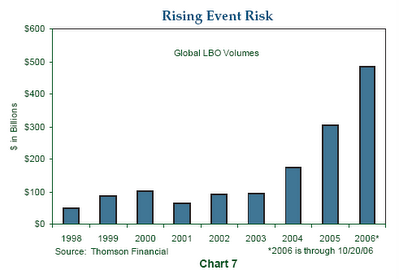
http://immobilienblasen.blogspot.com/search?q=lbo

dank geht an tweedle-dee und ben http://thehousingbubbleblog.com/?p=1910#comments

U.S. Credit Perspectives / Credit Innovation and Opportunities http://tinyurl.com/y3ljk8
.....financial market innovation has shifted the status quo for individuals and corporations. Thanks to new products in the mortgage and credit markets, homebuyers and corporations can access capital like never before. And with the global economy growing and default rates at historically low levels, investors have been ready and willing to provide that capital.

However, with innovation comes risk. Uncharted waters have not yet been tested during turbulent times. If the U.S. economy slows sharply, today’s healthy risk appetites could quickly wither. Most likely, a deceleration in the economy will diminish the availability of capital, increase volatility, and apply downward pressure on asset prices by raising risk premiums in credit markets from today’s historically low levels.

Innovations in the Mortgage Market
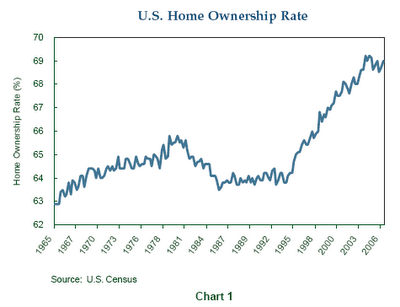
Innovations in the mortgage industry have made it easier than ever for homebuyers to acquire real estate. The home ownership rate in the United States today is at 69%, up 5% in the last 10 years ....mortgage industry’s ability to develop new products that keep initial monthly payments low, enabling consumers to buy homes they could not otherwise afford,(yes they can not afford this kind of houses!)....... Last year, ARMs represented 31.4% of total mortgage originations whereas in 2001 ARMs contributed only 10.2%1. Other examples of new mortgage products include mortgages with maturities up to 40 years, low or no down payments, reverse mortgages, and introductory teaser-rates. Creative financing kept housing accessible despite rising short-term interest rates.

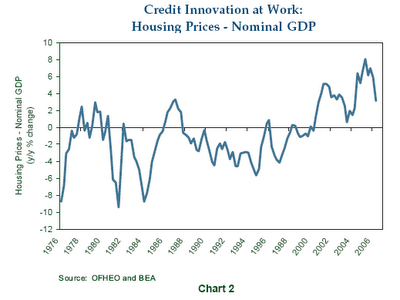
....... Consequently, due to innovation, disintermediation and leverage, housing prices have appreciated significantly faster than nominal GDP growth over the past several years

Ironically, despite a significant slowdown in housing price appreciation and soaring inventories2, credit availability for home buyers is only just beginning to tighten. Why? Investors remain focused on low default rates. In addition, abundant global liquidity continues to flow into the credit markets.....

Nevertheless, innovations in the mortgage market have brought a new and growing class of buyers, including sub-prime, adjustable-rate, and speculative borrowers, into the housing market. In all likelihood, these new players contributed to the rapid appreciation in the housing market over the past several years. However, if delinquencies and foreclosures rise, the prevalence of these marginal players will probably reduce risk tolerances. How the cooling housing market will impact the overall economy is still unclear.

What does seem clear to us is that the tightening of credit for homebuyers we are beginning to see is just that: the beginning. If we are correct, it follows that the influence of leverage and innovation on the housing market will turn and asset prices will be challenged.

Innovations in the Credit Market
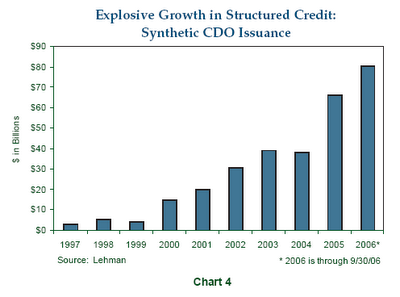
As new mortgage products transformed credit availability for homebuyers, credit market innovations have also influenced corporate bond spreads. Credit default swaps (CDS) have grown such that the notional value of all outstanding CDS is now three times larger than the cash corporate bond market (Chart 3). As a result of growing liquidity in the CDS market, corporate bond collateralized debt obligations (CDOs) are increasingly replaced by synthetic CDOs, which are funded with CDS contracts as opposed to cash bonds. ....... Placated by historically low default rates, investors are now comfortable taking on more structured credit risk......


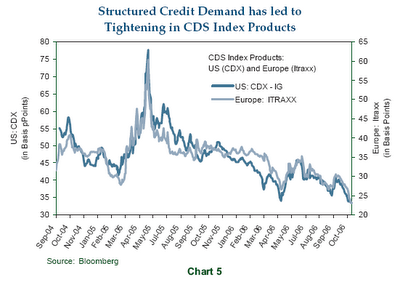
Does credit innovation carry risks? Yes. As we have seen with housing, new home buyers can be lured into buying homes they cannot afford. Ultimately, rising defaults and restricted credit availability will negatively affect the housing market, foreshadowing what is also in store for the credit market. ......... These products (cds, cdo´s, cpdo´s....) and markets are relatively new and, more importantly, have yet to be tested in a bear market. Leverage has been pushed to the point that corporate bonds, and particularly CDS securities, may have limited upside potential going forward. In fact, the explosive growth in leveraged structured credit products globally is likely a main catalyst behind the dramatic tightening in the major U.S. and European credit default indices (CDX and iTraxx) where credit spreads have now reached new tights (Chart 5). We are clearly in uncharted waters.


rest is tied to their tradingstrategies of bonds and derivatives........

Labels: , , ,

Thursday, September 11, 2008

You Know That Times Are Really Bad When Even Buffet Won´t Insure The Risk.....

There is really nothing more you need to know..... I assume the death toll on the Bank Closure Map will spike very soon....

Diese Mitteilung spricht Bände......Bei der Flut an untergehenden Banken die zu erwarten sind sicher keine Überraschung.... Die Anzahl der "Todesfälle" auf der Bank Closure Map wird schon sehr kurzfristig explodieren.....


Berkshire, in Blow to Banks, Reins In Its Deposit Insurer WSJ
Warren Buffett's Berkshire Hathaway Inc. has told one of its subsidiaries to stop insuring bank deposits above the amount guaranteed by the federal government, dealing a fresh blow to the financial-services industry as it tries to assuage anxious customers.

The subsidiary, Kansas Bankers Surety Co., is notifying about 1,500 banks in more than 30 states that it will no longer offer a program called "bank deposit guaranty bonds." KBS is an 18-employee subsidiary of Berkshire Hathaway, according to the parent firm's 2007 annual report. It is one of a handful of firms that offer such insurance, a big selling point for banks trying to attract wealthy customers.

That Mr. Buffett is withdrawing from this insurance market is an indicator of how many in the industry are worried about future bank failures.

In some cases, companies that acquire failed banks will buy all the deposits, making the government insurance limits irrelevant.

But customers with large deposits can lose money if the acquiring bank doesn't take on the extra deposits. When Columbian Bank & Trust Co., of Topeka, Kan., failed Aug. 22, there were about 610 accounts with $46 million total that potentially exceeded government insurance limits, the FDIC said.

KBS insured some deposits at this bank and lost money in the failure, people familiar with the matter said. Mr. Towle declined to comment on whether the bank was a customer.

AddThis Feed Button

Labels: ,

Thursday, November 09, 2006

Buy now, worry later/ bring on another creditinnovation.......

can´t wait for the "realtime" stresstest to proove that all the innovations really reduce risk.........especially when you keep in mind that a lot of the derivatives buyers are hedge funds ( up to 30%)!

kann es kaum abwarten das diese instrumente mal unter realen bedingungen einen stresstest unterzogen werden und ob dann immer noch risiko reduzeirt worden ist oder ab das nur vorgegaukelt war. besonders wenn man bedenkt das bis zu 30% der derivatekäufer heutzutage hedgefonds sind.

more on credit mania
http://immobilienblasen.blogspot.com/2006/10/dangerexplosive-loans-another-credit.html
http://immobilienblasen.blogspot.com/2006/09/shadows-of-debt-economist.html
http://immobilienblasen.blogspot.com/2006/09/credit-machine-is-running-amok-mother.html
http://immobilienblasen.blogspot.com/2006/10/money-supply-is-running-wild.html
http://immobilienblasen.blogspot.com/2006/10/private-equity-excess-business-week.html


Buttonwood
Premium bonds

http://www.economist.com/finance/displaystory.cfm?story_id=8150178

FEAR and greed are supposed to govern financial markets. Right now, investors seem far more like lumberjacks at an all-you-can-eat buffet than claustrophobes trapped in a lift. Despite nagging concerns about the American economy, global stockmarkets are at multi-year highs. ....

If there is one market that sums up the insouciant attitude to risk, it would have to be corporate debt. After an extremely good run, the difference between the interest rate companies pay and that which (much safer) treasury bonds pay has fallen substantially. Until recently, most investors expected that as the American economy slowed, companies would run into difficulty, forcing those borrowing costs higher.

why worry...?


But it hasn't and bankers are coming up with increasingly ingenious ways to offer fixed-income investors additional returns. Enter the newest symbol of the corporate-bond bonanza: an instrument known cryptically as the constant proportion debt obligation, or CPDO.

CPDOs are built on the back of credit-default swaps—the greatest credit innovation of the past decade—which give investors the chance to insure against a company going bust. Now CPDOs offer the same option for an entire index. And with the help of a lot of borrowed money, they offer some juicy returns. (right, more leverage/mehr hebel)

Like a swap, issuers of CPDOs get premium income upfront but have to pay out if a company in the index defaults. The beauty of the structure is that the insurance is sold only on a rolling six-month basis. The chance of one of the index's components defaulting within the next six months is very low. Even if the company's finances do deteriorate, it will probably be dropped from the index by the time the six months are up.

That means the credit agencies are happy to award CPDOs their highest (AAA-style) rating. But unlike other top-rated debt instruments, CPDOs pay a succulent interest rate of as much as two percentage points over cash.

Gary Jenkins of Deutsche Bank points out that, historically, investors have been overpaid for the default risk on high-quality corporate bonds. CPDOs take advantage of this anomaly. They employ another gimmick, too. If the markets move against them, the issuer borrows more money to sell more insurance. The extra premiums earned make up for the capital loss suffered in the market. In theory, a CPDO could have 15 times more debt than capital. (read this twice!even more leverage)

The structure was pioneered only in August, and has yet to be tested in a crisis. However, Georges Assi of Lehman Brothers says it is inherently market-stabilising: CPDO issuers will be buying when others are selling. (until the music stopps....)

The CPDO craze is just one sign of investors' appetite for corporate debt. Sales of corporate bonds and leveraged (high-risk) loans are breaking records. Investors are happy to take the extra yield today and worry about the risk later.

Similar sang froid is being displayed about America's stockmarket. By the start of this week, the S&P 500 index had not fallen by 1% in 111 days, one of its longest winning streaks in the past 25 years. http://immobilienblasen.blogspot.com/2006/10/remember-what-1-decline-feels-like.html

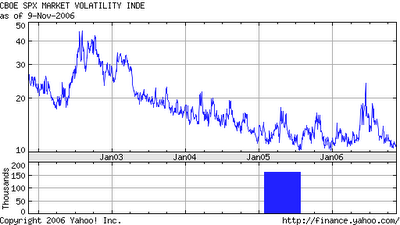
If investors were worried about losing those gains, they would be paying up for options to protect against a sudden fall in share prices. But the VIX index of American stockmarket volatility (a measure of the cost of buying options) was close to a ten-year low in late October.

... isn't there too much complacency? America's recent economic data have sown confusion

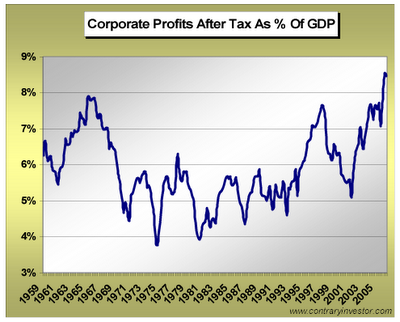
, but even where the news has appeared positive, dangers lurk. The biggest threat for companies is that unit labour costs are growing faster than 5% a year. A combination of slower overall growth and rising wage costs should squeeze profit margins. With profits at a 40-year high as a share of GDP, it is hard to see the news getting much better.

But though investors may realise that something is bound to go wrong eventually, getting the timing right is a completely separate question. Over the past three years, those who have acted out of fear have generally lost money. With tasty morsels such as CPDOs on the table, greed is the much more tempting option.

i bet that the next creditinnovation in already in the making/jede wette das die nächste innovation schon in der mache ist.......

Wednesday, August 22, 2007

Wells Fargo Gorges on Mark-to-Make-Believe Gains

Why i´m not surprised....... Looks like the earnings quality is "subprime". Combine this with the fact that financials account for over 30% of the S&P 500 earnings and you get a picture how "cheap" this market really is.......

Warum überrascht mich das eigentlich nicht mehr......Es sieht so aus als wenn auch die Gewinnqualität immer mehr "Subprime" zu sien scheint. Kombiniert mit der Tatsache das der Finanzsektor für über 30% der S&P 500 Gewinne erkennt man das die Dauerberieselung von einem "günstig" bewerteten Markt plumpe PR ist.

Aug. 22 (Bloomberg) -- There's the kind of earnings investors can take to the bank. And then there's the kind the bank can show to investors.

Word to Wells Fargo & Co. investors: Beware the second kind.

Last quarter Wells Fargo reported record net income of $2.28 billion, up 9 percent from a year earlier. Read the footnotes to its latest quarterly report, though, and you will see a new term in accounting lingo called ``Level 3'' gains. Without these, the financial-services company's earnings would have declined.

So what are Level 3 gains? Pretty much whatever companies want them to be.
You can thank the Financial Accounting Standards Board for this. The board last September approved a new, three-level hierarchy for measuring ``fair values'' of assets and liabilities, under a pronouncement called FASB Statement No. 157, which Wells Fargo adopted in January.

Level 1 means the values come from quoted prices in active markets. The balance-sheet changes then pass through the income statement each quarter as gains or losses. Call this mark-to- market.

Level 2 values are measured using ``observable inputs,'' such as recent transaction prices for similar items, where market quotes aren't available. Call this mark-to-model.

Then there's Level 3. Under Statement 157, this means fair value is measured using ``unobservable inputs.'' While companies can't actually see the changes in the fair values of their assets and liabilities, they're allowed to book them through earnings anyway, based on their own subjective assumptions. Call this mark-to-make-believe.

Antennae Up
``If you see a big chunk of earnings coming from revaluations involving Level 3 inputs, your antennae should go up,'' says Jack Ciesielski, publisher of the Analyst's Accounting Observer research service in Baltimore. ``It's akin to voodoo.''

For San Francisco-based Wells Fargo, whose stock is up 5 percent this year at $37.37, last quarter was a veritable mark- to-make-believe feast.

About $1.21 billion, or 35 percent, of its $3.44 billion in pretax income came from Level 3 net gains on the $18.73 billion portfolio of residential mortgage-servicing rights that Wells Fargo marks at fair value. These assets, known as MSRs, consist of rights to collect fees from third parties in exchange for keeping mortgages current, by doing things like collecting and forwarding monthly payments.
Thanks to Randy Glasbergen
Wells Fargo's July 17 earnings release didn't mention Level 3 items. This isn't how the second-largest U.S. home lender wants investors to parse its earnings either.

Hurting Earnings
Instead it stresses a metric called ``market-related valuation changes to MSRs, net of hedge results,'' which was minus $225 million last quarter. Spun this way, it looks like changes in the servicing rights' values actually hurt earnings.

To get that figure, the company first broke the $1.21 billion of net gains on MSRs into two parts.

Part one was $2.01 billion of gains ``due to changes in valuation model inputs or assumptions.'' Part two was $808 million of fair-value declines from changes related to the servicing rights' expected cash flows over time. (All figures are rounded.)

Next, Wells Fargo took the first part -- the $2.01 billion in gains -- and netted it against $2.24 billion in fair-value losses on certain ``free-standing derivatives.'' The company says it uses these derivatives as ``economic hedges'' against changes in MSR values, although they don't qualify for hedge accounting under the accounting board's rules.

The Rub
Here's the rub: The footnotes show the vast majority of the $2.24 billion in derivative losses were Level 1 or Level 2, while the $2.01 billion in MSR gains were all Level 3.

In other words, it's a safe bet the losses were real, while the gains had all the substance of a prayer. Indeed, Wells Fargo said in its Aug. 6 quarterly report that ``the valuation of MSRs can be highly subjective and involve complex judgments by management about matters that are inherently unpredictable.''

Moreover, to get to minus $225 million for ``market-related valuation changes to MSRs, net of hedge results,'' Wells Fargo excluded the other $808 million in MSR losses, meaning these fair-value changes weren't hedged at all.

In an e-mail, Wells Fargo spokeswoman Janis Smith Appleton said ``it would be inaccurate to characterize one component of our servicing revenue for the quarter in relation to our total results.'' She said that's ``because it would ignore the effect'' rising interest rates had ``on both the increase in fair value of our residential MSRs as well as the corresponding net derivative losses associated with the economic hedges of our MSRs.''

Real Stretch
Inaccurate? No. The real stretch is calling these derivatives hedges.

Nobody forced Wells Fargo to start running quarterly fair- value changes for MSRs through its income statement. The accounting standard that let it do so, called Statement 156, gave it a choice.

SunTrust Banks Inc., by comparison, elected not to. Why? ``In my mind there is no effective hedging strategy out there that captures all those risks that would move in offsetting directions to MSR,'' says Tom Panther, SunTrust's chief accounting officer. So, SunTrust waits until the servicing rights are sold before recognizing any pent-up gains.

MSR values normally rise when interest rates do, because fewer customers refinance and prepay their mortgages. At some point if rates rise too high, though, delinquencies on adjustable-rate mortgages could soar, as customers' rates reset, pushing MSR values down.

With mortgage markets now crashing, SunTrust looks like it made the more prudent choice. Yet in the lunch buffet of generally accepted accounting principles, both companies' approaches are permitted.

Someday, Wells Fargo investors may regret this.
AddThis Feed Button

Labels: , , ,