Friday, January 21, 2011

How Not To Restore Credibility..... "BOE´s Adam Posen Edition"

The fact that he is also an American economist & has co-written a book on inflation targeting with Fed Chairman Ben S. Bernanke might explain at least in part his quote...... ;-)

Man muss zu seiner "Verteidigung" erwähnen das er laut Wikipedia ebenfalls ein amerikanischer Ökonom ist. Da verwundert es wenig das er zusammen mit Bernanke Co-Autor eines Werkes zum Thema Inflation ist.... Dies relativiert zumindest ein wenig den fast satirisch anmutenden Charakter seines Zitates....;-)


"CPI, excluding currency, commodities and VAT impact, is low"

The quote came in response after CPI once more "slightly" missed the 2 percent target....... Sometimes it´s better to stay just silent.....

Diese Aussage kam nachdem im Dezember die Konumentenpreisinflation in UK mal wieder "knapp" das angestrebte Ziel von 2% verfehlt hat........ Ähnlich wie bei etlichen "Offiziellen" scheint das Sprichwort "Reden ist Silber, Schweigen ist Gold" nicht sonderlich viele Anhänger zu haben....

Record-breaking, forecast-busting UK inflation FT Alphaville
Highest yy rate for CPI food and non-alcoholic beverages since May 2009
Highest yy rate for CPI housing, utilities component since Aug 2009
Highest yy rate for CPI goods component since April 2010
Highest yy rate for CPI services component since Aug 2010 -
Highest yy rate for CPI fuels and lubricants component since July 2010

Posen is almost as funny as ECB´s Smaghi with his "joke" "€ More Stable Than Deutsche Mark" ..... But in comparison with Bernanke & Greenspan even they seem "reasonable".... ;-)

Finde trotzdem das im Fach "Realsatire" die EZB dank Bini Smaghi mit der Behauptung das der "€ stabiler als die DM ist" noch immer knapp den zweiten Platz hinter den unangefochtenen Spitzenreitern Bernanke & Greenspan einnimmt.....

Now take a look at real rates ( base rates minus CPI ) in the UK......

Der nachfolgende Chart zeigt den "realen Zinssatz" in UK verglichen mit dem Letzins und ich empfehle jedem drigend den treffenden Kommentar (!) der FT Deutschland zu diesem Thema zu lesen.....


UPDATE: The Real 10-Year Rates Chart confirms the "vigilance" of the the BOE ....

UPDATE: Der Chart der realen 10 Jahresrenditen bestätigt welch "Sonderstellung" die BOE einnimmt....

This in combination with the next chart showing the printing that the BOE has done so far & the remarks from the end of September doesn´t make Posen´s quote less "cynical".......

Das im Zusammenhang mit dem nächsten Chart, der zeigt das selbst die Fed in Relation zur BOE "zurückhaltend" agiert, sowie den Aussagen Ende September lassen das Zitat nicht gerade weniger "zynisch" erscheinen.....

H/ T RBS via FT Alphaville

Posen Makes BOE ‘Prosecution’ Case for More Stimulus September 29, Bloomberg
Bank of England policy maker Adam Posen made the strongest call yet for the bank to restart its asset-purchase program.

“Additional monetary stimulus at this point should begin in the form of additional QE as the Bank of England pursued by purchasing gilts in 2009-2010,” he said. “In case such QE were to prove insufficiently effective,” Posen said he would “still want preparation ahead of a Plan B of large-scale non-gilt asset purchases” in close coordination with the Treasury.

Posen, 43, an American citizen, joined the central bank from the Washington-based Peterson Institute for International Economics. A co-writer of a book on inflation targeting with Fed Chairman Ben S. Bernanke, he also published a study of the Japanese financial crisis and was a researcher at the Bundesbank and European Central Bank.
Wouldn´t surprise me if down the road even politicians will be more popular than members of the BOE & when the term "central banksters" will gain more and more traction....

Ich persönlich wäre nicht überrascht wenn zumindest in UK die Notenbänker in absehbarer Zeit noch unbeliebter als Politiker unterwegs sind.....

UPDATE:

Searching for BoE credibility on inflation FT Alphaville

From Deutsche Bank, the number of news stories that match three topical words:


SCHADENFREUDE........ ;-)

A Crisis of Faith in Britain’s Central Banker NYT
A central banker need not be loved, but at the least he should command respect — and in Britain these days Mervyn King cannot count on either.
The pre-emptive UK rate hike FT Akphaville
…over the last 6 years (ie 2005Q1 to 2010 Q4), real GDP growth has undershot the MPC’s forecast made a year earlier in 22 quarters and overshot in just 2 quarters. Conversely, inflation has overshot the MPC’s forecast in 20 quarters and undershot in just 4 quarters.

Share

Labels: , , , , , , ,

Wednesday, January 05, 2011

Food Prices Hit Record High......

One can only hope that the very critical price of Rice ( see Chart & Rice Market Monitor ) will stay well below the last "riot" highs from 2008..... UPDATE: Jim Rogers Rotates From Gold To Rice, Sets Foundation For Next Bubble ZH

Man kann nur hoffen das der alles entscheidende Preis für Reis ( siehe Chart & Rice Market Monitor ) weiterhin deutlich unter dem letzten (Unruhe)Hoch aus dem Jahr 2008 bleiben wird....UPDATE: Jim Rogers Rotates From Gold To Rice, Sets Foundation For Next Bubble ZH


WSJ
The index doesn't measure domestic retail prices, which can be affected by a wide range of factors, including government subsidies. Instead, the index tracks export prices and can still serve as a barometer of what consumers may pay.
FT

Food prices hit a record high last month, surpassing the levels seen during the 2007-08 crisis, the UN’s Food and Agricultural Organisation said on Wednesday.

The Rome-based organisation said the increase did not constitute a crisis. But Abdolreza Abbassian, senior economist at the FAO, acknowledged that the situation was “alarming”. He added: “It will be foolish to assume this is the peak.”

The jump will increase fears about the repetition of the crisis of 2007-2008. However, poor countries have not so far seen the wave of food riots that rocked countries such as Haiti and Bangladesh two years ago, when prices of agricultural commodities jumped.

The increase in food costs will also hit developed economies, with companies from McDonald's to Kraft raising retail prices.

Higher food prices are also boosting overall inflation, which is above the preferred targets of central banks in Europe.

Compare the food CPI problems of the ECB, BOE & FED with the rest of the world.....

Der Rest der Welt kann über die Nahrungsmittelpreisprobleme der EZB, BOE & Fed wohl nur gequält lächeln.....


Please note that the chart above covers only the first 6 Month in 2010....Looking at the monthy price table it should be clear that the real spike happenend since July.....

Der obige Chart wird noch weniger appetitlich wenn man bedenkt das lediglich der Zeitraum bis einschließlich Juni 2010 berücksichtigt ist....Ein Blick auf den Food Price Index zeigt leider das der Löwenanteil des Anstieges im 2. Halbjahr vollzogen worden ist....


H/T FT Alphaville

Probably not an understatement that at least a "small" part of the increase is related to the wisdom of the central banksters around the world..... I´m very sceptical that without "QE" & with "credible" central bankers ( and politicians ) we would face similar headlines.....UPDATE: Speaking of "credible" people Ben Bernanke and the Price of Oil.....Wouldn´t surprise me if way too many on Wall Street & in the numerous "ivory towers" around the world are calling develompents like this "collataral damage"....

Denke es ist keine Untertreibung zu sagen das zumindest ein "kleiner" Anteil des Preisanstieges der geballten Weisheit der weltweiten Notenbänker geschuldet ist..... Ich kann mir nur sehr schwer vorstellen das wir ohne "QE" und mit "glaubwürdigen und vertrauenserweckenden" handelnden Personen ähnliche Schlagzeilen zu verkraften hätten...UPDATE: Da wir gerade von Glaubwüdigkeit gesprochen haben Ben Bernanke and the Price of Oil...Würde mich ebenfalls stark wundern wenn an Wall Street & in den leider reichlich vorhandenen "Elfenbeintürmen" eine solche Entwicklung nicht als "Kollataralschaden" bezeichnet wird.....
UPDATE:

Just in time comes the follwoing chart via FT Germany showing the correleation from REAL US rates ( rhs inverted ) & the commodity complex...... And the FED is not alone.....

Passender hätte der folgende Chart der FT Deutschland nicht sein können.....Mit Ausnahme des fehlenden "QE" Hinweises hätte ich den dazugehörigen Bericht nicht besser formulieren können .... Zu allem übel muß man leider feststellen das die FED in Ihrer Politik nicht allein auf weiter Flur steht.....

Real rates in the Euro area & UK....

Realzinsen unter Aufsicht der EZB und der BOE.......

H/T FT Deutschland

H/T FT Deutschland

Back with then original Story..... Weiter mit dem Eröffnungslink.....

The FAO said its food price index, a basket tracking the wholesale cost of commodities such as wheat, corn, rice, oilseeds, dairy products, sugar and meats, jumped last month of 214.7 points – up almost 4.2 per cent from November.

The FAO is drawing comfort from relatively stable prices for rice, one of the two most important cereals for global food security, which remains far below its record high. Rice is the staple of 3bn people in Asia and Africa.

The FAO food index is at its highest since the measure was first calculated in 1990. During the 2007-08 food crisis, the index reached a peak of 213.5 in June 2008

However, the cost of the other critical staple, wheat, is now rising fast on the back of poor harvests.

“This is a high prices situation,” said Mr Abbassian, although he pointed to the fact the costs of cereals – and particularly rice – were below the peaks set in 2007-08.

“Rice and wheat are, from a global food security perspective, the critical agricultural commodities, not sugar, oilseeds or meat,” he said.

The increasing costs of sugar, whose price recently hit a 30-year high, oilseeds and meat are the main reason behind the rise in the FAO food index

.

The rise of commodity prices makes it likely that the global food import bill will hit a record high in 2011,after topping $1,000bn last year for only the second time. In November, the FAO raised its 2010 forecast to $1,026bn, up almost 15 per cent from 2009 and within a whisker of a record high of $1,031bn set in 2008 during the food crisis.

At least the "food import bill" will provide incentives to withstand or slow down the "competitive devaluation trend".....UPDATE: Asia Fights Inflation With Stronger Currencies
Wenn man überhaupt etwas positives an der Situation erkennen will dann vielleicht das die bedrohlich steigenden Nahrungsmittelpreise den bisher vorherrschenden "Währungskrieg" mit der klaren Tendenz die eigene Währung künstlich niedrig zu halten, wenn auch nicht aufhalten, so doch zumindest verlangsamen könnte.....UPDATE: Asia Fights Inflation With Stronger Currencies
Agricultural commodities prices have surged following a series of crop failures caused by bad weather. The situation was aggravated when top producers such as Russia and Ukraine imposed export restrictions, prompting importers in the Middle East and North Africa to hoard supplies.

I think it´s a safe bet that around the world subsidies & government involvement ( food stamps, price controls, ban on exports etc ) will not "deflate".....

One uselful "involvement" would be to start with the derivatives complex... ;-)

Sicherlich wird weltweit das Thema Subventionen & "Regierungseinmischungen" ( Essensmarken, Preiskontrollen, Exportbeschränkungen usw. ) in den nächsten Jahren häufiger die Schlageilen dominieren....

Eine der wenigen produktiven "Einmischungen" wäre, wenn man sich dem Thema "Derivate & Terminbörsen" mal etwas genauer widmen würde... ;-)UPDATE:

Food production is down, hunger is up and prices are rising / INFOGRAPHIC The Globe And Mail

U.N. Data Notes Sharp Rise in World Food Prices NYT


Needless to say that the NYT & GAM make no reference when it comes to the relation of prices & "sound money" .... ;-)

Überflüssig festzustellen, das es auch die NYT & GAM versäumen zumindest in einem Nebensatz die nicht unwesentliche Korrelation von Preisen und "verantwortungsvoller Geldpolitik" zu erwähnen.... ;-)

Immerhin wunderschön zu sehen das eine Firma wie Monsanto, die bei diesen Nahrungsmittelpreisen eigentlich durch die Decke gehen müßten, noch immer 50% vom Hoch notiert.....Um meine SCHADENFREUDE zu verstehen, muß man sich zwingend Monsanto - mit Gift und Genen ansehen.... Meiner Meinung nach die beste und wichtigste Doku der letzten Jahre über eine Firma die wahrscheinlich über noch bessere Lobbyisten verfügt(te) als alle Banken der Wall Street zusammen ..... ;-)


More UPDATES :

Youths riot in Algeria over high food prices Associated Press
Riots over rising food prices and chronic unemployment spiraled out from Algeria's capital on Thursday, with youths torching government buildings and shouting "Bring us Sugar

Wednesday's violence started after evening Muslim prayers. It came after price hikes for milk, sugar and flour in recent days, and amid simmering frustration that Algeria's abundant gas-and-oil resources have not translated into broader prosperity.
Food Riots Commence As The Fed's Loose Money Policy Leads To First Violence Of 2011 Zero Hedge

Mann bei Protest gegen teures Essen erschossen Die Welt

Big Picture Agriculture / Lester Brown via Reformed Broker
In the United States, which harvested 416 million tons of grain in 2009, 119 million tons went to ethanol distilleries to produce fuel for cars. That's enough to feed 350 million people for a year.... The combined effect of these three growing demands is stunning: a doubling in the annual growth in world grain consumption from an average of 21 million tons per year in 1990-2005 to 41 million tons per year in 2005-2010. Most of this huge jump is attributable to the orgy of investment in ethanol distilleries in the United States in 2006-2008.
Bond Vigilanties
The reasons behind the ugly scenes in Tunisia are down to a combination of political and economic factors, but at least part of the discontent stems from rising food and energy prices

The problem these countries face is that food and energy prices are a much bigger percentage of an emerging consumer's shopping basket than for a developed consumer's basket. Food and energy therefore carry a much higher weight in domestic consumer price indices within emerging markets, which is something I discussed last year when going over some of the risks to the emerging market story
To an extent, higher food and energy prices are a result of expansionary economic policy in the US combined with a reluctance of emerging market countries (particularly China) to allow their currencies to appreciate versus the US dollar. Would it not be ironic if the very policies that US authorities have pursued to return the US economy to growth then proceed to be the cause of global economic weakness?
Food Stamp Usage Hits New High Of 43.2 Million ZH


It´s safe to say that without similar programs in the G7 countries we would see similar "riots" like in Algeria etc.....

Man muß kein Prophet sein, um zu erkennen das in den G7 Ländern ohne ähnliche Programme längst "ziviler Ungehorsam" wie momentan in Algerien, und demnächst wohl noch deutlich mehr Ländern, zu sehen sein würden....

The food price vulnerability index Citi via FT Alphaville / Tilt

The index has been created by Citigroup and its based on the idea that a country’s central banks are more likely to have to respond to a food price shock if:

1) the consumer price index is sensitive to changes in good prices.

2) growth is strong — the chances of contagion from food prices to core CPI are strongest when demand pressures are in any case robust.

3) Relatively loose monetary policy– on the grounds
that a country already behind-the-curve might have some nasty catching-up to do if a food price shock leads to a surge in inflationary pressures overall.

And China ticks all those boxes.
Back with a vengeance Economist


Russia Imposes Inflation-Driven Price Controls: Will Use Price Caps On "Socially Important" Commodities
Russia has just announced it would proceed with price caps on a variety of foodstuffs, from buckwheat, to potatoes, assorted fruits and vegetables and all other commodities it deems "socially important" accoding to Russian newspaper gazeta.ru.
Interactive Map Of Recent Food Riots And Price Hikes ZH

Labels: , , , , , , , , , ,

Thursday, January 07, 2010

Don´t Call It A Bubble........

After the introduction of the "Pay-If-You-Can-Loans" the comeback of Toggle/PIK Bonds are more than early warning signs that something is at least a little bit "frothy"...... The same is true for numerous stock markets ( see the following chart Mexican Stock Market Back To All Time Highs WOW!)

Nachdem ja vor kurzem die "Pay-If-You-Can-Loans" ins Leben gerufen worden sind ist die noch vor wenigen Monaten undenkbare Wiederaufersteheung der Toggle/PIK Bonds ein weiteres Anzeichen, das nennen wir es mal vorsichtig, eine leichte "Überhitzung" eingetreten ist.... Leider sieht es in etlichen Aktienmärkten nicht bedeutend anders aus ( siehe nachfolgden Chart Mexican Stock Market Back To All Time Highs WOW! )

Treasurers Embrace Pay-in-Kind Bonds as Ghost of Lehman Fading
( Bloomberg ) Companies are selling debt with terms last seen before credit markets froze, showing why the world’s biggest bond fund manager says another bubble may be brewing.

JohnsonDiversey Holdings Inc., a Sturtevant, Wisconsin, maker of cleaning supplies, and Wind Acquisition Holdings Finance SpA, parent of Italy’s third-largest mobile-phone company, sold bonds that can pay interest in new debt instead of cash, the first such deals since 2007, according to Bloomberg data.

Goodman Global Inc. raised $320 million to pay its owner, leveraged buyout firm Hellman & Friedman, a dividend, one of at least seven similar offerings since November

Two years after credit markets seized up, treasurers are luring investors to junk bonds that returned a record 58 percent last year, as measured by Bank of America Merrill Lynch indexes. U.S. sales of $162 billion beat the all-time high of $149 billion in 2006, Bloomberg data show.
“Six months ago I wouldn’t have imagined being able to do this deal,” said Karim-Michel Nasr, head of corporate development in Paris at Weather Investments SpA, Wind’s holding company.....
Capital Access
At least two dozen borrowers since November have asked lenders to change terms of debt agreements to permit bond sales, extend loan maturities or pay dividends to their owners, Bloomberg data show.
Access to capital means defaults will likely drop to 3.9 percent by November from 12.7 percent a year earlier, New York-based Moody’s Investors Service says.

Speculation that companies will have less difficulty making payments has led investors to accept lower interest rates and looser borrowing terms. The extra yield demanded on junk bonds instead of Treasuries narrowed to 6.39 percentage points at the end of 2009 from almost 19 percentage points on March 9, Merrill Lynch indexes show. Speculative grade debt is rated below Baa3 by Moody’s and BBB- by Standard & Poor’s.

‘We Forget’
“I’m looking at some of the things that are being priced and I’m saying, ‘Wow, how quickly we forget,’” said JohnsonDiversey Chief Financial Officer Joseph Smorada. The market is “starting to get a little dangerously aggressive,” he said.

The company sold $250 million of so-called toggle debt due in May 2020 on Nov. 20 that allows it to pay a 10.5 percent interest rate either in cash or notes for the first five years.
The first pay-in-kind bonds since 2007 were part of a $2.6 billion recapitalization in which New York-based LBO firm Clayton Dubilier & Rice Inc. agreed to buy a 46 percent equity interest in the company.
Moody’s gave the notes its fifth-lowest ranking of Caa1, saying the debt is five times more than adjusted earnings before interest, taxes and amortization costs. It has had negative free cash flow the past three years, though it’s expected to break even in 2010, Moody’s said.
‘Dangerously Aggressive’
“In early 2009, I don’t think we could have borrowed a nickel if our life depended on it,” Smorada said. Investors submitted bids for almost four times the amount of notes offered, he said.
Investors haven’t lost discipline and companies are mainly selling bonds to refinance or cut interest expenses, said William Cunningham, the head of credit strategy and fixed-income research at State Street Corp.’s investment unit in Boston.
Wind Acquisition of Luxembourg raised $1.1 billion last month selling 7.5-year, 12.25 percent notes in dollars and euros that allow it to pay interest with more debt until 2014. Wind, controlled by Egyptian billionaire Naguib Sawiris and the parent of Wind Telecomunicazioni SpA, boosted the offering 50 percent as demand rose.
The investment flood has undercut efforts to toughen restrictions that protect investors, said Alexander Dill, senior covenant officer at Moody’s in New York. Many covenants are “largely replicating” rules from 2006 and 2007, Dill said in a Dec. 10 report.
TRW Automotive Inc., the world’s biggest supplier of vehicle-safety equipment, sold $250 million of eight-year notes in November rated Caa1 with covenants “substantially unchanged” from its 2007 indenture for debt graded four steps higher at Ba3, according to the Moody’s report. The Livonia, Michigan-based company said Dec. 22 it raised $400 million in term loans as lenders amended and extended its revolving credit facility.
FT Alphaville
Global high yield debt volume for the week of January 11th totaled $11.7 billion, the biggest week for high yield debt on record. The previous record was set during the week of November 5, 2006 when $11.4 billion was raised. With $14.4 billion raised so far this month, it is the best all-time start for the high yield markets since records began in 1980.
Update High Yield Bonds Continue To Do Well Bespoke
Over the past month or so, the only area of the bond market that has done well is junk. Both Treasuries and investment grade corporates have struggled, while high yield bonds have continued to surge. Below we highlight a six-month performance chart of the high yield bond ETF (HYG) and the investment grade corporate bond ETF (LQD).
Lqdhyg

Mortgage-Bond Leverage Reaches 10-to-1

Wall Street firms are loosening terms of their lending to mortgage-bond investors as markets heal, an RBS Securities Inc. executive said.

Repurchase agreement, or repo, lending against the debt has expanded so much since freezing in late 2008 that some banks now offer as much as 10-to-1 leverage and terms as long as one year on certain securities backed by prime jumbo-home loans

Update

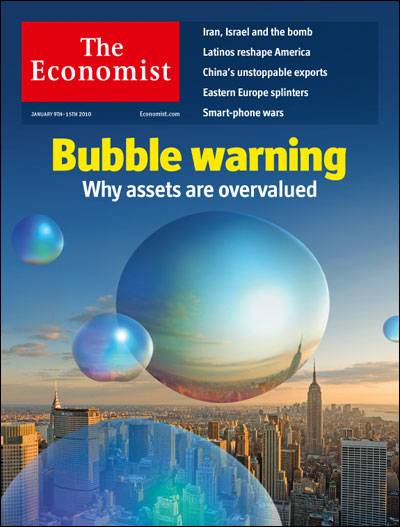
Bubble warning ( Economist )

Once again, cheap money is driving up asset prices
( Economist )

Ladies and Gentlemen, We Are Trading On The Moon :-) Reformed Broker

Labels: , , , , , , , ,

Tuesday, December 15, 2009

Sovereign Misery Index

One important reason why i like gold long term regardless of the US$ direction ( especially when you take a look at the "off balance sheet chart" )........

Einer der Hauptgründe die leider noch auf lange Zeit unabhängig von der Entwicklung des US$ für Gold sprechen ( gilt erst Recht wenn man sich den "Off Balance Sheet Chart" und die damit verbundene Aussage genauer ansieht ) .....

Anothery misery index - Moody's

FT Alphaville

Moody’s has compiled a 1970s-style ‘Misery’ index. But instead of showing inflation and unemployment rates, it shows the fiscal deficit and the unemployment rate.
Theme 1 Aaa countries will probably not have the luxury of waiting for the recovery to be secured before announcing credible fiscal consolidation plans.

Theme 4 Most governments cannot afford another financial crisis. Attempting to ring-fence balance sheets from contingent liabilities will keep policy makers busy.

Theme 5 Very large public debt and low economic vitality will prompt unprecedented questions about how governments can discharge their obligations without changing the rules of the game.

One way of looking at this is to realize that governments are more willing to default on social obligations – such as changing the retirement age – than on financial obligations

Theme 10 Debt hang-hover will test social and political cohesiveness.

In several countries – including some highly advanced ones like Iceland or Ireland, but also Latvia or Hungary, as well as in some much poorer countries like Jamaica – a great sacrifice is required from the respective populations. Cohesive and/or very enduring societies like the Baltic countries, Iceland or Ireland have accepted sacrifices (salary cuts, public spending cuts, etc.) that would have seemed unimaginable a few years ago and continue to seem hardly replicable in comparable societies.
Moodys Sovereign


At least some "Enron-esque characteristics" are difficult to deny......

Böswillig könnte bzw. müßte man sagen das "Enron-esque characteristics" nicht zu leugnen sind....

larger/vergrößerte Version

Credit's Golden Age? WSJ

[CREDITHERD]

We all can thank the regulators, accounting stunt experts, central banksters & the politicans that after trillions of worldwide banking bailouts the banks are now "well capitalized"( proven by yesterdays news like $38 Billion Tax Break Granted to Citigroup to Help Improve the TARP Results & Fannie Freddie May Need Another $400 Billion Taxpayer Assistance & ECB Said to Start Consulting Banks, Investors on Collateral .... No kidding, they are STARTING NOW ! , etc > compare this kind of number with the haggling about the pay for the climate bill.). & strong "regulation" ( Banks Said to Get More Time to Implement Stricter Capital Rules ( Update MEA CULPA! ): & Solving Everything but the Problem ) without loopholes is on the way ..... ;-)

Immerhin sind die Banken ja nachdem weltweit Billionen für die Bankenbailouts geflossen sind jetzt "well capitalized" ( wie gestrige Nachrichten wie $38 Billion Tax Break Granted to Citigroup to Help Improve the TARP Results & Fannie Freddie May Need Another $400 Billion Taxpayer Assistance & ECB Said to Start Consulting Banks, Investors on Collateral .... beruhigend zu wissen das bereits JETZT damit angefangen wird...usw. eindrucksvoll belegen > Richtig gute Laune bekommt man dann wenn man sieht wie verbissen um die Verteilung der Lasten zur Klimarettung verhandelt wird..... Da droht der Gipfel wegen einiger weniger Mrd zu scheitern..... ) & die Schlupflöcher durch die gewohnt "strenge" Regulierung ( z.B. Banks Said to Get More Time to Implement Stricter Capital Rules (Update:MEA CULPA! ) & Solving Everything but the Problem ) geschlossen .. ;-)

There has been a lot of bubble talk ( see Gold: A Contrarian's Dilemma ) when it comes to recent performance of gold. The following chart from Todd Harrison / Minyanville via Pragmatic Capitalist puts things into perspective.....

Gerade in letzter Zeit ist im Angesicht der Outperfmance von Gold immer öfter der Begriff "Bubble" ( siehe Gold: A Contrarian's Dilemma ) gefallen. Da kommt der nachfolgende Chart von Tod Harrison via Pragmatic Capitalist gerade rechtzeitig.....

larger/vergrößerte Version

`There’s no bubble in gold,’ CIBC says Ft Alphaville

Labels: , , , , , , , , , ,

Tuesday, November 17, 2009

Mark Faber : "Gold Won't Go Below $1,000" & "Gold A Better Buy Than At $300/oz. "

Hearing quotes like this i sometimes have the feeling that i´m one of the more bearish GOLD-BUGS out there.... ;-)

Muß allerdings gestehen das ich bei solchen Zitaten so langsam als einer der pessimitischeren GOLD-BUGS durchgehe... ;-)

H/T Expected Returns for the videos & Tim from The Mess That Greenspan Made for digging out the following quote and analyzing it perfectly....

Dank an Expected Returns für die Videos und Tim von The Mess That Greenspan Made der nachfolgendes Zitat hervorgehoben hat und dies dann mehr als treffend analysiert hat.....

Faber : Maybe, gold at this level is a better buy than it was at $300 per ounce in 2001.

Tim: At first glance, the idea that gold priced at over $1,100 an ounce is "a better buy" than when the metal traded at about a quarter of that price seems reposterous. But, when you think about it just a little bit (i.e., what constitutes a "better buy" and how the fundamental factors have now swung so decidedly in gold's favor), maybe it isn't a crazy idea at all.

I wouldn't be surprised if, in another eight years - in 2017 - the yellow metal fetches $5,000 an ounce or more which, by my math, would make it a better buy. Gold may not rise as much against other currencies, but, after almost a decade of trillion dollar deficits, that almost seems like a slam dunk when the measuring stick is the U.S. dollar.


Compare yesterdays quotes from Yellen, Kohn & Bernanke with what Faber said.....In the context of these remarlks i just couldn´t resist to post the following video "highlighting" Bernanke´s past track record in seeing the obvious.... Gold is a not the way to get rich but is a wonderful way to PROTECT your "puchasing power" with a very long track record ( 750 Years Of Real Gold Prices )

Vergleicht die Zitate von Yellen, Kohn & natürlich Bernanke vom Vortag mit dem was Faber gesagt hat..... Konnte in diesem Zusammenhang nicht verkneifen das nachfolgende Video mit einigen von Bernankes vergangenen "Glanzleistungen" zu bringen wenn es darum geht einen gewissen "Überschwang" zu "sichten"......... Gold ist sicher nicht geeignet um zu spekulieren aber die Historie ( 750 Years Of Real Gold Prices ) zeigt das es sich bei Gold zumindest um eine der weinigen Möglichkeiten handelt die nachweisbar zumindest die KAUFKRAFT ERHALTEN......


Geithner Blames Collapse On Previous Admin Even As Tim Was President Of FRBNY Under Bush; Resignation Time H/T Zero Hedge


Dylan Grice / Societe Generale ZH

Of course, any gold bull, gold "bug" or otherwise, faces some serious competition, in the face of none other than Goldman Sachs' most recent partner in philanthropic, TARP subsidized ( disturbing table / diese Übersicht "entzaubert" Buffet zumindest als den "guten" Amerikaner, er bleibt ein guter Investor... mehr aber auch nicht....! ) deeds, Warren Buffett.

“Gold gets dug out of the ground in Africa, or someplace. Then we melt it down, dig another hole, bury it again and pay people to stand around guarding it. It as no utility. Anyone watching from Mars would be scratching their head.”

Warren Buffett
At least the quote is funny but after taking a look at the following link "Our Governments Are Insolvent" it is easy to see why Buffet is wrong. Wouldn´t be the first time.....At least one quote where he is not talking his book .... ;-) This Chart is clearly telling what is going on.......I´m still thinking that the Dow/Goldratio reached in 1980 is not "unrealistic" over time......

Immerhin ein witziges Zitat von Buffet das aber gerade wenn man die Grafik in "Our Governments Are Insolvent" ansieht wohl zu den weniger ruhmreichen Einschätzungen von Buffet gehören wird.....Dieser Chart spricht zumindest momentan eine eindeutige Sprache.....Bin mehr denn je der Meinung das ein Dow/Goldratio vergleichbar mit dem Jahr 1980 in den nächsten Jahren nicht "unrealistisch" ist....

UPDATE:

Gold: Short-Term and Long-Term Outlook Expected Returns

The Fed is sending gold higher Rolfe Winkler

Wells Fargo Needs TARP Money More Than It Admits: Jonathan Weil "Buffet Watch....."

Labels: , , , ,

Monday, November 02, 2009

IMF Sells Gold To India's Reserve Bank & Remembering The "Brown Bottom"

Good to be a GOLD-BUG .......Take a look at this excellent Graph to put today´s news when it comes to gold & central banks into perspective..... So much for the overhang of the "massive" IMF gold sale threatening the price of gold...... As discussed earlier it looks like the headwind has transformed into a tailwind.....The price is flirting with new highs today....And it´s not only a "weak US$ story" ( H/T The Privateer via Mish ).... The chances are very high that Gold will continue to outperform for some time to come ( not so sure obout the short term ).......

Schon schön wenn.. man ein GOLD-BUG ist..... Diese Grafik gibt einen erstklassigen Überblick wenn es um Gold und Zentralbanken geht..... Da Gold heute nahe neuer Hochs (und das nicht nur in US$ , H/TThe Privateer via Mish )notiert ist von dem vielbeschworenen Überhang der den Goldpreis angeblich extrem belasten wird wenn das Gold letztendlich verkauft wird nicht viel zu spüren....Wie bereits früher erwähnt sieht es ganz so aus als wenn aus dem jahrelangen Gegenwind von Verkäufen durch die Institutionen zunehmend ein Rückenwind geworden ist..... ;-) Die Chancen stehen mehr als gut das Gold auch weiterhin outperformen wird ( kurzfristig bin ich mir weniger sicher ) .....

IMF sells gold to India's Reserve Bank

The International Monetary Fund said Monday it's selling 200 metric tons of gold to the Reserve Bank of India, to help shore up the fund's finances. The sale is part of a total of 403.3 metric tons of gold approved for sale in September, the IMF said.

via Jesse

RBI’s decision to shore up its gold reserves needs to be seen in the context of other central banks across the globe increasing their gold reserves. Among them are the central banks of China, Russia and a few countries in the European Union.

In the last one year, China has increased its gold holdings, by weight, by 75.69%, Russia by 18.78%, the Philippines by 18.50% and Mexico by 108.91%.

Compared with this, India’s central bank did not add anything to its gold reserves in the last one year, according to Bloomberg data.

In fact, the share of gold in India’s total reserves has dwindled over the decade.

In March 1994, the share of gold in the total reserves of the country was 20.86%; by the end of June 2009, gold constituted only 3.7% of the total reserves.

“Gold is the ultimate currency. In fact, only gold came to our rescue during (the) 1991 crisis, so it makes sense that RBI should try to increase its gold holdings,” Patil said.

At the current market value of $1,054 an ounce, or per 28.5g, RBI would need to spend about $7.4 billion to buy 200 tonnes of gold. With this, its gold reserve will rise to $17.716 billion, or roughly 6.20% of the total reserves.

A committee set up by a group of central banks overseeing the gold sales by the IMF has allowed the fund to sell 400 tonnes of its gold annually and 2,000 tonnes in total during the five years starting 27 September.

According to a report by the Associated Press dated 20 September, India, along with China and Russia, had evinced interest in buying IMF-held gold.

IMF’s total holding at historical price is valued at about $9.2 billion on its balance sheet. At market prices, as of 28 August, the fund’s total gold holdings were worth $98.8 billion.
I just coudn´t resist......

Konnte mir den nachfolgenden Chart einfach nicht verkneifen......

Gold: Does Gordon Brown's regret selling half of Britains' gold reserves 10 years ago?

Gold chart: Price of gold since Britain sold half of its reserves in 1999

Adjusting to todays & future prices combined with the "rock solid" outlook for the pound the "Brown Bottom" will provide even more reasons for SCHADENFREUDE for years to come.....

Auf aktuelle und zukünftige Preise gemünzt und den mehr als soliden Ausblick für das "britische Pfund" dürfe der "Brown Bottom" noch jahrelang für gehörig SCHADENFREUDE sorgen......

The Mess That Greenspan Made

IMAGE Make sure you read The significance of the IMF-RBI gold sales also from Tim

Verweise zudem auf The significance of the IMF-RBI gold sales ebenfalls von Tim. Sehr gute Zusammenfassung

UPDATE:

Couldn´resist...... Nice call...... ;-)

Wohl ein Trade an dem Goldman kein Geld verdient...... ;-)

Goldman on Gold Prices: Central Bank Buying Something to Watch
MB WSJ

“In addition to this potential shift of central banks from being net sellers to net buyers of gold, the continued weakness in real interest rates continues to provide strong support to gold prices over the medium term,” Goldman analysts write.

IMF gold data - Goldman Sachs

Low interest rates could make for “upside risk” to Goldman’s price forecast of $960 a troy ounce.

But we can’t help but notice that they haven’t raised their forecast even though we’re already around $1,100. The obvious question is when does Goldman see a pullback coming?

The following chart via Rolfe Winkler sums it up...

Denke der nachfolgende Chart von Rolfe Winkler spricht Bände....

Labels: , , , , ,

Tuesday, October 27, 2009

Scarcity. That Is The Answer To The Question “Why Gold?” End Of Story !

The headline is from the latest David Rosenberg piece ( as always much needed ANTI SPIN ) and sums up the some of the reasons (here is another good overview, thank god that at least the banks are "well capitalized"...... ) why Gold should outperform for some time to come ( not so sure obout the short term )....... Especially when one of the biggest headwinds during the past decades is becoming a tailwind ( see Central Banks Net Buyers Of Gold....... )

Die Überschrift stammt aus dem letzten Report von David Rosenberg ( dringend benötigter ANTI SPIN ) und faßt einige der Gründe ( hier noch ne nette Übersicht., da kann man ja von Glück sprechen das zumindest die Banken ""well capitalized" sind...) dafür zusammen das Gold auch weiterhin outperformen wird ( kurzfristig bin ich mir da weit weniger sicher ) ..... Das gilt umso mehr als sich der stärkste Gegenwind der letzten Jahrzehnte zunemhemnd in einen angenehmen Rückenwind zu wandeln scheint ( siehe Central Banks Net Buyers Of Gold....... )

WHAT IT IS ABOUT GOLD?

After all, you can’t calculate a P/E. There is no dividend discount model. There is no interest rate or income stream. No — gold is a store of value and one that has been durable and reliable for thousands of years. No fiat currency system has outlived gold. The question is what is so sacred about fiat paper money? A backing of the government printing press, is that the alluring factor? The Fed has been pumping money into the system at an unprecedented fashion and even if it is sitting idle on commercial bank balance sheets as excess reserves, that money is still in the system.

So what about gold? How much of that is in the system? How about the fact that global gold production, after doubling from 1980 to 1999, has completely stagnated over the past decade? Has fiat currency done that? And, how long does it normally take for a gold mine to yield production? Answer -- five years or so? Do you think it takes Bernanke et al that long to print greenbacks? At least we know with some degree of confidence about the supply of gold; there are reserves equivalent to about 40% of the total amount of gold above the ground (and half of that is in South Africa).

As we said, it takes time, usually five years, and plenty of financial resources to bring gold mines into production. In this sense the supply side of the gold equation is relatively constant — in economic parlance. Fiat government-issued currency is not — especially in the context of a U.S. monetary and fiscal authority that will stop at nothing to revive a cycle of overspending and overborrowing.

In the current sense, the pullback in consumer spending is being replaced either by government spending or incentives to prevent households from modifying their spending behaviour away from frugality; and the pullback in credit demand by the consumer sector is being offset by the Fed’s involvement in the mortgage market to ensure that borrowing costs remain very low, and by the FHA to ensure that down-payment requirements are as close to zero as possible. The supply of gold is reasonably easy to figure out — the supply of fiat currency is less easy to figure out. The behaviour of not just the U.S. government but governments everywhere seems to be that reflationary policies will ultimately be the key towards redressing the ongoing private sector deleveraging cycle.

Back to the gold market. There is an estimated 120,000-140,000 tons of gold above ground. That would equate to roughly $4 trillion. The total amount of U.S. dollars in circulation globally is estimated at $8 trillion, and the total size of the global money supply would thereby be closer to $30 trillion. The size of the world stock market is around $40 trillion. At last count, the total size of the global bond market was north of $80 trillion. The total world derivatives market has been estimated at about $800 trillion, face or nominal value. Hopefully all this places the total value of gold above ground into a certain perspective.
So, here is what makes gold so attractive, beyond the fact that it is a hedge against irresponsible fiscal, monetary policies and reckless trade policies, is that relative to fiat currency, bonds and equities, it is scarce.
We can also get into geopolitical uncertainties and reckless trade policies, but they are just the proverbial cherry on the ice cream.
Scarcity. That is the answer to the question “why gold?” End of story.

Just to back the amount of currency that is out there right now, gold has the potential to triple from here, never mind merely double. Sounds outlandish, to be sure, but when gold was carving out its bottom at $255/oz in September 1999 (when the S&P 500 was flirting near 1,300 — sorry to have to add that one in), was anyone calling for it to rise four-fold in the next decade? Secular bull markets usually last 16 to 18 years and this one is just in year 10, so let’s say that we are barely past the halfway point in both duration and magnitude in this gold cycle

Paul Tudor Jones ♥ gold FT Alphaville

By our estimation, G7 central banks have upwards of 35% of total reserve
assets in gold. However, the remaining countries that make up the G20 only have 3.5% of their reserve assets in gold. These countries have seen a $2.2 trillion increase in reserve assets over the last five years, making up well over 50% of the increase in global reserves. However, despite a 150% increase in the price of gold, 97% of the increase in reserve assets has been in the form of paper currency or interest-bearing notes backed by paper currency.

> I also urge everybody still not convinced that at least a small part of their portfolio should include GOLD to read the following report........

> Der nachfolgende Report verdeutlicht mehr als eindrucksvoll warum meiner Meinung nach in jedes Depot GOLD zumindest einen gewissen Prozentsatz enthalten sollte.....

Sprott Oct 2009 Comment


H/T ZH

Labels: , , , , , , , ,

Monday, August 24, 2009

Central Banks Net Buyers Of Gold.......

Looks like my critisism ( see Gold & The Wisdom Of Central Bankers ) was too widespread.... A better title would have been "Gold & The Wisdom Of Western Central Bankers"..... ;-)

Sieht so aus als meine Kritik ( siehe Gold & The Wisdom Of Central Bankers ) etwas zu breitgefächert war. Hätte wohl richtiger "Gold & The Wisdom Of Western Central Bankers" heißen müssen..... ;-)


Gold demand declines in Q2, still high Rolfe Winkler
The central bank sector had a dampening impact on supply - net purchases of 14 tonnes were recorded in Q2’09 compared to net sales of 69 tonnes in Q2’08, the figures indicating the first net purchase by central banks for a considerable length of time.
> Check out the rest of the link . As usual great stuff from Winkler

> Empfehle den kompletten Link von Winkler zu lesen. Wie immer großartig......


China's gold buy raises eyebrows for all the right reasons MW May 1, 2009

The precious-metals market took notice for all the right -- but not-so-obvious -- reasons when China announced last week that it ramped up its gold reserves by 76% in the last six years.

Last week, China announced that the amount of gold in its reserves has climbed to 1,054 tons from 600 tons in 2003

It also asked the International Monetary Fund to sell its entire 3,217 tons reserve

China's gold reserves are worth almost $31 billion -- about 1.6% of its total foreign- exchange reserve holdings, and gold as a percent of the country's total reserves has actually declined since 2003, according to Sam Subramanian, editor of AlphaProfit Sector Investors' Newsletter.

To put that into better perspective, if China was to purchase the IMF's reserves of 3,217 tons at a price of $1,000 per ounce, the price would be $103 billion, according to Kosares.

Disclosure: "Goldbug" ;-)

Labels: , ,

Wednesday, June 24, 2009

ECB: Record 442 billion Euros “Stimulus by Stealth”

HT to Alea for the excellent headline. After reading the latest ECB "Instability" Report....... & the almost irresistable conditions ( despite news like this ECB Tightens Rules On Liquidity Facilities & Adjustment of risk control measures for newly issued asset-backed securities and for uncovered bank bonds ) it is no surprise to see such a huge number. .......A no brainer...... I can imagine Trichet is already praying that this will work.....I have some serious doubts......Liquidity is & was not the issue..... Core problems ( impaired bank balance sheets, not enough creditworthy borrowers ) are still unsolved and are getting worse on a daily basis..... Update : Spanish banks to get €90 billion bailout

Dank an Alea für die sehr treffende Überschrift. Nachdem ich den letzten ECB "Instability" Report....... gelesen habe und wenn man die unwiderstehlichen Konditionen ( trotz leicht verschärfter Bedingungen / siehe ECB Tightens Rules On Liquidity Facilities & Adjustment of risk control measures for newly issued asset-backed securities and for uncovered bank bonds ) berücksichtigt dürfte die Höhe nicht wirklich überraschen. Eine echte Lizenz zum Gelddrucken.....Kann mir bildlich vorstellen wie Trichet & Co beten, das dieser Kraftakt endlich dazu führt, das die Kreditmärkte wieder wie gewünscht funktionieren ( Update Banken tragen Milliarden zurück zur EZB ).... Ich denke das auch dieser Versuch maximal etwas Linderung in Form von geringeren Spreads verschaffen wird..... Dummerweise ist mangelnde Liquidität nicht das Problem. Solange die Problematik der bilanztechnisch insolventen Banken nicht gelöst wird und man anerkennt das es im Angesicht einer lang anhaltenden Rezession einfach zu wenig kreditwürdige Unternehmen gibt, dürfte sich die Lage weiter verschlechtern. Wenn man so will handeln die Banken aus Ihrer Sicht ironischerweise momentan das erste Mal nach Jahren der "Trunkenheit" richtig. Tragisch aus deutscher Sicht ist vor allem das unser Bankensystem trotz fehlender eigener Blase dank der desaströsen Exzesse besonders der Landesbanken ( folgerichtig kommen die Sparkassen als Anteilseigner dank massivster Wertberichtigungen auf Ihre LB Anteile in ernste Schieflagen, was das besonders für den Mittelstand bedeutet kann man leicht erahnen..... ) eher einen bzw. den Spitzenplatz der Problemliste belegt..... Updadte: EZB pumpt Rekordbetrag in den Markt FTD & Spanish banks to get €90 billion bailout


ECB pumps €442bn into banking system FT
The European Central Bank on Wednesday pumped hundreds of billions of euros in one-year loans into the eurozone’s weakened banking system, making record amounts of emergency finance available in a bid to unlock credit markets and revive the region’s economies.

In a dramatic step dubbed “stimulus by stealth” in financial markets, the ECB lent €442.2bn for 12 months to more than 1,100 banks at its current benchmark interest rate of 1 per cent.

The high demand for the funds, in what was the ECB’s first ever auction for one-year loans, reflected a growing realisation by the banks that emergency funding may not be available again on such favour-able terms.

The central bank’s action could boost the eurozone’s recovery prospects by lowering market interest rates and creating more scope for banks to lend to the private sector.

The ECB action, which attracted 1,121 bidders – more than usual in ECB operations – had an immediate impact in driving down overnight and longer-term market interest rates, though the full effects are still to feed through.

Don Smith, economist at inter-dealer broker Icap, said: “The massive scale and undoubted success of this tender almost entirely reflects the cheapness of the funds on offer.”

The previous largest amount injected in a single ECB operation was €348.6bn in December 2007.

The economic impact will depend on whether demand for liquidity in future ECB market operations is reduced as a result of Wednesday’s action, as well as whether banks step up lending.

“They must pass it along,” Lorenzo Bini Smaghi, an ECB executive board member, said in Rome.

> "...must pass it along" This kind of rhetoric will only be working in China ( see Number Of The Day "Credit Explosion In China" & todays must see Borrowed in China from FT Alphaville ). Probably ( after FT Alphavilles update DEFINITELY ) the NPL from the not so distant future...... Smaghi probably one of the ECB members pressing for "quantitive easing" ( despite intense discussions among the ECB members so far almost non existent ).......

> "...must pass it along" Wird wohl ein Wunschgedanke bleiben..... In China sieht das momentan ganz anders aus ( siehe Number Of The Day "Credit Explosion In China" sowie die aktuellen Daten für Juni Borrowed in China WAHNSINN!). Da wird solchen Wünschen wenn Sie von der richtigen Stelle geäußert werden "bedingungslos" Folge geleistet. Die Chancen das es sich um die faulen Kredite von morgen handelt sind nicht zu unterschätzen ( nach dem Update von FT Alphaville eine "leichte" Untertreibung )...... Unschwer zu erkennen das Smaghi eher dem Camp innerhalb der EZB angehört die PRO "Quantitive Easing" ( bisher trotz intensiver Diskussionen praktisch kaum vorhanden ) sind......

WSJ

By promising a full allocation of all bids on Wednesday, the ECB has effectively passed responsibility for any easing of policy to the banks themselves, giving license to any institution that thinks it can lend the money profitably into the real economy.
AJ via Alea
“If I were a bank I would be gathering up all the furniture to use as collateral to take part.” said Erik Nielsen, European economist at Goldman Sachs.
AMEN!

Labels: , , , , , , , ,

Wednesday, May 06, 2009

Gold & The Wisdom Of Central Bankers

After a few weeks it´s about time for another post on gold. The first chart showing the "private investment demand" comes via The Mess That Greenspan Made and is a good addition to the last graph observing the "behavior" from the central banks during the past decade. It´s also worth noting that one of the best performing hedge funds over the past few years has allocated "quite a bit" of the portfolio to gold ( see Paulson & Company's golden portfolio )

Nach einigen Wochen ist es mal wieder Zeit für ein Goldposting. Der erste Chart der den gewaltigen Anstieg der "privaten Investoren" mittels der Gold ETF´s anzeigt kommt von Tim und seinem Blog The Mess That Greenspan Made und ist eine gute Ergänzung zur letzten Grafik die sich mit dem Verhalten der Zentralbanken in einem ähnlichen Zeitraum befasst. Besonders hervorzuheben ist noch das einer der am besten performenden Hedge Fonds der letzten Jahre einen nicht unwesentlichen Teil des Portfolios in Gold hält ( siehe Paulson & Company's golden portfolio )

The following graph via Option Armageddon gives the explanation why despite soaring investment demand and decreasing central bank sales gold hasn´t moved higher. And with collapsing jewelry demand ahead this headwind will likely continue for some time to come.

Die nachfolgende Grafik via Option Armageddon zeigt sehr schön warum Gold trotz massiver Investmentkäufe ( alle ETF´s zusammengenommen halten momentan die sechstgrößten Goldreserven / China hat sich dank der letzten Käufe gerade wieder auf Platz 5 geschoben ) und gleichzeitigen Verkaufsvolumen der Zentralbanken Gold nicht höher gelaufen ist. Und da die Nachfrage aus dem Schmucksektor momentan im Crashmode ist dürfte dieser Gegenwind noch eine Weile anhalten.

But with quoptes like the following the demand structure will shift even more quickl in the favor of investment.....

Ich denke angesichts Zitaten wie diesem dürften sich die Nachfragegewichte demnächst massiv verschieben....

A policy mistake made by some major central bank may bring inflation risks to the whole world. As more and more economies are adopting unconventional monetary policies, such as quantitative easing, major currencies’ devaluation risks may rise.

- People’s Bank of China quarterly report, May 6 (via Bloomberg) via FT Alphaville

Gold sales cost Europe’s central banks $40bn FT
Europe’s central banks are $40bn poorer than they might have been after they followed a British move taken 10 years ago on Thursday to shrink the Bank of England’s gold reserves, analysis by the Financial Times has shown.

London’s announcement on May 7 1999 that it would sell a large share of the Bank’s gold reserves in favour of assets offering a return, such as government bonds, was the high water mark of so-called “anti-gold” sentiment among European central banks.

Many of these banks, such as those in France, Spain, the Netherlands and Portugal, decided later in 1999 to follow Britain and sell off their reserves. At that time, gold was worth around $280 an ounce, less than a third of its current level of more than $900.
European banks sold about 3,800 tonnes of gold, reaping about $56bn, according to calculations from official sales data and bullion prices.

> Here an extra piece on Brown and his epic mistake

> Weil es so schön ist und uns Brown leider noch immer viel zu oft in den Medien begegnet ein extra Link zum epochalen Versagen....... Aber eigentlich genügt ein Blick auf den Chart......

Gold: Does Gordon Brown's regret selling half of Britains' gold reserves 10 years ago?

Gold chart: Price of gold since Britain sold half of its reserves in 1999

Taking into account the likely returns from the investments in bonds, the banks have gained another $12bn. But because today’s gold prices are far higher, they are about $40bn poorer than if they had kept their reserves

The biggest loser is the Swiss National Bank which sold 1,550 tonnes over the decade and at today’s gold prices is $19bn poorer, followed by the Bank of England, which is $5bn poorer.

The UK Treasury on Wednesday defended its decision to sell gold as a way to diversify reserves and cut risk. “As a result of the programme, a one-off reduction in risk of approximately 30 per cent was achieved,” it said. The Swiss National Bank declined to comment other than to say that it did not plan to sell more gold.

However, central bankers are confident that over the long run their move out of gold and into bonds will pay off and reduce the volatility of their portfolios, people familiar with their thinking said. Analysts also argue that because some banks had more than 90 per cent of their assets in gold, some disposals were warranted.

The proportion of European reserves held as gold remains extremely large even after years of sales, at an average of about 60 per cent, compared with the world average of 10.5 per cent.

After 10 years of steady sales, Europe’s gold sales are set to slow to their lowest levels since 1999, while central banks outside Europe have already become net buyers of gold.

The US, the world’s biggest holder of gold, decided not to follow Europe’s move. Germany and Italy are the only two big European central banks which did not follow the UK, mostly because of domestic disputes about what to do with the proceeds.

> Looks like Spain´s central bank is "desperate" ...... Selling gold to buy hyperinflated covered bonds backed by toxic Spanish real estate.... Brilliant!

> Sieht ganz so aus als wenn die spanische Zentralbank sich dem unrühmlichen Beispiel von UK und der Schweiz anschließt...... Anders kann man die Tatsache das Gold verkauft worden ist um den hyperinflationierten Covered Bond Markt ( der durch nicht gerade werthaltige spanische Immobilien gesichert ist ) zu stützen nicht bezeichnen......

Banco de España has already been delving into the covered bond market with money from gold-sale proceeds FT Alphaville

Barclays Capital on Wednesday morning cites Spain’s Expansion newspaper on a report that Banco de España has already been delving into the covered bond market with money from gold-sale proceeds .

We note that the latest available data, as reported to the IMF for March, show that Spanish gold holdings at end-March were 9.054mn oz, unchanged since end-July 2007. That said, it should also be noted that Spain slashed its gold holdings during 2005-2008: from 16.826mn oz at end-2004 to 9.054mn in July 2007.

"Cleaner Graph"


I think this piece from Jesse The US Dollar Rally Will End in a Crisis of Confidence isn´t "unrealistic"......

Ich denke das die Message aus dem nachfolgenden Link via Jesse The US Dollar Rally Will End in a Crisis of Confidence eher früher als später zum Tragen kommen wird......

Labels: , ,

Wednesday, January 28, 2009

How Not To Restore Confidence....."United Arab Emirates & Spain Edition"

So much for the transparancy...... Looks like the prospects for the gulf region reagion are somewhat "clouded"...... This is especially true for the Dubai where the drop height is particularly high..... :-) ( see also No Kidding.... Dubai May Need Help To Repay Debt....)

Einmal mehr zeigt sich das der Ruf nach mehr Transparenz rund um den Globus zu hören ist nicht mehr als Lippenbekenntnisse sind. Schade das man nicht mehr nur explizit auf Fed & Co aus den Staaten schimpfen kann........ Die Aussichten für die noch vor einem Jahr "unverwundbare" Golfregion haben sich nicht nur wegen des fallenden Ölpreises merklich eingetrübt. Zum Glück sind immerhin Teile der Region dank Ihrer Sovereign Wealth Funds nicht von der Gnade ausländischer Kreditgeber abhängig. Dummerweise gilt das nicht für Dubai wo die Fallhöhe besonders hoch ist...... :-) ( siehe auch No Kidding.... Dubai May Need Help To Repay Debt.... )

Hat tip to Tim and his blog The Mess That Greenspan Made

‘Banks are hereby required not to be in a hurry to publish their audited annual accounts’ FT Alphaville

Yes, that’s right.

If you happen to be a bank in the United Arab Emirates you have most likely received the above request from the central bank, according to reports from the Zawya Dow Jones newswire. Could the regional lender of last resort be trying to buy some time? As the agency reports (our emphasis):

DUBAI (Zawya Dow Jones)–The United Arab Emirates’ central bank has sent letters to local lenders asking them not to rush the announcement of their fourth-quarter earnings and to be fair in evaluating their investments, a senior banker said Tuesday. “The central bank sent letters to banks on Saturday to ensure prudent application of disclosure principles.

The central bank asked banks not to rush to announce their results,” the banker, who spoke on condition of anonymity, told Zawya Dow Jones. Under U.A.E. regulations, local banks have a 45-day period from Dec. 31 to report their results. “Banks are hereby required not to be in a hurry to publish their audited annual accounts,” Central Bank Governor Sultan bin Nasser Al Suwaidi said in the letter, seen by Zawya Dow Jones. “It’s a very prudent step to ensure the central bank is able to provide guidance for consistency across all banks in the U.A.E., in particular regarding determination of fair value and on general provisioning such as portfolio level rovisions,” said Sanjay Uppal, chief financial officer at Emirates NBD.

In the letter, the central bank tells bankers that both it and the federal government are aware of the impact the global credit crisis is having on world markets and are addressing the issue of liquidity in the U.A.E., but that banks also have a role to play. “Under these circumstances, banks should exercise vigilance and utmost caution before they publish their audited annual accounts for the year 2008,” Suwaidi said, adding that world markets remain highly volatile as investors have been prone to overreact and as a result securities may be hard to assess. Suwaidi said the central bank has started to examine the “true value” of asset quality in banks. But gauging this may take more time than under normal circumstances, as the central bank needs to identify carefully the nature and value of the assets, Suwaidi said. The central bank also asked financial institutions to build adequate provisions and reserves.


From Creditflux via Alea / FT Alphaville

Spanish website Cotizalia reports that Spain’s banks and cajas are negotiating on a one-to-one basis with the Bank of Spain to “fine-tune” their 2008 accounts in order to avoid taking catastrophic write-downs on lans.According to the article, the central bank has agreed to allow the banks to increase the “calendar of amortisation” of these troubled assets, which are said to be mostly loans to property developers.

AddThis Feed Button

Labels: , , , , , , ,