Wednesday, January 05, 2011

Food Prices Hit Record High......

One can only hope that the very critical price of Rice ( see Chart & Rice Market Monitor ) will stay well below the last "riot" highs from 2008..... UPDATE: Jim Rogers Rotates From Gold To Rice, Sets Foundation For Next Bubble ZH

Man kann nur hoffen das der alles entscheidende Preis für Reis ( siehe Chart & Rice Market Monitor ) weiterhin deutlich unter dem letzten (Unruhe)Hoch aus dem Jahr 2008 bleiben wird....UPDATE: Jim Rogers Rotates From Gold To Rice, Sets Foundation For Next Bubble ZH


WSJ
The index doesn't measure domestic retail prices, which can be affected by a wide range of factors, including government subsidies. Instead, the index tracks export prices and can still serve as a barometer of what consumers may pay.
FT

Food prices hit a record high last month, surpassing the levels seen during the 2007-08 crisis, the UN’s Food and Agricultural Organisation said on Wednesday.

The Rome-based organisation said the increase did not constitute a crisis. But Abdolreza Abbassian, senior economist at the FAO, acknowledged that the situation was “alarming”. He added: “It will be foolish to assume this is the peak.”

The jump will increase fears about the repetition of the crisis of 2007-2008. However, poor countries have not so far seen the wave of food riots that rocked countries such as Haiti and Bangladesh two years ago, when prices of agricultural commodities jumped.

The increase in food costs will also hit developed economies, with companies from McDonald's to Kraft raising retail prices.

Higher food prices are also boosting overall inflation, which is above the preferred targets of central banks in Europe.

Compare the food CPI problems of the ECB, BOE & FED with the rest of the world.....

Der Rest der Welt kann über die Nahrungsmittelpreisprobleme der EZB, BOE & Fed wohl nur gequält lächeln.....


Please note that the chart above covers only the first 6 Month in 2010....Looking at the monthy price table it should be clear that the real spike happenend since July.....

Der obige Chart wird noch weniger appetitlich wenn man bedenkt das lediglich der Zeitraum bis einschließlich Juni 2010 berücksichtigt ist....Ein Blick auf den Food Price Index zeigt leider das der Löwenanteil des Anstieges im 2. Halbjahr vollzogen worden ist....


H/T FT Alphaville

Probably not an understatement that at least a "small" part of the increase is related to the wisdom of the central banksters around the world..... I´m very sceptical that without "QE" & with "credible" central bankers ( and politicians ) we would face similar headlines.....UPDATE: Speaking of "credible" people Ben Bernanke and the Price of Oil.....Wouldn´t surprise me if way too many on Wall Street & in the numerous "ivory towers" around the world are calling develompents like this "collataral damage"....

Denke es ist keine Untertreibung zu sagen das zumindest ein "kleiner" Anteil des Preisanstieges der geballten Weisheit der weltweiten Notenbänker geschuldet ist..... Ich kann mir nur sehr schwer vorstellen das wir ohne "QE" und mit "glaubwürdigen und vertrauenserweckenden" handelnden Personen ähnliche Schlagzeilen zu verkraften hätten...UPDATE: Da wir gerade von Glaubwüdigkeit gesprochen haben Ben Bernanke and the Price of Oil...Würde mich ebenfalls stark wundern wenn an Wall Street & in den leider reichlich vorhandenen "Elfenbeintürmen" eine solche Entwicklung nicht als "Kollataralschaden" bezeichnet wird.....
UPDATE:

Just in time comes the follwoing chart via FT Germany showing the correleation from REAL US rates ( rhs inverted ) & the commodity complex...... And the FED is not alone.....

Passender hätte der folgende Chart der FT Deutschland nicht sein können.....Mit Ausnahme des fehlenden "QE" Hinweises hätte ich den dazugehörigen Bericht nicht besser formulieren können .... Zu allem übel muß man leider feststellen das die FED in Ihrer Politik nicht allein auf weiter Flur steht.....

Real rates in the Euro area & UK....

Realzinsen unter Aufsicht der EZB und der BOE.......

H/T FT Deutschland

H/T FT Deutschland

Back with then original Story..... Weiter mit dem Eröffnungslink.....

The FAO said its food price index, a basket tracking the wholesale cost of commodities such as wheat, corn, rice, oilseeds, dairy products, sugar and meats, jumped last month of 214.7 points – up almost 4.2 per cent from November.

The FAO is drawing comfort from relatively stable prices for rice, one of the two most important cereals for global food security, which remains far below its record high. Rice is the staple of 3bn people in Asia and Africa.

The FAO food index is at its highest since the measure was first calculated in 1990. During the 2007-08 food crisis, the index reached a peak of 213.5 in June 2008

However, the cost of the other critical staple, wheat, is now rising fast on the back of poor harvests.

“This is a high prices situation,” said Mr Abbassian, although he pointed to the fact the costs of cereals – and particularly rice – were below the peaks set in 2007-08.

“Rice and wheat are, from a global food security perspective, the critical agricultural commodities, not sugar, oilseeds or meat,” he said.

The increasing costs of sugar, whose price recently hit a 30-year high, oilseeds and meat are the main reason behind the rise in the FAO food index

.

The rise of commodity prices makes it likely that the global food import bill will hit a record high in 2011,after topping $1,000bn last year for only the second time. In November, the FAO raised its 2010 forecast to $1,026bn, up almost 15 per cent from 2009 and within a whisker of a record high of $1,031bn set in 2008 during the food crisis.

At least the "food import bill" will provide incentives to withstand or slow down the "competitive devaluation trend".....UPDATE: Asia Fights Inflation With Stronger Currencies
Wenn man überhaupt etwas positives an der Situation erkennen will dann vielleicht das die bedrohlich steigenden Nahrungsmittelpreise den bisher vorherrschenden "Währungskrieg" mit der klaren Tendenz die eigene Währung künstlich niedrig zu halten, wenn auch nicht aufhalten, so doch zumindest verlangsamen könnte.....UPDATE: Asia Fights Inflation With Stronger Currencies
Agricultural commodities prices have surged following a series of crop failures caused by bad weather. The situation was aggravated when top producers such as Russia and Ukraine imposed export restrictions, prompting importers in the Middle East and North Africa to hoard supplies.

I think it´s a safe bet that around the world subsidies & government involvement ( food stamps, price controls, ban on exports etc ) will not "deflate".....

One uselful "involvement" would be to start with the derivatives complex... ;-)

Sicherlich wird weltweit das Thema Subventionen & "Regierungseinmischungen" ( Essensmarken, Preiskontrollen, Exportbeschränkungen usw. ) in den nächsten Jahren häufiger die Schlageilen dominieren....

Eine der wenigen produktiven "Einmischungen" wäre, wenn man sich dem Thema "Derivate & Terminbörsen" mal etwas genauer widmen würde... ;-)UPDATE:

Food production is down, hunger is up and prices are rising / INFOGRAPHIC The Globe And Mail

U.N. Data Notes Sharp Rise in World Food Prices NYT


Needless to say that the NYT & GAM make no reference when it comes to the relation of prices & "sound money" .... ;-)

Überflüssig festzustellen, das es auch die NYT & GAM versäumen zumindest in einem Nebensatz die nicht unwesentliche Korrelation von Preisen und "verantwortungsvoller Geldpolitik" zu erwähnen.... ;-)

Immerhin wunderschön zu sehen das eine Firma wie Monsanto, die bei diesen Nahrungsmittelpreisen eigentlich durch die Decke gehen müßten, noch immer 50% vom Hoch notiert.....Um meine SCHADENFREUDE zu verstehen, muß man sich zwingend Monsanto - mit Gift und Genen ansehen.... Meiner Meinung nach die beste und wichtigste Doku der letzten Jahre über eine Firma die wahrscheinlich über noch bessere Lobbyisten verfügt(te) als alle Banken der Wall Street zusammen ..... ;-)


More UPDATES :

Youths riot in Algeria over high food prices Associated Press
Riots over rising food prices and chronic unemployment spiraled out from Algeria's capital on Thursday, with youths torching government buildings and shouting "Bring us Sugar

Wednesday's violence started after evening Muslim prayers. It came after price hikes for milk, sugar and flour in recent days, and amid simmering frustration that Algeria's abundant gas-and-oil resources have not translated into broader prosperity.
Food Riots Commence As The Fed's Loose Money Policy Leads To First Violence Of 2011 Zero Hedge

Mann bei Protest gegen teures Essen erschossen Die Welt

Big Picture Agriculture / Lester Brown via Reformed Broker
In the United States, which harvested 416 million tons of grain in 2009, 119 million tons went to ethanol distilleries to produce fuel for cars. That's enough to feed 350 million people for a year.... The combined effect of these three growing demands is stunning: a doubling in the annual growth in world grain consumption from an average of 21 million tons per year in 1990-2005 to 41 million tons per year in 2005-2010. Most of this huge jump is attributable to the orgy of investment in ethanol distilleries in the United States in 2006-2008.
Bond Vigilanties
The reasons behind the ugly scenes in Tunisia are down to a combination of political and economic factors, but at least part of the discontent stems from rising food and energy prices

The problem these countries face is that food and energy prices are a much bigger percentage of an emerging consumer's shopping basket than for a developed consumer's basket. Food and energy therefore carry a much higher weight in domestic consumer price indices within emerging markets, which is something I discussed last year when going over some of the risks to the emerging market story
To an extent, higher food and energy prices are a result of expansionary economic policy in the US combined with a reluctance of emerging market countries (particularly China) to allow their currencies to appreciate versus the US dollar. Would it not be ironic if the very policies that US authorities have pursued to return the US economy to growth then proceed to be the cause of global economic weakness?
Food Stamp Usage Hits New High Of 43.2 Million ZH


It´s safe to say that without similar programs in the G7 countries we would see similar "riots" like in Algeria etc.....

Man muß kein Prophet sein, um zu erkennen das in den G7 Ländern ohne ähnliche Programme längst "ziviler Ungehorsam" wie momentan in Algerien, und demnächst wohl noch deutlich mehr Ländern, zu sehen sein würden....

The food price vulnerability index Citi via FT Alphaville / Tilt

The index has been created by Citigroup and its based on the idea that a country’s central banks are more likely to have to respond to a food price shock if:

1) the consumer price index is sensitive to changes in good prices.

2) growth is strong — the chances of contagion from food prices to core CPI are strongest when demand pressures are in any case robust.

3) Relatively loose monetary policy– on the grounds
that a country already behind-the-curve might have some nasty catching-up to do if a food price shock leads to a surge in inflationary pressures overall.

And China ticks all those boxes.
Back with a vengeance Economist


Russia Imposes Inflation-Driven Price Controls: Will Use Price Caps On "Socially Important" Commodities
Russia has just announced it would proceed with price caps on a variety of foodstuffs, from buckwheat, to potatoes, assorted fruits and vegetables and all other commodities it deems "socially important" accoding to Russian newspaper gazeta.ru.
Interactive Map Of Recent Food Riots And Price Hikes ZH

Labels: , , , , , , , , , ,

Tuesday, October 26, 2010

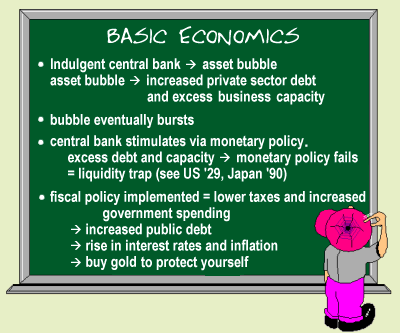
Jeremy Grantham "Night of the Living Fed’

After this post i will continue with my temporary "time out"...Image was just too spot on to pass and is topping even the "They Won´t Stay Dead" version".....

Werde nun meine wohlverdiente Pause fortsetzen....Konnte bei dieser wohl treffensten Illustration seit langem einfach nicht wiederstehen.....Toppt sogar noch die "They Won´t Stay Dead" Version...

Grantham October

Unlike Grantham i think this is a not a bad long term hedge against the wisdom of the "Central Banksters"... ;-)

Selbst wenn einer wie Grantham es etwas anders sieht denke ich das dies langfristig nicht die schlechteste Absicherung gegen die geballten Wesiheiten der weltweiten ( aber inbesonders der angelsächsich geprägten ) "Central Bankster" ist....;-)

Labels: , , , ,

Monday, September 20, 2010

Quotes Albert Edwards, Bill Buckler, Alan Greenspan,William Buiter, Mr Mantega ( Brazil’s Finance Minister ), Ben Davies & Ambrose Evans-Pritchard

Cannot believe that i´m quoting Greenspan without making the usual jokes about his "wisdom"......... ;-)

Fast unheimlich das man mal ohne Häme Greenspan zitieren kann...... ;-)

Albert Edwards via ZH
Central bankers, by pursuing policies that allowed the middle classes to borrow against rising asset prices, kept them consuming despite the stagnation of their incomes and hence disguised the effect of government policies that allowed the rich to acquire virtually all of the gains in GDP growth.

And in the process of “robbing” the middle classes and now still attempting to keep asset prices artificially high, they are also robbing our children of the ability to buy a house at an affordable price. Yet central bankers still see QE as key to maintaining the illusion of prosperity and stoking consumer spending
Bill Buckler via ZH
"Ninety-seven percent of all existing Treasury debt has been created since August 15, 1971! Ninety-three percent of it has been created since Mr Volcker “saved” the paper Dollar in late 1979! Please note that the gain in Treasuries and the loss in the US Dollar almost exactly cancel out.

Please note also that even the biggest gain in these paper markets fades into insignificance against Gold’s rise."And here is the answer all the "gold bugs" have been waiting for: "The paper money “price” of Gold will last as long as the attempt to make paper money “work” lasts. In the end, Gold will no longer have a “price” because it has reverted to its role as MONEY. Whenever and wherever that happens, that nation can return to the production of wealth - rather than “money”."
Alan Greenspan via The Reformed Broker
Mr. Greenspan replied that he’d thought a lot about gold prices over the years and decided the supply and demand explanations treating gold like other commodities “simply don’t pan out,” as Mr. Malpass characterized Mr. Greenspan. “He’d concluded that gold is simply different,” Mr. Malpass wrote. At one point Mr. Greenspan spoke of how, during World War II, the Allies going into North Africa found gold was insisted on in the payment of bribes. Said the former Fed chairman: “If all currencies are moving up or down together, the question is: relative to what? Gold is the canary in the coal mine. It signals problems with respect to currency markets. Central banks should pay attention to it.”
William Buiter via FT Alphaville
…even the fiscally best-positioned G7 countries, Germany and Canada, face major fiscal challenges. Germany would not be able to join the Euro Area today if it were not a member already, because it fails to meet the deficit criterion (no more than 3% of GDP) and the debt criterion (no more than 60% of GDP) – in the case of the public debt to GDP ratio, by a significant and growing margin. Indeed, the aggregate Euro Area fails both criteria by wide margins, and of the 16 individual member states, only Luxembourg and Finland qualify on both criteria…
With QE 2.0 now finally on the table & spreading "competitive devaluations" ( timing wasn´t bad... see Update)around the globe i think you should give the Ludwig von Mises reference via John Hussman a second look....

Da ja nun auch endlich offiziell QE 2.0 angekündigt worden ist und weltweit ein finaler Abwertungswettlauf ( Timing hätte schlechter sein können...siehe Update )in Sachen Währungen um sich greift ( und dabei rasant an Fahrt gewinnt ) kann es nicht schaden noch einmal einen Blick auf das Ludwig von Mises Zitat via John Hussman zu werfen....

UPDATE:

Ambrose Evans-Pritchard Telegraph
States accounting for two-thirds of the global economy are either holding down their exchange rates by direct intervention or steering currencies lower in an attempt to shift problems on to somebody else, each with their own plausible justification. Nothing like this has been seen since the 1930s.
Brazil’s finance minister Mr Mantega via FT Alphaville
Mr Mantega, Brazil’s finance minister, declared earlier this month that the Brazilian real was caught up in ‘a silent war’ in currency markets, as nations compete to speed up their economic recoveries by putting their exporters at an advantage…
Ben Davies Ft Alphaville
Within a single week 25 nations have deliberately slashed the values of their currencies. Nothing quite comparable with this has ever happened before in the history of the world. This world monetary earthquake will carry many lessons.
Got GOLD ? ;-)

Labels: , , , , , , , ,

Tuesday, September 14, 2010

Interesting Irish National Debt Stats......

Stunning....If you want to put a positive spin on it one can argue that there is a lot of room for improvement for the Irish to boost their share.... Of course only if the ECB is willing to slow down their ongoing buying "frenzy" ;-) For more charts click here

Positiv formuliert bleibt da für die Irischen Mitbürger, Banken und Versicherungen noch viel Luft nach oben.....Natürlich nur für den Fall das sich die EZB in den nächsten Jahren mit Ihren Käufen zurückhält....;-) Für mehr Charts in Sachen Irland und Staatsverschuldung bitte hier klicken....

Irish government debt needs you Barclays Capital’s Laurent Fransolet via FT Alphaville

In common with a number of other countries, one of the problems Ireland has faced is the limited domestic investor base for its debt. There is only limited data on who owns the Irish debt. On the domestic side, the Irish central bank has detailed data on holders… Only 15% of the debt is held domestically (the lowest proportion in the euro area), and domestic buyers have not stepped up their purchases recently, in contrast to a number of other euro area countries (eg, Spain, Portugal).

…Irish domestic banks own just €8.5bn of the debt, compared with balance sheets of about €700bn

Similarly, insurance companies and pension funds hold just €3-4bn of Irish government bonds, compared with total fixed income assets of €66bn. These low domestic holdings probably reflect the fact that for a long time, Irish debt was scarce and low yielding, and thus shunned by domestic investors. We think it also shows that in a way, there is potential for more domestic buying, even if these changes in investment policies can take time.

To have an idea of who owns this external debt, we utilise a number of sources. First, we take into account the ECB Securities Markets Programme buying (SMP): in total, about €61bn of Greek, Irish and Portuguese securities have been bought by the ECB. We believe the majority was Greek debt, with the rest slightly skewed in favour of Irish debt (say 15bn to 20bn).

Overall, we assume 30% of the ECB SMP buying has been in Irish debt (€18bn – the SMP likely makes the ECB the biggest single debt holder of Ireland, Portugal and Greece).

Read the last paragraph twice & ( even if i have to repeat myself over and over again ) the Joke Of The Day From ECB´s Smaghi "€ More Stable Than Deutsche Mark" is getting even more "funny".... ;-)

Lasst den letzten Absatz in aller Ruhe nocheinmal Revue passieren und (ich wiederhole mich da gerne) der Witz des Tages von Smaghi das der "€ stabiler als die DM ist" nur noch witziger... ;-)
Importantly… Ireland built up a lot of cash deposits in 2008, which it could run down more than €10bn if market access remains limited/too expensive. With monthly cash deficits of about €1.5bn, limited bills redemptions (€2.75bn in Q1 11) and no bond redemption until November 2011 (€4.4bn), Ireland is not under severe pressure to issue large amounts for meeting cash needs. As such, the NTMA confirmed on 9 September that Ireland was fully funded until next June, which is our assessment as well, if Ireland decided to run down its cash balances entirely (although we suspect it will want to keep some cash buffer to hand).
Put the € 18 billion ECB number since March 2010 into perspective with the monthly cash deficit of only € 1.5 billion.... All this in the name of "tightening the unrealistic high spreads vs BUNDS"...... Spin at its best....UPDATE: Irish banks' ECB loans rise to 95.1 bln euros

Die ganze Sache wird dadurch nicht weniger witzig wenn man die geschätzten 18 Mrd € die die EZB seit März 2010 aufgekauft hat ins Verhätltnis zu dem monatlichen Cash Defizit von 1,5 Mrd € setzt..... Und all das läuft noch immer unter dem Motto "die unrealistischen hohen Renditeaufschläge vs den BUNDS mit dem Marktbild der EU / Politiker / EZB in Einklang zu bringen "..... Mir würden da haufenweise treffendere Begriffe einfallen.... UPDATE: Irish banks' ECB loans rise to 95.1 bln euros

Got GOLD ? ;-)

Labels: , , , , , , , ,

Monday, August 23, 2010

Quotes Edward Hugh, John Hussman & Andy Xie

I´m taking a quick break from my "Time-Out".... With "QE 2.0 & 3.0" just around the corner & the € crises off the front pages i think the links are not "unimportant".......

Verabscheide mich nach diesen Posting wieder in die angekündigte "Auszeit".... Im Zusammenhang mit der bevorstehenden "QE Version 2.0, 3.0 usw...." sowie der "fast vergessenen" € Krise erscheinen mir die kompletten Links besonders lesenwert....

Edward Hugh
Spain’s debt for 2010 according to the EDP is expected to reach around 77% of GDP (EU Commission spring forecast), and while we feel it is still possible to agree with the IMF when they say that that “Spain’s (public) debt ratio is low compared with many other countries in Europe”, it is only possible to do so if we do not forget that if we add in the 6% that is held by the Social Security Fund, the 7% that has built up in Accounts Payable and the 5% owed by Spains Public Corporations, we end up with a total of something like 95% debt to GDP, which is, of course, above the average. And this is not to even begin to count all those impending pension liabilities.
John Hussman

My impression is that Ben Bernanke has little sense of the damage he is about to provoke. A central banker who talks about throwing money from helicopters is not only arrogant but foolish.

Nearly a century ago, the great economist Ludwig von Mises observed that massive central bank easing is invariably a form of cowardice that attempts to avoid the need to restructure debt or correct fiscal deficits, avoiding wiser but more difficult choices by instead destroying the value of the currency.

Andy Xie

When the Fed or the European Central Bank tries to stimulate, they are actually stimulating the global economy as a whole. Water, no matter where it comes from, flows downwards. Stimulus, similarly, flows to where costs are low and banking systems are healthy.

If you believe this logic, the actions of the Fed and the ECB fuel inflation and asset bubbles in emerging economies rather than stimulate growth at home.

Lots of damage has already been done...... Regarding "healthy" banking systems China has nothing to worry about... ;-)

Denke das wir bereits heute mehr als genügend Auswirkungen dieser Erkenntnis sehen können.....Immerhin hat China in Sachen "gesunden" Bankensystem nichts zu befürchten.... ;-)

Labels: , , , , , , ,

Monday, July 12, 2010

Japan Pension Fund Becomes Net Government Bond Seller

So far every bet against JGB´s was a disaster.... But is at least not insignificant when the largest buyer for years has turned to a net seller...... I think when you take a look this link, the following presentation, the confident Rating Agencies & yields like this i think it´s safe to assume that the upside for bonds is "not substantial"......

Bisher haben Wetten gegen japanische Staatsanleihen etliche in den Wahnsinn und sicherlich auch in den finanziellen Ruin getrieben... Wenn aber nun der mit Abstand größte Akteur in diesem Segment nach Jahren von einem massiven Käufer zum Verkäufer notiert lässt das zumindest aufhorchen.....Wenn man sich diesen Link , die folgende Präsentation , die ( noch ) optimistischen Rating Agencies & die aktuellen Renditen vor Augen führt darf man sicherlich behaupten das sich das Chance/Risikoverhältnis nicht gerade merklich bessert...

Japan - Past the Point of No Return - By Vitaliy Katsenelson

H/T Barry Ritholtz

Flashback March 2010
The biggest JGB holder on the planet – the Government Pension Investment Fund (GPIF) – which has already admitted it’s no longer able to roll maturing bonds, has announced that it will open credit lines so it doesn’t have to sell them to fund its obligations…
Looks like they had to end the desperate attempt to stop the unavoidable....

Sieht ganz so aus als wenn jetzt der Zeitpunkt gekommen ist wo das Unvermeindliche nicht mehr länger hinausgezögert werden kann.....

Japan Pension Fund Becomes Net Government Bond Seller
July 13 (Bloomberg) -- Japan’s public pension fund sold more government bonds than it bought for the first time in nine years, underscoring concern that an aging population will make domestic investors less able to finance state borrowings.

The fund sold a net 443.2 billion yen ($5 billion) of Japanese government bonds in the year ended March 31, according to Bank of Japan data released last month. It held 79.5 trillion yen of the securities at the fiscal year end, 11.6 percent of the outstanding amount.

The retirement of baby boomers -- defined in Japan as those born between 1947 and 1949 -- may strain the public coffers as soon as 2012, according to Toshihiro Nagahama, chief economist at Dai-Ichi Life Research Institute in Tokyo. “That may be when Japan’s sovereign risk becomes evident,” he said in an interview in May.
So far the € crises has helped to fill the gap......

Da kommt die momentane € Krise ganz passend.....

M.Pettis
China bought a record amount of Japanese government bonds in May, in an apparent move to shift more of its massive foreign exchange reserves into Japanese debt. Chinese net purchases of Japanese government bonds soared to Y735.2bn ($8.3bn) in May, far outpacing the Y541bn in JGBs bought from January to April, according to Japanese finance ministry figures.

It will be interesting to see if or probably better when the BOJ will be "forced" to start QE Version 18 & 19..... With or without QE this alternative looks much more promising.....

Denke der entscheidende Faktor dürfte sein was die BOJ in Sachen QE machen wird.... Dürfte da über die Jahrezehnte wohl dann Version 18.0 & 19.0 sein..... Mit oder ohne QE ich denke diese Alternative dürfte in jedem Fall vielversprechender sein

Labels: , , , , , ,

Thursday, May 13, 2010

In Fiat Money We Do Not Trust

Nice addition to Gold...The Ultimate Triple-A Asset . If you are still not in the GOLD camp & "stunned" by the recent price action you really should give the link a chance..... Especially if you think GOLD is a bubble...... I think it´s more important than ever that a prudent asset allocation should at least have "some" GOLD exposure.......Doesn´t mean you have to do the "SPROTT","PAULSON" or "KAPLAN"......

Passt perfekt zu Gold...The Ultimate Triple-A Asset . Denke jeder der bisher die Preisbewegung beim Gold mit ungläubigem Staunen betrachtet sollte sich den Link zwingend zu Gemüte führen.... Gilt besonders für alle die ( oftmals seit Jahren ) im "GOLD IS A BUBBLE" Lager zu finden sind......... Ich bin mehr denn je der Meinung das jede vernünftige Portfolio Strukturierung zumindest "etwas" mit GOLD zu tun haben sollte.....Man muß ja nicht gleich den "SPROTT", "KAPLAN" oder "PAULSON" machen.....

H/T Wall Street Follies

The image from Wall Street Follies is well over 10 years old and an updated version would obviously include "QUNATITIVE EASING" aka "PRINTING MONEY"..... ;-)

Der Cartoon von Wall Street Follies ist deutlich über 10 Jahre alt..... Eine aktuelle Version würde sicher die Wörter "QUANTITIVE EASING" bzw "PRINTING PRESS" beinhalten..... ;-)

David Rosenberg ZH

Gold has broken out to the upside even as the U.S. dollar has done likewise on the back of a renewed flight-to-safety bid. What this means, of course, is that gold has managed to hit new highs even as, (i) the U.S. dollar has risen, which means gold is breaking out against all major currencies; and, (ii) other industrial commodities, such as oil and copper, have slumped from their recent highs.

So what this all means is that gold is no longer being considered as part of a resource complex that is outperforming the segment but is increasingly being viewed as a currency of its own.

Gold is a hedge against instability of all kindsdon’t think for a second that deflation does not engender instability whether it be financial, economic or political. To be sure, gold is also a hedge against inflation — but that is going to come much, much later and will be the icing on the cake.

Totally agree on the his deflation / inflation view & timeline....

Stimme zu 100% mit der Deflations / Inflationszeitachse überein....

In Fiat Money We Do Not Trust FT Alphaville

....the price of gold is rising against every major currency, not just the embattled euro.

Gregg Gibbs : "If the market won’t buy the government bonds, the central banks have to. There is no other choice. The alternative is just too damaging for the economy to contemplate. If the central banks don’t buy the debt, then governments are forced into a budget surplus (a surplus is required to cover interest payments on existing debt).

Imagine the carnage if major economies were forced from double digit deficits to surplus, you are talking Great Depression type scenario or worse."

Even though inflation is yet to break out, the price of gold is telling us that this threat is very real over the longer term. People rightly so do not trust fiat money anymore.

Pimco’s Mohamed El-Erian via Felix Salmon

I am inclined [to warn] against the long-term implications of additional steps to turn monetary authorities (with revolving balance sheets) into fiscal agencies (with more permanent exposure to dubious assets).

An even larger-scale use of central bank balance sheets, if it were to materialize, would provide only a temporary respite, and the collateral damage and unintended consequences would be serious, including the impact on inflationary expectations.

Welcome to the OECD debt trap George "Minsky" Magnus via FT Alphaville

There is little on offer in the underlying details of most governments’ deficit and debt arithmetic moreover that would suggest these debt ratios are about to peak and then decline to more manageable levels in the period ahead.

Indeed on current policy settings the evidence suggests that debt-to-GDP ratios will continue to climb.

The reasons are two-fold and relate to conventional textbook definitions of a ‘debt-trap1’

The first reason is that most governments will still be running a deficit on their cycle-adjusted primary budget balance in 2011 – the budget balance excluding interest payments that would appear if the economy was operating at full capacity.

The second reason concerns the relatively high real borrowing costs that governments are confronting at present, partly a function of low levels of inflation and – for some economies – the increasing premium that investors have been demanding to hold their sovereign debt. The ‘effective’ real borrowing rates for most OECD governments last year on their accumulated debt position was north of 3 percentage points (see charts below). For some economies it was north of 4 percentage points. Against an underlying backdrop where potential growth rates for most OECD economies are probably south of 2% and for many closer to 1.5%,this is deeply concerning.


Bill Gross WaPo

"In order to pay the interest and the bill when it comes due, we'll simply have to issue more IOUs. That, to me, is Ponzi-like," Gross said. "It's a game that can never be finished."
AMEN.....

Hinde Capital - ECB the European Commisssion's Whore May 2010

H/T ZH

Debasing the ECB’s Balance Sheet Hussman via Tim
A “sterilized intervention” is one where the euros created through the purchase
of distressed Euro-area debt will also be absorbed by selling other assets from
the ECB’s balance sheet

Therefore, we are fundamentally promising to debase the quality of our balance sheet, by exchanging higher quality Euro-area debt with lower-quality debt of countries that are ultimately likely to default.”.
Looks like even Hussman is too otimistioc when it comes to the ECB & "sterilisation"......

Beim Anblick des nächsten Links muß man leider sagen das wie zu befürcvhten war selbst Hussman beim Thema EZB und "Sterilisation" noch zu optimistisch ist....

Sterilised and scandalised FT Alphaville

But here’s the key bit from the ECB’s statement:

Fixed term deposits held with the Eurosystem are eligible as collateral for the Eurosystem’s credit operations.

Which means the ECB’s govt bond purchases will be offset for a full week — until the banks can repo the fixed term deposits at things like the Long-Term Refinancing Operation (LTRO). What liquidity the ECB takes away with one hand, via the term deposits, it gives in unlimited amounts with the other.
JP Morgan’s David Mackie
In the event, there was less symbolism than we expected . . .

what the ECB is doing is potentially far more worrying. The ECB is now purchasing the government debt of sovereigns whose solvency is in question: neither the Bank of England nor the Federal Reserve did that
"CENTRAL BANKSTERS".....;-)

Labels: , , , , ,

Monday, April 12, 2010

"The Unhappiness Of The Seller Does Not Mean That There Is No Market."

As always superb "Anti Spin" from Hussman.....Long read but with all markets at new highs & on a global scale well over 1 trillion in taxpayer money for the still ongoing bailouts , QE, ZIPR etc it is more important than ever to ask what happened to "the toxic assets" ..... Hussman focusses mainly on US mortgages but i think it is safe to say that similar things are true globally when it comes to CRE, corporate loans etc... Fits nicely to Fridays post "Surprise, Surprise....." Big Banks Mask Risk Levels - Quarter-End Loan Figures Sit 42% Below Peak .....I have to repeat myself when it comes to the ÜBERBULLISH Cramer´s Bull Case For Banks
"Would at least be honest if he mentioned the "ultimate moral hazard trade" & the "Enron-esque characteristics" when it comes to accounting as the two main reasons behind the motives to own banks.. ;-)"
Dringend benötigter "Anti Spin" vom gewohnt erstklassigen John Hussman....Recht ausführliche aber im Angesicht der neuen Markthochs aber unbedingt lesenswerte Ausführungen wenn es um das von einigen bereits als "gelöst" bzw. verdrängt geltende Problem der "Toxic Assets" geht....Schon erstaunlich ( einige würden auch sagen schockierend...) was weltweit gesehen wohl locker über 1 Billion an Steuergeldern die noch immer weiter fliessen ( siehe "The Rolling Bailout Bus" ) , QE, ZIRP usw bisher beim Kernproblem der Krise bewirkt haben.....Obwohl Hussman hier in erster Linie Hypotheken abhandelt ist es sicher keine Übertreibung zu behaupten das weltweit ähnliches auch für gewerbliche genutzte Immobilien sowie Firmenkredite gilt....Wie gemacht als perfekte Ergänzung zum letzten Posting "Surprise, Surprise....." Big Banks Mask Risk Levels - Quarter-End Loan Figures Sit 42% Below Peak ......Muß mich leider erneut wiederholen wenn es um zunehmend bullische Bankempfehlungen ( für ein besonders krasses Beispiel siehe Cramer´s Bull Case For Banks ) und damit indirekt auch für den Gesamtmarkt geht.....

"Wäre zumindest ehrlich gewesen wenn er in seinen 10 Gründen die unbedingt dafür sprechen sofort massiv Bankaktien zu kaufen den "ultimativen Moral Hazard Trade" sowie die kreative Bilanzierung die stark "Enron-esque characteristics" aufweist als die Topgründe aufführen würde.... ;-)"


Extend and Pretend John Hussman

With regard to credit conditions, the U.S. financial system continues to pursue a strategy of "extend and pretend." A year ago, the Financial Accounting Standards Board (FASB) suspended rule 157, which had previously required banks to mark their assets to market value when preparing balance sheet reports. The basic argument was that fair values were not appropriate because there was "no market" for troubled assets. Certainly, the FASB could have implemented something at least modestly reasonable, such as 2-year or 3-year averaging, but instead, they changed the rules to allow "substantial discretion" in the valuation of bank assets in their financial reports.

To a large degree, the idea that there was "no market" for troubled assets was false even at the time.
Last year, Dean Baker of the well-regarded Center for Economic Policy Research (CEPR) testified before Congress, observing "There has been considerable confusion about the nature of the troubled assets held by the banks. While banks do hold some amount of mortgage-backed securities, these securities are in fact a relatively small portion of their troubled assets. The troubled assets on the banks' books are overwhelmingly mortgages, both first and second or other junior
liens, not mortgage-backed securities. The FDIC has acquired large quantities of mortgages from its takeover of several dozen failed banks over the last year. It auctions these assets off on an ongoing basis. The results of these auctions are available on the FDIC website. Non-performing mortgages typically sell in these auctions at prices in the vicinity of 30 cents on the dollar."

He continued, "It is not clear on what basis these auctions can be said not to constitute a market. While the downturn and the constricted credit conditions affect the market, it is simply inaccurate to claim that there is no market for these assets. The major banks are undoubtedly not pleased at the prospect of having to sell off their loans at these prices, but this merely indicates that they are unhappy with the market outcome, just as a homeowner might be unwilling to sell her house at a loss. However, the unhappiness of the seller does not mean that there is no market."

The impact of "extend and pretend" is to create a gap between the reported value of assets and the value they would have on the basis of the cash flows that those assets can reasonably be expected to generate over their maturity. In order to avoid having to restate assets, banks have allowed an increasing gap to develop between the volume of delinquent loans and the volume of loans actually in foreclosure, creating a growing "shadow inventory" of impaired but unmodified and unforeclosed loans.

Moreover, regulatory changes over the past year have affected what actually gets reported as "troubled." As the New York Times recently observed, " A bank owed, say, $4 million on a property now worth $3 million would previously have had to classify the entire loan as
troubled. Now it can do that to the $1 million difference only." In effect, even though impaired loans tend to sell at only 30-50 cents on the dollar (reflecting a modest haircut to the amount typically received in foreclosure), banks can choose the amount of assets it reports as troubled simply by choosing what value to assign the property while it holds the bad loan on its books.

While it's interesting that credit card delinquencies have eased off modestly in recent months, this is not necessarily a healthy sign. Even in the third quarter of 2009, TransUnion reported that consumers delinquent on their mortgages but current on their credit cards increased by 6.6%. In effect, people have been choosing to pay their credit cards in priority to their mortgages.

As for policy efforts to reduce delinquencies, I've long argued that it is a bad idea for policy makers to announce delinquency prevention plans that have, as their centerpiece, publicly subsidized reductions in mortgage principal.
It's one thing to extend the loan in a way that preserves its present value, by swapping a claim on future appreciation in return for principal reduction, but it's quite another to offer to cut the principal outright. The reason ist that instead of confining the assistance to presently troubled borrowers, you create a whole new set of borrowers who then choose to be troubled in order to get the assistance. According to a University of Chicago study, "strategic defaults" - where people choose to default on their mortgages even though they can afford to pay - accounted for 35% of all residential defaults in December 2009, up from 23% in March 2009. Offering public subsidies for this behavior, when too many homeowners are already legitimately struggling, does not smack of a bright idea.

The New York Times recently provided a good picture of how the delinquency situation stood at the end of 2009 (based on FDIC data):


Bad Bank Loans Soar


In short, my impression is that investors are deluding themselves about the solvency of the banking system. People learned in the 1930's that when you don't require the reported value of assets to have a clear and tangible link to the value that the assets would have in liquidation, bad things happen. Yet this is what regulatory and accounting rules are allowing for the banking system at present. While I do believe that bank depositors are safe to the extent of FDIC guarantees, my impression is that the banking system is still quietly insolvent.

Will it work? Will it change?

Regardless of whether the U.S. banking system would not presently be able to meet its liabilities with its assets, there is another question: assuming that banks are allowed to extend and pretend for a long enough period of time, will they ultimately be able to accumulate enough retained earnings in the years ahead to cover eventual loan losses? In other words, is it possible that everything will be OK if we just look the other way long enough?

From my perspective, it depends on what "OK" means. Simply in terms of long-term solvency - assets being ultimately able to meet liabilities - my impression is that yes, given enough time, retained bank earnings should cover the losses on existing loans. Indeed, it's possible that banks might be able to report fairly healthy "operating earnings" to investors, and then somewhat more quietly write off losses as "extraordinary" charges over a period of years. This type of outcome is beginning to look possible, because investors evidently don't mind repeatedly having their pockets picked as long as "operating earnings" come in above analyst estimates.

Unfortunately, in that sort of world, the economy would likely be hobbled for a long period of time, as Japan has discovered over the past couple of decades. With banks focused primarily on survival and recapitalization, retained earnings would be directed to making the existing liabilities whole, rather than contributing to productive new investment.

So to the extent that "extend and pretend" is successful in averting insolvency concerns, it will also tend to weigh down lending activity, as resources are allocated toward servicing existing debt burdens on bad assets, rather than toward new lending for productive activity. The most efficient outcome is always for lenders who provide capital to take losses if the loans go bad. That sort of market discipline is the only way to ensure that capital gets allocated properly. This is not the world that we have lived in over the past year, as policy makers have pledged public money to make private bank bondholders whole, regardless of how irresponsibly the banks allocated the money. But it is important to recognize that this policy comes with longer term costs.

Needless to say that i think he is spot on....... It will be interesting to see how Mr. Market will react to the quality of ( bank ) earnings / balance sheets during the reporting season.....This could be at least a possible trigger to calm down the "somewhat elevated" risk appetite significantly.....

Überflüssig zu erwähnen das ich zu 100% übereinstimme..... Es wird spannend zu beobachten inwieweit in der jetzt startenden Berichtssaison die Gewinn und Bilanzqualität der Banken hinterfragt wird.... Sehe hier durchaus erhebliches Potential den "leicht erhöhten" Risikoappetit doch merklich zu zügeln.....

UPDATE:

Profit for Banks Dimmed by Home-Equity Loss Seen at $30 Billion
April 12 (Bloomberg) -- Bank of America Corp., JPMorgan Chase & Co. and Wells Fargo & Co. may have to set aside an additional $30 billion to cover possible losses on home-equity loans, an amount almost equal to analysts’ estimates of profit at the three banks this year.
Global Banking System Extend and Pretend Insolvency Mish

I happen to agree with John Hussman on all points mentioned. Moreover, it is not just the U.S. banking system that is insolvent, the global banking system is nothing but a giant extend and pretend operation including the PIIGS (Portugal, Ireland, Italy, Greece, Spain), China, the UK, and even Canada as soon Canada's gigantic housing bubble crashes.

Spot On Alex Cartoon :-)!

The DTA dodge FT Alphaville
The issue is that in order for banks to include DTAs in their Tier 1 capital, they need to be able to show regulators that they will generate enough income in the future to actually use them.

Citigroup, for instance, has been racking up enough losses in recent years to generate $47bn worth of DTAs at the end of 2009, about $21bn of which was included in their Tier 1 capital that year. So that’s $21bn coming out of years of losses, but based on the premise that the bank will soon be profitable.
They will find a "creative" way to reassure their future profibility..... The Treasury wants to sell a 7.7 billion shares within the next year... ;-)

Bin mir sicher das hier ein kreativer Weg gefunden wird um die zukünftige Profitabilität zu gewährleisten...Immerhin will das Finanzministerium noch 7,7 Mrd Aktien binnen 12 Monaten auf den Markt schmeissen ;-)

Foreclosure inventories hit record

February's foreclosure rate of 3.31% represented a 51.1% jump from February 2009
From Level I to Level III, the myth of fair value FT Alphaville

Lehman Channeled Risks Through ‘Alter Ego’ Firm NYT

Even now, a year and a half after Lehman’s collapse, major banks still undertake such transactions with businesses whose names, like Hudson Castle’s, are rarely mentioned outside of footnotes in financial statements, if at all.
"ENRON-ESQUE" .......

The search for Basel III loopholes begins Felix Salmon

Most of the arguments could be made only by banks who have been drinking their own kool-aid for so long that they no longer have any idea what sounds ridiculous and what doesn’t.

CHUZPAH!

Meredith Whitney vs the Banks Paul Kedrosky


She has not one single buy rating in the space she is covering.....

Eine der wohl besten Bankenanlaysten hat nicht eine einzige Bank auf "BUY".....

Labels: , , , , , , , , , , ,

Monday, April 05, 2010

Profit Margins, Margin Debt & Margin Of Error.......

Combine the data points with the excellent When Risk-Return Makes No Sense: How To Deal With An Overvalued Market and it should be clear that Mr. Market is walking on very thin ice now... I must admit that this is my view since September/October......Cannot help but it at least smells a little bit like "Flucht In Sachwerte"... I still think that the risk / reward is far more favourable in GOLD... ;-)

Wenn man die folgenden Daten mit dem extrem lesenswerten When Risk-Return Makes No Sense: How To Deal With An Overvalued Market kombiniert wird klar das man sich momentan auf sehr dünnem Eis bewegt.... Muß gestehen das ich diese Ansicht seit dem September/Oktober vertrete.... So langsam kann man zumindest unterschwellig das Gefühl haben das zumindest in Teilen eine "Flucht In Sachwerte" eingesetzt hat.....Bin mehr denn je überzeugt das in Sachen Chance/Risiko die Aussichten für GOLD weitaus vielversprechender sind.... ;-)

William Hester / Hussman Funds
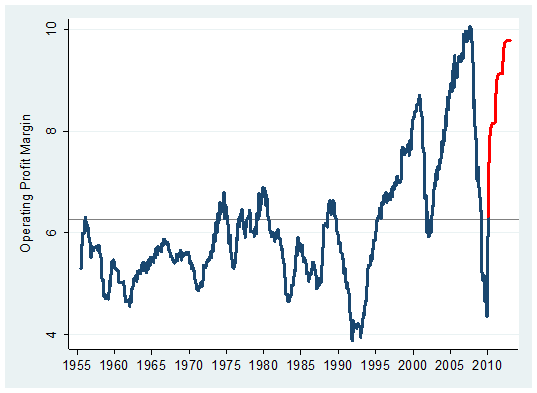
While earnings growth expectations are steep, sales growth expectations are more modest. Sales-per-share for S&P 500 companies is expected to grow about 5.5 percent this year and about 7 percent next year, according to forecasts. The difference between the growth rates of the top and bottom lines is implies a forecast for sharply rising operating profit margins. The graph below is updated from an earlier piece, and includes forecasts through the end of 2012. It plots the long-term level of S&P operating margins in blue. In red, I've plotted the operating margins currently being forecasted by analysts based on their projections for sales and earnings. Last October, analysts were about half way to pricing in profit margins that matched the record levels of 2007. Now, they are just about there.
David Rosenberg / Gluskin Sheff
As for 2011, the consensus is looking for $97 on S&P 500 operating EPS — we did $95 at the peak of the last cycle when the unemployment rate was at 4.5%, the industry CAPU rate was 81%, private sector credit xpanding at a 16.2% annual rate and nominal GDP at a 4.9% YoY pace.
So the consensus believes that barely two years into the second weakest post-recession recovery in the past six decades that we will actually get back to peak profit levels seems to be a tad outlandish.
Stock Market Rally Explained The Mess That Greenspan Made

Ad in the the Money & Investing section of today’s Wall Street Journal

Factoring in the tight junk spreads right now one must assume that looking at the next chart the "Margin Of Error" is probably "slim"......

Da momentan selbst historisch gesehen recht enge Junk Spreads vorherrschen muß man beim Anblick des nächsten Charts wohl unterstellen das in Sachen "Margin Of Error" wenig "Spielraum" bleibt.....

Investors really ♥ junk. We mean really. FT Alphaville

In most discussions of the high-yield bond market, historical spreads play a major role. But comparing spreads today to those of the past assumes that junk bonds are a constant entity over time. Unfortunately, junk is junkier today, as illustrated by this chart [at left] from last October’s Global Financial Stability Report.

The fraction of CCC or lower-rated bonds approximately doubled from early 2007 to early 2009. And according to a recent report from Fitch, the fraction at the end of 2009 was still 27%.

Debt ranked in the BB category gained 39.1 percent in the past 12 months, underperforming the CCC tier by 66 percentage points, according to Bank of America Merrill Lynch index data.


H/T EconomPicData

The "risk trade" is currently clearly not in the early innings....... Looks like the Mantra Bullish. No Matter What & the "Moon Trade" ( brilliant!) is still alive & kicking.... ;-)

Der sog. "Risikotrade" befindet sich sicher nicht mehr im "Anfangsstadium"..... Sieht so aus als wenn das Motto Bullish. No Matter What sowie Ladies and Gentlemen, We Are Trading On The Moon ( brilliant!) momentan noch immer zu greifen scheint...... ;-)+

UPDATE:

PARTS OF THIS MARKET ARE LOOKING IRRATIONAL PragCap

Why Young People Should Buy Stocks on Margin Time H/T Denninger

We just survived the worst debt-fueled binge since the Roaring '20s. Now two professors at Yale University are suggesting we introduce leverage into a new realm of our lives —our retirement portfolios. TIME's Barbara Kiviat asked economists Ian Ayres and Barry Nalebuff to explain themselves.

You are advocating that people in their 20s and early 30s take all of their retirement savings and buy stocks on margin. Can you explain why that's not as crazy as it sounds?

"It's not as crazy as it sounds because it helps people better diversify risk across time"

Read this twice....

UBS: EQUITY MARKET RISKS APPROACHING EXTREMES PragCap

Irrational Exuberance Is Here: VIX Lowest Since July 2007 As Options Speculation Highest Since Dot Com Days

The VIX has just hit the lowest level since July of 2007 as Sentiment Trader reports that "speculation in the options market has spiked to its highest levels since the spring of 2000."
As i´ve said, not in the early innings.....

Wie gesagt, nicht mehr im Anfangsstadium......

Labels: , , , , , , , , , , , , ,

Tuesday, March 23, 2010

Another "Reassuring" Sovereign Debt Chart........

Almost as "impressive" as this chart...... Taken from Dylan Grice Discusses When To Take Profits On Gold: Hint - Not For A Long While via ZH UPDATE: Speaking of Portugal and sovereign risk: a downgrade

Fast so "eindrucksvoll" wie dieser Chart...... Mehr zum Chart gibt es in Dylan Grice Discusses When To Take Profits On Gold: Hint - Not For A Long While via ZH UPDATE: Speaking of Portugal and sovereign risk: a downgrade

A reduction of this magnitude without a depression and social "tensions" is highly unlikely ...... Especially when the numbers are based on "realistic" forecasts that even would make "Wall Street Finest" proud.....

Eine Reduzierung in dieser Größenordnung ist ohne eine gefühlte Depression sowie starken sozialen "Spannungen" nicht vorstellbar..... Besonders vertrauenerweckend ist zudem das die Prognosen auf gewohnt konservativen Annahmen basieren die selbst Wall Street Finest blaß aussehen lassen..... ;-)

via NYT

This explains why GOLD Is Not A $ Story........ Wouldn´t also surprise me if charts like this won´t be seen as "unusual" any more down the road......

Damit erklärt sich auch leicht warum GOLD keinesfalls lediglich eine $ Story ist........ Zudem befürchte ich insgeheim das selbst zur Zeit noch aussergewöhnliche Charts wie dieser nicht länger die absolute Ausnahme bleiben......

The following story fits perfectly.......

Die nachfolgende Meldung passt da hervorragend ins Gesamtbild......

Obama Pays More Than Buffett as U.S. Risks AAA Rating

March 22 (Bloomberg) — The bond market is saying that it’s safer to lend to Warren Buffett than Barack Obama. Two-year notes sold by the billionaire’s Berkshire Hathaway Inc. in February yield 3.5 basis points less than Treasuries of similar maturity, according to data compiled by Bloomberg.

Procter & Gamble Co., Johnson & Johnson and Lowe’s Cos. debt also traded at lower yields in recent weeks, a situation former Lehman Brothers Holdings Inc. chief fixed-income strategist Jack Malvey calls an “exceedingly rare” event in the history of the bond market.
Reassuring........ At least the worldwide banking system is now "well capitalised" and not in danger of needing another bailout....... ;-)

Sehr vertrauenserweckend.... Immerhin sind ja inzwischen die Banken weltweit "well capitalised" und dürften die Sanierung der Staashauhalte auf Jahre hinaus nicht weiter belasten..... ;-)

Labels: , , , , , , ,

Monday, March 08, 2010

Maybe This Time It Is Different.........

So far every bet against the Japanese bond market was a disaster..... But the latest move from the GPIF ( $1.37 trln / 66.32percent of its assets in domestic bonds ! see Profile GPIF Government Pension Investment Fund, Japan ) is really looking "unconventional".....

Bisher ist jeder der gegen japanische Staatsanleihen (JGB) gewettet hat übelst auf den Bauch gefallen.... Da der letzte Schritt des 1.37 trln $ schweren und zu knapp 66% in JGB´s investierten GPIF ( mehr Details GPIF Government Pension Investment Fund, Japan ) allerdings doch recht "unkonventionell" daherkommt ist der Ausgang zwischen Bullen und Bären wohl ungewisser denn je.....

H/T Claire Morel / Reuters

‘Japan’s brewing fiasco’ SocGen’s Dylan Grice via FT Alphaville

The biggest JGB holder on the planet – the Government Pension Investment Fund (GPIF) – which has already admitted it’s no longer able to roll maturing bonds, has announced that it will open credit lines so it doesn’t have to sell them to fund its obligations…

To spell that out: we are going into a year in which the government has ¥213 trillion of bonds to roll over… and the biggest holder of JGBs is openly admitting he has no new inflows of money

Click here & here to get the entire report... Some pretty scary charts & the following stat............

Den kompletten Research Report gibt es hier & hier ... Einige extrem unschöne Charts sowie die nachfolgende Zahl..........

So who will fund the Japanese government´s deficit in the future? It is not likely to be the international capital markets, especially if its bonds are offering only a 1.5% yield.

But if international investors were to demand triple that, pricing JGBs in line with international bond market peers (all priced too generously in my opinion) the game would soon be up because Japan´s current debt service already amounts to 35% of pre-bond issuance revenues.

H/T Zero Hedge

For more on this topic make sure you visit the excellent slide show Japan - The Point Of No Return from Vitaliy N. Katsenelson via Barry

Wer mehr zu diesem Thema sehen möchte dem empfehle ich die erstklassige Ansammlung von Charts Japan - The Point Of No Return von Vitaliy N. Katsenelson via Barry

GOLD Is Not A $ Story........ ;-)

Labels: , , , , , , , , , ,

Tuesday, March 02, 2010

GOLD Is Not A $ Story........

Nice addtition to an earlier posting.....

Nette Ergänzung zu einem früheren Posting.....

Barrons

[Pedal to Metal]

Unrelated..... ;-) / Ohne jeden Bezug..... ;-)

8 reasons Wall Street loses another 20% in this decade Paul B. Farrell

.... the past decade. Wall Street lost trillions, lost 11% of your money. Adjusted for inflation, Wall Street lost 20% of your money.

Labels: , , , ,

Wednesday, February 10, 2010

As A Contrarian........

the following story is great.....Clearly a sign of a bubble when the most successful hedge fund manger is unable to collect more than $ 100 million inflows into his funds solely related to GOLD..;-)

Especially when the fundamentals against GOLD are now dramatically improving even outside the "rock solid" US on a daily basis.. Must be the reason why the "Sovereign Misery Index" is looking just fine.....;-)

Wenn der erfolgreichste Fondsmanager der letzten Jahre es nicht schafft mehr als 100 Mio $ für seinen GOLDFOND einzusammeln muß man klar zum Schluß kommen das sich GOLD in einer Blase befindet...;-)

Gilt umso mehr, da die Fundamentaldaten ( u.a. gesunde Banken & Staatsfinanzen.. )die gegen GOLD sprechen ja, wie gerade momentan recht anschaulich selbst in der gängigen Presse präsentiert, tagtäglich nicht nur in den gewohnt ""soliden" USA, sondern besonders für € Anleger besser werden....Ebenfalls wunderbar am "Sovereign Misery Index" zu erkennen....;-)

H/T Todd Harrison / Minyanville via Pragmatic Capitalist

Midas Touch Lost? Paulson Hits Hurdles in Gold Fund WSJ

It took John Paulson months to convince investors that housing would crumble.

Now it's taking him awhile to get them excited about gold, his latest passion

When Mr. Paulson's Paulson & Co. late last year announced it was starting a hedge fund to make a big gold bet, many on Wall Street expected investors to line up. Paulson & Co. scored about $20 billion in profits in 2007 and 2008 wagering against subprime mortgages and financial companies. It then bought financial shares last year to add more gains.

Some gold traders expected Mr. Paulson's new fund, launched Jan. 1, to raise billions of dollars and even help push gold higher when it started buying this year.

That hasn't happened. Despite months of investor meetings, Mr. Paulson has raised $90million or so for his new gold fund, according to people close to the matter. Even the $250 million that Mr. Paulson himself placed in the fund hasn't persuaded many investors to get on board.
Maybe he should do a roadshow among European investors....... ;-)

Empfehle zur Not mal ne Road Show durch Europa........ ;-)
Mr. Paulson has told investors that his gold strategy is a long-term one that will reap rewards over the next few years as the value of leading currencies drop
UPDATE:

A STERN REALITY CHECK FOR GOLD NAYSAYERS PC

Furthermore, the US dollar doesn’t have to decline for Gold to do well. Did you know that since the very end of 2004, the US$ is flat but Gold is up 143%? Since July 20, 2007, Gold is up 56% while the dollar is flat. Since early September 2008, Gold is up 35%, while the dollar is up 1%.
CLSA’s Christopher Wood FT Alphaville
A sovereign debt crisis in the West is coming sooner or later though it is probably not right now. This is why the recent correction in gold is an opportunity to buy more bullion and more gold mining shares.

As a German / European investor ( not speculator ) i´ve to repeat myself that it is always important to follow GOLD priced in €..... Unfortunately none of the so called German "business" papers / media takes care of this not insignificant fact.....See this Handelsblatt example in which several German "experts" discussing & charting the recent "correction" in GOLD denominated in $...

Auch auf die Gefahr hin das ich mich wiederhole gerade als Deutscher / Europäischer Investor ( nicht Spekulant ) ist einzig und allein der GOLDpreis in € relevant.... Mit etwas Glück findet man diesen auf den hinteren Seiten im Kleingedruckten der deutschen Fachpresse.....Verweise mal exemplarisch auf Taumelnder Euro zieht Goldpreis mit nach unten vom Handelblatt....

The fundamentals support our view as the financial crisis is entering the most bullish phase for Gold. The sovereign debt crisis, which really began in Iceland, will plague Europe this year and eventually spread to the UK and US by early 2011. Nations have no other choice but to monetize their growing obligations while trying to stimulate their economies with deficit spending and near 0% interest rates. It is a perfect storm for Gold

Chart Net Speculative Gold Long Positions When Gold Was Above $ 1.200

Yesterday / Gestern 222,282 net long gold contracts

To be honest i´m a little surprised that the long positions have only declined 50.000.....Hot money will lead to lots of volatility & great buying opportunities ( wouldn´t rule out something south of $ 1.000 ).... But according to Peter Boockvar this still elevated number means that "net longs in gold and silver both fell to its lowest level since Aug ‘09"

Muß gestehen das ich überrascht bin das die Longpositionen vom Hoch trotz der auf $ Basis heftiger Korrektur nur um 50.000 geschrumpft sind....Dürfte also gewohnt volatil bleiben und hoffentlich die ein oder andere Einstiegsgelegenheit ermöglichen.... Peter Boockvar weist darauf hin das die immer noch hohe Anzahl die Netto long position auf dem niedrigsten Stand seit August 2009 zurückgefallen sind.....

Labels: , , , , , ,