Thursday, November 09, 2006

Buy now, worry later/ bring on another creditinnovation.......

can´t wait for the "realtime" stresstest to proove that all the innovations really reduce risk.........especially when you keep in mind that a lot of the derivatives buyers are hedge funds ( up to 30%)!

kann es kaum abwarten das diese instrumente mal unter realen bedingungen einen stresstest unterzogen werden und ob dann immer noch risiko reduzeirt worden ist oder ab das nur vorgegaukelt war. besonders wenn man bedenkt das bis zu 30% der derivatekäufer heutzutage hedgefonds sind.

more on credit mania
http://immobilienblasen.blogspot.com/2006/10/dangerexplosive-loans-another-credit.html
http://immobilienblasen.blogspot.com/2006/09/shadows-of-debt-economist.html
http://immobilienblasen.blogspot.com/2006/09/credit-machine-is-running-amok-mother.html
http://immobilienblasen.blogspot.com/2006/10/money-supply-is-running-wild.html
http://immobilienblasen.blogspot.com/2006/10/private-equity-excess-business-week.html


Buttonwood
Premium bonds

http://www.economist.com/finance/displaystory.cfm?story_id=8150178

FEAR and greed are supposed to govern financial markets. Right now, investors seem far more like lumberjacks at an all-you-can-eat buffet than claustrophobes trapped in a lift. Despite nagging concerns about the American economy, global stockmarkets are at multi-year highs. ....

If there is one market that sums up the insouciant attitude to risk, it would have to be corporate debt. After an extremely good run, the difference between the interest rate companies pay and that which (much safer) treasury bonds pay has fallen substantially. Until recently, most investors expected that as the American economy slowed, companies would run into difficulty, forcing those borrowing costs higher.

why worry...?
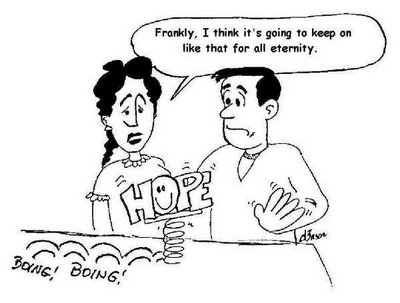


But it hasn't and bankers are coming up with increasingly ingenious ways to offer fixed-income investors additional returns. Enter the newest symbol of the corporate-bond bonanza: an instrument known cryptically as the constant proportion debt obligation, or CPDO.

CPDOs are built on the back of credit-default swaps—the greatest credit innovation of the past decade—which give investors the chance to insure against a company going bust. Now CPDOs offer the same option for an entire index. And with the help of a lot of borrowed money, they offer some juicy returns. (right, more leverage/mehr hebel)

Like a swap, issuers of CPDOs get premium income upfront but have to pay out if a company in the index defaults. The beauty of the structure is that the insurance is sold only on a rolling six-month basis. The chance of one of the index's components defaulting within the next six months is very low. Even if the company's finances do deteriorate, it will probably be dropped from the index by the time the six months are up.

That means the credit agencies are happy to award CPDOs their highest (AAA-style) rating. But unlike other top-rated debt instruments, CPDOs pay a succulent interest rate of as much as two percentage points over cash.

Gary Jenkins of Deutsche Bank points out that, historically, investors have been overpaid for the default risk on high-quality corporate bonds. CPDOs take advantage of this anomaly. They employ another gimmick, too. If the markets move against them, the issuer borrows more money to sell more insurance. The extra premiums earned make up for the capital loss suffered in the market. In theory, a CPDO could have 15 times more debt than capital. (read this twice!even more leverage)

The structure was pioneered only in August, and has yet to be tested in a crisis. However, Georges Assi of Lehman Brothers says it is inherently market-stabilising: CPDO issuers will be buying when others are selling. (until the music stopps....)

The CPDO craze is just one sign of investors' appetite for corporate debt. Sales of corporate bonds and leveraged (high-risk) loans are breaking records. Investors are happy to take the extra yield today and worry about the risk later.

Similar sang froid is being displayed about America's stockmarket. By the start of this week, the S&P 500 index had not fallen by 1% in 111 days, one of its longest winning streaks in the past 25 years. http://immobilienblasen.blogspot.com/2006/10/remember-what-1-decline-feels-like.html

If investors were worried about losing those gains, they would be paying up for options to protect against a sudden fall in share prices. But the VIX index of American stockmarket volatility (a measure of the cost of buying options) was close to a ten-year low in late October.
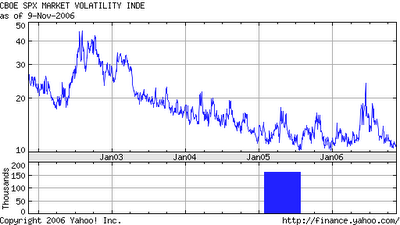
... isn't there too much complacency? America's recent economic data have sown confusion

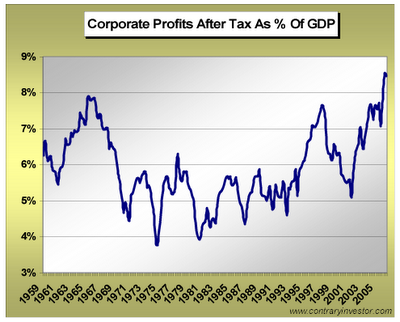
, but even where the news has appeared positive, dangers lurk. The biggest threat for companies is that unit labour costs are growing faster than 5% a year. A combination of slower overall growth and rising wage costs should squeeze profit margins. With profits at a 40-year high as a share of GDP, it is hard to see the news getting much better.
But though investors may realise that something is bound to go wrong eventually, getting the timing right is a completely separate question. Over the past three years, those who have acted out of fear have generally lost money. With tasty morsels such as CPDOs on the table, greed is the much more tempting option.

i bet that the next creditinnovation in already in the making/jede wette das die nächste innovation schon in der mache ist.......

Saturday, November 18, 2006

Derivatives Trading Soars to $370 Trillion / buffets "weapon of mass destruction"

as is wrote before. i´m waiting for the first real stresstest. i think that the derivatives are like buffet said "financial weapons of mass destruction". watch this stat and i have problems with the generall thinking that the counterpart always pays for the (false) "security"

.....wie ich schon vorher beschrieben habe warte ich auf den ersten realen stresstst. ich teile die meinung von buffet das es sich hier um "massenvernichtungswaffen" handelt. guckt euch die folgende statistik an und fragt euch ob sichergestellt ist das in panikzeiten diese versicherung nicht ne leere versprechung ist.(weil z.b. der hedgefonds untergeht).

Here we learn that hedge funds account for 32 percent of credit-default swap sellers and 28 percent of buyers, up from 15 percent and 16 percent in 2004, according to a British Bankers' Association report last month


it is also scray that the derivates exceeds often the amount of underlying assets like gold, stocks, bonds etc.


Credit-default swaps also are used by money managers as a cheaper and quicker alternative to buying and selling bonds. When Delphi Corp. filed for bankruptcy on Oct. 8, there were $20 billion of credit-default swaps related to its $2 billion of bonds (10xlarger!)


more on derivatives/derivaten

http://immobilienblasen.blogspot.com/2006/09/shadows-of-debt-economist.html
http://immobilienblasen.blogspot.com/search?q=creditinnovation
http://immobilienblasen.blogspot.com/2006/08/credit-default-swap-chaos.html
http://immobilienblasen.blogspot.com/search?q=hedgefunds+derivatives

dank an mish und sein http://www.markettradersforum.com/forum1/

http://tinyurl.com/yctych
Nov. 17 (Bloomberg) -- The use of derivatives grew at the fastest pace in eight years during the first half of 2006, boosting earnings at securities firms and reducing costs for investors.

The face value of derivatives based on corporate bonds, currencies, interest rates, commodities and stocks jumped 24 percent to $370 trillion, according to the Bank for International Settlements. It was the biggest percentage rise since the bank began keeping records in 1998.

Trading in credit-default swaps, the fastest-growing derivatives market, helped spur record earnings for banks including New York-based Morgan Stanley and Goldman Sachs Group Inc. At London-based Barclays Capital derivatives accounted for more than 60 percent of revenue and profit, Chief Executive Officer Bob Diamond said in May. http://immobilienblasen.blogspot.com/search?q=hedgefunds+derivatives

``The pace of growth is going to have continued unabated in the second half of the year,'' ....

The amount of outstanding credit-default swap contracts jumped to $20.3 trillion from $13.9 trillion at the end of last year, ....... The securities are financial instruments based on bonds and loans that are used to bet on an increase or decrease in indebtedness.

Investors who buy the contracts are paid the face value of the underlying debt in exchange for the defaulted notes should the company fail to adhere to debt agreements. A decline in the cost of the contracts indicates an improvement in the perception of credit quality; an increase signals deterioration.

Contracts Cheaper
Banks and hedge funds say it's cheaper and easier to use the contracts than buying or selling the underlying securities
. ....

Within the credit derivatives market, trading on indexes based on groups of companies soared as much as 86 percent, the report said.

``Greater standardization, deeper liquidity and more efficient pricing'' is helping to boost trading, said Sunil Hirani, chief executive officer of New York-based Creditex Group Inc., one of the brokers that matches buyers and sellers in the market. ``The number of participants will continue to grow.''

Greenspan Comments
Alan Greenspan, the former chairman of the Federal Reserve, has been saying since 2002 that derivatives reduce risks by making financial markets resilient to shocks. In May he told a Bond Market Association gathering in New York that derivatives are the most significant change on Wall Street ``in decades.'' make sure you read the other insights from alan g! (about housing, hedge funds, savingsrate etc..) and you know why i´m with buffet......
http://immobilienblasen.blogspot.com/search?q=interview+alan+greenspan


picture: thank to tim http://themessthatgreenspanmade.blogspot.com/

The rapid growth of derivatives is also raising concerns that their ease of use may lead to market abuse such as insider trading related to leveraged buyouts, after unusual price changes occurred prior to the announcement of takeovers in the U.S.

.....Trading in derivatives overall grew 24 percent in the first six months, compared with 5 percent in the second half of 2005, the BIS said.

Interest-rate swaps, which make up 70 percent of the derivatives market, rose the most in Europe, growing 27 percent in the first half compared with 18 percent in the U.S., the report said.

The outstanding amounts of derivatives (All numbers in $trillion).
End-June 2005 End-Dec 2005 End-June 2006
Interest rates 204.7 211.97 262.3
Credit 10.2 13.9 20.3
Equity 4.5 5.7 6.7
Commodities 2.9 5.4 6.4
Foreign Exchange 31 31.3 38.1
Unallocated 27.9 29.1 36

make sure oyu read the credit bubble bulletin from the great doug noland http://tinyurl.com/wymb6

scroll down to the last part Derivatives “Insurance”:

Labels: , ,