Saturday, November 18, 2006

Derivatives Trading Soars to $370 Trillion / buffets "weapon of mass destruction"

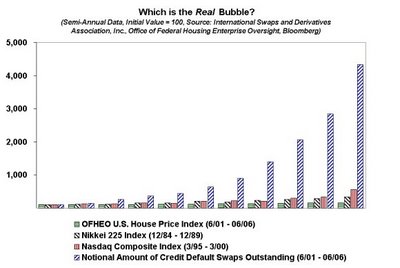
as is wrote before. i´m waiting for the first real stresstest. i think that the derivatives are like buffet said "financial weapons of mass destruction". watch this stat and i have problems with the generall thinking that the counterpart always pays for the (false) "security"

.....wie ich schon vorher beschrieben habe warte ich auf den ersten realen stresstst. ich teile die meinung von buffet das es sich hier um "massenvernichtungswaffen" handelt. guckt euch die folgende statistik an und fragt euch ob sichergestellt ist das in panikzeiten diese versicherung nicht ne leere versprechung ist.(weil z.b. der hedgefonds untergeht).

Here we learn that hedge funds account for 32 percent of credit-default swap sellers and 28 percent of buyers, up from 15 percent and 16 percent in 2004, according to a British Bankers' Association report last month


it is also scray that the derivates exceeds often the amount of underlying assets like gold, stocks, bonds etc.


Credit-default swaps also are used by money managers as a cheaper and quicker alternative to buying and selling bonds. When Delphi Corp. filed for bankruptcy on Oct. 8, there were $20 billion of credit-default swaps related to its $2 billion of bonds (10xlarger!)


more on derivatives/derivaten

http://immobilienblasen.blogspot.com/2006/09/shadows-of-debt-economist.html
http://immobilienblasen.blogspot.com/search?q=creditinnovation
http://immobilienblasen.blogspot.com/2006/08/credit-default-swap-chaos.html
http://immobilienblasen.blogspot.com/search?q=hedgefunds+derivatives

dank an mish und sein http://www.markettradersforum.com/forum1/

http://tinyurl.com/yctych
Nov. 17 (Bloomberg) -- The use of derivatives grew at the fastest pace in eight years during the first half of 2006, boosting earnings at securities firms and reducing costs for investors.

The face value of derivatives based on corporate bonds, currencies, interest rates, commodities and stocks jumped 24 percent to $370 trillion, according to the Bank for International Settlements. It was the biggest percentage rise since the bank began keeping records in 1998.

Trading in credit-default swaps, the fastest-growing derivatives market, helped spur record earnings for banks including New York-based Morgan Stanley and Goldman Sachs Group Inc. At London-based Barclays Capital derivatives accounted for more than 60 percent of revenue and profit, Chief Executive Officer Bob Diamond said in May. http://immobilienblasen.blogspot.com/search?q=hedgefunds+derivatives

``The pace of growth is going to have continued unabated in the second half of the year,'' ....

The amount of outstanding credit-default swap contracts jumped to $20.3 trillion from $13.9 trillion at the end of last year, ....... The securities are financial instruments based on bonds and loans that are used to bet on an increase or decrease in indebtedness.

Investors who buy the contracts are paid the face value of the underlying debt in exchange for the defaulted notes should the company fail to adhere to debt agreements. A decline in the cost of the contracts indicates an improvement in the perception of credit quality; an increase signals deterioration.

Contracts Cheaper
Banks and hedge funds say it's cheaper and easier to use the contracts than buying or selling the underlying securities
. ....

Within the credit derivatives market, trading on indexes based on groups of companies soared as much as 86 percent, the report said.

``Greater standardization, deeper liquidity and more efficient pricing'' is helping to boost trading, said Sunil Hirani, chief executive officer of New York-based Creditex Group Inc., one of the brokers that matches buyers and sellers in the market. ``The number of participants will continue to grow.''

Greenspan Comments
Alan Greenspan, the former chairman of the Federal Reserve, has been saying since 2002 that derivatives reduce risks by making financial markets resilient to shocks. In May he told a Bond Market Association gathering in New York that derivatives are the most significant change on Wall Street ``in decades.'' make sure you read the other insights from alan g! (about housing, hedge funds, savingsrate etc..) and you know why i´m with buffet......
http://immobilienblasen.blogspot.com/search?q=interview+alan+greenspan


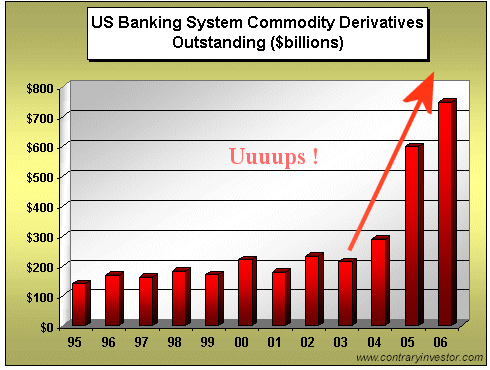
picture: thank to tim http://themessthatgreenspanmade.blogspot.com/

The rapid growth of derivatives is also raising concerns that their ease of use may lead to market abuse such as insider trading related to leveraged buyouts, after unusual price changes occurred prior to the announcement of takeovers in the U.S.

.....Trading in derivatives overall grew 24 percent in the first six months, compared with 5 percent in the second half of 2005, the BIS said.

Interest-rate swaps, which make up 70 percent of the derivatives market, rose the most in Europe, growing 27 percent in the first half compared with 18 percent in the U.S., the report said.

The outstanding amounts of derivatives (All numbers in $trillion).
End-June 2005 End-Dec 2005 End-June 2006
Interest rates 204.7 211.97 262.3
Credit 10.2 13.9 20.3
Equity 4.5 5.7 6.7
Commodities 2.9 5.4 6.4
Foreign Exchange 31 31.3 38.1
Unallocated 27.9 29.1 36

make sure oyu read the credit bubble bulletin from the great doug noland http://tinyurl.com/wymb6

scroll down to the last part Derivatives “Insurance”:

Labels: , ,

Sunday, October 15, 2006

Credit Suisse Lost $120 Million in Korean Derivatives Gone Awry

zwar nur ne kleine randnotiz aber die zeigt welche risiken sich im explosionsartig wachsenden derivatemarkt berbergen. bei der credi suisse geht es zwar um aktienderivate und nicht um den größeren markt der credit default swaps. aber auch hier sollte die frage erlaubt sein was passiert eigentlich wenn der counterpart mal keine bank sondern ein hedgefunds ist der probleme hat seine leistung zu erfüllen. ich denke dann sehen wir einen wirklichen "streßtest"..

its only small news with no big impact on the markets. but it shows you how risky the gigantic derivatesmarket is these days. the growth in this segment is staggering. it will be interesting to see what happens when the counterpart that is in trouble is not a bank with big pockets but a hedge funds. i think then we will see a real "stresstest".....

auch gibt es auf bestimmte basiswerte wie z.b. gold deriavate die niemlas mit dem basiswert unterlegt sein können weil ganz einfach nicht so viel gold zur lieferung existiert.

it is also scray that the derivates exceeds often the amount of underlying assets like gold, stocks, bonds etc.

wie wichtig das trading inzwischen für die banken ist sieht man hier hervorragend. here you can see how importend the tradingpart for the bankingcomplex ishttp://immobilienblasen.blogspot.com/2006/09/goldman-sachs-bank-oder-hedgefonds.html,http://immobilienblasen.blogspot.com/2006/08/investmentbank-oder-verkappter.html,http://immobilienblasen.blogspot.com/2006/09/goldman-und-jpm-grte-us-hedge-fonds.html

dank geht an russ winter
http://www.xanga.com/russwinter/536768177/tipping-point-for-the-ministry-of-truth.html
Here we learn that hedge funds account for 32 percent of credit-default swap sellers and 28 percent of buyers, up from 15 percent and 16 percent in 2004, according to a British Bankers' Association report last month

http://immobilienblasen.blogspot.com/2006/08/credit-default-swap-chaos.html
http://immobilienblasen.blogspot.com/2006/08/20-fehlerquote-bei-derivaten.html


Credit Suisse Lost $120 Million in Korean Derivatives Gone Awry http://tinyurl.com/y66kjc

Oct. 16 (Bloomberg) -- Credit Suisse Group, Switzerland's second-biggest bank, lost about $120 million on South Korean derivatives in the third quarter, an undisclosed stumble by equity traders struggling to catch the leaders in the securities industry.

The debacle, which wasn't reported to shareholders, resulted from the Zurich-based bank's failure to protect itself against swings in the value of Korean stock options, said two people with knowledge of the matter. The loss equals about 13 percent of Credit Suisse's second-quarter revenue from equities trading.

Brady Dougan, promoted by Chief Executive Officer Oswald Gruebel in 2004 to run Credit Suisse's investment bank, pledged last year to catch up to competitors in derivatives. The bank's equity-trading revenue rose less than half as fast as Goldman Sachs Group Inc.'s and Morgan Stanley's in the second quarter. ......

Korean Market
Credit Suisse was drawn to Korea as options trading in the country surged. In the third quarter of 2005, trading of Korean stock-index options rose 71 percent to $12 trillion, surpassing U.S. volumes for the first time, according to a December report from the Bank for International Settlements in Basel, Switzerland. .....

Reverse-Convertible Notes
When Korean stocks leveled off in the third quarter after slumping in May and June, option values fell. Credit Suisse, which hadn't taken positions to hedge against the decline in market volatility, was then forced to write down the value of its holdings, the people said. ....

French Rivals
Korea's structured-notes market grew 50 percent last year to about $15 billion in sales. Credit Suisse competes in it against companies including Paris-based BNP Paribas SA, Citigroup Inc. in New York, Frankfurt's Deutsche Bank and Zurich-based UBS AG, according to research from Arete Consulting, which tracks the market for structured products.

``The history of banks losing money in exotic derivatives is a fairly extensive one,'' said Robert Benson, who ran the structured-products group at HSBC Holdings Plc until he left in 2001 to set up Arete in London. ``At the end of the day, there will be a bust-up or a blowup somewhere. You just hope there are enough other things going right that you can absorb that.''

UBS, Credit Suisse's larger Swiss rival, booked a loss of 919 million francs in 1998 when the company said ``dramatic increases in volatility'' forced it to cut the value of some equity-derivative positions. The bank's statement said the positions included ``illiquid concentrations of market and event risks.''

Toronto-Dominion Bank and France's Credit Industriel & Commercial, or CIC, both incurred losses last year from structured-equity derivatives.

`Sweet Spot'
CIC, the investment banking arm of Paris-based Credit Mutuel, said in February it had losses of 320 million euros ($400 million) on equity derivatives related contracts in 2005. Toronto-Dominion, Canada's No. 2 bank, recorded about C$164 million ($145 million) of costs to close its structured-products unit outside North America. CEO Edmund Clark said in November that ``the reward for the risk isn't there.''

France's Societe Generale SA and BNP Paribas are the world's leaders in equity derivatives, said Kian Abouhossein, a London- based analyst at JPMorgan Chase & Co. Societe Generale's revenue from equity derivatives will reach $3.6 billion in 2007 and BNP Paribas's will be $2.4 billion, he estimates. Credit Suisse will have $1.1 billion of comparable revenue, he said.

Revenue from equity derivatives is increasing at an annual rate of 15 percent, Abouhossein said.
``Equity derivatives are going to be the hottest area, the sweet spot, for investment banking in the next couple of years,'' Abouhossein said. ``On the structured side, roughly 30 percent of revenues a year come from new products.'' (until the music stopps, bis zum bang)

Bankers Trust
Credit Suisse's equity-trading revenue rose 24 percent from 2003 to 2005, compared with 54 percent at Merrill Lynch & Co., 45 percent at Citigroup Inc. and 34 percent at Morgan Stanley. Equity-trading revenue fell 37 percent at New York-based JPMorgan in the same period.

Credit Suisse's revenue from equity trading rose 63 percent in the first half of this year, trailing gains of 81 percent at Goldman and 73 percent at Merrill.

Friday, December 08, 2006

crash boom bang! / subprime

this event is really an importend one. looks like the dots are connecting........ lets hope that all the mbs are "insured" by derivatives/cds... :-)! i´m sure the hedgefunds and pensions plans etc. have done this...... no wonder the risk premiums in this segment are starting to spike. thanks to russ winter for the chart http://wallstreetexaminer.com/blogs/winter/

dieses beispiel zeigt eindrucksvoll wie schnell der markt an die wand gefahren ist und so langsam aber sicher die fakten nicht mehr zu leugnen sind. man kann nur hoffen das alle hedge fonds und pensionkassen die diese mbs gekauft haben und nun nicht mehr zurückgeben können ihr risiko über derivate/cds abgesichert haben.... :-). guckt euch den chart an und ihr seht wie schnell diese art der mbs crashen. nach der meldung wird sich das ganze sicher beschleunigen. dank für den chart an russ winter http://wallstreetexaminer.com/blogs/winter/
Subprime lender Ownit Mortgage shuts down http://tinyurl.com/yzkcne

Ownit Mortgage Solutions, a California company that described itself as one of the top 15 lenders to homeowners with weak or no credit histories, has shut down, citing "the current unfavorable conditions of the mortgage industry."

Merrill Lynch & Co. (MER) and private equity firm CIVC Partners hold stakes in Ownit, which built its book of new loans to $8.3 billion in 2005 from $1.1 billion in 2003, in part by introducing products like 45-year mortgages, according to its Web site. Ownit's demise comes as subprime mortgage lenders are being squeezed by higher funding costs, weakening loan demand and rising delinquencies.


"Effective Dec. 5, Ownit closed its doors, and we are no longer able to fund or process your loans," the company said on a recorded telephone message. "We apologize for any inconvenience."

Ownit ran out of cash needed to meet its obligations to repurchase loans from investment banks and others (like hedge funds, pesnsion plans etc......) who bought them in the secondary market, people in the industry said. The banks, which convert the loan payments into mortgage-backed securities for sale to investors, can force the original lenders to repurchase loans if the mortgage borrowers default. ....

The end came quickly for Ownit.

"We were all working yesterday, assuming we were fine," Dave Hanthorn, a New Jersey-based employee who sells the firm's loans to mortgage brokers, said Wednesday evening. "At 5:15 last night we got the call that we were ceasing operations." He said the company gave no explanation for its funding problems.

..... The company took down the site - ownitmortgage.com - Wednesday afternoon so as "not to confuse" clients, said Dickinson.

Ownit laid off all its staff......

much more details ind insights on this topic / mehr hierzu :

mish http://globaleconomicanalysis.blogspot.com/2006/12/demise-comes-quickly.html
sacalmtgguy http://housingbubblecasualty.com/?p=50
aaron
http://www.autodogmatic.com/index.php/sst/2006/12/08/housing_finance_breakdown_begins
roubini http://www.rgemonitor.com/blog/roubini/162056

Labels: , , ,