Monday, January 14, 2008

One Of The Last Covenant Lite LBO´s Is Already Hitting The Wall

Oh boy..... Seems to be not a smart move to do a LBO in the music industry......Shocking! But that the worst case is coming just 6 month after the deal is done shows you how incomptente the buyers & lenders have become...... Needless to say that the rating agencies are as always way behind the curve and are just starting to wake up ( see Moody’s names ‘aggressive’ buy-outs )

Was für ein Deal..... Sieht ganz so aus als wenn ein LBO in der Musikindustrie nicht die beste aller Ideen ist. Wirklich überraschend....... Der eigentliche Hammer ist das bereits nach 6 Monaten anscheinend alle Dämme brechen. Das zeigt recht deutlich wie vollkommen abgehoben der Käufer und die Kreditgeber auf dem Höhepunkt der Übernahmewelle gewesen sind. Überflüssig zu erwähnen das die Ratingagenturen wie zuletzt üblich im Tiefschlaf gewesen sind und erst langsam erwachen ( siehe Moody's outet aggressive Investoren )


EMI falters on £2bn Citi loan facility? FT Alphaville
This weekend, EMI gave, perhaps, a grim portent of things to come for leveraged buyouts.

By our reckoning, Monday’s £200m rights issue is, in fact, an “equity cure.”

This equity has probably been issued to meet a cash-flow shortfall - real or projected - on EMI’s £2bn loan facility with Citi, put in place this July when the record label was the object of an LBO from Terra Firma. The cure may be required to bolster faltering EBITDA to debt ratios tested by the loan facility.

Cause for around a third of its workforce - or around 1,700 jobs - to be slashed, as reported by the Mail on Sunday.

Other LBOs too, are likely to be feeling the pinch. What, we wonder, will be the impact on deals such as Alliance Boots - where the debt taken on board is an eye-watering £12bn.

The Citi facility for EMI was one of the last “covenant-lite” LBO financing deals to be pushed through. Under more common LBO financing terms, we suspect EMI would be looking at a default.


> Time to review An investment banking lexicon :The post-credit squeeze edition :-)

COVENANT-LITE
Pre-squeeze: Please pay back the money (no rush)
Post-squeeze: Please get approval for all expenses above £50

EMI
Pre-squeeze: Coveted transaction
Post-squeeze: Distressed debt play

AddThis Feed Button

Labels: , , , , ,

Tuesday, October 31, 2006

Buyout Firms Punish Bondholders by Gorging on Record Dividends

würde mal darauf setzen das es in 2007 und 2008 den ersten streßtest in sachen geplatzter lbo geben wird.

i would bet that the stress test for lbo deals will come 2007/2008 whne the credit market maybe is drying up.

make sure you also read this piece about the excess in private equity from business week/unbedingt lesen!
http://immobilienblasen.blogspot.com/2006/10/private-equity-excess-business-week.html
http://immobilienblasen.blogspot.com/2006/10/dangerexplosive-loans-another-credit.html

http://tinyurl.com/yzf9mf
Nov. 1 (Bloomberg) -- After Weetabix Ltd., the maker of Britain's best-selling breakfast cereal, fired 7 percent of its workers and canceled the employee bus service to free up cash for debt from a leveraged buyout, the Kettering, England-based company borrowed 130 million pounds ($249 million) so it could enrich owner Lion Capital.

Bondholders worldwide are suffering a double whammy this year because more than 80 companies controlled by LBO firms have borrowed at the expense of workers and debt investors just so they can pay themselves dividends, ( but nobody forcec them to buy these bonds! bad luck of course when the bonds are already qwned when the compony is taken over/ niemand zwingt die investoren die anleiehn zu kaufen. blöd natürluch wenn die bonds bereits vor der übernahme im bestand waren)

``We don't like it,'' said Andrew Wilmont, who helps manage $65 billion of fixed-income assets at Axa Investment Managers in London. ``The more you leverage up the company, the less the company has to fall back on if things turn bad.''

Firms such as New York-based Blackstone Group LP and Kohlberg Kravis Roberts & Co. completed $269 billion of LBOs this year by borrowing at least $166 billion in loans and bonds, ...

Companies owned by the LBO groups sold an additional $30 billion of debt this year for dividends, said S&P. The payments have helped the firms recoup 86 percent of their investments within two years, according to Fitch Ratings.

LBO firms, which typically borrow two-thirds of the money they pay for acquisitions, used to wait three to five years before profiting from selling shares in their companies.

Hertz Bonds
The debt of companies owned by buyout firms has risen to the equivalent to 5.4 times their cash flow, the most ever, S&P says. ...

Payouts to buyout firms were partly to blame for the lagging performance of bonds sold by Hertz Corp., Brake Bros Plc and Impress Holdings BV. Their bonds trailed the 8 percent average return this year for securities with junk ratings, costing holders about $70 million in total,

Hertz pummeled bondholders after the rental-car company said in September 2005 it was being acquired for $15 billion. Its $175 million of 7.625 percent notes due 2012 lost as much as 10 percent of their face value. S&P cut the ratings on the Park Ridge, New Jersey-based company to BB- from BBB-.

`Bad for Credit'
Just six months after the buyout, Hertz used a $1 billion loan to pay a dividend to its new owners,

Hertz's $1.8 billion of 8.875 percent bonds due in 2014 yield 334 basis points more than similar-maturity Treasuries, 5 basis points more than before the dividend.

The price of the bonds has risen 1.9 percent in the past two months. That's less than half the 5.3 percent average increase for debt with BB ratings in the same period, according to Merrill. Investors holding Hertz's $3.3 billion of bonds would have made $60 million more by investing in a Merrill index of similarly rated bonds. ( why not sell this crap!/warum vertickert ihr das nicht)

The company plans to reduce debt and pay its owners another dividend, this time $427 million, when it raises as much as $1.83 billion in an initial public offering, (poor buyers of this ipo!/würde ich nicht zeichnen))

``Any time you replace equity with debt, that's bad for the credit,'' said Steven Bavaria, head of loan and recovery ratings at S&P in New York. ``You're bound to see an increase in the risk of default.''

Rise in Defaults
A slower economy may boost yield premiums on companies owned by leveraged buyout firms by more than 2 percentage points, ....

Bondholders typically lose 64 percent of their investment when a company defaults, according to Moody's. More borrowers will struggle with repayments next year, pushing the default rate on junk bonds to 2.8 percent by the end of 2007 from a nine-year low of 1.5 percent now, Moody's said.

``The simple fact is that the more leveraged you are, the more you're going to suffer when the cycle turns,''

Investors haven't turned down the new bonds because they yield as much as 2 percentage points more than debt from companies with similar ratings. (too much liquidity/anlagenotstand)

Higher Yields
Weetabix will pay annual interest of 13 percent for the next decade because of the dividend to Lion Capital. That's almost double the cost on loans it used earlier this year to refinance debt from its 2004 buyout,

``There were people who'd been there for 30 or 40 years,'' Dave Thom, regional organizer of the union that represents production workers at Weetabix, said of the 119 people who lost their jobs. ``They're destroying a community.'' (endgame could be is destroying the company/unternehmen)

When Paris-based cable television company Numericable SA borrowed 500 million euros ($635 million) to pay dividends to London-based buyout firm Cinven Ltd. in July, investors required interest of 9.125 percentage points more than the euro interbank offered rate, a lending benchmark. That was about 2 percentage points above the average for comparable notes,

`Vulnerable to Nonpayment'
Brake Bros, the Ashford, England-based food distributor, sold 275 million pounds of bonds in September to pay a dividend to Clayton Dubilier. The securities yield about 12.95 percent, or 7.75 percentage points more than the London interbank offered rate.

The sale drove up the yield on Brake Bros' existing 105 million euros of 11.5 percent notes due in 2011 to 9.4 percent from 9.2 percent. The securities yield about 2.2 percentage points more than similarly rated bonds, according to Merrill Lynch indexes.

S&P cut Brake Bros' ranking to CCC+. Bonds with that rating are ``vulnerable to nonpayment,

Exit Strategies
``Hedge funds and credit funds like the return and can make a judgment with respect to the company's equity value,'' said Eric Capp, head of European high-yield capital markets at JPMorgan Chase & Co. in London, which arranged the bond sales that paid the dividends by Brake Bros and Impress. ``As long as they're feeling confident the debt will eventually be refinanced with an exit, they're willing to buy it.''

Some firms are choosing dividends instead of selling stock, the traditional exit strategy in an LBO. London-based Doughty Hanson & Co. paid itself almost half the proceeds from a 1 billion-euro bond sale in September by Impress, which makes cans for StarKist tuna and 9-Lives cat food.

The Deventer, Netherlands-based company didn't sell shares because it sees ``considerable further upside,'' said Chief Financial Officer John Geake in an interview. Acquisitions will boost revenue, he said.

Impress's 250 million euros of 9.25 percent notes due 2014 lost 1.5 percent of their face value since the sale. Investors would have gained 1.3 percent in an index of similarly rated debt,

Adding Leverage
The combination of borrowing for dividends and delaying stock sales has triggered five times more downgrades than upgrades, according to Lehman Brothers.

``They're choosing to pay out a dividend, add more leverage and forestall what's typically a good event for bondholders in an IPO,'' said Paul Scanlon, managing director for U.S. high-yield and bank loan assets at Putnam Investments in Boston, which owns Hertz bonds in its $62 billion of funds. ``Any excess cash for paying down debt or reinvesting in the business isn't going to happen.''

Some investors say the LBO firms are getting too greedy.

``There's too much going back to the buyout firms,''


Monday, November 20, 2006

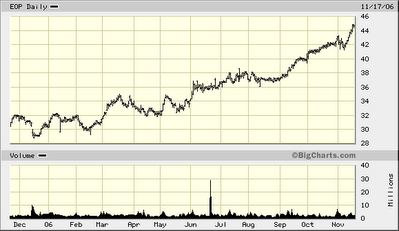
REITS going GAGA ..../ Blackstone to Buy Equity Office for 36 billion$ (incl. debt)

every week a new rekord on the lbo front...... 36 b$ including debt! to buy peak price assets like real estate looks crazy ......no bargain for sure.... but with high leverage everything seem possible..... who will buys those bonds?!
http://immobilienblasen.blogspot.com/search?q=lbo, http://immobilienblasen.blogspot.com/search?q=private+equity

es scheint fast so als wenn jeder woche neue rekorde bei lbo gebrochen werden. für 36 mrd $ auf absoluten spitzenpreislevel immobililien in den usa zu erwerben kann man als tollkühn bezeichnen. mit nem genügend großen finanzierunglevel scheint aber alles zu gehen..... bin gespannt wer diese bonds kaufen wird.....


here is the script from the last conference call from eop
with this quote from the ceo
" it´s a little crazy out there" deals are in the making that makes no sense. (he was right!)
http://immobilienblasen.blogspot.com/2006/10/why-is-this-not-ongoing-business-for.html#links


more on reits
http://immobilienblasen.blogspot.com/search?q=reit

http://tinyurl.com/yey3un (businessweek)
Litt notes, though, that Zell isn't the only veteran real-estate magnate selling out these days, suggesting that insiders believe today's valuations cannot last. REIT stocks are trading at a multiple of future earnings two percentage points higher than the Standard & Poor's 500-stock index today. Historically, they've traded at a seven-point discount. Why quibble with a sure thing? Litt says: "Take the money and run."

commercial real estate
http://immobilienblasen.blogspot.com/search?q=commercial+real+estate


http://tinyurl.com/yx4qjm
Nov. 20 (Bloomberg) -- Blackstone Group LP, manager of the world's largest buyout fund, agreed to acquire billionaire Sam Zell's Equity Office Properties Trust, owner of 580 office buildings, for about $20 billion in the biggest takeover of a real estate company.


Equity Office shareholders will receive $48.50 a share, 8.5 percent more than Friday's closing price, the companies said in a statement yesterday. Including debt, the transaction is worth $36 billion, exceeding this year's $33 billion purchase of hospital chain HCA Inc. to become the biggest leveraged buyout in history.

The acquisition will give Blackstone office space stretching from New York and Washington to Los Angeles as U.S. vacancy rates drop and rents climb to a record. Takeovers of property companies have doubled this year to $189 billion as investors including shareholder activist Carl Icahn and real estate developer Larry Silverstein pursue deals,

``Demand for office space and commercial property in the U.S. has been firm,'' said Hans Kunnen, who helps oversee $70 billion at Colonial First State in Sydney, including property stocks. ``With office properties, you get the rental income and that generates a nice stable yield.'' (really...?)

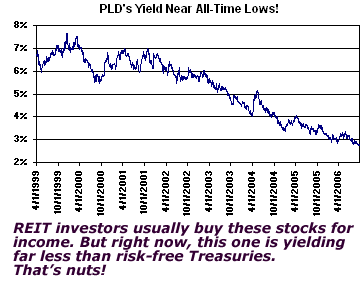
read this story from mike larson about the reits and the yields.
http://www.moneyandmarkets.com/press.asp?rls_id=433&cat_id=6

Blackstone has acquired 10 publicly traded real estate companies in the past two years, including CarrAmerica Realty Corp. and MeriStar Hospitality Corp. The New York-based company, founded by Stephen Schwarzman and Pete Peterson, raised a $5.25 billion fund to make property acquisitions in June.
U.S. office vacancy rates fell in the third quarter to 12.96 percent from 14.13 percent a year earlier, and rents for so- called Class A space in Manhattan rose last month to a record $63.26 per square foot, according to Colliers International. New construction has lagged behind an increase in demand as the economy adds jobs, pushing up rents. .....

Buyout firms more than doubled their acquisitions of property companies to $16.5 billion this year before the Blackstone announcement, Bloomberg data show.

Share Performance
Shares of Equity Office gained 47 percent this year, almost double the advance of the Bloomberg REIT Index.....

.....Equity Office in August said it planned to sell as much as $3.5 billion of real estate by the end of next year to reduce debt. Company spokeswoman Terry Holt said the decision wasn't intended to be part of a broader effort to sell the entire company.


Biggest LBOs
LBO firms including Blackstone, which finance the bulk of their takeovers using the target company's cash flow, have announced $600 billion of acquisitions so far this year, up from $241 billion in 2005, according to Bloomberg data. Total mergers and acquisitions have reached $3.1 trillion this year, surpassing 2000 as the busiest ever.

The biggest LBO to date was the purchase announced in July of HCA, the largest U.S. hospital chain, by Bain Capital LLC, Kohlberg Kravis Roberts & Co., Merrill Lynch & Co. and HCA co- founder Thomas F. Frist Jr. That topped the $31.3 billion that KKR paid in 1989 for RJR Nabisco Inc.

Labels: , ,

Wednesday, November 08, 2006

leverage buy out´s / lbo´s / private equity!

vivendi takeoverbid for 40 b €. no wonder that bondholders get worried......blackstone has collectet 15.6 b$ in june for their latest fund. 50% of this money is already investet!!! with over 200% levergare this is almost 10 b$. in the past it tokk the fund 4 years to screen the markets and find attractive tarkets. now it is the first time ever the funds reopened so that the investores (pension funds etc) can pump 5 b$ more in the fund. kkkr isn´t closing their latest fund at all. when this is not crazy......

this whole topic is very importend . as long as these players are fundet with cash and more importend with massive leverage the markets will/can go gaga for a longer time than some expecting. lets hope that more and more companies will put this kind of "poison" put on their debt/bonds.

vivendi übernahmeangeot über 40 mrd €. kein wunder das da einige anleihebesitzer nervös werden. blackstone hat in seinem letzten fonds im juni satte 15,6 mrd$ eingesammelt. 50% davon sind jetzt bereits investiert. mit einem hebel von über 200% sind das fats 10 mrd$ die in übernahmen gepumpt worden sind. bisher hat die platzierung eines kleineren fonds fast 4 jahre in anspruch genommen. so lange brauchte man um günstige und damit rentierliche anlagen zu finden. jetzt ist es zum ersten mal überhaupt dazzu gekommen das ein fonds wieder geöffnet worden ist damit weiter 5 mrd $ nachgeschossen werden durften. kkkr hat den letzten überhaupt nicht geschlossen. wenn das nicht nach übertreibung/überhitzung riecht.......

dieser punkt ist extrem wichtig. je länger diese spieler mit kohle überschüttet werden und billige finanzierung mit einme immer höheren hebel bekommen desto länger spielen die märkte verrückt. man kann nur hoffen das immer mehr firmen diese giftpille in ihren anleihen und kreditbestimmungen einsetzen.

i´m sure that when the credit market will dry up and some of the highly leveraged companies that have been taken over from private equity have problem the ywill invent something like this.......

ich bin mir sicher das wenn irgendwann die übernommenen firmen dank der hohen schulden in schwierigkeiten kommen sollten wird was neues an finanzinnovation geschaffen .........

more on private equity!

http://immobilienblasen.blogspot.com/2006/10/private-equity-excess-business-week.html
http://immobilienblasen.blogspot.com/2006/10/dangerexplosive-loans-another-credit.html
http://immobilienblasen.blogspot.com/2006/09/shadows-of-debt-economist.html
http://immobilienblasen.blogspot.com/2006/11/singapore-singapur-private-equity.html
http://immobilienblasen.blogspot.com/2006/08/rekordramschanleihe.html (only german)
http://immobilienblasen.blogspot.com/2006/09/private-equity-mania-madness.html (german)

Pimco, Bond Buyers Seek Protection From Kravis, LBOs http://tinyurl.com/yde3uj

Nov. 7 (Bloomberg) -- The world's biggest bondholders are determined to make an example of Henry Kravis.

Pacific Investment Management Co. and Advantus Capital Management, frustrated by the sudden losses caused by leveraged buyouts, are forcing companies to guarantee immediate payment of principal whenever the borrower is acquired by Kohlberg Kravis Roberts & Co., Blackstone Group LP or any of the dozens of LBO firms that have ravaged the corporate bond market.


While this year's five biggest LBOs afflicted bondholders with about $2 billion of losses, relief may be in sight,.... Owens Corning Inc., the maker of pink insulation for homes, and Realogy Corp., the owner of the Coldwell Banker and Century 21 real estate franchises, are among the more than a dozen companies since August that give investors protection from LBOs, which typically increase debt loads and lower credit ratings.

``The risk of re-leveraging is real and investors are trying to protect themselves,''....... ``This is something that's going to be with us for a while.''

Owens Corning, based in Toledo, Ohio, sold $1.2 billion of 10-year notes and 30-year debentures on Oct. 26, with a pledge to pay investors 101 cents on the dollar should the company lose its investment-grade rating in a takeover. ....

Biggest Deal Ever
Any buyer of the company would have to comply with that agreement, known as a ``poison put.'' Private equity firms splurged on a record $465 billion of deals this year,

KKR, Blackstone, Washington-based Carlyle Group, Fort Worth, Texas-based Texas Pacific Group and the rest of the buyout industry have borrowed $166 billion in loans and bonds to finance acquisitions in 2006, leaving 10 targets with lower credit ratings. The debt of companies owned by buyout firms totals 5.4 times their cash flow, the most ever, according to S&P.

HCA Inc.'s $1 billion of 6.5 percent notes due in 2016 have tumbled 13 percent since June, the month before a group led by KKR, Boston-based Bain Capital LLC and New York-based Merrill Lynch & Co. said they would pay $33 billion to acquire the Nashville, Tennessee-based hospital operator.

Decline in Bonds
HCA's debt dropped while the price of securities with the same rating gained on average 3 percent in the same period
, .... Below investment- grade companies pay an average of 3.13 percentage points more in yield than Treasuries, compared with less than 1 percentage point for investment-grade bonds, Merrill Lynch data show.

S&P last month cut its rating on HCA's senior unsecured notes five levels to B- from BB+ because the takeover will be financed with about $23 billion of debt.

Bondholders consider themselves lucky if they manage to avoid securities of companies that get purchased by LBO firms, which typically borrow to pay for about two-thirds of any acquisition. ...

Getting Deals Done
Offering provisions that protect against LBOs may enable some companies to sell bonds they otherwise couldn't,

``If you're in the market doing a deal and your biggest competitor announces an LBO the same day, you're probably going to have to include protection language to get the deal done,'' said Bamford. He said that for other companies it could help save as much as 20 basis points in yield, or 0.2 percentage point.

Before August, just one bond sale for an investment grade- rating contained a such a poison put: a $250 million offering of 5.625 percent notes due in 2015 by Laboratory Corp. of America Holdings,

Increasing Demand
Owens Corning has several traits that are attractive to buyout firms, including a low debt burden, ``significant'' cash flow and an expected investment-grade rating of Baa3, ...

Owens Corning sold $650 million of 6.5 percent notes due in 2016 and $550 million of 7 percent bonds maturing in 2036 to refinance loans. ....

In a typical acquisition, leveraged buyout firms assume the target's existing debt. Because of the poison put, buyout firms seeking to acquire Owens Corning would have to come up with an extra $1.21 billion upfront to pay off the bonds.

``Adding that language to investment-grade names, especially names that have appeared as potential LBO candidates, has certainly increased demand for those issuers,'' ........ ``From a private equity perspective, it could make it more costly.''

Step-Up Coupon
Realogy, the largest residential real estate broker in the U.S., was spun off from Cendant Corp. in July and was a ``prime LBO candidate'' at the time of its bond offering, .....

The Parsippany, New Jersey-based company sold $1.2 billion of bonds in three parts: $500 million of 6.5 percent debentures due in 2016; $450 million of 6.15 percent notes maturing in 2011 and $250 million of three-year securities that pay an interest rate that floats 70 basis points over the London interbank offered rate, a lending benchmark.

Realogy bond investors can sell the debt back at 100 cents on the dollar, if it's taken over and its ratings fall to junk. The securities also contain a step-up coupon, where its interest payments increase by a quarter of a percentage point for each ratings downgrade from Moody's or S&P.

``It's not a generous amount of compensation but it's a relatively benign economic environment,'' said Thomas Houghton, who bought the Realogy bonds for the $2 billion he manages at St. Paul, Minnesota-based Advantus. ``We don't see credit quality falling off a cliff.'' (in the case of real estate relatet realogy i´m not si sure..../wenn es um einen immobiliennahen titel in den sua geht bin ich mir da nicht so sicher...)

Unusual Circumstances
Realogy's bonds are rated Baa2 by Moody's and BBB by S&P. Both ratings companies have ``negative'' outlooks because of a weakening real estate market.

Investment-grade companies haven't been forced to give bondholders much protection in part because defaults fell to a record low of 0.89 percent in September, from an average of 4.61 percent the past 24 years, according to data compiled by S&P.

``Over the long-term, there have been very few times when covenants have been a focus in the investment-grade market,'' said Bamford at Barclays. ``You have to go back to the late '80s and early '90s, post-RJR Nabisco, to find a period when people were this concerned.''

In 1989, New York-based KKR took over RJR Nabisco Inc. for $31.3 billion in what was the biggest buyout until HCA's deal.

Credit Quality
Masco Corp., the maker of Delta faucets and Behr paint, sold $1 billion of 10-year debt on Sept. 28, a week after the Taylor, Michigan-based company lowered its forecast for 2006 profits as a cooling housing market hurt demand for building products.

Investors were granted the right to sell the bonds back to Masco for 101 cents on the dollar if Masco's ownership changes and results in below investment-grade ratings. Its debt is rated Baa1 by Moody's and BBB+ by S&P. ´....

Joy Global Inc., a maker of coal-mining equipment, sold $400 million of notes today to refinance debt and repurchase stock, according to S&P. The Milwaukee-based company's debt is expected to be rated Baa3 by Moody's and BBB- by S&P and contains a poison put at 101 cents on the dollar,

``Companies are now re-leveraging and that re-leveraging of corporate America is going to be happening for the next several years,'' Pimco's Kiesel said. ``You want to be going up in credit quality and staying high in credit quality.''


Wednesday, July 18, 2007

Bell Canada bondholders to sue company over LBO

I think the LBO mania will lead to more bond triggers that allow the bondholder to sell the bond to 100% when a change of ownership will occur or at least will give them a higher coupon when the rating will be cut. This will lead to less leverage and lower takeover prices.

That doesn´t help the current bondholders and i think that they have to blame themselves for their losses and they won´t have a chance to win in front of the courts. Back when they bought the bonds they couldn´t imagine in their wildest dreams what is going on right now and they now have to eat their losses........But the times are changing....as seen in Goldman, JPMorgan Saddled With Debt They Can't Sell the bond guys are already gaining ground....

Ich bin mir ziemlich sicher das der LBO Boom dazu führen wird das sich die Anleihekäufer zukünftig bei einem Eigentümerwechsel Klauseln zusichern lassen das Sie die Bonds im Falle einer Übernehme zu 100% zurückgeben können oder zumindest ein höherer Coupon lockt wenn das Rating gen Süden abschmiert. Das wird dann weniger Hebel und damit zu niedrigeren Übernehmepreisen führen.

Ich vermute das die aktuellen Anleihebesitzer sich diese Dimensionen die aktuell vorherrschen nicht einmal in Ihren "worst case" Träumen ausgemalt haben. Die Konsequenzen sind nun extrem kostspielig und es wird sicher nichts bringen etwaige Rechte vor Gericht einzufordern. Wie im o.g. Link zu sehen beginnt sich das Bild aber langsam wieder zugunsten der Anleihekäufer zu neigen.....
A lawsuit in the making by bondholders of Bell Canada Inc. may mark the start of a revolt by debt owners against leveraged buyouts.

"While equity shareholders appear pleased with the $42.75-a-share price tag, the bondholders have suffered since rumors of a potential takeover first surfaced in late March, with the benchmark 6.1%-coupon 2035 bond down about 23%," the report said.

"More and more bondholders are getting upset over equity-friendly deals," said Michael Gregory, a fixed-income analyst at BMO Nesbitt Burns. "This sort of thing may become more common."

AddThis Feed Button

Labels: , , , ,

Monday, May 21, 2007

No Place to Hide / LBOs Attack Finance Company Bondholders

this sums it up........ dieser satz sagt alles zum aktuellen kaufwahn in sachen lbo´s
They had assumed that companies whose profits depend on investment-grade credit ratings couldn't afford to pile on debt.

think again......

May 22 (Bloomberg) -- Finance company bonds, the fastest- growing part of the corporate debt market, are no longer a haven from leveraged buyouts.
Bondholders were ambushed by last month's $25 billion takeover of SLM Corp., the student loan company known as Sallie Mae. They had assumed that companies whose profits depend on investment-grade credit ratings couldn't afford to pile on debt.

``The LBO risk factor is dramatically underpriced,'' said Greg Habeeb, a senior vice president at Calvert Asset Management Co. in Bethesda, Maryland, who manages $8 billion of bonds. ``We're not rushing to buy anything.''
Bonds sold by finance companies ranging from CIT Group Inc. to American Express Co. lost as much as $5 billion of their value since the Sallie Mae deal was announced on April 16, according to CreditSights Inc., a New York-based fixed-income research firm. The acquisition eliminated the last shelter for investors after $1.11 trillion of debt-fueled takeovers since the start of 2006.

Investors this month demanded an average 86 basis points more in yield than on Treasuries to hold the debt of finance companies, 14 basis points more than before the Sallie Mae buyout and the most since 2003, ....

Finance companies were considered immune to LBOs because they profit from the difference between their borrowing costs and the amount they charge on loans.

The increase in yield premiums is bigger than any other part of the investment-grade debt market...

Hardest Hit
The increase means it costs an extra $1.4 million in annual interest to sell $1 billion of debt. Spreads may widen another 20 to 30 basis points, Habeeb said.....

Sallie Mae's $750 million of 5.45 percent notes due in 2011 tumbled 4 cents on the dollar to 96 cents on April 16 when New York-based private-equity firm J.C. Flowers & Co. said it would buy the largest U.S. provider of student loans, according to Trace, the bond-price reporting system of the NASD. The decline pushed the yield on the notes to 6.5 percent from 5.5 percent.

Biggest Holders
LBOs typically wreck returns for bondholders because buyers borrow about two-thirds of the company's purchase price, causing the value of existing debt and credit ratings to fall. Reston, Virginia-based Sallie Mae's A2 rating was put on watch for downgrade by Moody's, as was its A rating at S&P.....

LBO Sting
``Private equity will always swarm,'' said Kiesel. ``You can't keep the bees out of the tent. We had a hole in the screen and the bees got in, and they stung.''

More investors than ever are being hurt by finance company bonds. The industry represents 40 percent of the $2 trillion of corporate bonds outstanding, up from 20 percent in 1990
Finance companies sold $220 billion of debt through April, up 30 percent from the same period last year. Bond sales by industrial companies fell 3 percent to $65.5 billion, while utilities issued $5.7 billion, a decline of 17 percent, data compiled by Morgan Stanley show. Finance companies are selling about 75 percent of all bonds, the firm says.

`Middle of the Storm'
``Investors were looking for a safe harbor and the irony is that they put themselves in the middle of the storm,'' ....

CIT bond spreads widened 29 basis points in the past year to 99 basis points, according to Trace. The largest independent commercial finance company in the U.S. had $58.3 billion in debt as of March 31. Yield premiums for investment-grade companies have increased 4 basis points.....

New Twist
Yield premiums have increased for all the companies. Those of American Express, the fourth-biggest credit-card issuer, rose 10 basis points on average in the past year to 50 basis points. Spokesman Robert Glick declined to comment.

Financial firms such as Salle Mae can withstand additional leverage and get by with lower credit ratings because of the growth of the market for bonds backed by assets such as loans and other receivables, according to CreditSights.

Merrill's broadest asset-backed index contains $1.2 trillion in bonds, up from $253 billion in 2002. The average rating is AAA, and the yield is 5.74 percent. Companies whose ratings are lowered below investment grade pay an average of about 7.31 percent..

Not all finance companies are vulnerable to LBOs because many don't have assets that can easily be turned into asset- backed bonds, according to Pimco's Kiesel.....


Be `Cautious'
The average credit rating in Merrill's main index for finance bonds is A1, or three levels higher than the Baa1 rating for the firm's broadest index.

Even before the SLM deal investors began to hedge their bets, demanding the finance companies include protection from LBOs in bonds they sell.

The companies sold $12 billion of bonds this year through May 21 with so-called poison puts that allow investors to sell the securities back to the issuer at 101 cents on the dollar if there is a change in control, according to data compiled by Bloomberg. That is up 72 percent from the same period of 2006, and compares with a 60 percent rise for all industries.

Poison puts are ``sort of a quick fix'' for investors as they fret nothing's safe from a buyout, Dill at Moody's said.

Capmark Financial Group Inc., the former commercial mortgage unit of GM, on sold $2.55 billion of notes on May 3 containing a poison put, the most ever by a finance company,

Labels: , , , ,

Monday, March 19, 2007

ubs backing out of lbo madness

ubs is probably the most solid investmentbank out there. they generate close to 50% from their asset management the following report from bloomberg shows that they are willing to take less risk in the "lbo craze" that is going on right now.

bravo ubs. hatte aufgrund der starken position im asset management schon immer das gefühl das ubs die mit abstand solideste investmentbak ist. der nachfolgende bericht unterstreicht dieses und zeigt das die ubs anscheinend nicht gewillt ist jedes risiko (ganz im gegensatz zu goldman und co) einzugehen.


March 19 (Bloomberg) -- UBS AG, Europe's biggest bank by assets, risks falling behind rival investment banks in mergers and acquisitions with the imminent departure of Kenneth Moelis, its top-ranking dealmaker in the Americas.

The company may announce as early as today that Moelis, 48, is leaving as president of UBS Investment Bank, a person with knowledge of his plans said. His resignation would end a six-year effort to get Zurich-based UBS to finance more leveraged buyouts.

``He has succumbed to the ancient Swiss problem of wanting strong independent Americans to manage their investment-banking business but chafing at giving them the authority or resources to do so for fear of losing control,'' ...

UBS Chief Executive Officer Peter Wuffli and Huw Jenkins, head of the investment bank and Moelis's boss, have trailed competitors in lending to buyouts even after ending a financing freeze in Europe in 2004. Moelis helped UBS almost triple its share of U.S. mergers and acquisitions to 16 percent and pressured UBS to become more competitive in LBOs. .....

So far this year, UBS ranks 10th among LBO advisers after participating in 7.7 percent of announced deals by value, according to data compiled by Bloomberg. Goldman, the No. 1 M&A arranger for the past six years, is first, with 62 percent. Citigroup Inc., JPMorgan Chase & Co. and Credit Suisse Group, all commercial banks like UBS, each have more than 42 percent.


UBS didn't win a role in this year's $31 billion buyout of Dallas-based power producer TXU Corp. The purchasing group, led by Kohlberg Kravis Roberts & Co. and Texas Pacific, obtained financing commitments from all five of its financial advisers, Citigroup, Goldman, JPMorgan, Lehman Brothers Holdings Inc. and Morgan Stanley. ( when you read the details you may kow why ubs why ubs didn´t participate.../ wenn ihr euch die details des deals durchlest kann man erahnen warum ubs sich in diesem segment zurückhält http://tinyurl.com/26o44x )


Concern Over Leverage
Jenkins, 49, showed concern in November about the amount of debt employed in leveraged buyouts when he said it was ``reaching something near a top.'' He also ruled out joining competitors such as New York-based Goldman and Merrill Lynch & Co. as an equity investor in LBOs.

Last year, UBS still didn't rank among the top 20 leveraged- loan arrangers in Europe. In the U.S., it was 12th, behind securities firms such as New York-based Lehman and Bear Stearns Cos., Bloomberg data show.

Contrast With Equity
In contrast with equity offerings, where UBS jumped to second place last year from ninth in 2000, the bank's position in global takeovers was unchanged at seventh, Bloomberg data show...

here is the link to the ubs 2006 report
http://www.ubs.com/1/e/about/news.html?newsId=114155

Labels: , ,

Monday, October 01, 2007

Fineprint Citigroup Warning

This story fits perfect with the latest news from the UBS (and more to come probably on a weekly basis...). Make sure you also read this from Minyanville A Look Inside Citigroup's Writedowns & No Kidding.... More Off Balance Sheet Vehicles For Citigroup . A must read!

Das ganze paßt hervorragend zu den heutigen Neuigkeiten die aus der Schweiz von der UBS (und zukünftig auf Wochenbasis von rund um den Globus) kommen. Zudem solltet Ihr Euch das A Look Inside Citigroup's Writedowns via Minyanville & No Kidding.... More Off Balance Sheet Vehicles For Citigroup nicht entgehen lassen.

Quote Prince CEO Citigroup just a few weeks ago The $1 Billion Break Up Fee & An Ignorant And Deaf CEO

Dieses Zitat vom CEO der Citigroup ist gerade einige Wochen alt.......

"When the music stops, in terms of liquidity, things will be complicated. But as long as the music is playing, you’ve got to get up and dance. We’re still dancing".
Not a good sign if the CEO of the world biggest bank need signs like this.......

Kein gutes Zeichen wenn der CEO der weltgrößten Bank anscheinend solch deutliche Hinweisschilder benötigt.....


FT Citi takes big hits across the board: 60 per cent drop in Q3 income That huge loss has been realised from two hits from LBO debt and subprime mortgages. throughout the credit crunch, banks have been quick to point out that they hold few, or no subprime assets. Most casualties so far have thus been victims of contagion. No such luck for Citi.
Instead, there’s just huge amount of LBO debt and subprime mortgage securities stuck on the bank’s balance sheet - making it the most direct casualty of the credit crunch to date. Citi lost $1.4bn on holdings of LBO debts:

Write-downs of approximately $1.4 billion pre-tax, net of underwriting fees, on funded and unfunded highly leveraged finance commitments. These commitments totalled $69 billion at the end of the second quarter, and $57 billion at the end of the third quarter. Write-downs were recorded on all highly leveraged finance commitments where there was value impairment, regardless of the expected funding date.
And Citi are still having difficulty syndicating. As FT Alphaville observed earlier Monday, bank’s are having to brook significant losses on sales where they can make them - so there could be more pain for Citi to come.

As for Citi’s subprime debt, it too is stuck on the bank’s books: “warehoused” for use in future securitizations. Here the bank reports $1.3bn in losses:

Losses of approximately $1.3 billion pre-tax, net of hedges, on the value of sub-prime mortgage-backed securities warehoused for future collateralized debt obligation (”CDO”) securitizations, CDO positions, and leveraged loans warehoused for future collateralized loan obligation (”CLO”) securitizations.
Note that Citi, a touch coy here, hasn’t disclosed the total amount of subprime securities they hold - only the $1.3bn loss on them they’ve realised so far.

But those losses aren’t just coming from toxic debt products. Citi has also lost $600m through their fixed income trading operations because of “market volatility”. And a massive $2.6bn hit has been taken because of an increase in global “credit costs”. The charge was:
Due to continued deterioration in the credit environment, organic portfolio growth, and acquisitions. Approximately one-fourth of the increase in credit costs was due to higher net credit losses and approximately three-fourths was due to higher charges to increase loan loss reserves.
While other banks have been nimble on their feet and hedged their way around big losses, Citi’s results look nothing short of an out and out embarrassment. UBS was quick to direct senior figures towards the job pages and announce changes and cost cutting. Surely heads will also roll at Citi?

We suspect that all that troubling talk of a Citigroup break up to unlock shareholder value could gain ground again - fast.
> Maybe that´s the reason why the stock is up. I have the feeling that there is almost no news bad enough out there to put a positive spin on it. At least i havn´t heard a "Buffet" rumor yet... ;-)
> Wird wohl auch der Grund sein warum die Aktie z.Zt. höher notiert.Es gibt wohl kaum eine Meldung die schlecht genug ist um nicht für einen Spinversuch herhalten zu müssen. Immerhin mußte das letzte Mittel "Buffet" bisher nicht herausgeholt werden..... ;-)

AddThis Feed Button

Labels: , , , , , , ,

Tuesday, July 17, 2007

Goldman, JPMorgan Stuck With Debt They Can't Sell to Investors

Schadenfreude! Almost on a daily basis news are coming out that the "golden era" that Henry Kravis has described just a few month ago is not so golden anymore......

Kann meine Schadenfreude nicht wirklich unterdrücken. Es kommen momentan fast täglich Meldungen das das sog. "goldene Zeitalter" (Zitat Henry Kravis) für Private Equity bereits einige Monate später weniger golden ist.....

July 17 (Bloomberg) -- Goldman Sachs Group Inc., JPMorgan Chase & Co. and the rest of Wall Street are stuck with at least $11 billion of loans and bonds they can't readily sell.

The banks have had to dig into their own pockets to finance parts of at least five leveraged buyouts over the past month because of the worst bear market in high-yield debt in more than two years, data compiled by Bloomberg show.

Bankers, who just a few months ago boasted that demand for high-yield assets was so great that they would have no problem raising debt for a $100 billion LBO, are now paying for their overconfidence. The cost of tying up their own capital may curb earnings and stem the flood of LBOs, which generated a record $8.4 billion in fees during the first half of 2007, according to Brad Hintz, the former chief financial officer at New York-based Lehman Brothers Holdings Inc.
``The private equity firms, being very tough negotiators, are unlikely to let the banks off the hook,'' said Martin Fridson, chief executive officer of high-yield research firm FridsonVision LLC in New York. ``They'll say that's your problem and that's why we're paying you: To take risk.''

As the market began to turn sour last month, Goldman Sachs, Citigroup Inc., Lehman and Wachovia Corp. had to buy $725 million of bonds that Goodlettsville, Tennessee-based Dollar General Corp. was selling to finance Kohlberg Kravis Roberts & Co. purchase of the company for $6.9 billion.

Bonds Tumble
Those bonds are probably worth 94 cents on the dollar, or $43.5 million less than when they were sold on June 28,

Bear Stearns Cos. strategists estimate that about $290 billion of deals still need to get funded, including those of Greenwood Village, Colorado-based credit-card processor First Data Corp. and energy company TXU Corp. of Dallas. ...
>Here are the details from the TXU Deal and i have the feeling that the pricing of the debt could be lots of fun.....

Record Sales
Acquisitions by private equity firms such as New York's KKR and Blackstone Group LP helped push sales of high-yield bonds and loans worldwide up more than 70 percent during the first half of the year to a record $708 billion,

The investment banking fees generated by LBOs in the first half amounted to almost two-thirds of the $12.8 billion paid by LBO firms to Wall Street in 2006, data compiled by Freeman & Co. and Thomson Financial show. In the race to win deals, the five largest U.S. investment banks more than tripled their lending commitments to non-investment grade borrowers during the past year to $174 billion, according to their regulatory filings.

KKR co-founder Henry Kravis in May called it the ``golden era'' of buyouts at a conference in Halifax, Nova Scotia. The extra yield investors demanded to own junk bonds rather than Treasuries shrank to a record low of 2.41 percentage points in June from the peak of more than 10 percentage points in 2002, according to index data from New York-based Merrill Lynch & Co.

No Escape
For loans rated four or five levels below investment grade, the spread over the London interbank offered rate shrank to 2.12 percentage points in February from more than 4 percentage points in 2003. It has since widened to 2.72 percentage points.

Some bankers even speculated that $100 billion LBO was possible, a scenario that is now ``definitely'' off the table,

Just three of the 40 biggest pending LBOs have an escape clause that lets the buyer back out if funding can't be arranged, . A couple of years ago, a majority of deals included a financing contingency, Belin said, based on his research.

Market Cracks
The market for high-yield bonds and junk-rated, or leveraged loans began to crack in June as concerns that LBOs were becoming too risky coincided with a slump in the market for subprime mortgages that caused the near-collapse of two Bear Stearns hedge funds.

Junk bonds lost 1.61 percent last month, the most since March 2005 when General Motors Corp. forecast its biggest quarterly loss since 1992 and the debt lost 2.73 percent, according to Merrill Lynch.

In most deals, investment banks promise to provide loans to the buyer. They then seek other lenders to take pieces of the loans and find buyers for bonds. When buyers vanish, the banks must either buy the bonds themselves or provide a bridge loan to the borrower, tying up capital that would otherwise be used to finance more deals. The banks typically parcel out portions of bridge loans to reduce their risk.

Lending Commitments
Citigroup, the biggest U.S. bank, reported that its securities and banking division recorded an expense of $286 million in the first quarter to increase loan-loss reserves to account for higher commitments to leveraged transactions and an increase in the average length of loans.

Lehman reported on July 10 that its commitments for ``contingent acquisition facilities'' more than doubled in the quarter ended May 31 to $43.9 billion, exceeding its stock market capitalization of $39.1 billion. Lehman said its commitments contain ``flexible pricing features'' that allow it to charge more if market conditions deteriorate.

Goldman Sachs more than doubled its lending commitments to non-investment grade borrowers to $71.5 billion in the year ended May 31.

The biggest concern is ``hung deals,'' where a lender is left holding a large loan to a single borrower, said Azarchs. ``Those traditionally in all the prior credit cycles have caused the greatest amount of grief for the large syndicating banks,'' Azarchs said.

For firms such as KKR or Blackstone, both based in New York, the tighter credit environment may make their acquisitions less profitable and even change the way they go after future targets. Mark Semer, a spokesman for KKR, declined to comment.

``The underwriters are going to be forced to provide bridge loans and it's getting pretty ugly, but Wall Street deserves to get smacked around a little,'' said William Featherston, managing director in high-yield at J. Giordano Securities LLC in Stamford, Connecticut. ``It's been easy for so long.''
Disclosure: short GS, long UBS
AddThis Feed Button

Labels: , , , , , ,

Monday, August 07, 2006

rekordramschanleihe

kkr wrd die in den letzten tagen bekanntgegeben übernahme der halbleiterspart von phillips mit ner junkanleihe über 4,5 mrd€ finanzieren.

das ist bzw. wäre wenn das durchgeht neuer rekord und einmal mehr beweis das der analgenotstand immer noch unerträglich sein muß. zudem zeigen solche dimensionen ganz klar das wohl trotz der kleinen verwerfungen im mai/juni die risikoaversion immer noch extrem gering ist.

lt. der ftd sind seit jahresbeginn fast 20 mrd € an junkpapieren platziert worden. bis jahresende werden weitere 10 mrd € erwartet.

gruß
jan-martin

upadte:

heute im handelblatt steht passend dazu das alleine kkr 47 mrd$ in den letzten 2 wochen investiert hat. alle deals in form von "leverage buyouts" (lbo) wo die firmenübernahmen mittels hoher kreditsummen (entweder bankkredit oder anleihe) gehebelt werden.

dieses jahr hat es bereits lbo in höhe von 290 mrd$ gegeben.

die schuldenaufnahme der per lbo übernommenen europäischen unternehmen ist in q2 im schnitt auf das 5,3 fache des cashflow getsiegen. in 04 lag der schnitt noch bei 4,6.

jmf:

bin mir sicher das die ratios in den usa eher höher liegen. davor lagen diese ratios im übrigen bei ca. 3.

auch hier klar zu erkennen das anlagenotstand herrscht und die ratios trotz der in letzter zeit eher gestiegénen zinsen weiter gen norden gehen und damit immer riskanter werden.

gruß
jan-martin

Wednesday, September 12, 2007

First Data Loans Delayed as KKR, Banks Keep Talking, People Say

It looks like the banks and investors have realised that they have gone too far. We can now take this cover "The trouble with private equity" and the men one step further...... Please click at the label to read more about the private equity mess.

Es sieht ganz so aus als wenn Banken und Investoren endlich realisiert haben das Sie heftigst überzogen haben. Ich denken wie können das Cover von "The trouble with private equity" erweitern und davon ausgehen das er sich jetzt auf dem "Abstieg" befindet.... Wenn Ihr mehr "schmutzige" Details zum Thema Private Equity lesen mächtet klickt bitte auf die Labels am Ende des Posts.

Sept. 12 (Bloomberg) -- Kohlberg Kravis Roberts & Co. may delay the sale of loans to fund its $26 billion buyout of First Data Corp. until at least next week after failing to agree on terms with its bankers, people with knowledge of the talks said.

KKR, the New York-based private-equity firm run by Henry Kravis, and banks led by Credit Suisse Group couldn't agree today on pricing or how much of the debt lenders will try to sell, said the people, who asked not to be identified because the negotiations are private.
As recently as April, buyout legend Henry Kravis proclaimed a "golden age" of private equity
The First Data sale is the biggest to be attempted since rising U.S. mortgage defaults triggered the highest leveraged buyout borrowing costs in four years. It's being watched by bankers and buyout firms as a gauge for how $320 billion in debt committed for pending LBOs may fare. The banks would have to hold the loans and bonds if they can't be sold to investors.

``The pricing environment in the credit markets reflects illiquidity and fear,'' said Peter Plaut, an analyst with Sanno Point Capital Management LLC, a New York-based hedge-fund manager. ``If First Data gets done, it will show a significant vote of confidence.''

KKR has other deals to finance after Greenwood Village, Colorado-based First Data, the largest processor of credit-card payments. The firm and TPG Inc. agreed in February to buy Dallas-based power producer TXU for $32 billion in the largest U.S. buyout. The acquisition, which has been approved by shareholders and regulators, is set to close by the end of December.

> If you read the details from the TXU deal it is no wonder that the banks are having trouble to unload this junk.

> Wenn man sich die Details des TXU Deals durchliest ist es nicht weiter verwunderlich das keiner diese waghalsigen Kredite aufnehmen möchte.

Investors Balk
Demand for LBO debt has evaporated. After buying a record $754 billion of leveraged loans this year, investors are balking at debt without covenants, or restrictions, that give them greater power over a company's finances. More than 50 deals have been abandoned or reworked.

KKR has yet to agree to terms that would give its banks confidence they can sell the loans to investors without making the acquisition potentially less profitable, the people said.

The two sides have discussed various structures, including adding a provision that dictates how much debt First Data can assume relative to earnings, people with knowledge of the negotiations said Sept. 10.

Marketwatch reports First Data LBO may be costly for banks involved
Even if the banks manage to sell all the loans, they will probably have to offer them at a discount to entice investors.

If the First Data loans are sold at 94 cents on the dollar, that would leave the banks with a loss of between three and four cents on the dollar. On a $14 billion loan deal, that translates to a loss of $420 million to $560 million.

Citigroup is particularly exposed to such problems, according to analysts.

Quote Prince CEO Citigroup just a few weeks ago The $1 Billion Break Up Fee & An Ignorant And Deaf CEO

“When the music stops, in terms of liquidity, things will be complicated. But as long as the music is playing, you’ve got to get up and dance. We’re still dancing".

The bank is a lead underwriter on five of the six largest leveraged loan pending, including debt to support the LBOs of BCE Inc. , TXU Corp. and Alltel Corp. according to Banc of America Securities. That's more than $70 billion worth of loans

> But they are not alone.....See this excellent table The Banks Behind The Biggest Buyouts

> Immerhin sind Sie nicht alleine...Hier eine erstklassige Übersicht The Banks Behind The Biggest Buyouts

Citigroup is also lead underwriter on three of the five largest pending high-yield bond deals, worth more than $20 billion, Banc of America Securities noted.

First Data is one of the last so-called covenant-lite deals. These types of loans, which give companies more leeway and creditors less power, have fallen out of favor in recent months.

Over the weekend, KKR agreed to add one covenant to the First Data debt, the Wall Street Journal reported on Tuesday. The company must now maintain a certain ratio of earnings, before interest, depreciation, tax and amortization (EBITDA) to senior debt, the newspaper explained.

However, that's not much of a concession, especially considering the LBO is already highly leveraged, KDP's Lee said.

This is just in from the FT Talks to start on TXU $45bn financing
Negotiations over the terms of the financing package for the $45bn buy-out of TXU, the Texas-based energy group, are set to begin after the purchase by US private equity groups KKR and TPG received final regulatory approval earlier than expected.

The banks funding the TXU takeover - Citigroup, Goldman Sachs, JPMorgan, Lehman Brothers and Morgan Stanley - are expected to push for the inclusion of covenants in $37bn of loan financing and higher interest payments to make the debt more palatable to investors. But the buy-out groups will be reluctant to make any concessions that could hurt returns. The bond portion, worth about $8bn, would be sold after the loans.
AddThis Feed Button

Labels: , , , , , , , , , ,

Wednesday, May 09, 2007

first (small) signs of widening spreads for junk/lbo financing

very small signs that spreads are widening. but when you still can refinance within 2 month to lower the interest it is still no wonder that we see crazy deals on a daily basis....and we have blamed the homeowner for refinancing year after year....the big players can do it on a quarterly basis.....but this will change in the near future.

immerhin minimale anzeichen das sich an der kreditfront etwas verschärft. aber solange man binnen 2 monaten ne neue billigere refinanzierung durchdrücken kann ist es kien wunder das wir tagtäglich neue halsbrecherische deals sehen....wenn ich bedenke das mich die jährlichen refinanzierungen der immobilienbesitzer in den usa gewundert haben.......hier geschieht dieses anscheinend quartalsweise......noch....das wird sich sicher in naher zukunft ändern.


May 9 (Bloomberg) -- The high-yield loans that provided the most favorable terms to Kohlberg Kravis Roberts & Co. and Thomas H. Lee Partners LP as they completed the biggest leveraged buyouts are drying up.

Investors have scaled back such credit to LBOs by about 33 percent since February, according to ratings company Standard & Poor's. Yields on loans to buyout firms and companies considered below investment grade rose to 7.76 percent from 7.47 percent three months ago, S&P estimates.

Lenders who sacrificed safety for higher yields last year are becoming skittish after KKR, TPG Inc., Goldman Sachs Group Inc. and Boston-based Lee led a record $188 billion of takeovers in the first quarter. Not only are investors charging more for the riskiest loans, they're also resisting LBO firms that try to lower payments on existing debt. .....

>chart is for the european high yield market, new tranche at 202 (see discussion at the comments)

> europäischer high yield markt, aktuelle tranche bei 202 (bei interesse bitte unter den kommentaren die diskussion nachlesen)

Borrowing costs jumped to 2.4 percentage points more than the London interbank offered rate, a lending benchmark, from an all-time low of 2.12 percent in February for companies rated four or five levels below investment grade, according to S&P. Loans rated below BBB- by S&P and below Baa3 by Moody's Investors Service are considered ``leveraged.''


Petco Rebuffed
Investors bought $16.6 billion of loans with the fewest restrictions, known as covenant-lite financings, in April, down from a record $25 billion in February. The debt agreements impose no quarterly limits on the amount companies can borrow relative to earnings before interest, taxes, depreciation and amortization.

David Bonderman's Fort Worth, Texas-based TPG and Leonard Green & Partners LP of Los Angeles had to ask investors three times before they agreed in April to lower the interest on $700 million of Petco Animal Supplies Inc. debt. The second-biggest U.S. retailer of pet products borrowed the money to pay for a $1.8 billion LBO in October.

San Diego-based Petco asked lenders to reduce their interest margin to 2 percentage points from 2.75. Investors refused and Petco eventually convinced them to lower the premium to 2.5 percentage points over three-month Libor, according to a creditor who declined to be named because the agreement is private.

>bloomberg calls this rebuffed?!? / wie kann man das als zurückweisung bezeichnen?!?

Tighter Restrictions
In February Nashville, Tennessee-based hospital operator HCA Inc. was able to refinance $12.8 billion of loans used to finance its $33 billion purchase by a group of firms including KKR. HCA persuaded lenders to cut the rates by as much as half a percentage point to 2.25 percentage points over Libor.

Hedge funds and mutual funds said tighter lending conditions were inevitable after the increase in buyouts. Banks led by JPMorgan Chase & Co. of New York, Charlotte, North Carolina-based Bank of America Corp. and New York-based Citigroup Inc. arranged $686.2 billion of leveraged loans last year, almost triple the amount in 2003, data compiled by Bloomberg show.

About two-thirds of the loans are syndicated, or sold, to investors, up from a quarter in 2001, S&P says. More than 250 institutions purchased high-yield loans last year, compared with fewer than 100 in 2002, according to the New York-based ratings company.

Leveraged loans became more popular as corporate defaults dropped and yields on corporate bonds declined. The $25 billion of covenant-lite loans in February compared with a total of $32 billion from 1997 through 2006, according to S&P's LCD.

>and on the other hand bonds with convenants for "change in ownership" are soaring

>auf der anderen seite explodieren anleihen mit schutz vor eigentümerwechsel.

Investors say the turning point came March 12 when Philadelphia-based Aramark Corp., which runs food services at Boston's Fenway Park and New York's Shea Stadium, asked investors to cut rates on about $4.4 billion of loans. A group of firms including Goldman had used the money to buy the company two months earlier.

Aramark Denied
Aramark wanted to cut the interest margin to 1.75 percentage points more than Libor from 2.125 percentage points. Investors declined, agreeing to reduce the borrowing margin to 2 percentage points.

The Bank of England warned about the growth of leveraged loans last month, comparing them to the market for U.S. subprime mortgages that collapsed when the real estate boom cooled. About half the loans made this year worldwide were rated below investment grade, up from 20 percent in 2004, the U.K. central bank said......


Investors in collateralized loan obligations that own as much as two-thirds of the bank debt sold to institutional investors have become more wary. The extra yield over benchmarks on BB rated debt of CLOs, or pools of loans sliced into bonds, has increased to 4.50 percentage points from 3.50 percentage points at the start of the year, according to data compiled by JPMorgan. The firm is the biggest arranger of leveraged loans since 1999.

....the default rate on U.S. leveraged loans fell to a record low of 0.22 percent in April, according to S&P. That compares with a 10-year average of 3.05 percent

>i think moody´s is right this time. the record low´s are unsustainable......

>ich denke dieses mal bekommt moody´s recht und ist evtl. sogar zu konservativ. diese niedrigen ausfallraten sind unmöglich von dauer.

Credit-Default Swaps
The cost to protect $10 million in BBB rated CLOs from default with credit-default swaps has risen to $210,000 a year, from $145,000 in February

Borrowers who sought to refinance or reprice leveraged loans at lower rates are down 75 percent from the first quarter, said analysts at Bank of America, the second-biggest arranger of the debt.


Labels: , , , , , ,

Thursday, August 23, 2007

Not So Smart "In an era of easy money, the pros forgot that the party can't last forever "

What a difference 6 month made..... It was in early February when Business Week ran this cover story It's A Low, Low, Low, Low-Rate World .

Looks like the "Cover Story Indicator" has worked once more.....

Was doch 6 Monate für einen Unterschied ausmachen.....Anfang Februar hat Business Week noch die folgende Titelgeschichte It's A Low, Low, Low, Low-Rate World gebracht.

Es sieht so aus als wenn der "Cover Story Indicator" mal wieder ganze Arbeit geleistet hat.
Not So Smart / In an era of easy money, the pros forgot that the party can't last forever

The boasting and bluster that marked the just-ended era of easy money varied depending on the speaker and his stake in the boom. But the underlying message was consistent: This time it's different. When it came to the hazards associated with borrowing, the old rules no longer applied.

The titans of home loans announced they had perfected software that could spit out interest rates and fee structures for even the least reliable of borrowers. The algorithms, they claimed, couldn't fail. With similar bravado, buyout firms bid up private equity deals, arguing that investors had an insatiable appetite for the increasingly risky and mammoth loans used to fund them. "I don't think it's a bubble," David M. Rubenstein of Carlyle Group told the Financial Times in an interview last December. "I think really what's happening now is that people are beginning to use a different investment technique, and this investment technique, private equity, adds real value."

> This chart from Bespoke shows how well timed the "Low, Low......Rate World" cover was.....

> Dieser Chart von Bespoke zeigt wie gut die Titelgeschichte "Low, Low, ..Rate World" abgepaßt war.

Hedge funds were all too happy to enable the leverage arms race. They, too, borrowed to the max so they could gorge on the debt that financed the housing and buyout booms. "The consumer has to be an idiot to take on those loans," John Devaney, chief executive of United Capital Asset Management, said in May, referring to dicey adjustable-rate mortgages. But since there were plenty of "idiots" out there, and legions of lenders eager to serve them, Devaney and other hedge fund managers eagerly devoured the securities confected by investment banks from batches of dubious home loans. This securitization, the argument went, would spread the risk far beyond banks and mortgage companies. In March, Devaney bragged that mortgage-backed securities were one of his "best-performing investments.

"It didn't work out that way. In June, Devaney's Horizon funds booked a loss of more than 30%, according to Hedge Fund Alert. Shortly after, United Capital suspended redemption requests by investors trying to pull out. Devaney did not return calls for comment.

> maybe he is the guy on the cover.......:-)

> ist wahrscheinlich der Typ auf dem Cover :-)

Making sense of this mess is daunting. One good place to start: the ways various financial players indulged in layer upon layer of leverage, much of it far from transparent. Mortgage lenders threw out common sense underwriting standards. Wall Street sliced and diced the loans, creating the illusion that risk somehow disappeared in the process. Hedge funds then multiplied the leverage by borrowing copiously to buy securities based on the rearranged mortgages. In their version of the game, private equity firms used loads of debt to launch unprecedented buyouts.

bigger / größer

> Looks "contained"´to me....

> Sieht für mich ziemlich "contained" aus......

What some of the smartest guys in each of these fields seemed to forget is that new paradigms can crumble suddenly. Many miscalculated how long the period of easy credit would persist.

Mortgage companies argued their algorithms provided near-perfect precision. "We have a wealth of information we didn't have before," Joe Anderson, then a senior Countrywide executive, said in a 2005 interview with BusinessWeek. "We understand the data and can price that risk."

PRIVATE EQUITY: `A GOLDEN AGE'
As recently as April, buyout legend Henry Kravis proclaimed a "golden age" of private equity. Perhaps he should have called it a golden age of CLOs—collataralized loan obligations.

Like mortgage lenders, the giants of private equity have relied on complicated investment pools to fund their binge. CLOs are cousins of collateralized debt obligations. Managers of the investment pools buy groups of risky, junk-rated loans from banks that have financed buyouts by Kravis and his competitors. The CLOs package the loans, then divide them into risk levels. While the individual loans carry low credit ratings, three-fourths of the securities marketed by CLOs magically boast AAA marks. (That's because some investors give up extra yield in exchange for better protection against losses.)

The financial alchemy has allowed private equity firms to attract a whole new base of investors, including pension funds and insurance companies that never would have bought those risky loans outright. U.S. CLOs raised $100 billion in 2006, quadruple the amount two years earlier.

Buyout firms have generally fronted 30% of the equity in recent deals, vs. just 15% two decades ago. But that doesn't mean firms have been more cautious. Steeled by the seemingly insatiable demand for CLOs, they became bolder and bolder in the deals they pursued. After Kohlberg Kravis Roberts & Co. and Texas Pacific Group's $44 billion bid for Texas energy giantTXU in February, analysts began putting odds on imagined future megabillion-dollar targets like Home Depot Inc. (HD )

As private equity firms bid up the prices for ever-larger LBOs, the transactions began getting riskier. A key measure of leverage, a company's total debt divided by operating earnings, skyrocketed from 4.7 in 2004 to 7.0 in the second quarter of 2007, according to Standard & Poor's (MHP ) LCD. Meanwhile, the ability of companies to cover the interest payments of that debt dropped sharply; the ratio of profits to interest fell from 3.4 to 1.8 in that period.

> It is getting worse if you consider that profit margins are close to record highs and the economy is now tanking.... So there is almost no room for error.....

> Das ganze wird noch dramtischer wenn man berücksichtigt das die Firmen momentan noch Gewinnmargen nahe der historischen Hochs haben und die Wirtscahft sich gleichzeitig abschwächt bzw. wie in den USA sogar abschmiert.... Nicht viel Raum für Fehler......

At the same time, loan terms got looser. For example, in the buyouts of Freescale Semiconductor and retailer Claire's Stores (CLE ), LBO firms peddled bonds that allowed the companies to postpone interest payments until the bonds matured—a previously unheard of feature. Such stipulations applied to 10% of all junk bonds sold in 2007, vs. virtually none 18 months earlier, according to Lehman.

The red-hot demand for even the junkiest of loans allowed many firms to delude themselves into thinking they could endlessly pursue deals. In the three months through July 31, firms announced $254 billion in buyouts, as much as in 2004 and 2005 combined, according to Thomson Financial (TOC ). One credit crunch later, the market for LBO financing has evaporated. Investors won't buy the loans at current prices, leaving banks on the hook for $300 billion in loans to buyout artists.

So far, no big deals have collapsed. The hope is that the credit environment will improve in the fall, and stalled deals will move through the LBO pipeline. But there may be more pain ahead.
HEDGE FUNDS: STEALTH DEBT
Hedge funds helped power the mortgage and buyout booms by hungrily consuming securitized subprime debt and loans used to fund buyouts. By borrowing much of the money they invest, in some transactions up to 90%, hedge funds add another potentially dangerous layer of indebtedness to already highly leveraged markets. Because hedge fund disclosure is limited, huge pockets of leverage are barely visible. This stealth debt helped cause the problems in the subprime market to spread far beyond the housing sector.

One example: the hundreds of billions of dollars in so-called repurchase lines of credit, or repo loans, that Wall Street banks have lent to hedge funds. Disclosure of these esoteric agreements is murky at best, so their precise value can't be quantified. Another tool that pumps up leverage by untold billions is the total return swap. These arrangements allow a hedge fund to capture the gains of a security without having to buy it outright and with only limited collateral.

For some funds, extreme leverage became an acute problem when the mortgage crunch caused banks to doubt the value of the subprime bonds and CDOs the funds held. Banks pulled their lines of credit, forcing funds to come up with the full value of those assets. That caused dire consequences because, in some instances, the funds paid as little as 10 cents on the dollar and now had to come up with the remaining 90 cents. Many funds, including ones from Goldman, Sachs & Co. (GS ) and Renaissance Technologies, were forced to sell better-performing bonds, stocks, and commodities to pay back nervous bankers. ....

Related links from Business Week to the cover story

Main Street Is Fed Up

Bruce Wasserstein: "Expect Lots More Embarrassment"

It's Out Of Bernanke's Reach


AddThis Feed Button

Labels: , , , , , , , , , , , , , , , ,