Saturday, November 18, 2006

Derivatives Trading Soars to $370 Trillion / buffets "weapon of mass destruction"

as is wrote before. i´m waiting for the first real stresstest. i think that the derivatives are like buffet said "financial weapons of mass destruction". watch this stat and i have problems with the generall thinking that the counterpart always pays for the (false) "security"

.....wie ich schon vorher beschrieben habe warte ich auf den ersten realen stresstst. ich teile die meinung von buffet das es sich hier um "massenvernichtungswaffen" handelt. guckt euch die folgende statistik an und fragt euch ob sichergestellt ist das in panikzeiten diese versicherung nicht ne leere versprechung ist.(weil z.b. der hedgefonds untergeht).

Here we learn that hedge funds account for 32 percent of credit-default swap sellers and 28 percent of buyers, up from 15 percent and 16 percent in 2004, according to a British Bankers' Association report last month


it is also scray that the derivates exceeds often the amount of underlying assets like gold, stocks, bonds etc.


Credit-default swaps also are used by money managers as a cheaper and quicker alternative to buying and selling bonds. When Delphi Corp. filed for bankruptcy on Oct. 8, there were $20 billion of credit-default swaps related to its $2 billion of bonds (10xlarger!)


more on derivatives/derivaten

http://immobilienblasen.blogspot.com/2006/09/shadows-of-debt-economist.html
http://immobilienblasen.blogspot.com/search?q=creditinnovation
http://immobilienblasen.blogspot.com/2006/08/credit-default-swap-chaos.html
http://immobilienblasen.blogspot.com/search?q=hedgefunds+derivatives

dank an mish und sein http://www.markettradersforum.com/forum1/

http://tinyurl.com/yctych
Nov. 17 (Bloomberg) -- The use of derivatives grew at the fastest pace in eight years during the first half of 2006, boosting earnings at securities firms and reducing costs for investors.

The face value of derivatives based on corporate bonds, currencies, interest rates, commodities and stocks jumped 24 percent to $370 trillion, according to the Bank for International Settlements. It was the biggest percentage rise since the bank began keeping records in 1998.

Trading in credit-default swaps, the fastest-growing derivatives market, helped spur record earnings for banks including New York-based Morgan Stanley and Goldman Sachs Group Inc. At London-based Barclays Capital derivatives accounted for more than 60 percent of revenue and profit, Chief Executive Officer Bob Diamond said in May. http://immobilienblasen.blogspot.com/search?q=hedgefunds+derivatives

``The pace of growth is going to have continued unabated in the second half of the year,'' ....

The amount of outstanding credit-default swap contracts jumped to $20.3 trillion from $13.9 trillion at the end of last year, ....... The securities are financial instruments based on bonds and loans that are used to bet on an increase or decrease in indebtedness.

Investors who buy the contracts are paid the face value of the underlying debt in exchange for the defaulted notes should the company fail to adhere to debt agreements. A decline in the cost of the contracts indicates an improvement in the perception of credit quality; an increase signals deterioration.

Contracts Cheaper
Banks and hedge funds say it's cheaper and easier to use the contracts than buying or selling the underlying securities
. ....

Within the credit derivatives market, trading on indexes based on groups of companies soared as much as 86 percent, the report said.

``Greater standardization, deeper liquidity and more efficient pricing'' is helping to boost trading, said Sunil Hirani, chief executive officer of New York-based Creditex Group Inc., one of the brokers that matches buyers and sellers in the market. ``The number of participants will continue to grow.''

Greenspan Comments
Alan Greenspan, the former chairman of the Federal Reserve, has been saying since 2002 that derivatives reduce risks by making financial markets resilient to shocks. In May he told a Bond Market Association gathering in New York that derivatives are the most significant change on Wall Street ``in decades.'' make sure you read the other insights from alan g! (about housing, hedge funds, savingsrate etc..) and you know why i´m with buffet......
http://immobilienblasen.blogspot.com/search?q=interview+alan+greenspan


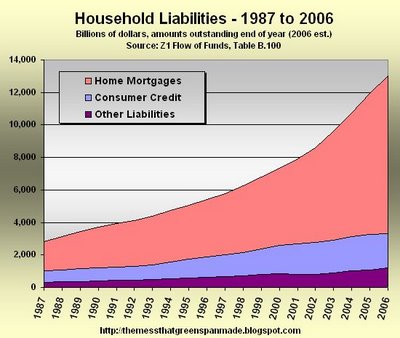
picture: thank to tim http://themessthatgreenspanmade.blogspot.com/

The rapid growth of derivatives is also raising concerns that their ease of use may lead to market abuse such as insider trading related to leveraged buyouts, after unusual price changes occurred prior to the announcement of takeovers in the U.S.

.....Trading in derivatives overall grew 24 percent in the first six months, compared with 5 percent in the second half of 2005, the BIS said.

Interest-rate swaps, which make up 70 percent of the derivatives market, rose the most in Europe, growing 27 percent in the first half compared with 18 percent in the U.S., the report said.

The outstanding amounts of derivatives (All numbers in $trillion).
End-June 2005 End-Dec 2005 End-June 2006
Interest rates 204.7 211.97 262.3
Credit 10.2 13.9 20.3
Equity 4.5 5.7 6.7
Commodities 2.9 5.4 6.4
Foreign Exchange 31 31.3 38.1
Unallocated 27.9 29.1 36

make sure oyu read the credit bubble bulletin from the great doug noland http://tinyurl.com/wymb6

scroll down to the last part Derivatives “Insurance”:

Labels: , ,

Tuesday, September 19, 2006

interview with alan greenspan

alan greenspan. meister aller bubbles. wenn dieser mann davon spricht das es für die fed keine möglichkeiten gibt bubbles zu erkennen (die man zudem selber geschaffen hat ) dann muß man diesem mann einfach zuhören und glauben......


Breakfast with Al http://www.page88.co.za/cr/greenspanbreakfast.shtml

On the US housing market

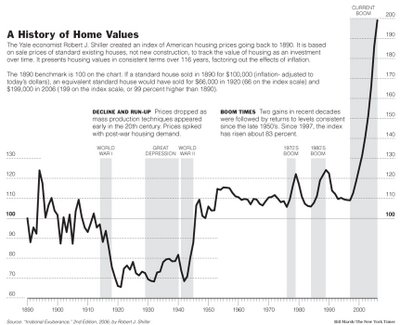
AG: I have never seen anything like the current US housing cycle before. Turnover used to be relatively stable but from about ten years ago turnover began to accelerate. It began to drive the whole asset price structure upwards. (du hast den bubble erst möglich gemacht, you pushed it!)

nur zur erinnerung. alan greenspan hat im juni 2005 "froth/schaum" im immosektor gesehen. just to remember, greenspan saw some "froth" in june 2005.

We now have a slowing down of that whole acceleration process. The level of mortgage rates is not really an issue, even now. (sicher/ sure)

However affordability has been squeezed because of the rise in property prices. We have not yet seen any decline in US house prices. It is hard to believe that we won't but Australian and UK experience suggests that the adjustment process might not be all that difficult.
watch this from australia / ein paar beispiel aus "down under"

http://immobilienblasen.blogspot.com/2006/08/trouble-in-down-under.html, http://immobilienblasen.blogspot.com/2006/09/down-under-gb-bubble-world-tour.html

das sieht für mich eher nach freefall und crash aus.

On China's capital markets and currency

AG: It's very evident dealing with regulators and the central bank in China that there is a cadre of very capable people who really understand how markets work in a way that is remarkable given that they were educated in a Marxist system. My impression is that reforms are moving forward however (interest) rates still can't move as rapidly as they should. (kommt vom richtigen..../ says the right guy....)

The PBOC is sterilising its intervention but it is only being partially successful and currency intervention is contributing to rapid growth in its monetary base. The potential threat to stability that this implies is large. China's economy is evolving rapidly and it needs flexibility in its financial and currency markets that it does not yet have.

On gold and commodity prices

AG: First of all separate gold from base metals. Base metals are going through a fairly broad inventory accumulation globally. This is the classic driver of industrial resource prices. It is likely to start to change because the inventory cycle is starting to change.

The gold price reflects something different. Gold is the ultimate means of payment in a fiat currency world. Gold is always acceptable. Its price is therefore driven by perceptions of geopolitical risk and it only needs a few people to move the price. This is the same factor that is driving the oil price. In other words the gold price has not been a measure of inflation risk. But it is a good representation of the tail of the curve of expectations of those people that are nervous about the future of the financial system

On negative US savings

AG: We have an interesting dichotomy in the US. If you ask individual households they say that they are saving enough. They point to the capital gains on their investment plans and their 401ks and in fact if you add the value of these capital gains to current income you do end up with decent savings. (wenn dir ein ergebnis nicht gefällt ändere einfach die parameter. diese statistik in eine der wenigen die in den letzten jahren nicht verwässert worden ist und zeigt egal wie man das drehen möchte neinen einbruch/when you can´t deal with the outcome change the statistic)http://immobilienblasen.blogspot.com/2006/08/zeit-fr-ne-neue-inflationsberechnung.html, http://immobilienblasen.blogspot.com/2006/08/statistikvoodoo-von-california.html

But the problem is that capital gains can't finance new capital investment. The accumulation of new assets can only be financed from saving out of current income. And the liability side of households' balance sheets is now increasing faster than the asset side in book value terms. The removal of equity from property has the effect of reducing the book value of household savings rates but is not seen as damaging by households. The issue is therefore going to relate to how quickly home equity extraction will slow as housing capital gains dwindle. There will then be a rising in saving out of current income and necessarily a fall in the growth of consumption. To date consumption is holding up better than I expected. (nicht mehr lange / this is going to change very soon)

On hedge funds

AG: The combination of hedge funds and private equity finance has been a huge innovation in finance. Also everyone now uses the hedge fund investment procedure to identifying niches. These can only exist where there are pricing inefficiencies. So the hedge fund mentality has eliminated these efficiencies. And increasing market efficiency increases flexibility. Hedge funds are the way of the future. (niches? i call it systematik risk! all chase the same assets and are more and more leveraged ) siehe hedge fonds blow uphttp://immobilienblasen.blogspot.com/2006/09/was-sind-schon-5billionen-verlust.html

Having said that, the number of junior partners that have left investment banking to go into hedge funds has created a surplus. And the law of supply and demand mean that when there is a surplus the price goes down.

jan-martin