One curious absence in this legislation is the lack of any commentary regarding “debt masking” – that is, using repo transactions to reduce balance sheet at quarter-end in order to report lower leverage.
Given all the (bad) press repo has received lately, we thought there would be more explicit language in the bill regarding such activity.
This is a perfect follow up on Eric Sprott Still Makes A Lot Of Sense...... ( !!! ) and shows that if you would eliminate the "Enron-Esque Accounting" probably 90% percent of all sovereign ratings are more than a little bit inflated...... UPDATE: Timing of the post could have been worse..... See end of the post.....
Die perfekte Ergänzung zu Eric Sprott Still Makes A Lot Of Sense...... ( !!! )die eindrucksvoll aufzeigt das wenn man die "Enron-Esque Bilanzierung" miteinbeziehen würde wohl knapp 90% aller Staatsratings zum Teil erheblich "inflationiert" sind..... UPDATE: Timing des Postings hätte schlechter sein können... Siehe Ende des Postings....
The rating agencies’ ranking of the United States is even more disconnected from reality. To believe that the US sets the benchmark for sovereign debt credit ratings is preposterous.
While we have written ad nauseam about the excessive debt issuance by the United States, we found a recent update written by United States Government Accountability Office (GAO) to be particularly instructive. The update noted the US’s budget deficit equivalent to 9.9% of GDP in 2009 - the largest since 1945 - and stated that without significant policy changes the US government would soon face an "unsustainable growth in debt". This was not news to us.
It goes on to state, however, that using reasonable assumptions, "roughly 93 cents of every dollar of federal revenue will be spent on the major entitlement programs and net interest costs by 2020." This is news!
In less than ten years, using reasonable assumptions, there will essentially be no money left to run the US government - 93% of all tax revenues the US government collects will go to pay social security, Medicare, Medicaid and the interest costs on their national debt.
This implies no money left over for defense, homeland security, welfare, unemployment benefits, education or anything else we associate with the normal business of government. And the US government is rated AAA!?
In our view it’s time for investors to acknowledge sovereign risk. The ratings agencies can opine all they want, but it seems clear to us that the only true AAA asset to protect your wealth is gold. The risk inherent to investors, of course, is what happens when the bond market begins to realize and react to this new level of risk.
The bond vigilantes who punished governments for profligate spending in past years have gone into hiding.
Sovereign bonds yield an average 2.385 percent, about the same as a year ago and below the average of 3.08 percent in 2008 when the credit market seizure led investors to seek the safety of government debt, according to Bank of America Merrill Lynch index data.
The cost to borrow is steady even though the amount of bonds in the index that includes nations from the U.S. to Germany and Japan has grown to $17.4 trillion from $13.4 trillion two years ago.
SUPERB RISK/REWARD........ ;-) Scheint mir ein ausgewogenes Chance/Risikoprofil zu sein..... ;-)
We are trapped in some horrendous Keynesian/monetarist nightmare, where policymakers, aided/abetted/advised by their buddies in the media, in the lobbyist cabal and in financial system, have YET AGAIN decided to go down the route which merely delays the problem/pushes it down the road, but which virtually guarantees that when the NEXT bubble collapses (I assume it will be the Global Government Debt/Bond Bubble and/or the Global Fiat Money/Paper Money/FX Bubble), there is NO pleasant way back.
"In order to pay the interest and the bill when it comes due, we'll simply have to issue more IOUs. That, to me, is Ponzi-like," Gross said. "It's a game that can never be finished."
Read this twice... Bill "The Bond King" Gross from PIMCO is hinting the obvious.....Glad that i didn´t have to bring PONZI into the mix myself....... All this should make all the "GOLD BUBBLE TALK" even more "credible.... ;-)
Das letzte Zitat von Bill "The Bond King" Gross, der ja mittels PIMCO bekanntlich der weltweit größte Investor in Anleihen ist, sollte zur Sicherheit lieber zweimal gelesen lesen werden........Bin dankbar das ich PONZI nicht selber ins Spiel bringen mußte.....Dieser "grundsoliden" Fundamentaldaten geben speziell all denen die noch immer nicht genug von der "GOLDBLASE" bekommen können sicher noch mehr "Nahrung"... ;-) "GOLD BUBBLE CHART" ;-) from Todd Harrison / Minyanville via Pragmatic Capitalist
In dem Link sind noch etliche andere unangenehme Weisheiten speziell im Hinblick auf Griechenland. Empfehle daher sich die kompletten Links etwas genauer durchzulesen sowie den kostenlosen Sprott Asset Management Newsletter zu abonnieren....Kein Wunder das "vorsorglich" der IMF die Mittel zur "Stabilisierung" der Sorgenkinder mal eben still und heimlich auf 500 Mrd $ verzehnfacht hat ( kein Tipfehler )....
"The Unhappiness Of The Seller Does Not Mean That There Is No Market."
As always superb "Anti Spin" from Hussman.....Long read but with all markets at new highs & on a global scale well over 1 trillion in taxpayer money for the still ongoing bailouts , QE, ZIPR etc it is more important than ever to ask what happened to "the toxic assets" ..... Hussman focusses mainly on US mortgages but i think it is safe to say that similar things are true globally when it comes to CRE, corporate loans etc... Fits nicely to Fridays post "Surprise, Surprise....." Big Banks Mask Risk Levels - Quarter-End Loan Figures Sit 42% Below Peak .....I have to repeat myself when it comes to the ÜBERBULLISH Cramer´s Bull Case For Banks
"Would at least be honest if he mentioned the "ultimate moral hazard trade" & the "Enron-esque characteristics" when it comes to accounting as the two main reasons behind the motives to own banks.. ;-)"
Dringend benötigter "Anti Spin" vom gewohnt erstklassigen John Hussman....Recht ausführliche aber im Angesicht der neuen Markthochs aber unbedingt lesenswerte Ausführungen wenn es um das von einigen bereits als "gelöst" bzw. verdrängt geltende Problem der "Toxic Assets" geht....Schon erstaunlich ( einige würden auch sagen schockierend...) was weltweit gesehen wohl locker über 1 Billion an Steuergeldern die noch immer weiter fliessen ( siehe "The Rolling Bailout Bus" ) , QE, ZIRP usw bisher beim Kernproblem der Krise bewirkt haben.....Obwohl Hussman hier in erster Linie Hypotheken abhandelt ist es sicher keine Übertreibung zu behaupten das weltweit ähnliches auch für gewerbliche genutzte Immobilien sowie Firmenkredite gilt....Wie gemacht als perfekte Ergänzung zum letzten Posting "Surprise, Surprise....." Big Banks Mask Risk Levels - Quarter-End Loan Figures Sit 42% Below Peak ......Muß mich leider erneut wiederholen wenn es um zunehmend bullische Bankempfehlungen ( für ein besonders krasses Beispiel siehe Cramer´s Bull Case For Banks ) und damit indirekt auch für den Gesamtmarkt geht.....
"Wäre zumindest ehrlich gewesen wenn er in seinen 10 Gründen die unbedingt dafür sprechen sofort massiv Bankaktien zu kaufen den "ultimativen Moral Hazard Trade" sowie die kreative Bilanzierung die stark "Enron-esque characteristics" aufweist als die Topgründe aufführen würde.... ;-)"
With regard to credit conditions, the U.S. financial system continues to pursue a strategy of "extend and pretend." A year ago, the Financial Accounting Standards Board (FASB) suspended rule 157, which had previously required banks to mark their assets to market value when preparing balance sheet reports. The basic argument was that fair values were not appropriate because there was "no market" for troubled assets. Certainly, the FASB could have implemented something at least modestly reasonable, such as 2-year or 3-year averaging, but instead, they changed the rules to allow "substantial discretion" in the valuation of bank assets in their financial reports.
To a large degree, the idea that there was "no market" for troubled assets was false even at the time. Last year, Dean Baker of the well-regarded Center for Economic Policy Research (CEPR) testified before Congress, observing "There has been considerable confusion about the nature of the troubled assets held by the banks. While banks do hold some amount of mortgage-backed securities, these securities are in fact a relatively small portion of their troubled assets. The troubled assets on the banks' books are overwhelmingly mortgages, both first and second or other junior liens, not mortgage-backed securities. The FDIC has acquired large quantities of mortgages from its takeover of several dozen failed banks over the last year. It auctions these assets off on an ongoing basis. The results of these auctions are available on the FDIC website. Non-performing mortgages typically sell in these auctions at prices in the vicinity of 30 cents on the dollar."
He continued, "It is not clear on what basis these auctions can be said not to constitute a market. While the downturn and the constricted credit conditions affect the market, it is simply inaccurate to claim that there is no market for these assets. The major banks are undoubtedly not pleased at the prospect of having to sell off their loans at these prices, but this merely indicates that they are unhappy with the market outcome, just as a homeowner might be unwilling to sell her house at a loss. However, the unhappiness of the seller does not mean that there is no market."
The impact of "extend and pretend" is to create a gap between the reported value of assets and the value they would have on the basis of the cash flows that those assets can reasonably be expected to generate over their maturity. In order to avoid having to restate assets, banks have allowed an increasing gap to develop between the volume of delinquent loans and the volume of loans actually in foreclosure, creating a growing "shadow inventory" of impaired but unmodified and unforeclosed loans.
Moreover, regulatory changes over the past year have affected what actually gets reported as "troubled." As the New York Times recently observed, " A bank owed, say, $4 million on a property now worth $3 million would previously have had to classify the entire loan as troubled. Now it can do that to the $1 million difference only." In effect, even though impaired loans tend to sell at only 30-50 cents on the dollar (reflecting a modest haircut to the amount typically received in foreclosure), banks can choose the amount of assets it reports as troubled simply by choosing what value to assign the property while it holds the bad loan on its books.
While it's interesting that credit card delinquencies have eased off modestly in recent months, this is not necessarily a healthy sign. Even in the third quarter of 2009, TransUnion reported that consumers delinquent on their mortgages but current on their credit cards increased by 6.6%. In effect, people have been choosing to pay their credit cards in priority to their mortgages.
As for policy efforts to reduce delinquencies, I've long argued that it is a bad idea for policy makers to announce delinquency prevention plans that have, as their centerpiece, publicly subsidized reductions in mortgage principal. It's one thing to extend the loan in a way that preserves its present value, by swapping a claim on future appreciation in return for principal reduction, but it's quite another to offer to cut the principal outright. The reason ist that instead of confining the assistance to presently troubled borrowers, you create a whole new set of borrowers who then choose to be troubled in order to get the assistance. According to a University of Chicago study, "strategic defaults" - where people choose to default on their mortgages even though they can afford to pay - accounted for 35% of all residential defaults in December 2009, up from 23% in March 2009. Offering public subsidies for this behavior, when too many homeowners are already legitimately struggling, does not smack of a bright idea.
The New York Times recently provided a good picture of how the delinquency situation stood at the end of 2009 (based on FDIC data):
In short, my impression is that investors are deluding themselves about the solvency of the banking system. People learned in the 1930's that when you don't require the reported value of assets to have a clear and tangible link to the value that the assets would have in liquidation, bad things happen. Yet this is what regulatory and accounting rules are allowing for the banking system at present. While I do believe that bank depositors are safe to the extent of FDIC guarantees, my impression is that the banking system is still quietly insolvent.
Will it work? Will it change?
Regardless of whether the U.S. banking system would not presently be able to meet its liabilities with its assets, there is another question: assuming that banks are allowed to extend and pretend for a long enough period of time, will they ultimately be able to accumulate enough retained earnings in the years ahead to cover eventual loan losses? In other words, is it possible that everything will be OK if we just look the other way long enough?
From my perspective, it depends on what "OK" means. Simply in terms of long-term solvency - assets being ultimately able to meet liabilities - my impression is that yes, given enough time, retained bank earnings should cover the losses on existing loans. Indeed, it's possible that banks might be able to report fairly healthy "operating earnings" to investors, and then somewhat more quietly write off losses as "extraordinary" charges over a period of years. This type of outcome is beginning to look possible, because investors evidently don't mind repeatedly having their pockets picked as long as "operating earnings" come in above analyst estimates.
Unfortunately, in that sort of world, the economy would likely be hobbled for a long period of time, as Japan has discovered over the past couple of decades. With banks focused primarily on survival and recapitalization, retained earnings would be directed to making the existing liabilities whole, rather than contributing to productive new investment.
So to the extent that "extend and pretend" is successful in averting insolvency concerns, it will also tend to weigh down lending activity, as resources are allocated toward servicing existing debt burdens on bad assets, rather than toward new lending for productive activity. The most efficient outcome is always for lenders who provide capital to take losses if the loans go bad. That sort of market discipline is the only way to ensure that capital gets allocated properly. This is not the world that we have lived in over the past year, as policy makers have pledged public money to make private bank bondholders whole, regardless of how irresponsibly the banks allocated the money. But it is important to recognize that this policy comes with longer term costs.
Needless to say that i think he is spot on....... It will be interesting to see how Mr. Market will react to the quality of ( bank ) earnings / balance sheets during the reporting season.....This could be at least a possible trigger to calm down the "somewhat elevated" risk appetite significantly.....
Überflüssig zu erwähnen das ich zu 100% übereinstimme..... Es wird spannend zu beobachten inwieweit in der jetzt startenden Berichtssaison die Gewinn und Bilanzqualität der Banken hinterfragt wird.... Sehe hier durchaus erhebliches Potential den "leicht erhöhten" Risikoappetit doch merklich zu zügeln.....
April 12 (Bloomberg) -- Bank of America Corp., JPMorgan Chase & Co. and Wells Fargo & Co. may have to set aside an additional $30 billion to cover possible losses on home-equity loans, an amount almost equal to analysts’ estimates of profit at the three banks this year.
I happen to agree with John Hussman on all points mentioned. Moreover, it is not just the U.S. banking system that is insolvent, the global banking system is nothing but a giant extend and pretend operation including the PIIGS (Portugal, Ireland, Italy, Greece, Spain), China, the UK, and even Canada as soon Canada's gigantic housing bubble crashes.
The issue is that in order for banks to include DTAs in their Tier 1 capital, they need to be able to show regulators that they will generate enough income in the future to actually use them.
Citigroup, for instance, has been racking up enough losses in recent years to generate $47bn worth of DTAs at the end of 2009, about $21bn of which was included in their Tier 1 capital that year. So that’s $21bn coming out of years of losses, but based on the premise that the bank will soon be profitable.
They will find a "creative" way to reassure their future profibility..... The Treasury wants to sell a 7.7 billion shares within the next year... ;-)
Bin mir sicher das hier ein kreativer Weg gefunden wird um die zukünftige Profitabilität zu gewährleisten...Immerhin will das Finanzministerium noch 7,7 Mrd Aktien binnen 12 Monaten auf den Markt schmeissen ;-)
Even now, a year and a half after Lehman’s collapse, major banks still undertake such transactions with businesses whose names, like Hudson Castle’s, are rarely mentioned outside of footnotes in financial statements, if at all.
Most of the arguments could be made only by banks who have been drinking their own kool-aid for so long that they no longer have any idea what sounds ridiculous and what doesn’t.
"Surprise, Surprise....." Big Banks Mask Risk Levels - Quarter-End Loan Figures Sit 42% Below Peak
At least one has to conclude / "admire" that they have "CHUZPAH"....... Just one more reason for Cramer´s Bull Case For Banks ... You really need a good dose of "humor" & GOLD to stay calm these days....;-)
Vor soviel "CHUZPAH" muß man ehrlich den Hut ziehen....... Ein Grund mehr für Cramer´s Bull Case For Banks.... Heutzutage muß man schon ein sehr "humorvoller" Zeitgenosse & "GOLD-BUG" sein um den tagtäglichen "Wahnsinn"nicht nur kopfschüttelnd zu erleben..... ;-)
Quarter-End Loan Figures Sit 42% Below Peak, Then Rise as New Period Progresses; SEC Review
Major banks have masked their risk levels in the past five quarters by temporarily lowering their debt just before reporting it to the public, according to data from the Federal Reserve Bank of New York.
A group of 18 banks—which includes Goldman Sachs Group Inc., Morgan Stanley, J.P. Morgan Chase & Co., Bank of America Corp. and Citigroup Inc.—understated the debt levels used to fund securities trades by lowering them an average of 42% at the end of each of the past five quarterly periods, the data show. The banks,which publicly release debt data each quarter, then boosted the debt levels in the middle of successive quarters.
The data highlight the banks' levels of short-term financing in the repurchase, or "repo," market. Financial firms use cash from the loans to buy securities, then use the purchased securities as collateral for other loans, and buy more securities. The loans boost the firms' trading power, or "leverage," allowing them to make big trades without putting up big money. This amplifies gains—and losses, which were disastrous in 2008.
According to the data, the banks' outstanding net repo borrowings at the end of each of the past five quarters were on average 42% below their peak in net borrowings in the same quarters. Though the repo market represents just a slice of banks' overall activities, it provides a window into the risks that financial institutions take to trade.
The SEC now is seeking detailed information from nearly two dozen large financial firms about repos, signaling that the agency is looking for accounting techniques that could hide a firm's risk-taking.The SEC's inquiry follows recent disclosures that Lehman used repos to mask some $50 billion in debt before it collapsed in 2008.
The practice of reducing quarter-end repo borrowings has occurred periodically for years, according to the data, which go back to 2001, but never as consistently as in 2009.
The repo market played a role in recent accusations leveled by an examiner in Lehman's bankruptcy case. But rather than reducing quarter-end debt, Lehman took steps to hide it.
The graphic representation of the Primary Dealer holdings of net assets shown as a Lo-High range during any given quarter, together with the closing net assets (presented by the red dot), is shown on the chart below.
We are confident that armed with this data, the SEC will be able to provide a prompt and logical response ( JMF : SARCASM AT ITS BEST!) why the PDs have such a peculiar pattern in downshifting their assets toward quarter end, and much more relevantly, who the counterparties are that would consistently take the other side of these quarter end window-dressing trades.
Three Quarters Of All German Exports Going To Europe
Correction: For 2009 the number is 63% ......I´m pretty sure the "experts" have figured this "minor" fact into their as usual conservative "Reported Earnings vs Operating Earnings Formula" for German companies ( and with almost $265 Billion in goodwill on the balance sheets of German listed companies this "magic" technique is more important than ever....) ....... Even while several "German Titans" are tied to global growth ( in my mind not sustainable ) i think it is important to keep the strong dependency on Europe in mind when very soon the same guys will tell us that the weak € will rescue Germany/Europe etc..... UPDATE: Spain’s woes and Germany’s export model could mean double dip Edward Harrison
KORREKTUR: Für 2009 beträgt der Anteil 63%..... Bin mir ziemlich sicher das die "Experten" die extrem starke Abhängigkiet von Europa ( UPDATE :Deutsche Exporteure erleiden herben Rückschlag ) wie gewohnt in Ihre extrem "konservativen" "Reported Earnings vs Operating Earnings Formula" miteinbezogen haben ( und bei schlappen 189 Mrd € in Goodwill die in DAX,MDAX und TECDAX Bilanzen schlummern ist diese "magische Formel" wichtiger denn je.... ) . Selbst wenn einzelne deutsche Firmen überdurchschnittlich vom globalen Wachstum ( welches meiner Meinung nicht nachhaltig ist ) profitieren kann man gespannt sein wie lange es dauert das trotz extremer Euroabhängigkeit der schwache € als Kaufargument "ausgepackt" wird.....Selbstredend von denselben "Experten"..... UPDATE: Spain’s woes and Germany’s export model could mean double dip Edward Harrison
WIESBADEN – As reported by the Federal Statistical Office (Destatis) on the basis of provisional data, 75.0% (EUR 746.6 billion) of all goods exported from Germany in 2008 (to the value of EUR 994.9 billion) went to European countries.
The second largest sales market for German goods was Asia with a share of 11.8% (EUR 117.2 billion), followed by America with a share of 10.2% (EUR 102.0 billion).
Only 2.0% (EUR 19.7 billion) of all German exports were sold to Africa and 0.8% (EUR 7.6 billion) to Australia and Oceania.
Compared to Tony Dwyer with his unique "playbook" the DAX estimates indeed look muted. ;-)
Verglichen mit dem US "Experten" Tony Dwyer sehen allerdings die Prognosen für den DAX noch moderat aus.....;-)
H/T TGTGT
I just couldn´t resist to post this quote........
Konnte mir einfach nicht verkneifen das nachfolgende Zitat zu posten.......
"Europe is emerging phoenix-like from the ashes as confidence in its banks boosts overall confidence in European equities," said Gary Baker, head of European equity strategy at BofA Merrill Lynch Global Research.
Either the "Too Big Too Fail Moral Hazard Play" is still alive & kicking or they are just averaging down..........Probably both.... SCHADENFREUDE that at least so far the timing was "subpar"...... ;-) .... Just as a reminder Citi has still a marketcap of $ 100 Billion! But this cannot stopp Dick Bove to give a price target of $ 8.5, bringing the market cap close to $ 250 billionen.......Even the $ 100 billion would be far bigger than any German company listed in the DAX..... Not bad for a bank that Chris Whalen calls the "queen of the zombie dance party".....
Entweder die "Too Big Too Fail & Moral Hazard Karte" wird von den Big Boys weiter heftig gezogen oder hier wird schlichtweg "verbilligt".....Wahrscheinlich eine Kombination von beidem..... Kann die Schadenfreude bei dem bisherigen Kursverlauf nicht wirklich verhehlen...... ;-) Verweise zusätzlich nochmal darauf hin das Citi aktuell einen Börsenwert von knapp 100 Mrd $ auf die Waage bringt.....Überflüssig zu erwähnen das Dick Bove bereits ein KZ von 8,5 $ ausruft.... Also mal eben schlappe 250 Mrd $..... Bereits 100 Mrd $ wären deutlich mehr als jedes im DAX gelistete Unternehmen ..... Nicht übel für ein Institut das Chris Whalen als queen of the zombie dance party" adelt......
Firms run by John Paulson, Eric Mindich and George Soros purchasedalmost half a billion shares in Citigroup Inc. last quarter as more than 120 hedge funds said they bought stock in the bank.
Paulson & Co. reported a stake equal to 506.7 million shares in New York-based Citigroup, up from about 300 million at the end of the third quarter, according to a government filing yesterday. Mindich’s Eton Park Capital Management LP acquired 138 million shares, making the company its largest holding. Soros Fund Management LLC reported 94.7 million shares worth $313.4 million.
Citigroup stock bought by hedge funds outnumbered the amount sold by a ratio of more than 10 to 1 in the October-to- December period, with about 1.2 billion shares added on a net basis, according to Securities and Exchange Commission filings compiled by Bloomberg.
The shares traded for an average of $4.10 in the quarter, 24 percent above its closing price yesterday of $3.31, data compiled by Bloomberg show. The company had 28.5 billion shares outstanding as of Dec. 31, the data show.
Taxpayers still own 7.7 billion Citigroup shares....
Citigroup has had to issue almost 23 billion new shares to bolster a weakened capital base. Investors who were shareholders prior to the financial crisis were left with about one-fifth their original stakes.
Let´s hope they will still be there when Citi has to issue another round of new shares....... This would be for a change good news for the taxpayer......
Bleibt zu hoffen das die bei den zukünftig regelmäßig nicht unwesentlichen anstehenden Kapitalerhöhungen immer noch an Bord sind....... Wäre für die Steuerzahler ausnahmsweise mal ne gute Nachricht....
"Absolutely not," Mr. Geithner said in an interview with ABC News's "This Week" when asked about the prospect of the U.S. losing its top rating. "That will never happen to this country."
Judging Geithners past "fabulous" forecasting track record i assume the downgrade is not far away....;-) Even the strongly US influenced rating agencies like Moddy´s & S&P cannot ignore the reality shown at the US National Debt Clock Real Time indefinitely.....Nobody expect them to tell the truth but at least they have to "adjust" ( as usual very very slowly ) to maintain the few percentage points of credibility left.... ;-)
Wenn man die "fantastische" Trefferquote von Geithners Prognosen berücksichtigt dürfte das Downgrade demnächst Realität werden bzw der Realität angepaßt werden.... ;-) Ein Blick auf die Us National Debt Clock Real Time dürfte es selbst den stark unter US Einfluß stehenden Ratingagenturen Moddy´s und S&P schwer machen sich zumindest den Realitäten anzunähern.... Immerhin gilt es die letzten paar verbliebenen Prozentpunkte an Glaubwürdigkeit zu verteidigen.....
Chinese Banking Financial Strength Rating Is Just Beating Iceland & Kyrgyzstan.....
I must admit that even as a long time sceptic ( see here , here & here for some recent extreme examples of "creative accounting" & "froth") i´m surprised that the ratings are that ugly....... At least the rating are rewarded with the highest price to book ratio......
Ich muß gestehen das selbst ich als alteingesessener Skeptiker ( siehe hier, hier & hier für die letzten Auswüche an "kreativer Bankenbilanzierung" & "leichten Übertreibungen" ) doch überrascht bin das die Ratings so desaströs ausfallen.....Paßt hervorragend in die Zeit das genau diese Institute weltweit die mit Abstand höchsten Bewertungen erzielen......
That's one interpretation of Fitch Ratings' decision to downgrade China Merchants Bank and China Citic Bank. Fitch is worried about the strain that a lending splurge last year is putting on their capital positions, even though CMB, for one, is in the process of raising $3.2 billion via a rights issue.
In truth the downgrades are more of a catch-up exercise for Fitch, placing CMB and Citic on the same footing as most Chinese banks. Eleven of the 16 Chinese banks to which it gives an individual rating are now ranked "D'; the others are rated below that.
And Fitch has for some time come across as bearish on the sector. Its analysts have raised concerns about practices like the repackaging of loans into wealth management products, and the way Chinese banks classify loans.
But it's not alone in showing what might seem a surprising caution about the Chinese banks' prospects. Moody's average rating for their financial strength is D-. On that scale, onlysix countries are worse off, including Iceland and Kyrgyzstan.
The concern all the agencies share is whether recent improvements in the way Chinese banks are run have been enough to match the huge increase in risk on their balance sheets as a result of last year's lending boom. None are expecting immediate answers: dire warnings of a large rise in non-performing loans at Chinese banks are based on the assumption that the music will stop, and their vulnerabilities will be revealed all at once.
In reality, the process could take some time: true recognition of nonperforming loans will likely be delayed by tactics such as rollovers or extra lending to pay off loans gone bad, the sort of practices Fitch has often highlighted.
D:A bank that has weaknesses of internal and/or external origin.
There are concerns regarding its profitability and balance sheet integrity, franchise, management, operating environment or prospects. Banks in emerging markets are necessarily faced with a greater number of potential deficiencies of external origin.
To be sarcastic i would argue that this definition is probably true for most banks worldwide.. ;-) No wonder the regulators are a bit nervous.... It wouldn´t surprise me if we will see some monster ( i don´t mean a few billions here & there ) captital increases in the not so distant future....... Probably in large part funded via several goverment controlled entities.... I repeat myself but if you want to get the best insight on China the blog from Michael Pettis is a must read!
Böse formuliert würde ich behaupten das die Definition von Fitch auf die meisten Banken weltweit zutrifft... ;-) Kein Wunder das die Offiziellen doch leicht nervös werden..... Ich denke es stehen uns in China demnächst einige Monsterkapitalerhöhungen ins Haus.... Rede da nicht von einstelligen Mrdbeträgen...... Würde mich wundern wenn das zum großen Teil aus privaten Mitteln finanziert wird...Wer einen erstklassigen und vor allem zeitnahen Blick auf das Geschehen in China haben möchte für den sollte China Financial Markets von Michael Pettis Pflichtlektüre sein....
Perhaps the only Western equivalents of a Chinese bank are the two American housing agencies, Fannie Mae and Freddie Mac—vast institutions with political mandates to expand credit, and protection from the consequences of their role in fostering bad debt.
Add to the chart the "brutal" accounting standards surpressing every leeway in showing the "real" earnings power, the draconian bailout terms, etc & i can understand them........ ;-)
Nachdem man sich den folgenden Chart ansieht kann man schon verstehen das die Banken momentan bei dem kleinsten regulatorischen Eingriff das große Wehklagen einsetzt...Muß zudem an den mehr als strengen Bilanzierungsrichtlinien, die ja seit Ausbruch der Krise nochmals drakonisch "verschärft" worden sind, sowie wie den wirklich unfairen Bedingungen der Bailouts liegen .... ;-)
"In all honesty 12 months ago we felt that the banks would likely become more utility-like in their profitability and their earnings would oscillate around their longrun trend – a level they had reverted back to after all the write downs.
So the size of the surge in profitability in 2009 perhaps surprised us more than the ’shock’ writedowns did in 2008"
"Enron-Esque Characteristics" Hiding An Even More Explosive Credit Growth In China
Ob boy......Looks like the Chinese have learnt quite a bit from their western rivals....;-) All this confirms my "sceptical" view on the sustainability of the recent recovery in China...... Nice to see that this kind of creative accounting is rewarded with a big valuation premium.... You really cannot make this up..... For an up to date inside view on China i highly recommend the blog China Financial Markets from Michael Pettis. A must read.
Sieht so aus als wenn die Chinesen in Sachen Bankenbilanzierung schnell vom Westen gelernt haben.....;-) All das bestätigt mich in meiner "skeptischen" Sichtweise das was momentan in China abgeht nachhaltig ist.... Immerhin ist es nett zu sehen das solch "Kreativität" momentan mit einem gewaltigen Bewertungsaufschlag gehandelt wird..... Paßt hervorragend zum sonstigen Marktgeschehen.... ;-)Wer einen erstklassigen und vor allem zeitnahen Blick auf das Geschehen in China haben möchte für den sollte China Financial Markets von Michael Pettis Pflichtlektüre sein....
China Cracks Down on Banks' Loan-Sale Practice WSJ BEIJING—China's banking regulator has quietly cracked down on banks selling their loans to trust companies, taking aim at a little-understood category of transactions that had fueled concerns about transparency in the banking system.
The transactions at issue had enabled banks to move loans off their balance sheets by temporarily selling them to Chinese trusts, lightly regulated companies that then repackaged the loans into financial instruments for clients.
The banks promised to repurchase the loans any time between a few weeks and a few years later.
The China Banking Regulatory Commission issued a notice banning banks that sell loans to trusts from removing the loans from their balance sheets, said an executive in the risk management department of a Chinese bank who has seen the document. The notice was issue Dec. 24, but wasn't made public.
Banks have been unwilling to discuss the trust deals publicly, but analysts who had studied the transactions say the banks were using them to report lower loan totals at a time when China's government was indicating concern about credit expansion and pushing lenders to increase their capital ratios as a precaution against bad loans.
While no official data on the loan-sale practice is publicly available, Shanghai Benefit Investment Consulting, a research company, estimates that 734 billion yuan ($107.53 billion) of bank loans were packaged into trust products in 2009.
About 80% of that was issued in the second half of the year, as Beijing's concern about loan growth mounted
The volume of new bank loans more than doubled in 2009, as Chinese lenders-almost all of which are majority owned by the state—assisted government efforts to stimulate the economy.
Not all the loans sold to trusts fall into the category barred by the CBRC notice, but the order appears to have nearly halted such transactions. According to Shanghai Benefit, only seven new trust products backed by banks loans have gone on sale this month, compared with 465 for the whole of December.
The regulatory change could add to difficulties for some Chinese banks that were already facing constraints on their lending this year by the declines in their capital-to-loan ratios as a result of last year's credit explosion.
Still, analysts say it's likely to be another banner year for bank lending in China, with many forecasting 2010's new loans will be between seven trillion and eight trillion yuan, down from around 9.5 trillion last year but far above the annual average for previous years.
> To put this number into perspective the loan figure for a booming 2008 was under 5 trillion Yuan......
> Um das in Verhältnis zu setzen muß man wissen das im Boomjahr 2008 unter unter 5 Billion Yuan an Krediten vergeben worden sind....
It seems that China's commercial banks have slowed the lending pace due to warnings from the People's Bank of China (PBOC) and banking regulator. However, new statistics showed that the pace actually accelerated during the first week of 2010.
New lending by banks reached 600 billion yuan, with the five biggest banks accounting for 280 billion yuan, according data obtained by Caixin Media.
> Let´s hope that at least a small part from the staggering amount is related to the reintegretaion from the "funny" off balance sheet structures.....
> Bleibt nur zu hoffen das zumindest ein kleiner Teil der unglaublichen Summe darauf zurückzuführen ist das einiges wieder in die Bilanz eingegliedert worden ist.....
China, which for more than a year has been pushing its banks to pump out cash to offset the global downturn, abruptly reversed course Tuesday, in the clearest sign yet that Beijing has turned its attention to controlling the repercussions of that credit explosion.
Starting Monday, most Chinese commercial banks will be required to put 16% of their deposits on reserve, an increase of a half percentage point.
The new rate will effectively lock up 300 billion yuan, or around $44 billion, that might otherwise have been lent, according to Tom Orlik, China analyst at Stone & McCarthy Research Associates.
Next to the 40 trillion yuan or more in loans outstanding and a 24 trillion yuan stock market, that is a small amount.
> Sweet Babystep... Too little and definitely way too late.....
> Wie niedlich..... Bestenfalls ein Anfang und definitv erheblich zu spät.....
The high quality of the GDP aka "Government Domestic Product" growth is indeed "impressive".... As a GOLDBUG you gotta love this kind of "sustainable" growth.....
Solch "solides" und vor allem "nachhaltig" erkauftes GDP bzw "Government Domestic Product" Wachstum verdeutlichen eindrucksvoll warum ich starker Befürworter von GOLD bin..... ;-)
Americans rejoice! GDP grew by 3.5% in the third quarter and the recession is over.
It’s time to drink champagne, dance in the streets, and have a group hug with Nancy Pelosi and Ben Bernanke. But whatever you do, don’t ask yourself why the recession has ended. The answer might ruin the party.
The recession is over only because Washington decided it should be. With billions in fresh government spending, it was only a matter of time before GDP posted some growth.
It’s too bad all that government spending is borrowed money. Someday, we’ll actually have to pay off this year’s $1.4 trillion deficit.
Of course, all of the president’s Keynesian men will argue that everything is working to plan — the stimulus is stimulating. But it’s hard not to see today’s GDP bounce as a bit of a sham.
Just check out where the economy grew. Almost half — or 1.7% of the pickup in GDP growth came from “motor vehicle output.” That’s the summer’s $3 billion cash-for-clunkers program doing its thing.
Edmunds.com just released some compelling analysis on cash-for-clunkers. Apparently, it cost the U.S. taxpayer about $24,000 per vehicle sold. Edmunds gets that number by dividing the $3 billion by the 125,000 additional car sales generated by the program. The methodology makes sense to me, but click here and decide for yourself.
The White House would probably contend that it’s impossible to determine incremental sales — meaning each sale that only happened because of the government $3,500 to $4,500 subsidy. And that the sale of each and every car spurs economic activity well beyond the program’s $3 billion.
But isn’t it possible that the Edmunds.com analysis is actually understating the true costs to the taxpayer? What about the interest costs on the borrowed $3 billion?
What about the cost of propping up GMAC so that it could underwrite cash-for-clunker loans?
That’s the catch with all this government intervention — lots of unforeseen consequences. And we never learn. The trillion dollar disasters with Fannie Mae and Freddie Mac haven’t stopped the government from tinkering with the housing market.
Consider another one of Washington’s smashing successes: the $8,000 credit for first-time home buyers.
For the third quarter, “real residential fixed investment” — also known as “homebuilding” — jumped 23.4%. That boosted GDP by another 0.5%. Do you feel like hugging Harry Reid now?
> Mehr Häuser.....Macht bei Ansicht der o.g. Grafik die das Verhältnis von neuen Hausverkäufen und neuen Zwangsvollstreckungen extrem viel Sinn..... Besonders wenn man bedenkt das in den USA lediglich 18.8 Million leerstehende Häuser existieren ...... Brauche nicht zu erwähnen das diese mehr als sinnvolle Förderung gerade ausgedehnt und verlängert worden ist......
But we’re not seeing the real cost of the homebuyer tax credit. This is very expensive stuff. The Calculated Risk blog figures the home-buyer credit costs the taxpayer $43,000 per incremental home sale. Goldman Sachs ran its own numbers, reckoning that each incremental home sale cost the taxpayer an astounding $80,000. Again, the methodology seems right to me, but decide for yourself.
Government purchases were surprisingly strong. Instead of falling back from what had looked an erratic 14.0% annualised rise in Q2, defence spending increased further, at an 8.4% rate.
Personal income decreased $15.5 billion (0.5 percent), while real disposable personal income decreased 3.4 percent, in contrast to an increase of 3.8 percent last quarter. Those are horrible numbers
The savings rate is down, which no doubt has misguided economists cheering, but people spending more than they make is one of the things that got us into trouble.
The government sloshed trillions around and yet disposable income is down, jobs are horrendously weak, and the only reason GDP rose is wasteful government spending, cash-for-clunkers and extremely unaffordable housing tax credits whose effect is soon going to start diminishing even though the program was just extended.
I see plenty of chances for negative territory or at least extremely anemic growth starting in the second quarter of 2010, if indeed not the first quarter.Let's see what Christmas brings.
I am expecting far weaker numbers than most. In the meantime, let's party even if only for a day or two. Reality is likely to return soon.
This suggests that all the growth in Q3 was due to the stimulus package, and the impact will now wane - only 2% in Q4, and 1.5% in Q1 2010 - and then the package will be a drag on the economy in the 2nd half of 2010.
Turns out coursing a few gigavolts of financial stimulus current through even an economy the size of the U.S. will still get Frankenstein off the slab, however briefly.
> Why i´m not surprised that the bubblehead from CNBC brouht up all the "Cash On The Sidelines"...... UPDATE: What a difference a day makes.... The same guys laughing at Rosenberg & spinning the cash on the sidelines, strong gdp, markets moving higher etc have reversed course and are suffering severe AMNESIA.....Click here for BUBBLEVISION at its best.....
> Passend zur euphoriuschen GDP Stimmung verwundert es nicht das der Typ von CNBC das Totschlagargument "Cash On The Sidelines" ins Spiel gebracht hat...... UPDATE: Was für ein Unterschied doch 24 Stunden machen können.... Dieselben "Gestalten" die noch gestern Rosenberg "belächelt" haben und was von Cash on the sidelines, starkes GDP, etc gefaselt haben leiden unter akutem Gedächnisverlust und haben Ihre Meinung um 180% gedreht....Hier klicken um zu erfahren warum CNBC als Bubblevision geadelt worden ist....
From the latest Rosenberg report
U.S. Q3 REAL GDP — ABSOLUTELY NOTHING TO GET EXCITED ABOUT
Never before did a gap between a 3.2% consensus GDP forecast and an actual print of 3.5% manage to elicit so much excitement in the equity market. It just goes to show how speculative the stock market has become. The question is why it is that the economy couldn’t do even better?
Historically, the auto sector adds 0.1 percentage point or 0.2 percentage point to any given GDP report. In the third quarter, courtesy of cash-for-clunkers, the sector added 1.7 percentage points to the headline figure, which is less a than 1-in-10 event in terms of probabilities.
Because of the housing and auto subsidies, the personal savings rate plunged to 3.3% in Q3 from 4.9% in Q2 — in the past quarter-century, there have been only four other times that the savings rate went down so much in one quarter.
If not for that plunge in savings, real GDP actually would have contracted fractionally last quarter. The entire GDP growth was funded by a rundown in the savings rate that occurs less than 5% of the time.
Moreover, what is normal in that first positive post-recession GDP release is a 5% annual rate of growth. That puts 3.5% in Q3 into a certain perspective, especially when you consider the massive amount of stimulus that underpinned the latest batch of data.
While it seems very flashy, 3.5% growth is far from a trend-setter. Let’s go back to Japan. Since 1990, it has enjoyed no fewer than 19 of these 3.5%-or-better GDP growth quarters.
That is almost 25% of the time, by the way.
And we know with hindsight that this was noise around the fundamental downtrend because the Japanese economy has experienced four recessions and the equity market is down more than 70% from the peak
Without "Cash for Kindles, I-Phones, trucks etc" 2010 will be very "interesting".... Thank god the "experts" still argue the stock market is discounting the obviously bright outlook for the coming years....How else would you justify one of the biggest stock market rallies of all time ( chart ) ...... Would be shocking to see the "Herd" get it wrong ......... ;-)
Ohne "Cash for I Phones, LKW´s usw. " dürfte das Jahr 2010 mehr als interessant werden.... Zum Glück schauen die Märkte ja wie uns regelmäßig erzählt wird voraus und haben die "exzellenten" Aussichten für die nächsten Jahre sicher eingepreist.... Wie anders ist einer der gewaltigsten Aktienmarktrallies aller Zeiten ( Chart ) auch sonst zu erklären.....Wäre ja auch das erste Mal das die "Herde" komplett daneben liegen würde, oder ? ;-) Fuzzy Numbers Chris Martenson
Major U.S. banks and securities firms are on pace to pay their employees about $140 billion this year -- a record high that shows compensation is rebounding despite regulatory scrutiny of Wall Street's pay culture.
Workers at 23 top investment banks, hedge funds, asset managers and stock and commodities exchangescanexpect to earn even more than they did the peak year of 2007, according to an analysis of securities filings for the first half of 2009 and revenue estimates through year-end by The Wall Street Journal.
Total compensation and benefits at the publicly traded firms analyzed by the Journal are on track to increase 20% from last year's $117 billion -- and to top 2007's $130 billion payout. This year, employees at the companies will earn an estimated $143,400 on average, up almost almost $2,000 from 2007 levels.
But just because we need these banks to exist does not mean that we want these banks to make enormous profits.....
So the answer to the question Sorkin poses in the question is, essentially, “yes”: we don’t want Goldman to fail, and neither do we want Goldman to reward success in the way it has of late. What we do want is less excess and less systemic risk.
Allowing a super-sized Goldman to pay out untold billions in bonuses every year — even if they’re cleverly structured in the form of slowly-vesting stock — achieves neither of those aims.
Havn´t heard the word "moral hazard" for a long long time.....Unfortunately i think the following excellent cartoon from Gary Varvel is spot on.....
Was ist eigentlich aus dem Wort "Moral Hazard" geworden.......Leider ist der Wahrheitsgehalt des folgenden Cartoons von Gary Varvel erschreckend hoch......
Speaking to financial executives last month, Obama said: “We will not go back to the days of reckless behavior and unchecked excess that was at the heart of this crisis, where too many were motivated only by the appetite for quick kills and bloated bonuses.”
At the same time, the president has promised to change Washington by keeping lobbyists for special interests at a distance and by making decisions in the open.
The financial services industry has poured more than $220 million into lobbying in 2009, much of it in anticipation of this Congressional effort now beginning
Thank God There Is No Conflict Of Interest....... ;-)
Nothing really new but with the Dow probably hitting 10.000 on Monday i think it´s not a bad time to update the topic "Wall Street Finest" ....... Watch the red line......
Da der Dow wahrscheinlich am Montag die 10.000 knacken wird und auch ansonsten alle Märkte weltweit nahe Ihren Hochs stehen kann es nicht schaden erneut einen Blick die selbstverständlich "höchst wertvolle" Rolle der sog. Experten , oder wie von mir liebevoll als"Wall Street Finest" tituliert, zu werfen..... Man beachte die rote Linie....
In October 2008, as the global financial system teetered on the brink of collapse, “sell” calls in U.S. markets constituted 6 percent of the total recommendations by analysts, with “buys” comprising 36 percent and “holds,” 58 percent, according to Bloomberg data.
Almost a year later, amid a stock market rally, the percentage of “buy” calls dropped: They made up 32 percent, with “holds” comprising 63 percent and “sells,” 5 percent, as of Oct. 8.
"Business as usual" ( across all segments ).....Now compare this kind of "wisdom" with the next report on valuations......
"Business As Usual" ( und das über alle Sektoren) ..... Vergleicht bitte die o.g. "Weisheit" mit dem folgenden Report zum Thema Bewertungen......
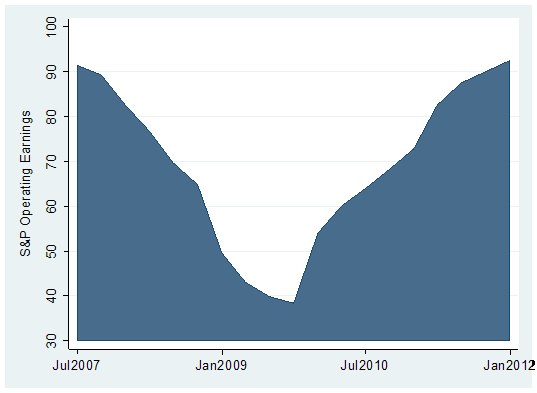
Even if one uses "operating earnings" a euphemism for "blatant lie" in which all "one-time losses" that recur like clockwork are ignored (along with everything else the companies want to ignore), the PE based clocks in at 29.64 as of the end of the third quarter according to S&P Earnings Data.
At these levels it seems that a full-blown V-shaped recovery is being priced in. There's no better example of a V-shaped forecast than for what is expected for the recovery in earnings over the next couple of years. The graph below shows the operating profit series, which includes actual results from the second quarter of 2007 – when earnings peaked – through this year's second quarter, and then continues with estimates through the end of 2011.
For operating earnings to get back to their peak levels, analysts have penciled in earnings growth of more than 40 percent over the next year, and then another 22 percent between 2010 and 2011
What is worth highlighting is that analysts expect that the typical company will soon achieve the same level of profit margin that they were able to deliver in the years leading up to 2007 – a period where leverage was preferred over balance sheet strength, a preference by company managements to focus on equity shareholders, during a political climate where labor lacked bargaining power, where consumer spending was fueled by mortgage equity withdrawals, and leverage ratios increased broadly because business and consumer credit was easy to come by.
To assume a return to peak profit margins is a bet that the economic and political landscape that emerges over the next year or two will match the pre-panic landscape perfectly.
But it is also important to keep this from Barry Ritholtz & Hester in mind......
In jedem Fall sollte man aber diesen Kernsatz von Barry Ritholtz & Hester im Hinterkopf haben.....
Barry: As noted previously, at times, things like “valuation” or the economy or earnings don’t matter — until they suddenly do.
Hester : While S&P earnings may not be able to rise to the lofty expectations of analysts over the next couple of years, this isn't a strongly bearish argument in itself. The link between near-term earnings and stock direction is tenuous. Outside of very large changes in earnings, there is essentially no correlation between year-over-year changes in earnings and changes in stock prices.
But if you're investor that is sensitive to valuation and your preference is to use forward earnings, then an understanding of the building blocks that create those earnings estimates is important.
Regardless of this rule the risk/reward ratio isn´t quite "favourable" ( i´m being polite ) right now...... But as long as the technicals are not breaking down it is still too dangerous to entry a short position...... Even if it is very tempting.... ;-) At least the first not insignificant signs are popping up that the party might be over rather sooner than later......At some point this kind of "wealth transfer" has to stop...... I´m pretty sure this guy will have lots of fun in 2010...... ;-)
Denke es bleibt in jedem Fall festzuhalten das das momentan vorhandene Chance/Risikoverhältnis nicht gerade vorteilhaft ( höflich vormuliert ) ist...... Solange die Markttechnik aber noch intakt ist sollte man auf jeden Fall der Versuchung widerstehen short zu gehen. Auch wenn das tagtäglich schwerer fällt...... ;-) Immerhin sind doch erste ernsthafte Anzeichen zu erkennen die andeuten das der Party bald der Treibstoff ausgeht.......Spätestens wenn diese Art von "Umverteilung notgedrungen Ihr Ende findet......Ich bin mir ziemlich sicher das dieser Typ spätestens im Jahr 2010 eine Menge Spaß haben wird...... ;-)






![[CBANKS]](http://s.wsj.net/public/resources/images/AI-AZ850_CBANKS_NS_20100111133638.gif)
![[China Hits Brakes on Stimulus]](http://s.wsj.net/public/resources/images/NA-BD440A_Cecon_NS_20100112200829.gif)


![[wall_street_bonuses.jpg]](https://blogger.googleusercontent.com/img/b/R29vZ2xl/AVvXsEiG4nYfusu1mZRMTvjJ39u7M2eSf8HAhNHm1mCEOdoSwOE_tDMaVew2Z4LcqwOn4MVaNvga1R6ZU04kk0FKfxUsJqItblTnDLb8c0eC6co5lmAlQbBhXZVsZslStwFhXSsJsliLiw/s1600/wall_street_bonuses.jpg)
![[Rebound]](http://s.wsj.net/public/resources/images/P1-AS021_PAYcov_NS_20091013190028.gif)


![[Most Recent Quotes from www.kitco.com]](http://www.kitconet.com/charts/metals/gold/t24_au_en_usoz_2.gif)
![[Most Recent Quotes from www.kitco.com]](http://www.kitconet.com/charts/metals/gold/t24_au_en_euoz_2.gif)