Friday, December 01, 2006

Growth forecasts 2007/2008

to be honest i really find this longer term forecasts useless. in the us they can´t even figure out the next quarter. bernanke sees at it 2,6%, deutsche bank calls the gdp 0,0%! but one thing is for sure. when the housingbubble bursts it will crash the numbers (like in the us from over 5% in the first quarter to around 1-2% and falling.....). and i think that is no surprise that the countries with the bigger bubbles are leading the forecasts.......http://immobilienblasen.blogspot.com/2006/09/bubble-goes-global.html#links

halte diese längeren prognosen für wertlos. in den usa können ide nicht mal das nächste quartal vorhersagen. bernanke sieht es bei 2,6%. die deutsche bank erwartet 0% gdp wachstum. eines aber dürfte klar sein. wenn die immobilienblasen in den jeweiligen ländern zu ende sind kann man alle prognosen getrost über den haufen werfen. (wie in den usa wo das wachstum von über 5% auf 1-2% und weiter fallen an die wand gefahren ist). und es ist sicher kein zufall das die länder die liste mit den höchten werten anführen wo diese blase noch nicht geplatzt ist.http://immobilienblasen.blogspot.com/2006/09/bubble-goes-global.html#links

http://www.economist.com/markets/indicators/displaystory.cfm?story_id=8360075
The OECD forecasts that growth in its member countries will slow to an average rate of 2.6% in 2007 and 2008, down from 3.2% this year. America and Japan are expected to see a sharper slowdown than the euro area. Ireland (wait until the housing bubble has burst......http://immobilienblasen.blogspot.com/search?q=bubble+goes+global+is tipped to remain the fastest-expanding of the rich economies in our chart, with average growth of 4.8% over the two years. At the other extreme, Italy is forecast to grow by a measly average of only 1.5%.


Labels:

Friday, December 08, 2006

bubble world tour / economist

looks like germany is a weird place to start a "immobilienblasen"/housingbubble blog............. :-)
the bubble in the usa has popped. it is no question if it is a question when it will deflate in the rest of the world.
more on the bubble worldwide http://immobilienblasen.blogspot.com/2006/09/bubble-goes-global.html#links


schon komisch das ich als deutscher ein immobilienblasen blog gestartet habe..... :-)
in den usa ist die blase bereits geplatzt. beim rets ist frage eher wann und nicht ob sie platzen wird. mehr zum weltweiten bubble http://immobilienblasen.blogspot.com/2006/09/bubble-goes-global.html#links


While America's housing market cools, property elsewhere is still hot http://www.economist.com/finance/displaystory.cfm?story_id=8381960

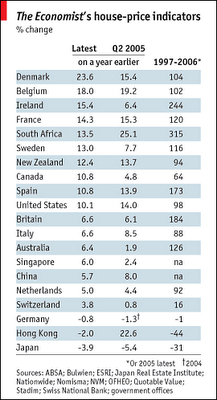
IN MANY countries, people are showing little sign of losing their appetite for residential property. Although the pace in several of the raciest markets around the world has eased a bit in the last quarter, prices have risen by more than 10% in the past year in eight of the countries in our table. ....


However, in America the steam has come out of the housing market. .......


A huge number of homes is awaiting sale: 7.4 months' supply of both existing and new properties.


David Rosenberg, an economist at Merrill Lynch, points out that inventories of new homes are 40% above their historical norm. The number of new properties completed but not yet sold has risen by 50% in the past year, to 166,000. America's builders are cutting back hurriedly. In October alone private residential-construction spending fell by 1.9%; it was 9.4% lower than a year before.

Although America's bubble is deflating, other markets are still looking decidedly frothy. Denmark tops our property-inflation table; elsewhere in Europe, house prices in France, Spain and Ireland are still simmering. In Australia and Britain, where it once seemed that property markets had levelled off, prices have picked up again, rising by 9.5% and 9.6% respectively to November of this year.

The Australian figure disguises marked regional variations. Prices in Sydney rose rapidly in 2003, fell in late 2004 and 2005 and are (just) increasing again. In sizzling Perth prices rose by 46% in the year to the third quarter. In Britain too the pace varies from one area to another: in the year to the third quarter, prices in Northern Ireland rose by a third, ....., while those in the north of England rose by less than 1%. But the renewed pep in the national pattern has revived talk of a housing bubble.

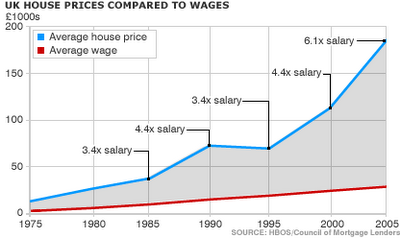
In a thoughtful recent study David Miles, of Morgan Stanley, tries to explain the doubling of real British house prices in the past decade. Some of the increase, he says, can be ascribed to rising real incomes; a smaller share can be explained by increases in population; some can be put down to lower real interest rates (including the keener pricing of mortgages by lenders). However, a lot of it is speculative.(quite an understatement chart!/ lerichte untertreibung chart)

Between one-third and one-half is due to increased expectations of house-price inflation. These amplify the effects of other factors. Faster increases in prices foster the belief that future increases will also be stronger, so that higher prices fuel demand rather than dampen it.


The need to explain so much of Britain's house-price inflation by a change in expectations, writes Mr Miles, “suggests that the current level of house prices may be rather unstable.” Once those expectations come down, real house prices are likely to fall. The trouble, of course, is predicting when. (coming sooner than most people think, kommt schenller als die meisten denken....)

Labels: , , , , ,

Thursday, November 02, 2006

Morgan Stanley Seeks $8 Billion for Property Fund

in my opinion not many places without a bubble left. but at least they search outside the us...........
http://immobilienblasen.blogspot.com/2006/09/bubble-goes-global.html

meiner meinung werden die es schwer haben hohe erträge zu erzielen. aber immerhin suchen sie ausserhalb der usa..........
http://immobilienblasen.blogspot.com/2006/09/bubble-goes-global.html


http://tinyurl.com/y94exk
Morgan Stanley, the largest real estate investor among Wall Street banks, is raising as much as $8 billion for what would be the biggest-ever high-yield real estate fund.

``We continue to see significant investment opportunities outside the U.S., dominated by activity in Japan,'' ....

Real estate firms are raising record amounts from institutional investors such as pension funds that are seeking higher returns than stocks and bonds. Morgan Stanley is raising an opportunity fund, a type that seeks annual returns of at least 20 percent. It will be invested outside the U.S., with 75 percent in developed markets such as Japan and Germany and 25 percent in emerging markets led by China and India. ....

Morgan Stanley Real Estate has acquired about $62.3 billion of property assets worldwide, including Canary Wharf in London, that city's second financial district. The firm in July made its first real estate in Russia, buying a stake in a local developer, and plans to increase investment in China and India, where fast economic growth is creating more demand for housing and retailers. ....

$30 Billion to Invest
Adding borrowings to the fund's equity of $8 billion could give Morgan Stanley as much as $30 billion to invest, Humphrey said.

``That is a level we haven't seen before,'' he said. ``The immediate question that comes to mind is can they access investments at a pace that's reasonable, given that level of capital,'' he said. ?''

Yields, or capitalization rates, on real estate probably won't fall much further, said Sonny Kalsi, global head of investing for Morgan Stanley Real Estate. ``As we look at things globally, we think cap rates are more likely to go up,'' Kalsi told the committee. Economic conditions remain favorable for property income growth in cities such as Tokyo, London and Shanghai, he said. (i´m not sure /bin mir da nicht so sicher http://immobilienblasen.blogspot.com/2006/10/london-calling-new-skyline.html, )

Government of Singapore Investment Corp., which manages more than $100 billion of foreign reserves and is one of the world's 10 biggest investors in real estate, earlier this year said it may buy real estate in India and Brazil to guard against the risk of falling U.S. property prices (clever!)

Monday, September 11, 2006

bubble goes global

hier nochmal ne schöne übersicht über das inzwischen wohl globale problem houisngbubble.
zu bedenken bei den angaben ist das die datenerhebung oft nur bis ende 2005 reicht und daher der erste downturn nicht enthalten ist. wie wir speziell aus den usa wissen ist dort der markt in q2 2006 ungebremst an die wand geknallt.

wie schon vermutet ist in der tat irland spitzenreiter was die inflationierung angeht.

was das ausmaß der blase in den usa verzerrt ist das besonders in den entscheidenden regionen der usa (küstenregionen und florida) die ausmaße locker mit denen in irland zu vergleichen sind.

besonders anfällig ist der us markt auch deswegen weil der bubble in erster linie auf hochriskanten finanzierungsformen basiert und die wirtschaftsleistung im gegensatz zu irland und anderen ländern weniger stark gewachsen ist.

fakt ist aber in den heißgelaufenen märkten das die ersten ernsten probleme im ersten halbjahr 2006 aufgetaucht sind. denke das diese risse nicht mehr zu kitten sind.

nochmal dank an the economist und tim http://themessthatgreenspanmade.blogspot.com/2006/09/home-price-stories-and-statistics.html


links zu irland:
http://immobilienblasen.blogspot.com/2006/09/irland-ireland-usa-reloaded-20042005.html
http://immobilienblasen.blogspot.com/2006/09/irland-ireland.html
http://immobilienblasen.blogspot.com/2006/08/irland.html, http://immobilienblasen.blogspot.com/2006/10/db-research-usuk-ie-esp-fra-dk-ger.html

links zu australien:
http://immobilienblasen.blogspot.com/2006/08/trouble-in-down-under.html
http://immobilienblasen.blogspot.com/2006/08/in-australien-haben-66-der-vermieter.html
http://immobilienblasen.blogspot.com/2006/08/zinserhhung-schlimmer-wie-terror-von.html, http://immobilienblasen.blogspot.com/2006/10/db-research-usuk-ie-esp-fra-dk-ger.html, http://immobilienblasen.blogspot.com/2006/10/housing-slump-in-us-versus-uk.html, http://immobilienblasen.blogspot.com/2006/09/wer-bietet-mehr-ltv-125-uk-buuble.html, http://immobilienblasen.blogspot.com/2006/10/australien-bauantrge.html

links zu uk
http://immobilienblasen.blogspot.com/2006/08/mehr-kreative-finanzierungsformen-uk.html
http://immobilienblasen.blogspot.com/2006/08/uk-bubble-kufer-fr-ne-wg-gesucht.html
http://immobilienblasen.blogspot.com/2006/08/uk-debt-that-never-dies.html
http://immobilienblasen.blogspot.com/2006/08/england-uk.html, http://immobilienblasen.blogspot.com/2006/10/db-research-usuk-ie-esp-fra-dk-ger.html, http://immobilienblasen.blogspot.com/2006/09/great-britain-bubble-world-tour.html, http://immobilienblasen.blogspot.com/2006/09/singapore-bubble-world-tour.html, http://immobilienblasen.blogspot.com/2006/10/uk-home-shortage-keeps-property-market.html, http://immobilienblasen.blogspot.com/2006/10/housing-slump-in-us-versus-uk.html, http://immobilienblasen.blogspot.com/2006/10/addicted-to-debt-uk-auf-den-spuren-der.html, http://immobilienblasen.blogspot.com/2006/09/wer-bietet-mehr-ltv-125-uk-buuble.html, http://immobilienblasen.blogspot.com/2006/09/wer-bietet-mehr-ltv-125-uk-buuble.html,

links to kanada, moskau, china, dubai .......
http://immobilienblasen.blogspot.com/2006/09/canada-kanada.html
http://immobilienblasen.blogspot.com/2006/09/moskau.html
http://immobilienblasen.blogspot.com/2006/08/bubble-in-china-shanghai.html
http://immobilienblasen.blogspot.com/2006/07/zur-abwechslung-mal-shanghai.html
http://immobilienblasen.blogspot.com/2006/09/dubai.html
http://immobilienblasen.blogspot.com/2006/07/spanien.html, http://immobilienblasen.blogspot.com/2006/09/polen-poland-bubble-world-tour.html, http://immobilienblasen.blogspot.com/2006/10/db-research-usuk-ie-esp-fra-dk-ger.html,


Monday, September 18, 2006

Japan's big cities post first land price gain since '90/ blueprint recovery usa and the rest ?

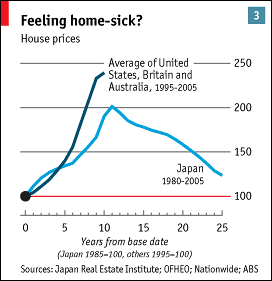
15 jahre. das ist der zeitraum den vom peak bis überhaupt wieder ein wertzuwachs erzielt worden ist un der markt seinen boden anscheinend gefunden hat. da die bubbles gemäß der grafik vom "economist" in vielen ländern mit dem bubble in japan vergleichbar sind können sich diese länder warm anziehen. das ganze geschwafel vom soft landing sowie wie z.b. in den usa das im 2007 wieder steigende preise zu erwarten sind ist nichts anderes als wunschdenken.

wenn man jetzt nich bedenkt das dieser wertzuwachs trotz ner jahrelangen "nullzinpolitik/zero interest policy" erst nach 15 jahren erzielt worden ist macht das ganze ausmaß noch anschaulicher.

berichte aus dem rest der "welt buuble tour/ world bubble tour"
http://immobilienblasen.blogspot.com/2006/09/bubble-goes-global.html


Japan's big cities post first land price gain since '90

Real estate prices in Japan's top three cities have shrugged off a decades-long deflationary hangover to post their first year-on-year rise since 1990

In the year ending July 1, residential prices in the three main metropolitan areas of Tokyo, Osaka and Nagoya gained on average 0.4%, while commercial land prices rose 3.6%, according to a survey released Tuesday by the government's Ministry of Land, Infrastructure and Transport.

Strong demand for office space and retail space during the economic recovery underpinned the recovery in commercial prices. Improvements in employment and wages also increased home ownership.

The popularity of real estate investment trusts (REITs) also was supporting the rebound in urban prices. Net assets of Japanese domestic REITs amounted to 1.66 trillion yen, ($14 billion) at the end of August, compared with 563.7 billion yen a year ago, according to Lipper.
Nationwide, however, land prices continued to soften, with commercial prices falling 2.1% and residential prices down 2.3%.
The survey, which is used to calculate property taxes, is based on prefectural governments' data and uses a methodology based on an average of percentage changes in price.
Japanese economy and banking minister Kaoru Yosano said Tuesday another real estate bubble was unlikely because investors were basing their decisions on yield rather than speculating on future-price appreciation.
"The emergence of a bubble isn't possible," Dow Jones Newswires reported Yosano as saying at a press conference.
Since the Japanese property bubble peaked in 1991, prices on a nationwide level for residential land have fallen 35%, or about equivalent to the same level as 1983.
Commercial land prices have fallen 60% and are now at their lowest level since 1977, although the pace of price declines is on the wane, according to the report.
The survey found price gains were particularly strong in Tokyo's Chiyoda, Chuo and Minato wards, where residential land prices rose an average of 17.8%, while commercial prices rose 14.2%.
The report also found Tokyo land values rose sharply along the new Tsukuba Express line linking Akihabara Station with the city of Tsukuba, Ibaraki Prefecture.
A survey by the National Tax Agency last month, which uses a weighted average of land prices taken at Jan. 1, found nationwide land prices rose for the first time in 14 years.

wie man es dreht und wendet. die aufräumarbeiten werden hammerhart sein !

tough times ahead !

jan-martin


Thursday, November 16, 2006

uk: regulators wants stresstest with property prices down 40%!

it seems that more and more feels uncomfortable with the level of the bubble in the uk. this would be a "stresstest" that deserves the name. i would assume that with a 40% dive in housepricevalues that any major lender will have big big problems...... i doubt that we will see any of the results in the public any time soon. in the meantime the banks are getting more creative to support the bubbleprices and fule the fire.....

es sieht wirklich so aus als wenn es einigen inzwischen mit blick auf den immobilienmarkt unbehaglich wird. dieser test hätte den namen "stresstest" wirklich verdient. bei einem fall um 40% wäre sicher jede bank in großen schwierigkeiten. i denke nicht das wir in absehbarer zeit (wenn überhaupt) die testrusalte zu gesicht bekommen werden. in der zwischenzeit entwickeln die banken immer neue finnazierungsformen um das ganze am laufen zu halten..


more on the uk http://immobilienblasen.blogspot.com/search?q=uk
and the global bubble http://immobilienblasen.blogspot.com/2006/09/bubble-goes-global.html#links

dank geht an mish und sein http://www.markettradersforum.com/

Banks warned of 'end to the good times' http://tinyurl.com/utjvr

The City regulator issued a warning to the high street banks yesterday that the "clouds were already darkening" and urged them to prepare for the impact of rising unemployment and the knock-on effect on bad debts.

The Financial Services Authority highlighted mortgages based on high multiples to income - as much as five times in some instances http://immobilienblasen.blogspot.com/2006/11/five-times-salary-mortgage-offer-gb.html#links- and questioned whether sales of these products would be monitored properly. (plus the 125% ltv loan...) here a link to a bbc audioreport http://housingpanic.blogspot.com/2006/11/bbc-report-on-125-and-five-times.html
(thanks to keith from housing panic http://housingpanic.blogspot.com/ )

.....In a speech to the British Bankers' Association, he also urged them to conduct stress tests - essentially worse case planning scenarios - to assess the impact of a downturn in the housing market on the business. The regulator believes banks should consider the impact of a 40% fall in property prices and a 35% increase in the repossession rate on their business but stressed that it does not mean it expects such sharp movements to take place.

House prices fell about 15 per cent nationwide in 1989-1992, and in parts of East Anglia by 40 per cent, leading to repossessions, write-downs and bank losses.

Labels: , ,

Friday, September 15, 2006

down under + gb / bubble world tour

australien ist in sachen bubble den anderen ländern 12-18 monate voraus. es sah lange so aus las wenn der rohstoffboom tatsächlich dem immomarkt zu hilfe kommen würde undein soft landing ermöglichen würde. allerdings hat es meiner kenntnis nach ner blase noch nie ein soft landing gegeben. da andere länder (abseits der bauwirtschaft) wie die usa alles andere als eine boomende wirtschaft haben dürfte der fall dort noch schmerzlicher werden.

dank geht an http://www.housepricecrash.co.uk/

The real lesson from Australia’s property slump

http://www.moneyweek.com/file/18349/the-real-lesson-from-australias-property-slump-.html

highlights:

The economic outlook for the UK isn’t getting any better.

But rather than focus on our own little bubble, we’d like to take another trip Down Under this morning, to find out what the state of the Aussie housing market can tell us about the future of our own…

Many people thought the Australian housing market had achieved the holy grail of a ‘soft landing’. But that‘s looking more and more like wishful thinking. Stories are emerging of negative equity and of houses in Sydney being sold at well below prices fetched in 2004.

One particular tale that has been enthralling Sydney-siders is the story of a house in the city’s western suburbs. It was bought for A$450,000 (about £180,000) in 2004. But the unfortunate owners ran into trouble making their mortgage payments, and the home recently sold again - this time for just A$260,000 (£104,000), a 42% drop over two years

That’s pretty hefty. And so compelling was the tale that the Sydney Morning Herald recently revisited the street to interview neighbours about their housing plans.

Here’s a quote from local homeowner Judith Marshall: “Our house was valued two years ago at about A$330,000 [£132,000] and since the market has come back we’re thinking it would be about A$300,000 [£120,000], maybe less. Bricks and mortar is supposed to be the most solid investment of your life, but for many people these days, I think you’re better off renting.”

Those are words to strike terror into the heart of any estate agent. No more talk of how “you can’t go wrong with property.” No more “renting is just paying someone else’s mortgage,” or “renting is dead money.” Now it’s the homeowners who look like they’ve wasted money while the canny renters have avoided the millstone of negative equity.

The key lesson is that sentiment changes. And once it changes, it takes a long time to change back.

In our own property market, we’re at the point where the greatest of the greater fools are still climbing on the ladder. Tales of 40-year interest-only mortgages and complete strangers (apparently) clubbing together to buy and share over-priced housing proliferate. http://immobilienblasen.blogspot.com/2006/08/uk-bubble-kufer-fr-ne-wg-gesucht.html, http://immobilienblasen.blogspot.com/2006/08/uk-debt-that-never-dies.html

But when these stories start to spread around, it’s a sure sign that a market’s in its final spasms before the turnaround. It won’t be long before the typical person starts to think - “you’d have to be daft or have money to burn to buy property in the UK today.”

In fact, even the people who really do have money to burn think UK property is poor value. Chelsea’s Michael Ballack, who earns a mere £130,000 a week, has been widely reported as saying: “London is extremely expensive. It is better to rent.” (was living the past 3 years in the most expansive germany city "munich", than these word makes really sense)

Now we wouldn’t normally advise taking economic advice from a footballer – but in his case, we’ll make an exception.

alle anderen storys zu australien und uk hier / other story to uk and australia here:http://immobilienblasen.blogspot.com/2006/09/bubble-goes-global.html

denke das wir ähnliche geschichten die nächsten jahre rund um den globus hören werden.

jan-martin

Friday, September 29, 2006

spanien / spain bubble world tour

nur irland hat in europa ne größere blase zu bieten. denke spanien ist kanpp vor england auf dem zweiten platz. rest der bubble world tour
http://immobilienblasen.blogspot.com/2006/09/bubble-goes-global.html

Real Estate Slowdown in Spain May Cut Sales of `Covered' Bonds


highlights http://tinyurl.com/ojhh2

Sept. 29 (Bloomberg) -- Sales of bonds backed by home mortgages in Spain may drop for the first time in five years as prices of apartments in Madrid and villas on the Costa del Sol rise at the slowest pace since 2001.

Banks in Europe's fifth-largest economy probably will reduce sales of bonds to finance mortgages by 23 percent next year to 50 billion euros ($63 billion

The banks raised 59 billion euros this year with so-called covered bonds, debt backed by mortgages and guaranteed by the seller, almost as much as in all of 2005 and the most in Europe

Mortgage lending fell for three of the past four months as borrowing costs for home buyers rose to the highest since 2003, the Spanish Mortgage Association said.

Yield Premium

Investors demand 4 to 5 basis points in extra yield to purchase Spanish mortgage debt rather than similar securities in Germany, partly because of the higher amount being sold, said Ted Packmohr, a credit analyst at Dresdner Kleinwort in Frankfurt. The covered market in Spain, which started in 1998, now has 190 billion euros of bonds.

Holders of Madrid-based Banco Popular Espanol SA's 2.5 billion euros of 3 percent covered notes due in 2012 lost 0.5 percent so far this year, Citigroup Inc. prices show. That compares with a 0.1 percent loss on similar securities sold by Munich-based Muenchener Hypothekenbank AG. Moody's Investors Service rates both notes Aaa.

The premium on Spanish covered bonds compared with similar- maturity government debt rose 10 basis points to 29 basis points this year, according to the International Index Company's iBoxx indexes. In Germany, spreads widened by 2 basis points to 17 basis points.

Housing Bubble

Home prices will increase 4.5 percent next year, down from an annual 10.8 percent in the second quarter of this year, according to Madrid-based Banco Bilbao Vizcaya Argentaria SA, Spain's second-biggest bank.

The last time home values rose more slowly was in 2001, when they gained 8.8 percent.

``In Spain we've had bubble-like conditions for some time,'' said Vishal Pathak, an interest rate strategist at BNP Paribas SA in London. ``If you get reduced volumes of supply, that will help'' bond performance, he said.

Covered bonds typically get AAA ratings by requiring borrowers to set aside assets that can be sold to ensure repayment. (that is the main difference from an mbs and wm uses this structure for their european issuance, das ist der unterschied zu den mbs in den usa.)

Better Than U.S.

Spain's slowdown is nowhere near the slump in the U.S. housing market

The average lending rate for mortgage loans for periods of more than three years has risen to 4.23 percent, the highest since 4.25 percent in January 2003, according to Spanish Mortgage Association data. The rate has risen from 3.19 percent in August, 2005, the lowest in at least 15 years. (this is a consequence from the ecb that sets the rate for whole europe. a independent bank of spain would have raised the rate to at leat 5% or higher in the past years. same in ireland etc., folge der einheitlichen zinspolitik der ezb. ne unabhängige notenbank von spanien hätte die zinsen längst auf 5% plus x anheben müssen. gleiches gild für irland usw)

Holiday Homes

Declining purchases of second homes by U.K. and German citizens is causing the slowdown in Spain. Foreigners reduced their investments in Spain by 21 percent last year to about 400 million euros a month

Holiday homes account for about 30 percent of residential properties being built in Spain, according to DCM Securities, a London-based broker that finances property development. Half the holiday homes are for foreigners, with U.K. residents making up 52 percent of overseas sales, DCM's data show.

``The Spanish market definitely can't go at the speed we've seen in recent years,'' said Max Beinhofer, who helps manage the equivalent of $15 billion of covered bonds at Deutsche Asset Management in Frankfurt.

jan-martin

Monday, October 30, 2006

Europe Faces Infection From U.S. Home-Price Fall

die studie auf die sich der autor bezieht kann hier in voller länge eingesehen werden
http://immobilienblasen.blogspot.com/2006/10/db-research-usuk-ie-esp-fra-dk-ger.html

the full study from deutsche bank the writer is refering to can be viewed here in full lenghth
http://immobilienblasen.blogspot.com/2006/10/db-research-usuk-ie-esp-fra-dk-ger.html

mehr/more on the "bubbel world tour"
http://immobilienblasen.blogspot.com/2006/09/bubble-goes-global.html

Europe Faces Infection From U.S. Home-Price Fall
http://tinyurl.com/yctrrg


Oct. 30 (Bloomberg) -- In the last decade, real-estate prices in Europe have moved in one direction -- up. (not germany! / nur deutschland nicht)

That may be about to change. In the U.S., a booming property market has stalled. Plenty of people think it may be facing a full-scale crash. If that happens, it would be complacent to assume that Europe could avoid the fallout.

In the past 10 years, Spanish property values have more than doubled, while home prices have tripled in the U.K. and quadrupled in Ireland, ....

House-price growth across the region has moderated this year, according to real-estate advisers Knight Frank LLP. Residential-property values in France gained 9.4 percent last year, compared with 15 percent in 2004, while Irish prices rose 9.4 percent in 2005 versus 10.1 percent the previous year.

In both countries, Knight Frank predicts prices will increase 7.5 percent next year, very healthy when you consider the gains already made. The emerging economies of eastern Europe will experience the most dramatic growth, with Lithuanian values expected to expand 20 percent next year, while Latvia and Slovenia won't be far behind.

Even the perennially disappointing German market is expected to have modest price gains (2,5% 2007e) as it emerges from a prolonged economic decline

In the U.S., however, the outlook is a lot cloudier. (really an understatement!/untertreibung)

Impact on Europe
There is room for debate about the scale and duration of the decline. Yet nobody would dispute that the market is falling.

The issue is whether a slowdown in the U.S. will infect Europe. Not everyone thinks so. ....

Others aren't so sure. In a recent note, Deutsche Bank analysts Tobias Just and Stefanie Ebner said there was a serious risk of ``contagion'' between the two markets.

The U.S. has very different demographics from most of Europe. Yet there are four reasons to think that a decline in U.S. real estate will be bad news for Europe.

`Similar Growth Pattern'
First, history tells us that the two markets generally move together. ``Over the past 20 years, most housing markets on both sides of the Atlantic followed a similar growth pattern,.....

``Considering all these interdependencies, European markets might well be affected by the slowing U.S. housing market.'' Just as European and U.S. equity markets tend to follow the same cycle, it turns out property markets do as well. The relationship has held in the past -- and there is no reason why it shouldn't this time around.

Next, valuations are stretched in Europe just as they have been in the U.S. market. With the exception of Germany, house prices have been increasing much faster than wages at a time of slow European economic growth. In countries such as Spain and Ireland, house-price growth rates have been matching those of the U.S. market. Many people are getting priced out of the market -- eventually that will reduce home values.

Third, the European Central Bank may not have been raising borrowing costs as fast as the U.S. Federal Reserve, yet it has boosted its benchmark lending rate five times since December to 3.25 percent and shows few signs of stopping. The capital markets are global. As money gets more expensive it will restrict European home buyers as much as U.S. property purchasers.

U.S. Recession?
Finally, a U.S. housing decline could help cause a recession around the world. If that happens, it will hurt European real- estate prices. More broadly, a dip in the U.S. will damage confidence, and the property market is reliant on sentiment. If people think prices will drop, they almost certainly will.

In the medium term, house prices depend on how much money people can afford to borrow and whether they have employment. A drop in global economic growth and rising interest rates would make it impossible for European real-estate prices to continue their gains of the past few years.

With the U.S. market cooling, the times of unbridled price increases in the European home market will soon be over.


Tuesday, September 12, 2006

singapore / bubble world tour

next stop singapore.

the rest of the stops here:
http://immobilienblasen.blogspot.com/2006/09/bubble-goes-global.html

nicht wirklich überraschend. bemerkenswert ist hier das die preise noch 33% unter dem peak von 1996 sind. zudem ist das wirtscahftswachstum in singapur sicher eines der hächsten und das land in einer sehr guten verfassung. möchte also singapur noch nicht in eine linie mit den anderen bubbles stecken. allerdings tut die regierung gerade alles um das zu ändern.


Singapore Luxury Homes Prices Reach Records on Economy, Taxes
http://www.bloomberg.com/apps/news?pid=20601109&sid=a1nd81sHs6Bw&refer=home

highlights:

Sept. 12 (Bloomberg) -- Mark Edleson, a former Citigroup Inc. vice president, needed a waterfall to persuade his wife to quit their estate outside Jakarta and move to Singapore. He found it inside a $2.9 million, marble-floored apartment.

The market for Singapore's luxury homes -- those costing more than about S$1,500 ($953) per square foot -- is on a roll as the $118 billion economy has its longest expansion in five years. Prices are rising to match gains of as much as 42 percent in Bangkok, Hong Kong and Shanghai in the past two years, as new tax breaks and ownership rules lure overseas wealth

Bidders for luxury digs such as Edleson's -- with 3,300 square feet (307 square meters) of living space set in a tropical garden -- have driven home purchase costs to records this year. Developer Kwek Leng Beng forecasts a further 10 percent to 20 percent increase in 2006

``We're just at the beginning of an upward trend,'' said billionaire Kwek, 65, chairman of City Developments Ltd., Singapore's second-largest property company. ``That's not just a possibility, that's a probability


Singapore buyers are paying 11 percent more for the most expensive homes in the past two years, according to property broker Jones Lang LaSalle Inc.

In June, a City Development apartment with South American hardwood floors sold for a record of more than S$3,000 (1900 us$, 1500 €)per square foot, the company said without disclosing the total.

The gain was about 8 percent, to S$1,670 per square foot on average, in the second quarter this year from the first three months, CB Richard Ellis said. Joseph Tan, the company's director of residential services in Singapore, forecasts a further 20 percent increase.

The surge is powered by new tax laws designed to lure wealth to the city-state's private banking industry and an easing of home-ownership curbs, especially for non-natives.

The government exempted domestic and overseas investments from capital gains tax in 2004. Singapore's private banks now manage $200 billion, according to the central bank, with about 70 percent of funds coming from abroad.

``In private banking, the next big wave will be Indians and Chinese, and they will buy apartments,'' said Francis Yeoh, managing director of YTL Corp., Malaysia's biggest builder. ``Singapore properties will not come down, especially high end.''

The government also included property last year in the S$2 million that overseas investors must hold in Singapore to apply for residency. In addition, it permitted non-Singaporeans to buy apartments in buildings with fewer than seven stories without seeking government approval.

Development is booming. Eight publicly traded property companies and their units raised S$5 billion from equity and debt investors in the first half of 2006, almost three times the amount raised in the same period in 2005, according to data compiled by Bloomberg.

Shares of CapitaLand Ltd., Singapore's largest developer, have risen 61 percent in the past 12 months. SC Global stock has gained 72 percent and City Developments is up 5 percent.

Winston Liew, a property analyst at OCBC Investment Research Pte. in Singapore, cautions that the boom may not last. Developers buying older apartments, known as en-bloc purchases, risk overbuilding, Liew said.

``The reason there are so many en-blocs is the perception that the appreciation in the high-end prices is sustainable,'' Liew said. ``This hot money could potentially disappear.''

Even so, home prices are 33 percent off their peak, government data shows. Prices started falling in mid-1996 when the government moved to curb speculation by taxing as much as 100 percent of profit from the immediate sale of residential property.

Las Vegas Sands Corp.'s planned $3.6 billion casino-resort for Singapore, which is due to open in 2009, also may drive prices higher. Bids for a second casino are due next month.

jan-martin

Monday, October 23, 2006

db research / us,uk, ie, esp, fra, dk, ger real estate

wow! ne brilliante übersicht über alle releventen immobilienmärkte in europa und den usa. inklusive scoringmodell, preis/miete, verhältnis preise zu einkommen, guten charts etc.. sehr empfehlenswert. besonders um zu sehen wie weit deutschland auf dem teppich bzw zurückgeblieben ist.

wow! a brilliant study from dbresearch about all relevant european and the us market. including a riskscoring model, prices/rent ratios, affordability, very good charts. highly recommend it.

deutsche bank research ( pdf 8 seiten )
http://tinyurl.com/u9gfq !!!!!

andere geschichten zum globalen bubble / other storys to the worldwide bubble
http://immobilienblasen.blogspot.com/2006/09/bubble-goes-global.html

Friday, September 15, 2006

sydney / bubble world tour

passend zum letzten bericht http://immobilienblasen.blogspot.com/2006/09/down-under-gb-bubble-world-tour.html hier mehr anhaltspunkte das die party in sydney und damit auch in down under 2004/2005 den peak erreicht hat und nun katerstimmung herrscht. was das ganze umso bedrückender macht ist das jetzt rekorde bei zwangsvollstreckungen gebrochen werden die seinerzeit zinssätze von 15%-20% als grundlage hatten.

irgendetwas muß also verdammt schief gelaufen sein..........
dieses zitat/dieser bericht verdeutlicht das http://immobilienblasen.blogspot.com/2006/08/zinserhhung-schlimmer-wie-terror-von.html

Repossessions at all-time high
http://www.domain.com.au/Public/Article.aspx?id=1157827074647&index=NationalIndex


Sydneysiders are losing their homes at a record rate, forced out by crippling mortgage payments, exorbitant petrol prices and high personal debt.

In 2002 there were 2189 repossessions by banks and financial institutions following defaults by borrowers. But they now stand at 4873 - more than double the rate under Paul Keating's 17 per cent interest rate regime in 1990.

Mr Dimarco said the market had slumped by up to 25 per cent in some pockets of Sydney, which had added to the panic in the market.

People who had borrowed heavily to buy a $400,000 property just a few years ago wouldn't sell it now for much more than $300,000

There was no pattern to those defaulting on their loans. They were families, singles, investors and retirees

"I had one in Leichhardt that was bought in 2003 for $750,000, and it's just sold for $500,000," he said.

Another couple nearing retirement age used the equity in their Marrickville home to buy an investment unit, which had since plummeted in price.

He predicted things would get worse. "A lot of people are going broke."

rest der worldtour hier:http://immobilienblasen.blogspot.com/2006/09/bubble-goes-global.html

jan-martin


Thursday, September 14, 2006

polen / poland "bubble world tour"

nächster halt polen. denke das man polen stellevertretend für den immobiliensektor in den osteuropäischen staaten nennen kann die in die eu gekommen sind bzw. demnächst dazukommen. muster ist immer dasselbe. ausländer die in ihren ländern einen immobilienboom hinter sich haben kaufen alls was bei 3 nicht auf den bäumen ist und treiben so die preise.

hat leider den nebeneffekt das es für die einheimischen immer schwieriger und oftmals unmäglich wird mit ihren einkommen selber eigentum zu erwerben. man kann also von einem rolling bubble sprechen.

Foreigners Spur Housing Boom in Poland
http://www.chron.com/disp/story.mpl/ap/fn/4183939.html

Klaudia Kocimska's dream is slipping away: She would love to own a small but modern apartment in downtown Warsaw

Like many Poles hoping to buy a home, the 30-year-old journalist has resigned herself to painful compromises _ having to live in a suburb and commute by car _ as soaring housing prices driven partly by foreigners put much of the city's best property off limits to normal working people

House and apartment prices in Warsaw and other leading Polish cities have spiraled upward since the eve of the nation's 2004 entry into the European Union _ a boom driven by low interest-rate mortgages, housing shortages and foreign speculators snapping up real estate as investments.

In 2005 alone, real estate prices in Warsaw rose 30 percent in prime locations, and between 10 and 20 percent in other areas amid the strong demand, according to Knight Frank. Now, for example, a one-bedroom apartment of 700 square feet in central Warsaw runs between $90,000 to $325,000.

"The demand is generally driven by local people but there are buyers from Spain, the U.K. and Ireland buying new constructions in bulk _ 10, 20 or 30 apartments and sometimes even more," Rutkowski said. "They compare Poland to Ireland and Spain of 20 and 25 years ago, and they believe the price appreciation in residential property there will happen in the same way in Poland." (kein zufall das dieses genau die länder mit den größten bubbles in europa sind)

But as housing prices in this former communist country rise, wages for most Poles remain low compared to western European levels _ making much of the housing stock unaffordable. Last year, gross domestic product in Poland was at $15,000 per capita, significantly lower than Ireland's $41,000 or Britain's $35,000, according to Polish government figures.

rest der worldour
http://immobilienblasen.blogspot.com/2006/09/bubble-goes-global.html


jan-martin

Monday, April 26, 2010

Gold...The Ultimate Triple-A Asset

This is a perfect follow up on Eric Sprott Still Makes A Lot Of Sense...... ( !!! ) and shows that if you would eliminate the "Enron-Esque Accounting" probably 90% percent of all sovereign ratings are more than a little bit inflated...... UPDATE: Timing of the post could have been worse..... See end of the post.....

Die perfekte Ergänzung zu Eric Sprott Still Makes A Lot Of Sense...... ( !!! ) die eindrucksvoll aufzeigt das wenn man die "Enron-Esque Bilanzierung" miteinbeziehen würde wohl knapp 90% aller Staatsratings zum Teil erheblich "inflationiert" sind..... UPDATE: Timing des Postings hätte schlechter sein können... Siehe Ende des Postings....

Eric Sprott: Weakness Begets Weakness: from Banks to Sovereigns to Banks via ZH

The rating agencies’ ranking of the United States is even more disconnected from reality. To believe that the US sets the benchmark for sovereign debt credit ratings is preposterous.

While we have written ad nauseam about the excessive debt issuance by the United States, we found a recent update written by United States Government Accountability Office (GAO) to be particularly instructive. The update noted the US’s budget deficit equivalent to 9.9% of GDP in 2009 - the largest since 1945 - and stated that without significant policy changes the US government would soon face an "unsustainable growth in debt". This was not news to us.

It goes on to state, however, that using reasonable assumptions, "roughly 93 cents of every dollar of federal revenue will be spent on the major entitlement programs and net interest costs by 2020." This is news!

In less than ten years, using reasonable assumptions, there will essentially be no money left to run the US government - 93% of all tax revenues the US government collects will go to pay social security, Medicare, Medicaid and the interest costs on their national debt.

This implies no money left over for defense, homeland security, welfare, unemployment benefits, education or anything else we associate with the normal business of government. And the US government is rated AAA!?

Speaking of Rating Agencies :-)! ....

Da wir gerade bei den Rating Agenturen :-)! sind....
In our view it’s time for investors to acknowledge sovereign risk. The ratings agencies can opine all they want, but it seems clear to us that the only true AAA asset to protect your wealth is gold.

The risk inherent to investors, of course, is what happens when the bond market begins to realize and react to this new level of risk.

Banking To Debt Crisis Roundabout GLG Partners via FT Alphaville

Bond Traders Declare Inflation Dead After Yields Fall

The bond vigilantes who punished governments for profligate spending in past years have gone into hiding.

Sovereign bonds yield an average 2.385 percent, about the same as a year ago and below the average of 3.08 percent in 2008 when the credit market seizure led investors to seek the safety of government debt, according to Bank of America Merrill Lynch index data.

The cost to borrow is steady even though the amount of bonds in the index that includes nations from the U.S. to Germany and Japan has grown to $17.4 trillion from $13.4 trillion two years ago.

SUPERB RISK/REWARD........ ;-)

Scheint mir ein ausgewogenes Chance/Risikoprofil zu sein..... ;-)

Bob Janjuah: "We Are Trapped In Some Sort Of Horrendous Keynesian/Monetarists' Nightmare...." via ZH

We are trapped in some horrendous Keynesian/monetarist nightmare, where policymakers, aided/abetted/advised by their buddies in the media, in the lobbyist cabal and in financial system, have YET AGAIN decided to go down the route which merely delays the problem/pushes it down the road, but which virtually guarantees that when the NEXT bubble collapses (I assume it will be the Global Government Debt/Bond Bubble and/or the Global Fiat Money/Paper Money/FX Bubble), there is NO pleasant way back.
Bill Gross WaPo
"In order to pay the interest and the bill when it comes due, we'll simply have to issue more IOUs. That, to me, is Ponzi-like," Gross said. "It's a game that can never be finished."
Read this twice... Bill "The Bond King" Gross from PIMCO is hinting the obvious.....Glad that i didn´t have to bring PONZI into the mix myself....... All this should make all the "GOLD BUBBLE TALK" even more "credible.... ;-)

Das letzte Zitat von Bill "The Bond King" Gross, der ja mittels PIMCO bekanntlich der weltweit größte Investor in Anleihen ist, sollte zur Sicherheit lieber zweimal gelesen lesen werden........Bin dankbar das ich PONZI nicht selber ins Spiel bringen mußte.....Dieser "grundsoliden" Fundamentaldaten geben speziell all denen die noch immer nicht genug von der "GOLDBLASE" bekommen können sicher noch mehr "Nahrung"... ;-)


"GOLD BUBBLE CHART" ;-) from Todd Harrison / Minyanville via Pragmatic Capitalist

I highly recommend to read the entire links & to subscribe to the free Sprott Asset Management Newsletter.... No wonder the IMF has just Superzised Their "Backup Rescue Facility" By Half A Trillion ( no typo ) for "Contribution To Global Financial Stability"......

In dem Link sind noch etliche andere unangenehme Weisheiten speziell im Hinblick auf Griechenland. Empfehle daher sich die kompletten Links etwas genauer durchzulesen sowie den kostenlosen Sprott Asset Management Newsletter zu abonnieren....Kein Wunder das "vorsorglich" der IMF die Mittel zur "Stabilisierung" der Sorgenkinder mal eben still und heimlich auf 500 Mrd $ verzehnfacht hat ( kein Tipfehler )....

UPDATE:

S&P cuts Portugal’s ratings two notches to A- FT Alphaville

S&P cuts Greece ratings to junk status MW

S&P Downgrades Spain To AA On "Risks To Budgetary Position", Outlook Negative ZH

Labels: , , , , , , , , , , ,

Monday, November 27, 2006

Irish mortgage debt is double European level

more on the "bubble world tour"
http://immobilienblasen.blogspot.com/2006/09/bubble-goes-global.html#links


dank geht an http://www.housepricecrash.co.uk/

http://tinyurl.com/yk4acp Mortgage debt in Ireland is increasing at almost three times the EU average and Irish people owe twice as much on their mortgages as their European counterparts, according to new research.

The European Mortgage Federation (EMF), which represents EU lenders, found that mortgage debt in Ireland increased by 28.5 per cent last year, compared to an EU average of 10.7 per cent.

Only Greece and eastern European countries such as the Czech Republic, Estonia, Latvia and Lithuania had higher mortgage debt growth rates than Ireland.

The average amount owed on a mortgage in Ireland per head of population is €24,082, compared to an EU average of €11,184, according to the EMF.The Irish figure was the third highest amount owed in the EU, with only Danish and Dutch people owing more.

Ten years ago, the average Irish person owed just €3,830 on their mortgage. The EMF said that house price growth in Ireland ''outperforms other EU countries'', with house prices increasing by more than 400 per cent between 1991 and 2005 - twice the EU average.

Labels: ,

Wednesday, November 01, 2006

Five-times-salary mortgage offer / GB bubble watch

wer bietet mehr bzw niedrige kreditbestimmungen? im vergleich zu den usa sind selbst diese bestimmungen noch immer streng! aber die briten bewegen sich schnell in die richtung der usa.......

who offers lower lending standarts? in comparisson to the us lending standarts the uk seems to be even with this offer tight. but the brits is moving fast to close the gap....

mehr/more http://immobilienblasen.blogspot.com/2006/09/bubble-goes-global.html


Abbey, Britain's second largest home loan provider, is offering borrowers five times their salary in order to help them get onto the property ladder. http://news.bbc.co.uk/1/hi/business/6104522.stm
The bank is making the offer available to individuals or couples with a 25% deposit for their house and an annual income of £50,000 or more.

Abbey said it was reacting to surging house prices.

But a leading credit counsellor warned that borrowing on this scale meant buyers could be "very stretched".

Encourage

couple borrowing £250,000 with a shared annual income of £50,000 would face repayments of about £1,400 a month - £17,000 a year.

However, only borrowers with good credit ratings and low debt levels would qualify, Abbey said.

"Our customers are continually asking for more money to purchase the house they want and subsequently we looked into the affordability ratings of certain people,"

....The current industry standard is for homebuyers to be offered mortgages of up to three-and-a-half times their salary.

Analysts say Abbey's move is likely to encourage other lenders to follow suit, as they fight for the business of would-be homeowners.

Last week, Bank of Ireland Mortgages and Bristol & West increased their standard salary multiple allowances from 4 to 4.5.


...."For some people this is going to look like an answer to their prayers but it risks taking them into dangerous territory," he said.

"If their salaries do not go up in the way they think, then they are going to be very stretched." ..


Thursday, October 26, 2006

U.K. Home Shortage Keeps Property Market Ablaze as Rates Rise

fast all diese im nachfolgenden aufgeführten zitate und rechtfertigungen warum die preise so astronomisch sind und auch zukünftig steigen werden habe ich in genau der selben form im jahr 2004 und 2005 aus den usa gehört. all diese argumente haben sich 12 monate später in luft aufgelöst.

when you read the article and see the arguments you really feel like the pieces that came out from the nar in the year 2004 and 2005. we all now what happened shortly after this......

more on the bubble in the uk
http://immobilienblasen.blogspot.com/2006/09/bubble-goes-global.html


http://tinyurl.com/ymsvom
....Average home prices have climbed by 2.3 percent since the Bank of England raised its benchmark lending rate to 4.75 percent on Aug. 3. With too many buyers chasing too few houses, economists say, the further quarter-point rate increase they expect next month isn't likely to cool things off either. (i´m not so sure, da bin ich mir nicht so sicher)

``Rates at 5.5 percent might be enough to slow the rest of the economy, but not property,.... ``The housing market is going to keep on chugging.''

.... The average price of a U.K. home has risen to 181,186 pounds ($339,000), according to figures from HBOS Plc, the nation's largest mortgage lender. The stock of unsold property on the market has fallen by 11.2 percent since August 2004, a period when prices rose 13 percent


Britain's population of 60 million is struggling to squeeze onto an island about the size of Oregon, while government restrictions on defoliating the countryside leave building permits in short supply.

The result is that homebuilding has stagnated, producing an average of 148,000 new homes a year between 1989 and 2005, according to the Department for Communities and Local Government. The most the industry ever produced was 203,000 homes in 1998, below the 209,000 the government estimates are needed each year until 2026.

Demand Without Supply
``We've got an increase in housing demand without an increase in supply,'' said Gavin Redknap, an economist at Standard Chartered Bank in London. ``That's what's underpinning the housing market in the U.K., as opposed to the U.S., where you can always easily build more houses.''

In the London borough of Kensington and Chelsea, so few homes are on sale that neither surging prices nor higher interest rates have curtailed buyers. Rightmove Plc, a property Web site, said asking prices for homes there surged 10 percent last month, to an average of 999,087 pounds. Asking prices rose 2 percent nationally, it said. (asking is not market or sellingprice, just ask in the us..../angebotspreise sind keine markt oder verkaufspreise, fragt mal in den usa nach....)

....It's the same story in the industrial West Midlands, where the average asking price of a home rose 1.2 percent in October to 186,026 pounds, eight times the average wage.

Higher Taxes
In addition to the paucity of new homes, an increased tax burden is discouraging people from moving up the housing chain, further limiting the number of homes on sale.

Since Blair took office in 1997, Chancellor of the Exchequer Brown has doubled the tax on house purchases, known as stamp duty, to 3 percent on properties costing between 250,000 pounds and 500,000 pounds. He also introduced a 4 percent rate on properties above half a million pounds.

....``Supply of homes coming onto the market is dropping as prices increase (does this make any sence?macht diese aussage sinn?)because fewer home owners can afford to trade up,'' said Miles Shipside, commercial director at Rightmove. ``This adds to the shortage of suitable properties for sale, resulting in further upward pressure on prices.''

Rates and Prices
A home in the London region worth 100,000 pounds a decade ago, when the interest rate was 5.75 percent, has more than tripled in value, HBOS figures show. In that time, the U.K.'s benchmark interest rate peaked at 7.5 percent and fell as low as 3.5 percent.

While Britain's house-price boom has helped fuel 57 consecutive quarters of economic growth, it also creates headaches for the central bankers as consumers borrow against the rising value of their homes to spend more.

Mortgage-equity withdrawals have averaged 11 billion pounds a quarter for the past three years; as recently as 1998, that level was zero, Bank of England figures show. (amazing!/unfassbar)!

With consumers shouldering a record 1.25 trillion pounds of debt, the housing market's importance to the economy may deter the bank from clamping down too quickly. A speedy increase in rates might drive the investors and speculators who are helping fuel the boom out of the market, triggering a collapse in prices, according to Dominic White, an economist at ABN Amro Holding NV and former economist at the U.K.


Friday, October 13, 2006

london calling... / new skyline

dank geht an das handelsblatt, clash :-) und degi. mehr zum globalen bubble
http://immobilienblasen.blogspot.com/2006/09/bubble-goes-global.html

besonderen dank auch nochmal luigik! klasse hinweise!

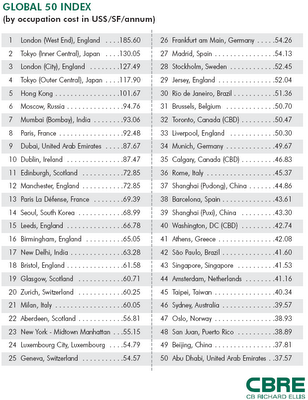
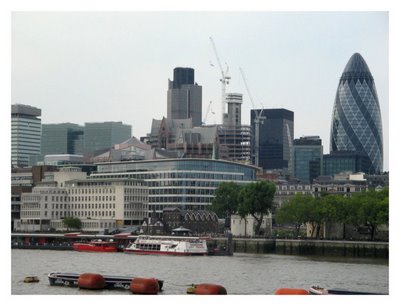
london ist bereits jetzt der ort in europa mit dem am abstand höchsten mieten und immobilienpreisen. ein großteil erklärt sich sicher durch den boom den london als weltfinanzentrum gerade erlebt. in teilen (hedge funds, große internationale börsengänge aus rußland, dem nahen osten und asien) london drauf und dran new york den platz an der spitze streitig zu machen.


vergrößert/enlarge http://img204.imageshack.us/img204/1923/cbyp4.png

london at this point is already europes most expansive place in terms of rents and price. the main reason is that london benefits from the boom in the financial markets. london is on its way to challange new york as the nr.1 city in the financial world. in some categories (hedge-funds and especially in attracting large international ipo´s from rusia, middle eat and asia) they overtook nyc already.


bisher spiegelt die skyline diese fakten nicht wieder. aber dieses ändert sich in den nächsten jahren gewaltig.
die jahresmieten in der city liegen aktuell zwischen 800-900 € und inkl. steuern und servicegebühren bei 1500€ je quadratmeter. diese mieten liegen noch ein drittel unter denen aus dem westend wo sich überwiegend hedgefunds und private equity ansiedeln.

up to now the skyline in the financial district is not very imopressive. but this will change in the next years. the one year rents in the "city/financial district" are round about 1.100$ and including taxes and servicefees 1.1875$ per quadratmeter.http://www.volker-quaschning.de/datserv/us-rechner/index.html. this is one third below the rents in the westend where the hedgefunds and private equity are mainly locatet

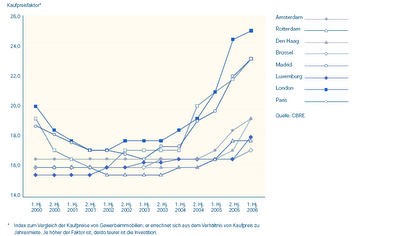
kauf/mietpreisratio london gewerbeimmobilien

buy/rent ratio london commercial properties

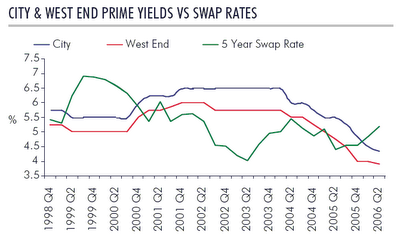
"Central London Offices Market View Q2 2006" Seite 10"The increasing contribution of equity-rich institutions hassustained the downward pressure on yields, even in the contextof increases in the cost of borrowing. Five-year swap rates haverisen by around 70 basis points since the beginning of the yearto nearly 5.2%, restricting the scope for highly-leveragedpurchasers to push yields lower. Nevertheless, with the weight ofinstitutional buying pressure yields sharpened further, withprime West End yields edging down to 3.9% and City yieldsnarrowing to 4.35%."

mehr details zu london und allen stadtteilen und segmenten http://tinyurl.com/ymzemj / wunderbar!

more details on the whole london property market http://tinyurl.com/ymzemj / fantastic!


nur 8% der büros sind nicht vermietet. nur halb so viele m2 wie 2003

only 8% vacancy rate. that represents only half the m2/qudratmeter from 2003.


über 45% der bürofläche in der "city" sind in hand ausländischer investoren. vor 25 jahren waren es erst 5%

over 45% of the office space in the "city" is owned by foreign investors. before 25 years the number was only 5%.

der überwiegende teil der neubauten hat noch keinen mieter.

the majority of all the new buildings has no lease agreements.


hier ist eine fantastische übersicht (pdf) vom september 2005 über die globalen büroimmobilienmärkte. sehr zu empfehlen sind die seiten 16,19,23,26 und 29 !http://www.degi.de/pdf/research/marktreport/global_values_Handout.pdf
here is a fantastic piece about the worldwide officeproperty market with great charts about euope, asia, us kanada. highlights page 16, 19,23,26,29! http://www.degi.de/pdf/research/marktreport/global_values_Handout.pdf

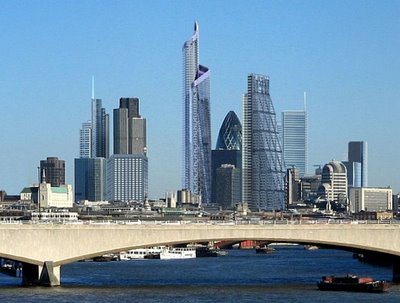
so sieht die city/finanzdistrikt aus wenn in ein paar jahren alles fertiggestellt ist. würde mich wundern wenn alles vermietet ist und wehe die finanzmärkte sollten ne krise durchmachen...... die mietrenditen sind schon jetzt senseits von gut und böse niedrig....

this is the future skyline form the financial district or the "city". i would be very surprised if the ycan lease the space out and maintain a good yield on their investments. at least this should bring the oberall rents/leases down. and i cannot imagine what happens when there is "stress" in the financial markets....... the yields today without this "overbuilding?" are already at or near historic lows


Wednesday, September 13, 2006

great britain / bubble world tour

rest der world tour
http://immobilienblasen.blogspot.com/2006/09/bubble-goes-global.html

dank geht an http://www.housepricecrash.co.uk/

Thousands risk all for mortgages http://news.bbc.co.uk/1/hi/uk/5340878.stm

http://firstrung.co.uk/articles.asp?pageid=NEWS&articlekey=2852

Hundreds of thousands of people are failing to maintain mortgage payments and risk losing their homes, according to a national charity.

Some 770,000 people have missed one or more repayments in the past year, a Citizens Advice survey suggests.

The survey suggests two million people fear they cannot keep up with their monthly payments.

The survey showed that younger people are more likely to have missed a mortgage payment, with 13% of 21-24 year-olds surveyed said they had missed one or more mortgage payments in the last twelve mont

Local Citizens Advice Bureaux helped people to deal with 1.25 million debt problems last year

Case studies

A CAB in Gloucestershire saw a couple who had debts of nearly £300,000. Most of this amount was secured on their home, and the clients had remortgaged eight times (four times with the same lender). The clients had sought advice when they could no longer afford to make the repayments on the mortgage from the husband's self-employed income.

A CAB in County Durham saw a 54 year old woman who was finding it difficult to meet the repayments on a secured loan of £74,000 and other debts. She told the CAB that she had chosen the secured loan because she felt she could trust the celebrity who appeared on the TV advert for the loan company. The client did not understand the implications of the secured loan she had taken out - i.e. that if she did not meet the repayments she would lose her home.

jan-martin