Wednesday, February 16, 2011

Herding, Risk Appetite & Complacency Somewhat "Elevated".......

Just in time after the fastest 100 percent run of the S&P 500 ever....From a risk/reward standpoint this should at least raise some eyebrows......Especially when you add things like "Rally Intensity", margin pressure, geopolitical "instability", "poor" balance sheet quality, Korean bank runs, "Covenant Lite Flashback 2007, "surreal" trading records, a not so pleasant "Misery Index" ( Unemployment & CPI ), persistant "Buy The Dip" Mentality & an überbullish Biriny into the mix....The term "razor-thin margin of error" is probably not an overstatement..... And i havn´t even mentioned the "almost forgotten" ( sovereign ) debt crises.... I assume the markets will at the latest be "tested" when there are hints that "QE 3.0" will be temporarily off the table......Just as a reminder...QE 2.0 "Run Rate " right now : $3.3 billion per day ($2.3 million every minute) & movements in the Fed’s balance sheet in the last 14 months have had an 86% correlation with the S&P 500 ( David Rosenberg ).... The "Run Rate" number is taken from the latest must read Kyle Bass / Hayman Capital Management investor letter

All das fast auf den Tag genau nach einer Verdopplung des S&P 500....Nebenbei bemerkt im kürzesten jemals gemessenen Zeitraum.....Unter Chance/Risikogesichtspunkten haben die Ergebnisse historisch gesehen eher selten eine "stressfreie" Zeit signalisiert....Wenn man weitere Eckpunkte wie z.B. "Rally Intensität", Margendruck, geopolitische Instabilität, Koreanische "Bank Runs", ultralockere Finanzierungsbedingungen, euphorische Analysten, "surreal" anmutende Handelsergebnisse, einen wenig erfreulichen "Misery Index" ( Arbeitslosigkeit & Konsumentenpreisinflation ), extrem hartnäckige "Buy The Dip" Mentalität & "fragwürdige" Bilanzierungsmethoden zum Gesamtbild hinzufügt, dürfte klar sein, das "das Eis nicht gerade dicker geworden ist"......Das "fast vergessene" Thema (Staats)Schuldenkrise will ich nur am Rande erwähnen...... Die "Widerstandsfähigkeit" dürfte allerspätestens ( dann aber "ernsthaft" ) getestet werden, wenn es erste Signale gibt, das "QE 3.0" zumindest für ein kurzes Zeitfenster nicht auf der Tagesordnung steht.....Man muss sich immer wieder aufs Neue vergegenwärtigen das alleine die FED/Bernanke seit Monaten (und noch bis Juni) im Schnitt umgerechnet tagtäglich $3.3 Mrd ($2.3 Millionen jede Minute ) in die Märkte pumpt & lt. David Rosenberg sich der S&P 500 in den letzten 14 Monaten mit einer Korrelation von satten 86% analog zur Bilanzsumme der US Notenbank entwickelt hat....In diesem Zusammenhang komme ich nicht darum hin auf den wirklich lesenswerten Kyle Bass / Haymann Capital Management Investorenbrief zu verweisen.....Danach dürfte selbst die rosaroteste Brille zumindest einen kleinen Spliss davon getragen haben.....


Net Overweight Equities via FAZ


Raging bulls FT Alphaville
And the overwhelming theme of the latest BofA Merrill Lynch fund managers survey is…

Complacency.

From record equity and commodity overweights…

Asset allocation is straightforward and extreme: equity surges to a record O/W of 67%; commodities also at record O/W of 28%; bond allocation tumbles to -66%, lowest since April’06 and close to a record low.

The February FMS is one of the most bullish in years. Institutions have record equity and commodity overweights, very low cash levels and the strongest risk appetite since Jan‘06.

The FMS Risk Appetite Index rose to its highest level (47) since Jan‘06. Hedge fund net exposure rose to 39%, highest since July’07. Cash balances fell from 3.7% to 3.5%, triggering our FMS cash trading rule equity sell signal

Net Overweight Cash via FAZ


Fondsmanager sind rekordoptimistisch FAZ

Fondsmanager sind äußerst optimistisch. Noch nie hatten so viele von ihnen Aktien in ihren Depots übergewichtet, seit die Frage bei der Umfrage von BofA Merrill Lynch im April des Jahres 2001 zum ersten Mal gestellt wurde.

67 Prozent von ihnen haben Aktien in ihren Depots, so das Ergebnis der Februarausgabe der einmal monatlich stattfindenden Umfrage von BofA Merrill Lynch unter 188 Fondsmanagern weltweit. Das ist der höchste Stand, seit die Frage im April des Jahres 2001 in dieser Form zum ersten Mal gestellt wurde.

Noch im Januar hatte dieser Anteil lediglich 55 Prozent betragen und im Dezember des vergangenen Jahres sogar nur 40 Prozent.

Währen der „Aktienoptimismus“ immer extremer wird, werden die Anleihen immer unbeliebter. 66 Prozent der Fondsmanager haben sie untergewichtet, nach 54 Prozent im Januar und 47 Prozent im Dezember. Die Differenz zwischen jenen, die Aktien über- und Anleihen untergewichtet haben, ist so groß wie noch nie zuvor im Rahmen der Befragung.

Merrill Finds That Money Manager Confidence In Stocks At All Time Record High ZH

Couldn´t resist ( Page 17 )....... ;-)

Kann mir diesen Hinweis ( Seite 17 ) einfach nicht verkneifen..... ;-)

GOLD VALUATION :

FMS respondents remain firmly outside of the GOLD fan club with panellists seeing the metal as overvalued for much of the past 3 years.

February’s reading of net 31% overvalued is little changed from a record reading of a net 33% last month.
Not quite the definition of "ALL IN"..... Reassuring to see that at least since 2008 it seems almost nobody of the so called "Smart Money" has read the Special Gold Report "In Gold We Trust"....

Nicht gerade die Definition von "ALL IN"....... Beruhigend zu sehen das seit 2008 anscheinend immer noch sehr wenige der Fondsmanager einen Blick in den Special Gold Report "In Gold We Trust" geworfen haben....

Sentiment & Herding UPDATE via David Rosenberg ( see Blogroll )
The latest investment surveys show 52% bulls and a mere 13% bears. We heard anecdotally that at the ISI conference, the widespread majority believed new highs were coming for equity valuations, bonds were the most detested asset class, and that inflation was going to rip.

One person who attended told us that he had never before been to an event when the consensus was so one-sided, and that says a lot when you consider all the tech conferences being held in 1999 and 2000.

Reading a Bloomberg news story this morning, we were reminded that you have to go back 40 years to see the last time the U.S. stock market surged as much as it has in the past six months with such little volatility and opportunities to buy on dips along the way. In other words, this is not a normal market by any means,having been a virtual straight line up ever since Mr. Bernanke announced QE2 in late August.

And the same institution that conducted the survey above also just published a report concluding that the Shiller cyclically-adjusted P/E ratio is a relic and not to be relied upon as a valuation tool — perhaps because it is now suggesting that the market is 30% more expensive relative to historical norms.

Share

Labels: , , , ,

Monday, April 05, 2010

Profit Margins, Margin Debt & Margin Of Error.......

Combine the data points with the excellent When Risk-Return Makes No Sense: How To Deal With An Overvalued Market and it should be clear that Mr. Market is walking on very thin ice now... I must admit that this is my view since September/October......Cannot help but it at least smells a little bit like "Flucht In Sachwerte"... I still think that the risk / reward is far more favourable in GOLD... ;-)

Wenn man die folgenden Daten mit dem extrem lesenswerten When Risk-Return Makes No Sense: How To Deal With An Overvalued Market kombiniert wird klar das man sich momentan auf sehr dünnem Eis bewegt.... Muß gestehen das ich diese Ansicht seit dem September/Oktober vertrete.... So langsam kann man zumindest unterschwellig das Gefühl haben das zumindest in Teilen eine "Flucht In Sachwerte" eingesetzt hat.....Bin mehr denn je überzeugt das in Sachen Chance/Risiko die Aussichten für GOLD weitaus vielversprechender sind.... ;-)

William Hester / Hussman Funds
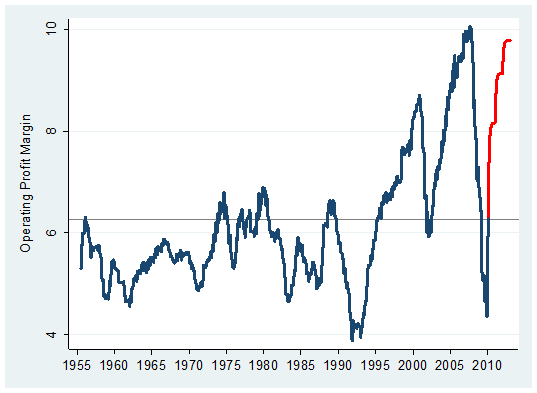
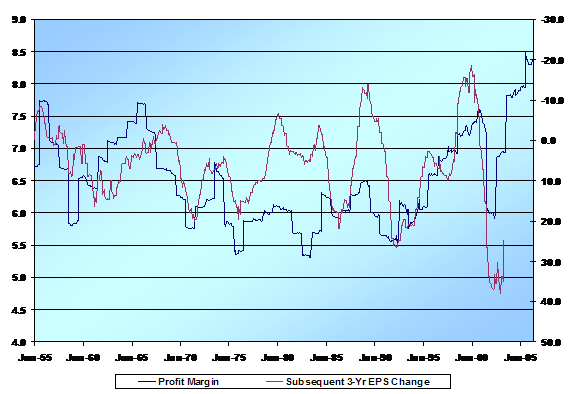
While earnings growth expectations are steep, sales growth expectations are more modest. Sales-per-share for S&P 500 companies is expected to grow about 5.5 percent this year and about 7 percent next year, according to forecasts. The difference between the growth rates of the top and bottom lines is implies a forecast for sharply rising operating profit margins. The graph below is updated from an earlier piece, and includes forecasts through the end of 2012. It plots the long-term level of S&P operating margins in blue. In red, I've plotted the operating margins currently being forecasted by analysts based on their projections for sales and earnings. Last October, analysts were about half way to pricing in profit margins that matched the record levels of 2007. Now, they are just about there.
David Rosenberg / Gluskin Sheff
As for 2011, the consensus is looking for $97 on S&P 500 operating EPS — we did $95 at the peak of the last cycle when the unemployment rate was at 4.5%, the industry CAPU rate was 81%, private sector credit xpanding at a 16.2% annual rate and nominal GDP at a 4.9% YoY pace.
So the consensus believes that barely two years into the second weakest post-recession recovery in the past six decades that we will actually get back to peak profit levels seems to be a tad outlandish.
Stock Market Rally Explained The Mess That Greenspan Made

Ad in the the Money & Investing section of today’s Wall Street Journal

Factoring in the tight junk spreads right now one must assume that looking at the next chart the "Margin Of Error" is probably "slim"......

Da momentan selbst historisch gesehen recht enge Junk Spreads vorherrschen muß man beim Anblick des nächsten Charts wohl unterstellen das in Sachen "Margin Of Error" wenig "Spielraum" bleibt.....

Investors really ♥ junk. We mean really. FT Alphaville

In most discussions of the high-yield bond market, historical spreads play a major role. But comparing spreads today to those of the past assumes that junk bonds are a constant entity over time. Unfortunately, junk is junkier today, as illustrated by this chart [at left] from last October’s Global Financial Stability Report.

The fraction of CCC or lower-rated bonds approximately doubled from early 2007 to early 2009. And according to a recent report from Fitch, the fraction at the end of 2009 was still 27%.

Debt ranked in the BB category gained 39.1 percent in the past 12 months, underperforming the CCC tier by 66 percentage points, according to Bank of America Merrill Lynch index data.


H/T EconomPicData

The "risk trade" is currently clearly not in the early innings....... Looks like the Mantra Bullish. No Matter What & the "Moon Trade" ( brilliant!) is still alive & kicking.... ;-)

Der sog. "Risikotrade" befindet sich sicher nicht mehr im "Anfangsstadium"..... Sieht so aus als wenn das Motto Bullish. No Matter What sowie Ladies and Gentlemen, We Are Trading On The Moon ( brilliant!) momentan noch immer zu greifen scheint...... ;-)+

UPDATE:

PARTS OF THIS MARKET ARE LOOKING IRRATIONAL PragCap

Why Young People Should Buy Stocks on Margin Time H/T Denninger

We just survived the worst debt-fueled binge since the Roaring '20s. Now two professors at Yale University are suggesting we introduce leverage into a new realm of our lives —our retirement portfolios. TIME's Barbara Kiviat asked economists Ian Ayres and Barry Nalebuff to explain themselves.

You are advocating that people in their 20s and early 30s take all of their retirement savings and buy stocks on margin. Can you explain why that's not as crazy as it sounds?

"It's not as crazy as it sounds because it helps people better diversify risk across time"

Read this twice....

UBS: EQUITY MARKET RISKS APPROACHING EXTREMES PragCap

Irrational Exuberance Is Here: VIX Lowest Since July 2007 As Options Speculation Highest Since Dot Com Days

The VIX has just hit the lowest level since July of 2007 as Sentiment Trader reports that "speculation in the options market has spiked to its highest levels since the spring of 2000."
As i´ve said, not in the early innings.....

Wie gesagt, nicht mehr im Anfangsstadium......

Labels: , , , , , , , , , , , , ,

Wednesday, January 13, 2010

Does Anyone Detect A Hint Of Complacency?

What a fascinating market and via FT Alphaville comes another good indicator of how "extreme" investor sentiment has become. Joshua Brown in Ladies and Gentlemen, We Are Trading On The Moon (!) has so far the best & funniest transcription of the latest market behavior....

As i have written in the past few days in Don´t Call It A Bubble.... & "Anti Spin" i´m a very sceptical ( more bearish than ever ) that this kind of market level is sustainable.... Especially in the face of a "spiking" Sovereign Misery Index .....To be honest i´m thinking this since October.... Make sure you watch the following clip.... Nice to see that Saluzzi still isn´t drinking the kool aid....

Bin jeden Tag aufs neue fasziniert wie der Markt auf die Nachrichtenlage reagiert. Meiner Meinung nach Joshua Brown in Ladies and Gentlemen, We Are Trading On The Moon (!) die bisher beste und lustigste Analyse zu Papier gebracht.

Ich bin wie in Don´t Call It A Bubble.... & "Anti Spin" geschrieben "skeptisch" ( höflich umschrieben ) was die Nachhaltigkeit der Kursanstiege angeht. Und all das im Angesicht eines täglich steigenden Sovereign Misery Index .....Meiner Meinung nach ist das Chance/Risikoprofil so unvorteilhaft wie selten....Die Skepsis steigt momentan tagtäglich und erreicht geradezu schwindelerregende Höhen.... ;-) Der nachfolgende Clip von Saluzzi liefert eine weitere gute Bestandsaufnahme in Sachen aktuelle Marktstimmung.....


Chilled markets FT Alphaville

Markets move on the interaction of news with flows of greed and fear among investors. When fear is lowest, the danger of a fall is greatest.

Especially when other sentiment indicators are considered:

Another great contrarian indicator is the survey of sentiment by the American Association of Individual Investors. Last week, this showed the lowest proportion of self-described “bears” since February 2007 – when volatility first started to spike as investors at last began to grasp the severity of the subprime mortgage crisis in the US.

Bearishness in this survey hit an all-time high in March last year when the current rally first started, showing how much money can be made by betting against extremes of sentiment.

But it’s not just the retail punter who’s bullish.

The Pros are too.

From Bloomberg:

Investors forecast gains in each of the nine countries represented in the Bloomberg Professional Confidence Survey for the first time since the data began in 2007.

The sentiment measure for the Standard & Poor’s 500 Index climbed 35 percent to 54.37. That’s only the second time the reading exceeded 50, signaling participants anticipate a rally in the next six months.

The responses from 4,101 Bloomberg users were gathered Jan. 4-8 as the MSCI World Index added 2.6 percent.

The Bloomberg sentiment indexes for the U.S., Japan and Spain rose above 50 and reached all-time highs.

The U.K. gauge topped 50 for the first time since October, while Switzerland climbed to a record.

Spain exceeded 50 for the first time, adding 17 percent to 51.41.

Confidence in Switzerland climbed 3.6 percent to 60.89, and the U.K. index surged 22 percent to 55.61. The measures for Italy, France and Germany increased 14 percent, 3.7 percent and 2.4 percent to 62.61, 57.77 and 53.33, respectively.

Does anyone detect a hint of complacency?
FUND MANAGER BULLISHNESS COULD BE WARNING SIGN PragCap
The latest survey showed the highest surge in Merrill’s Risk & Liquidity(46%) indicator since May of 2006. In the past, this indicator has served as a fairly good contrarian indicator.

This survey is showing some contrariansell signals. Just 45% of fund managers are protecting themselves against a downturn versus 52% in December. The survey also shows a strong appetite for risk and high beta names

FMS1 FUND MANAGER BULLISHNESS COULD BE WARNING SIGN

Faber on complacency & investor sentiment......


EXCELLENT!

Labels: , , , , , , , , ,

Thursday, January 07, 2010

Don´t Call It A Bubble........

After the introduction of the "Pay-If-You-Can-Loans" the comeback of Toggle/PIK Bonds are more than early warning signs that something is at least a little bit "frothy"...... The same is true for numerous stock markets ( see the following chart Mexican Stock Market Back To All Time Highs WOW!)

Nachdem ja vor kurzem die "Pay-If-You-Can-Loans" ins Leben gerufen worden sind ist die noch vor wenigen Monaten undenkbare Wiederaufersteheung der Toggle/PIK Bonds ein weiteres Anzeichen, das nennen wir es mal vorsichtig, eine leichte "Überhitzung" eingetreten ist.... Leider sieht es in etlichen Aktienmärkten nicht bedeutend anders aus ( siehe nachfolgden Chart Mexican Stock Market Back To All Time Highs WOW! )

Treasurers Embrace Pay-in-Kind Bonds as Ghost of Lehman Fading
( Bloomberg ) Companies are selling debt with terms last seen before credit markets froze, showing why the world’s biggest bond fund manager says another bubble may be brewing.

JohnsonDiversey Holdings Inc., a Sturtevant, Wisconsin, maker of cleaning supplies, and Wind Acquisition Holdings Finance SpA, parent of Italy’s third-largest mobile-phone company, sold bonds that can pay interest in new debt instead of cash, the first such deals since 2007, according to Bloomberg data.

Goodman Global Inc. raised $320 million to pay its owner, leveraged buyout firm Hellman & Friedman, a dividend, one of at least seven similar offerings since November

Two years after credit markets seized up, treasurers are luring investors to junk bonds that returned a record 58 percent last year, as measured by Bank of America Merrill Lynch indexes. U.S. sales of $162 billion beat the all-time high of $149 billion in 2006, Bloomberg data show.
“Six months ago I wouldn’t have imagined being able to do this deal,” said Karim-Michel Nasr, head of corporate development in Paris at Weather Investments SpA, Wind’s holding company.....
Capital Access
At least two dozen borrowers since November have asked lenders to change terms of debt agreements to permit bond sales, extend loan maturities or pay dividends to their owners, Bloomberg data show.
Access to capital means defaults will likely drop to 3.9 percent by November from 12.7 percent a year earlier, New York-based Moody’s Investors Service says.

Speculation that companies will have less difficulty making payments has led investors to accept lower interest rates and looser borrowing terms. The extra yield demanded on junk bonds instead of Treasuries narrowed to 6.39 percentage points at the end of 2009 from almost 19 percentage points on March 9, Merrill Lynch indexes show. Speculative grade debt is rated below Baa3 by Moody’s and BBB- by Standard & Poor’s.

‘We Forget’
“I’m looking at some of the things that are being priced and I’m saying, ‘Wow, how quickly we forget,’” said JohnsonDiversey Chief Financial Officer Joseph Smorada. The market is “starting to get a little dangerously aggressive,” he said.

The company sold $250 million of so-called toggle debt due in May 2020 on Nov. 20 that allows it to pay a 10.5 percent interest rate either in cash or notes for the first five years.
The first pay-in-kind bonds since 2007 were part of a $2.6 billion recapitalization in which New York-based LBO firm Clayton Dubilier & Rice Inc. agreed to buy a 46 percent equity interest in the company.
Moody’s gave the notes its fifth-lowest ranking of Caa1, saying the debt is five times more than adjusted earnings before interest, taxes and amortization costs. It has had negative free cash flow the past three years, though it’s expected to break even in 2010, Moody’s said.
‘Dangerously Aggressive’
“In early 2009, I don’t think we could have borrowed a nickel if our life depended on it,” Smorada said. Investors submitted bids for almost four times the amount of notes offered, he said.
Investors haven’t lost discipline and companies are mainly selling bonds to refinance or cut interest expenses, said William Cunningham, the head of credit strategy and fixed-income research at State Street Corp.’s investment unit in Boston.
Wind Acquisition of Luxembourg raised $1.1 billion last month selling 7.5-year, 12.25 percent notes in dollars and euros that allow it to pay interest with more debt until 2014. Wind, controlled by Egyptian billionaire Naguib Sawiris and the parent of Wind Telecomunicazioni SpA, boosted the offering 50 percent as demand rose.
The investment flood has undercut efforts to toughen restrictions that protect investors, said Alexander Dill, senior covenant officer at Moody’s in New York. Many covenants are “largely replicating” rules from 2006 and 2007, Dill said in a Dec. 10 report.
TRW Automotive Inc., the world’s biggest supplier of vehicle-safety equipment, sold $250 million of eight-year notes in November rated Caa1 with covenants “substantially unchanged” from its 2007 indenture for debt graded four steps higher at Ba3, according to the Moody’s report. The Livonia, Michigan-based company said Dec. 22 it raised $400 million in term loans as lenders amended and extended its revolving credit facility.
FT Alphaville
Global high yield debt volume for the week of January 11th totaled $11.7 billion, the biggest week for high yield debt on record. The previous record was set during the week of November 5, 2006 when $11.4 billion was raised. With $14.4 billion raised so far this month, it is the best all-time start for the high yield markets since records began in 1980.
Update High Yield Bonds Continue To Do Well Bespoke
Over the past month or so, the only area of the bond market that has done well is junk. Both Treasuries and investment grade corporates have struggled, while high yield bonds have continued to surge. Below we highlight a six-month performance chart of the high yield bond ETF (HYG) and the investment grade corporate bond ETF (LQD).
Lqdhyg

Mortgage-Bond Leverage Reaches 10-to-1

Wall Street firms are loosening terms of their lending to mortgage-bond investors as markets heal, an RBS Securities Inc. executive said.

Repurchase agreement, or repo, lending against the debt has expanded so much since freezing in late 2008 that some banks now offer as much as 10-to-1 leverage and terms as long as one year on certain securities backed by prime jumbo-home loans

Update

Bubble warning ( Economist )

Once again, cheap money is driving up asset prices
( Economist )

Ladies and Gentlemen, We Are Trading On The Moon :-) Reformed Broker

Labels: , , , , , , , ,

Sunday, June 17, 2007

Number Of The Day.....Central Banks Are Increasing Risk

wow! don´t know how to read this number. on the one hand it is for sure not good news for government bonds. this is especially true for US treasuries. on the other hand it is somewhat frightening to see that now central banks are increasing risk in an attempt to boost returns. this comes just at the point when spreads are almost nonexistent and the risks are higher then in the past. one more reason to own gold....... :-)

the right graph shows the spread on European investment grade bonds vs. euro government bonds. the picture around the world is from a historic perspective quite similar. donnerwetter! bin mir nicht ganz sicher wie man diese zahl deuten soll. auf der einen seite sicher keine guten news für staatsanleihen. das gilt sicher besonders für US anleihen. auf der anderen seite kann einem ganz schön mulmig werden wenn man bedenkt das jetzt selbst die zentralbanken probieren ihr risiko just zu dem zeitpunkt erhöhen wo weltweit die risikiaufschläge historische tiefs erlangt haben und die risiko ungleich größer als in der vergangenheit sind. ein grund mehr gold zu besitzen..... :-)

Seventy-four percent of central banks surveyed by Zurich- based UBS AG this month said they increased their holdings of asset-backed securities, emerging market debt and other higher- risk securities this year. In the next year, 68 percent plan to add more, according to the survey, which covers banks that oversee 91 percent of the world's foreign-currency reserves.

> the number gets more worrysome if you consider that some of the central banks (Spain, Swiss) are selling big parts of their gold holdings at the same time........

>das ganze wird noch bemerkenswerter wenn man bedenkt das einige zentralbanken (Spanien, Schweiz) zeitgleich bedeutende teile ihres goldbestandes veräussern

disclosure: long gold, goldbugs/hui


Labels: , , , , ,

Tuesday, February 27, 2007

liquidity and risk taking / Jeff Saut

great stuff from jeff saut! (headline for more!)
looks like in china (down 9% http://immobilienblasen.blogspot.com/2007/02/china-down-9-biggest-slump-in-10-years.html they have become a little more nervous )

zumindest in china scheint diese these heute einzutreffen.
....my firm believes liquidity certainly plays a role and currently the monetary base is exploding. Moreover, it is not just our money supply that is surging but Austrailia’s (+13% year-over-year), England’s (+13%), the Euro Zone’s (+9.3%), Korea’s (+10.3%), China’s (+16.9%), etc.


Yet as my firm has suggested, while liquidity is unquestionably a driver of asset classes, if investors are unwilling to take that liquidity and buy something with it asset classes go nowhere. Manifestly, you can throw all the liquidity you want at the markets and if investors have no “risk appetite” they will merely take said liquidity and stuff it in a money market fund.
We, therefore, have argued that investors’ risk appetite is the ultimate driver of asset prices and after the nearly unprecedented rally from July 2006 to February 2007, participants’ risk appetites are currently high. When this will change is unknowable, but change it will.

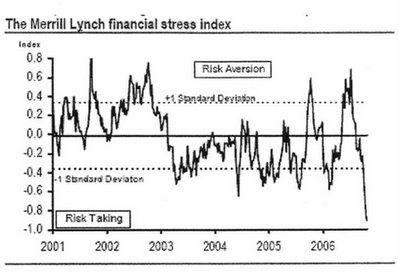
i´ve put up a chart from end of 2006 that meassiures risk taking. but you just have to look to the spreads, the latest action in the private equity sector, carry trade etc to see that risk taking is going into extra innings.....


ich habe hier einfach mal nen chart von ende 2006 genommen. man muß aber nur auf die spreads und die letzten wahnwitzigen private equity transaktionen, den carry trade etc blicken um zu sehen das hier wohl bereits die verlängerung läuft...

Labels: , , ,

Thursday, February 22, 2007

"Hall of Fame" A New Era / pimco

looks like the risktakers don´t need to invent the cash cow. they have found it .....for now.
once more fantastic stuff from pimco.

die cash cow muß momentan nicht erfunden werden. die scheint momentan überall vorhanden zu sein. wieder einmal mehr geniales von pimco


Global Liquidity Boom
The global financial system is indisputably experiencing a boom in liquidity, driven by growth in corporate cash balances, foreign central bank reserves, private equity and hedge funds. This liquidity boom, along with new financial products, is changing the way that investment professionals traditionally view, evaluate and invest in financial markets. On the corporate front, strong global economic growth and easy global monetary policy over the past several years have led to a sharp rebound in corporate profit growth. In the United States, corporate profits as a percent of nominal GDP are now at 40-year highs (Chart 1). Despite this solid profit growth, most CEOs have remained conservative with capital spending.

As a result, corporate cash flow and cash balances have soared, providing Corporate America with a surplus of funds.
The growth in cash on corporate balance sheets is serving as a catalyst for rising shareholder activism. Aggressive shareholders are increasingly putting pressure on management to redirect large cash balances toward share buybacks and increased dividends. High cash levels are further helping to facilitate more mergers and acquisitions. In addition, private equity investors are tapping into Corporate America’s significant cash position to use as part of an initial equity stake for leveraged buyouts (LBOs). These trends, influenced by high corporate cash balances, are fueling a global boom in equity markets. Thanks to easy access to capital from both the high yield and bank debt markets, cash is being transferred from bondholders to shareholders as Corporate America engages in a re-leveraging campaign.


International developments have also bolstered global liquidity. Solid global economic growth has boosted exports from emerging economies and supported rising commodity prices. The resulting trade surpluses have led to rapid foreign exchange reserve accumulation by central banks in emerging markets (Chart 2), ....., central banks have supported the U.S. bond market by helping to keep interest rates low, contributing to generous liquidity conditions.

The broader change in global savings patterns has been dramatic. Current account deficits in the emerging world have given way to current account surpluses. Borrowers have turned into lenders. China, now with a current account surplus of over 8% of GDP, exemplifies this trend of capital rolling “uphill” from the developing world to the developed world. In addition to Asian savings, the rise in crude oil over the past several years has resulted in massive savings by oil exporters, a large portion of which have flowed into sovereign investment funds in Middle Eastern countries. ...

foreigners have become the dominant bid in some segments of the U.S. market. In the U.S. corporate bond market, foreigners are increasingly shifting their bond allocations into credit markets, in order to earn higher yields. Due to large foreign capital flows, the credit market is currently in a state of technical imbalance in which the demand for bonds is greater than the new supply of bonds. Over the past three years, foreign buyers have absorbed more than 100% of the net new corporate bond issuance in the marketplace (Chart 4). Therefore, not surprisingly, credit spreads remain near all-time tight levels.

Finally, private equity capital and hedge funds have further benefited from a structural shift in the markets, and have helped to provide fresh liquidity into the financial markets. Private equity groups announced $700 billion worth of deals in 2006, more than double the record set in 2005.1 Deal sizes are also increasing. The Blackstone Group’s recent $39 billion all-cash purchase of Equity Office Properties (EOP) attests to the liquidity private equity players now have at their disposal. Hedge fund growth has also exploded and there appears to be no near-term end in sight given that these firms are now able to come to the public markets to raise equity to grow their capital base. As an example, Fortress Investment Group LLC recently raised $634.3 million in equity through an initial public offering (IPO).2 Private equity and hedge fund investors, driven by the need to justify lofty management fees, are seeking higher returns by embracing higher risk tolerances. As we discussed in our December 2006 U.S. Credit Perspectives, Credit Innovation and Opportunity, the quest for yield has fueled rapid innovation and rising risk in the credit markets.

New pools of capital are also seeking out alternative investments. .... Goldman Sachs has benefited tremendously from these secular changes in the financial markets . Goldman Sachs is not only one of the largest global advisory firms in the world, but it is also the largest manager of hedge fund assets.3 It is a primary beneficiary of the growth in collateralized debt obligations (CDOs) and credit derivatives, which have acted to expand liquidity in the credit markets through disintermediation and innovation. Goldman Sachs has aggressively moved into private equity capital fund raising, and reportedly just raised $19 billion through a new fund, ....


The trends that have contributed to tight corporate bond spreads are having a similar effect on the U.S. stock market. The supply of new stock issuance (Chart 6) has turned sharply negative due to rising share buybacks and LBOs. This technical imbalance, combined with solid economic and corporate profit growth, has helped lift equity prices to record highs. Robust global liquidity combined with reduced supply has changed the landscape of equity investing.


Asset Prices, Risk Premiums and Financial Conditions
The global liquidity boom has its consequences. Rising asset prices are leading to easy credit conditions, which in turn are supporting economic growth, lowering volatility and compressing risk premiums. In this environment, investors with relatively short memories have embraced this recent period of economic nirvana as if it were here to last, by taking on more leverage and adding even riskier investments.

In the credit markets, the low and declining default rate has encouraged a strong propensity to take risk over the past few years. As a result, the growth in global liquidity has increasingly been funneled into higher risk asset classes such as lower-quality investment grade corporate bonds, high yield bonds, emerging market bonds, collateralized debt obligations (CDOs), real estate and equities. This trend further reduces the cost of capital to take on leverage, supports more LBOs and provides additional fuel for the equity market. In fact, LBO volumes have grown at an annualized rate of 64% from 2002-2006.5 We have not seen this type of growth in corporate re-leveraging since the late 1980s. Given these conditions, it is no wonder the Federal Reserve is sounding hawkish. Accommodative financial conditions are providing a stimulus to the economy.

While monetary conditions have tightened somewhat with a higher Fed Funds rate, credit and financial conditions remain easy. These conditions are a significant reason why Moody’s consistently has pushed back its estimates for rising default rates (Chart 7). I believe investors are underestimating the risks present in today’s low default rate environment, because today’s credit markets are significantly impacted by technical factors. I am skeptical that credit spreads are at near all-time tights because of improved fundamentals, especially given the rise in shareholder-friendly initiatives, growth in private equity and increasing occurrence of LBOs. ...here an example where they are way too late..http://immobilienblasen.blogspot.com/2007/02/rating-agencies-fallen-asleep-doug-kass.html

Implications for Credit Investing
The liquidity-driven boom in today’s financial markets has had a significant impact on corporations. Cash continues to pile up on corporate balance sheets, and companies have never before found such easy access to capital, due to a benign credit environment and tremendous growth in the bank debt and private equity markets. Hedge fund growth has also led to strong demand for structured credit risk. These financial sponsors are flooding corporations and markets with new pools of capital. This trend helps to explain why corporate default rates have failed to rise despite projections of higher default rates. Simply put, it is hard to default when investors continue to lend money. http://immobilienblasen.blogspot.com/2006/11/leverage-buy-outs-lbos-private-equity.html

Despite low default rates, the credit market faces significant challenges arising from the growth in private equity and hedge fund capital. Equity-friendly measures, such as LBOs (chart 8), share buybacks, divestitures and mergers and acquisitions are on the rise. In addition, corporate profit growth is slowing, and management is beginning to re-leverage balance sheets in response to increasing pressure from hedge fund and private equity investors. As the pendulum continues to shift from bondholders to equity holders, we should expect shareholder-friendly initiatives to remain elevated.

Despite extremely tight credit spreads on investment-grade corporate bonds, investors continue to seek higher returns by investing further down the capital structure. This classic, late-cycle behavior supports the notion that we are in a liquidity-fueled market in which downside risk far exceeds potential upside returns, particularly for most investment-grade corporate bonds without covenant protection and for lower-rated, high yield bonds.

Labels: , , , , , , , , ,

Thursday, January 25, 2007

Can't pay? Won't pay... watch the credit default swaps/ economist

oh boy. some sobering examples that the world is really awash with excess cash and that the protection/insurance from the swaps maybe not always be on top of things. here is another example of "junk bond schadenfreude" from eastern europe http://immobilienblasen.blogspot.com/2007/01/junk-bond-schadenfreude.html.
oh mann! einmal mehr beispiele für eine welt in der einfach zu vile liquidität herrscht und risiken dadurch nicht wahr genommen werden. besonders schön zu sehen wie das mittel der "versicherung" gegen ausfälle die swaps anscheined längst nicht immer auf der höhe der zeit sind. ein weiteres beispiel aus osteuropa könnt beim link oben sehen.

In emerging markets, the bond-market dogs lose their bite

“WHEN I come back, I want to come back as the bond market, because then you can intimidate everybody,” said James Carville, Bill Clinton's political adviser, in the 1990s. But the “bond-market vigilantes” are not always as menacing as they once were.


Emerging-market governments now seem able to thumb their noses at investors. The latest is Ecuador, where the economy ministry has described some parts of its debt as “illegitimate” and hinted at repaying just 40% of the outstanding total

It is not that Ecuador lacks resources. Investors generally agree that any default would be the result of unwillingness, rather than inability, to pay. Standard & Poor's, a rating agency, said Ecuador had “one of the weakest payment cultures” of the 113 countries it monitors.

WOW!!!!!! more questions...?.....when this is "insurance" cost for one of the weakest players out there.......noch fragen? wenn das die versicherungskosten für den schwächsten schuldner überhaupt sind....

.....credit-default swaps, which insure the buyer against non-payment, traded as low as 270 basis points (hundredths of a percentage point) in August; they are now at 1,350 basis points.!!!!!!!


...... With returns on American Treasury bonds and high-grade debt too low to meet the needs of pension funds and endowments, they have to take more risks. ( is also true for almost every other asset class out there.../ gilt gleichermaßen für fast jede andere anlageklasse.......)

According to the Institute of International Finance (IIF), an international banking club, some $502 billion of private capital flowed into emerging markets last year, only slightly down on the $509 billion in 2005. The IIF predicts $469 billion of capital flows this year, which would be the third-highest level on record. (the liquidity has to go somewhere........)


Those flows reflect the general perception that emerging-market economies have improved substantially since the Asian crisis of 1997-98. Many developing countries are running current-account surpluses, in order to be less dependent on foreign capital than they were a decade ago.....
An element of moral hazard may have entered the equation. Argentina imposed a substantial default on its creditors five years ago. Its debt now yields a little above two percentage points more than American Treasury bonds; hardly a sign that it is a financial pariah. ....... (read this twice. wow! they are for sure fans of madness. (and some may have also alzheimer)....... wie kurz doch das gedächnis manchmal ist......sind bestimmt fans von madness darunter..einge evtl. mit alzheimer......:-)


This may reflect a change among investors. When the Latin American debt crisis broke in the 1980s, much of the debt was in the hands of Western banks. Given the importance of these banks to the financial system, there was a lot of political interest in ensuring that the loans were restructured. ( not so sure about this point about the "political interest" if not from government the central banks will take an important role. would be great but ltcm has shown that at least the fed is way too often willing to bail somebody out..../ bin mir da nicht so sicher. wäre fast sicher hilfreich. die geschichte zeigt allerdings das zumindest die fed bei der schieflage von ltcm sofort eingesprungen ist)
Now that debt is widely dispersed among hedge funds, pension funds and the rest, it may be harder for creditors to join ranks. And while one hedge fund may give up on Ecuador, another may see the crisis as a buying opportunity.


...... Ecuador's bonds were trading close to their face value in the spring of last year, according to PIMCO, a fund-management group; now the benchmark 2030 bond trades at only 70 cents to the dollar. Its credit-default swaps, which insure the buyer against non-payment, traded as low as 270 basis points (hundredths of a percentage point) in August; they are now at 1,350 basis points. (schadenfreude!)

Emerging-market investors also point out that Ecuador is a small country, in terms of both population and importance to financial markets. They argue it would be wrong to see it as a harbinger. So far there has been little sign of a “contagion effect” in other markets.

However, Richard Bernstein of Merrill Lynch likens risk to popcorn in a microwave. One kernel pops, but it seems to be an isolated event. Then another goes and another, until the entire bag is active. Ecuador is only the latest pop, following Thailand's botched capital controls, Venezuela's proposed nationalisations and sharp falls in commodity prices.


At some point, the credit cycle will turn and some emerging markets may regret “dissing” international investors when the going was good. .......( well, i think thet in the first place the investors of this bonds with only 2 points spread will regret the purchase.........../nun ja, ich denke das wohl zuallererst die käufer dieser anleihen die zu niuedrigen risikoaufschlägen gekauft haben das bereuen werden......
so just when you think that at least some riskpremiums are widening the next player steps in to fill the gap..... / so gerade wenn man denkt das zumindest ein teil der risikoaufschläge sich ausweiten kommt schon der nächste spieler und füllt die lücke
Nigerian bonds / No laughing matter
IF YOU had told an international banker a few years ago that Nigeria was preparing to issue bonds on the global market, he may well have laughed in your face. The banking sector was weak and fragmented and Nigeria's government was bogged down in fruitless negotiations over the billions of dollars of debt racked up during years of corrupt military rule.

But on January 22nd one of the country's main commercial banks issued a five-year Eurobond worth $350m at an interest rate of over 8%, and demand was high. It was the first time any Nigerian institution, private or public, had approached the international capital markets since the early 1990s. ...
The government is itself looking seriously at entering the Eurobond market this year, once important capital-market guidelines have been implemented, he says. The country should be able to take advantage of its lower debt profile after it finally succeeded in negotiating an $18 billion write-down from Paris Club lenders in return for a $12 billion settlement last year and announced plans to repay—through a complicated manoeuvre—its remaining London Club debt.......

Mr Muhtar says that Nigeria hopes to win better debt ratings from Standard & Poor's and Fitch. Both credit-rating agencies still place it a few notches below investment grade. The government is keen to place its own Eurobond so that it can offer investors a sovereign benchmark, against which other issuers are measured. It also wants to use debt to finance the country's pressing infrastructure needs without having to dip into its international reserves, valued at more than $40 billion. ( hey its always better to negotiate the debt when things go wrong.... when you can finance things to 8% its no wonder that nigeria is taking on debt. clever and a good move from nigeria (honestly) / kein wunder. wenn man sich zu 8% verschulden kann hat man wenn sachen nacher nicht gut laufen immer noch die möglichkeit die kredite zu verhandeln )

Despite the economy's progress, politics are likely to be the determining factor in Nigeria. It took the government of President Olusegun Obasanjo almost two terms in office to bring Nigeria's capital-market reforms this far. With national elections in April that are due to be hotly contested and Mr Obasanjo fully aware that politics could upset his economic reforms, international investors still have plenty to be nervous about. “We are keeping our fingers crossed,” says Mr Muhtar.

Labels: , , , , ,

Thursday, December 07, 2006

Jessica Simpson model of investing / saut+minyanville

ank an jeff saut und minyanville
full story! http://www.raymondjames.com/inv_strat.htm

Almost 2% of the NYSE’s entire market capitalization has been taken private (read: LBO’ed) since the beginning of this year.

So much money is sloshing around in private equity funds that we now have the Jessica Simpson model of investing – “I don’t know what it is, but I want it!”

Private equity funds are looking to “lever” corporate America’s under-leveraged balance sheets and exploit them accordingly.

There are now more hedge funds than there are stocks and 60% of those funds are less than 5 years old. This trend will end with mediocre performance by most hedge funds.

Gold is going up against most assets. And, foreign energy stocks are making new all-time highs and “pulling” U.S. energy stocks higher.

The U.S. has the highest “real” (inflation adjusted) interest rates in the developed world, implying capital should continue to flow here. (which is needed to protect the remaining of the $.....)

If current profit margins, and free cash flows, are sustainable, then the equity markets can continue to levitate. However, a “mean reverting” world suggests we are long-of-tooth in this trend.

for scale plus bigger from hussman http://www.hussmanfunds.com/rsi/profitmarginsh.gif

Sam Zell is not stupid! Therefore, the recent sale of his flagship REIT (EOP/$48.30/Underperform) should be viewed as a watershed event. http://tinyurl.com/yhkquq

Bank indices are deteriorating against the S&P 500 Index (SPX). Since the Financials have roughly a 22% weighting in the SPX, this is troublesome.

If the rumors about a Home Depot (HD/$38.97/Outperform) LBO were for real, the long-dated call-options on HD should have collapsed and that just didn’t happen.

Volatility and Risk are currently being WAY under-priced by the markets

Labels: , , ,

Monday, November 20, 2006

jeff saut / Roger Real Estate, Larry Leverage, Jimmy Junk bond, and the over-leveraged dance continues

what a summary!. great read and very interesting charts!/ tolle zusammenfassung und wirklich klasse charts.

dank geht an jeff saut http://www.raymondjames.com/inv_strat.htm
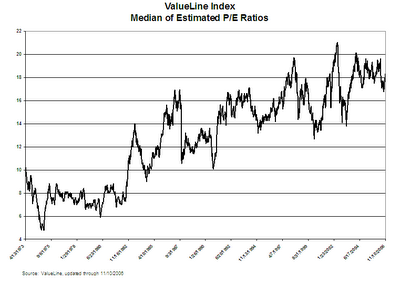
......Speaking first to valuations, we have often stated that the best representative index for the average stock is not the S&P 500, but the ValueLine Index. At its peak the median P/E ratio of the ValueLine Index was 20.9x (see chart 1).

Currently its P/E ratio is 18.3x, and while not as expensive as it was at its zenith, it is certainly not “cheap” by historic standards.

Second, as for earnings momentum, if you deduct share repurchases, and seasonally adjust earnings, one finds that earnings momentum has been slowing since 4Q05 and is currently tracking toward mid-single digits.

Third, recent reports leave little doubt that the economy is slowing. Indeed, GDP, capex shipments, ISM, private payrolls, Industrial Production, Existing Home sales, retail sales, et all, have been contracting. The lone stand-out arguing for economic strength remains governmental tax receipts, which continue to record low double-digit growth readings. Plainly that just does not “foot” with the recent 1.6% GDP report.

größer/bigger http://www.raymondjames.com/images/inv_strat/inv_strat_061120_1lrg.gif

Other “non-footers” include:

1) a personal U.S. savings rate that appears to have bottomed, implying that Americans are saving more. This is not an unimportant observation, for it can be argued that for every 1% increase in the nation’s savings rate the business sector loses roughly $100 billion in profits;

2) reinforcing point one is a rare event that saw consumer credit actually get paid down in September with a concurrent reduction in bank lending to households during the month of October;

3) that begs the question, “following the Goldman Sachs-induced crash in gasoline prices, which have subsequently rebounded now that the gasoline weighting has been cut from 7.3% to 2.5% in Goldman’s much indexed commodity index, why have the retail stocks held up so well?!;”

4) evidently Amazon (AMZN/$42.55) and Wal-Mart (WMT/$47.50) don’t believe the retail rebound is sustainable since they are cutting their respective capex spending budgets;

5) and why, pray tell, does the U.S. Dollar Index remain amazingly resilient in light of low interest rates and given the fact that China, Russia, the United Arab Emirates, Saudi Arabia, Switzerland, New Zealand, etc. all telegraphed that they are reducing their weightings of U.S. Dollar reserves?;

6) why did the SEC, in mid-October, reduce margin requirements for select investments by hedge funds?;

7) how in the world can “guest workers” sue U.S. companies for under-paying them ( USA Today 11/15/06)?;

8) we could go on, but you get the idea . . .there are a lot of disconnects currently.

Meanwhile, participants have continued to increase their “risk profile,” as seen in the nearby chart from Merrill Lynch (chart 2), with an attendant parabolic rise in the D-J Industrial Average (DJIA). We have seen such parabolic rises before, most recently in gold’s upside blow-off between March and May of this year (we were sellers of gold back then), and historically such moves have tended to end badly. Verily, since the July “lows” the DJIA has truly gone parabolic. Interestingly, of the Dow’s 1500-point gain over those 87 sessions, roughly 1300 points have come during only 12 sessions where the often mentioned “mysterious buyers” showed up in the futures markets. This unnatural sequence has left the DJIA residing at nearly an unprecedented 1000 points above its 200-day moving average (@ 11341 DMA) and well over-bought relative to its MACD and Relative Strength Indicators (RSI)......
größer/bigger http://www.raymondjames.com/images/inv_strat/inv_strat_061120_2lrg.gif

The call for this week: We were aggressively bullish at the mid-June trading lows, and currently we are aggressively cautious. While that stance has cost us relative performance points recently, we continue to believe that you should not put in your “Rent-a-Kid” application right here because we think we are well past the hiring stage in this bull phase. Indeed, some of the “kids” are well on their way to going broke, like Armand Amaranth, Roger Real Estate, Larry Leverage, Jimmy Junk bond, and the over-leveraged dance continues. Our ideal trading pattern calls for a trading “top” during this holiday week, leading to a correction into the second week of December, which would set up the fabled year-end rally. Whether this plays or not only time will tell, but we have learned the hard way it is difficult to break the markets “down” during the latter half of December. However, when the markets do break down in December it can be significant . . . hello 2002, which saw the DJIA fall from its December high of 9000 into its March 2003 low of 7400.

Consequently, we find ourselves left with a George Soros quote from the year 2000 – “Maybe I don’t understand the market, but I prefer not to have the same kind of continued exposure I’ve had up until now. In some ways I think the music has stopped only most people are still dancing.” (what a great quote!)

Labels: , , , ,