Junk Bond Covenants Less Strigend Than Their Previous Junk Deals.....
Let´s be generous and call this kind of datapoint "frothy"...... ;-) Make sure you take a closer look at the stunning example provided in the update at the end of the post........
Höflich formuliert dürften Daten wie diese als "überschäument" durchgehen.... ;-) Verweise in diesem Zusammenhang ausdrücklich auf das Beispile das ich am Ende des Postings im Update verewigt habe.....
Trotz allem kann man zumindest den Run in Sachen Unternehmesanleihen mehr als nachvollziehen.... Denke besonders die Überschrift "Einkommen verzweifelt gesucht" trifft den Nagel auf den Kopf..... Die Warnhinweise für eine gewisse "Sorglosigkeit" wachsen tagtäglich.....
Desperately seeking income FT Alphaville
Denke das spätetstens wenn eine Verschiebung weg vom Refinanzierungs bzw "Extend & Pretend" Segment zu beobachten ist, die ganze Angelegenheit recht schnell mehr als "ungemütlich" zu werden droht....Bin mir zudem ziemlich sicher das der Markt noch immer nicht realisiert hat das die bisherige Erholung historisch gesehen nicht gerade "eindrucksvoll ausgefallen ist und das entgegen der täglichen Meldungen slebst bei den Firmen die "Entschuldungsphase" noch nicht wirklich aus dem Startblock gekommen ist ( siehe Clevelend Fed "One Measure Of Corporate Leverage Recently Reached A New Historical High" )....
Junk windfall Moody´s via FT Alphaville
Höflich formuliert dürften Daten wie diese als "überschäument" durchgehen.... ;-) Verweise in diesem Zusammenhang ausdrücklich auf das Beispile das ich am Ende des Postings im Update verewigt habe.....

One of the worrisome developments is occurring in the junk-bond market, where companies are taking advantage of strong demand to sell bonds that have fewer protections for investors than similar bonds sold by the companies in years past.Junk bond prices hit pre-crisis levels FT
Some have watered down covenants, which are supposed to protect investors if a company is sold and prevent companies from loading on too much other debt or paying out their cash, which would cause a drop in value of the bonds or make it less likely the bonds they hold would get paid off.
Fifty-seven percent of junk-bond issuers had less-stringent covenants than their previous junk deals, according to an analysis for The Wall Street Journal by Covenant Review which analyzed 58 junk bonds issued in 2010 by companies that previously had issued debt. Just one deal had stronger covenants for investors. Some 41% of the deals had the same covenants.
"It reflects a weakening in covenant protections even below those existing at the peak of the market, in 2006 and 2007," Alexander Dill said in a May report from Moody's.
Strong investor demand for junk bonds has pushed the average price on such corporate debt to its highest level since June 2007, when companies could borrow with ease at the height of the credit boom.In general i agree with the following statement and especially the headline "desperately seeking income" .... But signs of some kind of "serious excess" are clearly growing on a daily basis.....
The Bank of America Merrill Lynch index used by many investors to track the junk bond market – bonds sold by companies with credit ratings below investment grade – rose last week above 100 for the first time since the start of the credit crunch.
Dealogic, the data provider, said junk bonds sold to US investors so far in 2010 reached $168bn (€129bn) last week. This is more than was marketed in the whole of 2009, when the $164bn total set a record.
Mr Fridson said the average spread was 625 basis points over US Treasuries, still far above the level of June 2007, when spreads reached lows of close to 250bp.
Trotz allem kann man zumindest den Run in Sachen Unternehmesanleihen mehr als nachvollziehen.... Denke besonders die Überschrift "Einkommen verzweifelt gesucht" trifft den Nagel auf den Kopf..... Die Warnhinweise für eine gewisse "Sorglosigkeit" wachsen tagtäglich.....
Desperately seeking income FT Alphaville
...because corporate credit represents an attractive middle ground between equities and government bonds for income hungry investors
One can, of course, question the wisdom of piling into junk but given the paucity of alternatives it is understandable.

Denke das spätetstens wenn eine Verschiebung weg vom Refinanzierungs bzw "Extend & Pretend" Segment zu beobachten ist, die ganze Angelegenheit recht schnell mehr als "ungemütlich" zu werden droht....Bin mir zudem ziemlich sicher das der Markt noch immer nicht realisiert hat das die bisherige Erholung historisch gesehen nicht gerade "eindrucksvoll ausgefallen ist und das entgegen der täglichen Meldungen slebst bei den Firmen die "Entschuldungsphase" noch nicht wirklich aus dem Startblock gekommen ist ( siehe Clevelend Fed "One Measure Of Corporate Leverage Recently Reached A New Historical High" )....
Junk windfall Moody´s via FT Alphaville

Wouldn´t surprise me if the topic I Want My Buyback Back.... will be again on the agenda within 12-24 months....
Würde mich nicht wundern wenn das Thema I Want My Buyback Back.... binnen absehbarer Zeit erneut zu zweifelhaften Ruhm kommen wird.....
UPDATE:
THIS summer, executives from the New York-based private equity firm SK Capital traveled to Houston to celebrate the first anniversary of their acquisition of a nylon manufacturing business. Soon they will have a bigger reason to uncork the Champagne.
The nylon manufacturer has announced plans to issue about $1 billion in debt, of which $922 million will be used to pay a dividend to SK. For SK, which paid $50 million in cash for the business, that is an astonishing almost 18-fold return in a little more than a year.
Labels: "extend + pretend", "pray + delay", amnesia, covenant, desperately seeking income, junk, spreads, ZIRP
posted by jmf at 1:41 AM
5 comments






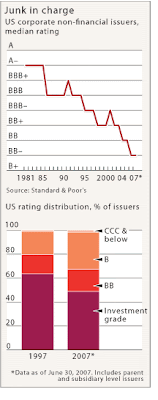
 This week the latest Federal Reserve Senior Loan Officer survey highlighted tougher lending conditions from banks to lower-rated corporate borrowers. In spite of the recent rally in credit markets, the number of junk-rated companies trading at highly elevated levels remains well above normal.
 Other metrics also suggest that the credit crunch continues to impact the overall credit markets. For example, the non-distressed speculative-grade bond spread widened to 502 basis points in mid-November from 392 basis points a month earlier, according to S&P.



 When Goldman raised $2.5 billion of 10-year debt on August 30, bond buyers considered it little better than a BBB borrower, even though the firm has a AA- rating. Goldman paid a premium, or spread, of 1.67 percentage points to sell the bonds, almost double what it cost the firm for a similar issue in January.
 Following are 10-year bond yields for each of the five largest Wall Street firms:
 Wall Street pays for its opacity
 > More details on State Street from
  It hurts all the more to fall from a great height. Until a couple of months ago the investment banks were flying. Profit records were smashed quarter after quarter. Bonus pools looked more like lakes. Valuations climbed to three times book value, implying sustainable returns on equity of over 30%, when even 25% is rare in the industry.
 As long as the money rolled in, no one seemed to mind that much of the business was cloaked in mystery.
 Thanks to
 Second, good first-half results will help to bail Wall Street firms out, as half of their accrued bonus pools can be taken back to cover second-half losses. A generous pay structure can come in handy if markets falter at the right time of the year.

![[Most Recent Quotes from www.kitco.com]](http://www.kitconet.com/charts/metals/gold/t24_au_en_usoz_2.gif)
![[Most Recent Quotes from www.kitco.com]](http://www.kitconet.com/charts/metals/gold/t24_au_en_euoz_2.gif)


