Monday, December 06, 2010

John Hussman Is Stating The Obvious......

I´ve promised to come back after QE 3.0 has started.... Well, it looks like Bernanke started at least the "campain" to hint QE 3.0..... Initially my comment that the break would take only a few weeks should sound ironic... With Bernanke in charge i should have known better...;-) Thank god he is 100 PERCENT! ( no typo ) certain ( his "brilliant" track record ,see Youtube : Bernanke in Denial, should insprice confidence.... ) he could stave off ( core LOL ) cpi inflation when and if it came to that... Probably no coincidence that the topic asset price inflation aka bubbles & the US$ didn´t made it into the interview .... ;-) ( Quote Mish : That was not really an "interview" on 60 minutes, it was an infomercial for Bernanke ) On the topic Bernanke & QE 2.0 i urge you to read the latest comment from Hugh Hendry, Jeremy Grantham & Mish.

Habe ja angekündigt spätestens nachdem QE 3.0 gestartet worden ist wieder etwas regelmäßiger zu bloggen.... Nach diesem Wochenende kann man sagen das Bernanke zumindest die Kampagne für QE 3.0 gestartet hat..... Eigentlich war mein Hinweis, das die Bloggerpause wahrscheinlich nur einige Wochen dauern wird, ironisch gemeint....Mit einem wie Bernanke an den Schalthebeln hätte ich es besser wissen müssen.... ;-) Nur gut das sich Bernanke zu 100 PPROZENT! sicher ist ( leider kein Übersetzungsfehler.... Nach Ansicht von Youtube : Bernanke in Denial sind Aussagen wie diese bestenfalls als bedenklich, bin halt ein höflicher Zeitgenosse, zu bezeichnen ) auf den eh schon massiv geschönten ( hedonisch, Kernrate, usw ) Warenpreiskorb auswirken .... Sicher kein Zufall das die Frage nach der Vermögenspreisinflation sprich BLASE sowie der US$ es nicht in das Interview, das Mish richtig als INFOMERCIAL für Bernanke bezeichnet, geschafft hat.... ;-) In diesem Zusammenhang empfehle ich einen Blick in den den letzten Kommentar von Hugh Hendry , Jeremy Grantham & Mishz u werfen...

John Hussman

It doesn't take much thought to recognize that, like Bernanke's actions, the actions of the ECB are ultimately likely to represent not monetary policy but fiscal policy.

When you buy the debt of countries that have a high likelihood of defaulting on this debt, or will avoid default only by the creation of currency that could have been issued to finance fiscal expenditures, it follows that you are engaging in fiscal policy without the authorization of elected governments.

We are allowing 99% of the world to accept budget cuts and austerity in order to defend bondholders from taking losses or having to accept debt restructuring. When bondholders lend money to a financial company or to a country, at a spread over the yield available safe debt, they are explicitly accepting the risk that the bet will not work out, and that they may lose money in the event of a restructuring.

When government policy at every level focuses on making bondholders whole, then government policy at every level focuses equivalently on protecting the inefficient and dangerous misallocation of capital.

Almost a miracle that so far the populist backlash & the social unrests against the "war on taypayers" are still minor... I fear that this will change rather sooner than later...... UPDATE: Video: Fire bombs, Stones Fly in Greek Riots; All Flights to/from Athens Cancelled

The daily headlines about trillions in black holes & the people in charge should be at least enough to give the Special Gold Report "In Gold We Trust" - Erste Group a shot..... In contrast to Hendry & Grantham i still think GOLD is not a bad long term hedge against the wisdom of the "Central Banksters" & politicians... ;-)

Bin überrascht das es bisher in Sachen Populismus und vereinztelten ( zu 99% glimpflich verlaufenden ) Demos vorwiegend in Südeuropa ( UPDATE: Video: Fire bombs, Stones Fly in Greek Riots; All Flights to/from Athens Cancelled bisher kein größerer Gegenwind für ständig wiederkehrende Rettungsaktionen einzig und allein zu Lasten der Steuerzahler gibt... Dank des bisher eingeschlagenen Weges befürchte ich allerdings das sich das demnächst ändern wird....Spätestens dann dürfte speziell Europa und der € irreparablen Schaden davon getragen haben....

Die inzwischen zur Gewohnheit gewordenen tagtäglichen ( und noch vor 12 Monaten für unmöglich gehaltenen) Schlagzeilen über gigantische Summen sowie die Historie der handelnden Personen sollten ausreichen zumindest mal einen Blick in den Special Gold Report "In Gold We Trust" der Ersten Group zu werfen... Obwohl ich damit anderer Meinung als Hendry & Grantham bin, denke ich das GOLD langfristig nicht die schlechteste Absicherung gegen die geballten Wesiheiten der weltweiten ( aber inbesonders der angelsächsich geprägten ) "Central Bankster" sowie der momentan handelnden Politiker ist....;-)

Without a good dose of humor the daily spin is almost impossible to withstand... So enjoy an almost instant classic.....

Da dies alles mit einer gehörige Portion Humor wesentlich leichter zu ertragen ist lege ich allen dringend den nachfolgenden Clip ans Herz....Dürfte bereits jetzt ( 4 Wochen nach Veröffentlichung ) als Klassiker durchgehen....


Update:

Did Bernanke Pull a Fast One Last Night? The Mess That Greenspan Made

Guest Post: Bernanke Is 100% Sure Jim Quinn of The Burning Platform via ZH

Lies, Half-Truths, and 100% Hubris on 60 Minutes Mish

Money Printing and 100% Confidence – Day 4 Pento & Baum via Tim

Helicopter Ben gets in a spin The Economist


The Daily Show With Jon StewartMon - Thurs 11p / 10c
The Big Bank Theory
http://www.thedailyshow.com/
Daily Show Full EpisodesPolitical HumorThe Daily Show on Facebook

Labels: , , , , , , , , ,

Monday, August 23, 2010

Quotes Edward Hugh, John Hussman & Andy Xie

I´m taking a quick break from my "Time-Out".... With "QE 2.0 & 3.0" just around the corner & the € crises off the front pages i think the links are not "unimportant".......

Verabscheide mich nach diesen Posting wieder in die angekündigte "Auszeit".... Im Zusammenhang mit der bevorstehenden "QE Version 2.0, 3.0 usw...." sowie der "fast vergessenen" € Krise erscheinen mir die kompletten Links besonders lesenwert....

Edward Hugh
Spain’s debt for 2010 according to the EDP is expected to reach around 77% of GDP (EU Commission spring forecast), and while we feel it is still possible to agree with the IMF when they say that that “Spain’s (public) debt ratio is low compared with many other countries in Europe”, it is only possible to do so if we do not forget that if we add in the 6% that is held by the Social Security Fund, the 7% that has built up in Accounts Payable and the 5% owed by Spains Public Corporations, we end up with a total of something like 95% debt to GDP, which is, of course, above the average. And this is not to even begin to count all those impending pension liabilities.
John Hussman

My impression is that Ben Bernanke has little sense of the damage he is about to provoke. A central banker who talks about throwing money from helicopters is not only arrogant but foolish.

Nearly a century ago, the great economist Ludwig von Mises observed that massive central bank easing is invariably a form of cowardice that attempts to avoid the need to restructure debt or correct fiscal deficits, avoiding wiser but more difficult choices by instead destroying the value of the currency.

Andy Xie

When the Fed or the European Central Bank tries to stimulate, they are actually stimulating the global economy as a whole. Water, no matter where it comes from, flows downwards. Stimulus, similarly, flows to where costs are low and banking systems are healthy.

If you believe this logic, the actions of the Fed and the ECB fuel inflation and asset bubbles in emerging economies rather than stimulate growth at home.

Lots of damage has already been done...... Regarding "healthy" banking systems China has nothing to worry about... ;-)

Denke das wir bereits heute mehr als genügend Auswirkungen dieser Erkenntnis sehen können.....Immerhin hat China in Sachen "gesunden" Bankensystem nichts zu befürchten.... ;-)

Labels: , , , , , , ,

Sunday, July 11, 2010

Hussman & Hester vs Wall Street Finest.......

Once more brilliant "Anti Spin" & almost a rant from the usually polite Hussman.....Spot on with my take Of Course It Is Still A Good Time To Buy, Buy, Buy..... when it comes to Wall Street Finest.....
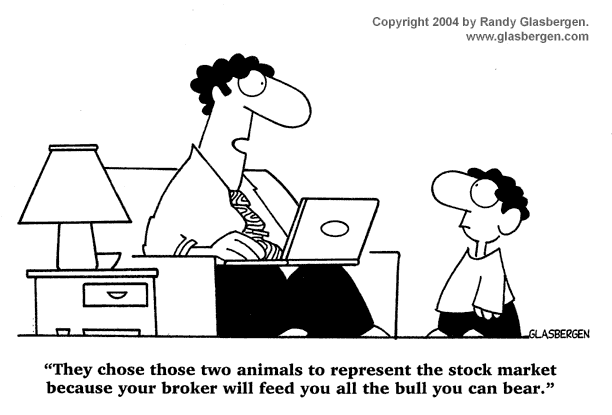
There maybe are legitimate reasons to buy stocks, but a favourable opinion from "Wall Street Finest" should definitely not play any role among your screening process .... Except you use them as a "contrary indicator".... ;-)
Einmal mehr deutliche Worte vom ansonsten doch recht zurückhaltenden Hussman....Eine erstklassige Ergänzung zu meinem früheren Posting Of Course It Is Still A Good Time To Buy, Buy, Buy.....
Grundsätzlich mag es ja durchaus gute Gründe die für Aktien sprechen geben, man sollte aber sicherstellen das die Einschätzungen der "Experten" beim Auswahlprozess keinerlei Rolle spielen....Es sei denn man nutzt sie als Kontraindikator.... ;-)

H/T Randy Glasbergen Collection

Misallocating resources John Hussman
On a valuation basis, the S&P 500 remains about 40% above historical norms on the basis of normalized earnings. The disparity between our valuation assessment and the putative undervaluation being touted by Wall Street analysts is so great that a few remarks are in order. First, virtually every assessment that "stocks are cheap" here is based on the ratio of the S&P 500 to year-ahead operating earnings estimates, and often comes with a comparison of the resulting "earnings yield" with the depressed 10-year Treasury yield. What's fascinating about this is that this is the same basis on which analysts deemed stocks to be about 40% undervalued just prior to the 2007 top, following which the market plunged by more than half.

To properly understand the price-to-forward operating earnings ratio, you have to recognize that operating earnings exclude a whole host of charges - what some observers correctly call "recurring non-recurring" charges. These include large and often quite regular losses that the companies deem, often on the thinnest basis, to be detached from their core business - even if the losses are directly related to their core business.
More on this topic in "Reported Earnings vs Operating Earnings"

Mehr zum Thema in "Reported Earnings vs Operating Earnings"

When you hear analysts say that the historical average P/E ratio is about 15, you have to recognize that this is the normal P/E based on trailing 12-month earnings after subtracting all writeoffs and other charges. Forward operating earnings are invariably much higher, and it turns out that the comparable historical norm, as I discuss in that 2007 piece, is only about 12. If you exclude the late 1990's bubble valuations, you get a historical norm closer to 11.5. The 1982 and 1974 market lows occurred at about 6 times estimated forward operating earnings

A final observation is crucial. Current forward operating earnings estimates assume profit margins for the S&P 500 companies that are nearly 50% above their long-term historical norms. While we did observe such profit margins for a brief shining moment in 2007, profit margins are extraordinarily cyclical. Investors will walk themselves over a cliff if they price stocks as if profit margins, going forward, will be dramatically and sustainably higher than U.S. companies achieved in all of market history.

They also ignore the large percentage of reported earnings that are actually quietly distributed to corporate insiders through the issuance of stock and options.

They blindly accept that "share repurchases" are somehow a pleasant distribution of earnings, whereas the majority of share repurchases are actually made by companies to do nothing more than offset the dilution from stock shares and options granted to insiders.

A good question to ask in the years ahead, immediately after profits are reported, is "how much of this figure is actually delivered to shareholders?" If you've been attentive over the past decade, the answer turns out to be much closer to the dividend yield than to the operating earnings yield that companies have reported.

For a moment, at least, it is good to be a corporate insider, particularly at major financial companies.

First, you get to report productivity gains and "operating profits" - not by making smart investments in productive assets, but instead by writing up debt thanks to Treasury intervention, by misstating your balance sheet thanks to FASB changes last year, and at industrial firms, by cutting the number of workers per unit of capital.

Next, you quietly write off large losses on bad investments and unrecoverable loans as "extraordinary expenses," to which investors pay no notice.

And to add insult to injury, you deliver a significant portion of the remaining profits to yourself as "incentive compensation," followed by buybacks of stock to offset the dilution, which investors actually cheer because they don't realize they've been taken for suckers.

Wall Street Earnings Expectations Ignore Economic Divergences Bill Hester / Hussman Funds

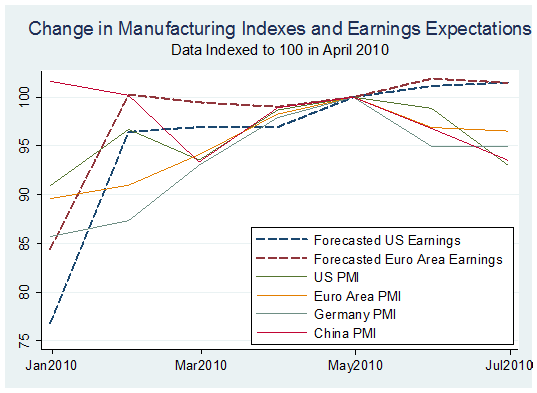
The graph below attempts to contrast the erosion in the global PMI indexes against the rising optimism of stock analysts.

Six series of data are plotted: the changes in earnings expected for the companies in the S&P 500 and the Euro Stoxx Index, and four PMI indexes for the US, the Euro area, Germany, and China. Each of the series is indexed to 100 in April, the month where most of the PMI data peaked.

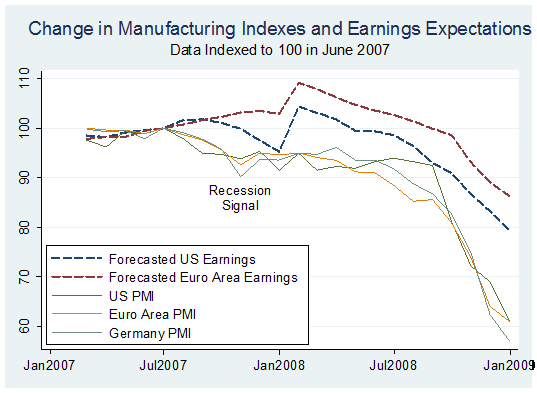
Now take a look at the Chart showing the period between 2007 and 2008 using the same indices.... I highly recommend to read the entire links.... There is much more.....

Hier zum Vergleich der identische Chart für die Zeit von 2007 bis 2008...... Empfehle die kompletten Links zu lesen... Wie üblich findet man dort noch deutlich mehr "Anti Spin"......

UPDATE:

RARE INTERVIEW WITH JOHN HUSSMAN: WHY HE IS BEARISH RIGHT NOW PragCap

Stocks Expected To See 12% Increase In Revenues In Q2, 41% Increase In EPS, And A Summary Outlook From Rosenberg ZH

As for all of 2010, the consensus is at $82 operating EPS, and for a new record to be reached in 2011, at $96 — breaking the record of $88 three years ago. Good luck in seeing a further 30% increase in profits with nominal GDP rising at a 3.0-4.0% annual rate at best in the next six quarters and at a time when margins are already back to cycle peaks.
For the full John Hussman archive visit the blogroll.....

Für eine komplette Auflistung der gesammelten Werke von Joghn Hussman bitte Blogroll beachten.....

Labels: , , , , ,

Sunday, May 23, 2010

Most Impressive Sovereign Funding Official 2009 Award Went To Spyros Papanicolaou ( Greece )

You cannot make this up......Very hard to hide a big deal of SCHADENFREUDE when you keep in mind that the awards were determined by a poll of bankers and borrowers .... On the other side it´s too bad that exact these same so called "sophisticated" investors ( not speculators! ) got once again bailed out for their ( ongoing ) very poor judgement.....The following quote from John "Anti Spin" Hussman "Prostituting the fiscal stability of an entire nation for the benefit of bondholders who made bad loans ?"( Hussman is really "upset"..... ) & this must see clip :-)! are unfortunately spot on... Go and read the entire link !

Kein Aprilscherz......Wenn man bedenkt das dieser Preis in einer Abstimmung von Bänkern und Investoren vegeben worden ist kann man sich eine gewisse Portion SCHADENFREUDE einfach nicht verkneifen...... Gleichzeitig wird die Wut darüber, das genau diese Investoren ( nicht Spekulanten! ) trotz Ihres offensichtlich zum wiederholten Male vernebeltem Urteilsvermögen erneut über immer größer werdende Bailouts rausgehauen werden, tagtäglich größer ......Leider handelt es sich beim nachfolgenden Zitat von John "Anti Spin" Hussman "Prostituting the fiscal stability of an entire nation for the benefit of bondholders who made bad loans?" ( Wer den ansonsten sehr besonnenen Hussman kennt kann erahnen das hier einer ziemlich "aufgebracht" ist ...) sowie diesem wunderbar humoristischen Clip :-)! um eine treffende Bestandsaufnahme und um keine Übertreibung......Empfehlen allen den kompletten Link zu lesen !


WSJ

Beware the lessons of history—especially when they involve Greece. The winner of Euroweek's 2010 award for most impressive sovereign funding official richly deserved it: Robert Stheeman, head of the U.K. Debt Management Office, steered through a whopping £185 billion ($268 billion) of gilt sales in the last fiscal year.

But Mr. Stheeman might not want to look too closely at the award's history: Last year's winner was one Spyros Papanicolaou, the former head of Greece's Public Debt Management Agency.

Rough times for GILTS & the POUND ahead.....

Sieht ganz so aus als wenn es für GILTS und das britische Pfund demnächst ruppig werden könnte......

Labels: , , , , , , , , , ,

Monday, April 12, 2010

"The Unhappiness Of The Seller Does Not Mean That There Is No Market."

As always superb "Anti Spin" from Hussman.....Long read but with all markets at new highs & on a global scale well over 1 trillion in taxpayer money for the still ongoing bailouts , QE, ZIPR etc it is more important than ever to ask what happened to "the toxic assets" ..... Hussman focusses mainly on US mortgages but i think it is safe to say that similar things are true globally when it comes to CRE, corporate loans etc... Fits nicely to Fridays post "Surprise, Surprise....." Big Banks Mask Risk Levels - Quarter-End Loan Figures Sit 42% Below Peak .....I have to repeat myself when it comes to the ÜBERBULLISH Cramer´s Bull Case For Banks
"Would at least be honest if he mentioned the "ultimate moral hazard trade" & the "Enron-esque characteristics" when it comes to accounting as the two main reasons behind the motives to own banks.. ;-)"
Dringend benötigter "Anti Spin" vom gewohnt erstklassigen John Hussman....Recht ausführliche aber im Angesicht der neuen Markthochs aber unbedingt lesenswerte Ausführungen wenn es um das von einigen bereits als "gelöst" bzw. verdrängt geltende Problem der "Toxic Assets" geht....Schon erstaunlich ( einige würden auch sagen schockierend...) was weltweit gesehen wohl locker über 1 Billion an Steuergeldern die noch immer weiter fliessen ( siehe "The Rolling Bailout Bus" ) , QE, ZIRP usw bisher beim Kernproblem der Krise bewirkt haben.....Obwohl Hussman hier in erster Linie Hypotheken abhandelt ist es sicher keine Übertreibung zu behaupten das weltweit ähnliches auch für gewerbliche genutzte Immobilien sowie Firmenkredite gilt....Wie gemacht als perfekte Ergänzung zum letzten Posting "Surprise, Surprise....." Big Banks Mask Risk Levels - Quarter-End Loan Figures Sit 42% Below Peak ......Muß mich leider erneut wiederholen wenn es um zunehmend bullische Bankempfehlungen ( für ein besonders krasses Beispiel siehe Cramer´s Bull Case For Banks ) und damit indirekt auch für den Gesamtmarkt geht.....

"Wäre zumindest ehrlich gewesen wenn er in seinen 10 Gründen die unbedingt dafür sprechen sofort massiv Bankaktien zu kaufen den "ultimativen Moral Hazard Trade" sowie die kreative Bilanzierung die stark "Enron-esque characteristics" aufweist als die Topgründe aufführen würde.... ;-)"


Extend and Pretend John Hussman

With regard to credit conditions, the U.S. financial system continues to pursue a strategy of "extend and pretend." A year ago, the Financial Accounting Standards Board (FASB) suspended rule 157, which had previously required banks to mark their assets to market value when preparing balance sheet reports. The basic argument was that fair values were not appropriate because there was "no market" for troubled assets. Certainly, the FASB could have implemented something at least modestly reasonable, such as 2-year or 3-year averaging, but instead, they changed the rules to allow "substantial discretion" in the valuation of bank assets in their financial reports.

To a large degree, the idea that there was "no market" for troubled assets was false even at the time.
Last year, Dean Baker of the well-regarded Center for Economic Policy Research (CEPR) testified before Congress, observing "There has been considerable confusion about the nature of the troubled assets held by the banks. While banks do hold some amount of mortgage-backed securities, these securities are in fact a relatively small portion of their troubled assets. The troubled assets on the banks' books are overwhelmingly mortgages, both first and second or other junior
liens, not mortgage-backed securities. The FDIC has acquired large quantities of mortgages from its takeover of several dozen failed banks over the last year. It auctions these assets off on an ongoing basis. The results of these auctions are available on the FDIC website. Non-performing mortgages typically sell in these auctions at prices in the vicinity of 30 cents on the dollar."

He continued, "It is not clear on what basis these auctions can be said not to constitute a market. While the downturn and the constricted credit conditions affect the market, it is simply inaccurate to claim that there is no market for these assets. The major banks are undoubtedly not pleased at the prospect of having to sell off their loans at these prices, but this merely indicates that they are unhappy with the market outcome, just as a homeowner might be unwilling to sell her house at a loss. However, the unhappiness of the seller does not mean that there is no market."

The impact of "extend and pretend" is to create a gap between the reported value of assets and the value they would have on the basis of the cash flows that those assets can reasonably be expected to generate over their maturity. In order to avoid having to restate assets, banks have allowed an increasing gap to develop between the volume of delinquent loans and the volume of loans actually in foreclosure, creating a growing "shadow inventory" of impaired but unmodified and unforeclosed loans.

Moreover, regulatory changes over the past year have affected what actually gets reported as "troubled." As the New York Times recently observed, " A bank owed, say, $4 million on a property now worth $3 million would previously have had to classify the entire loan as
troubled. Now it can do that to the $1 million difference only." In effect, even though impaired loans tend to sell at only 30-50 cents on the dollar (reflecting a modest haircut to the amount typically received in foreclosure), banks can choose the amount of assets it reports as troubled simply by choosing what value to assign the property while it holds the bad loan on its books.

While it's interesting that credit card delinquencies have eased off modestly in recent months, this is not necessarily a healthy sign. Even in the third quarter of 2009, TransUnion reported that consumers delinquent on their mortgages but current on their credit cards increased by 6.6%. In effect, people have been choosing to pay their credit cards in priority to their mortgages.

As for policy efforts to reduce delinquencies, I've long argued that it is a bad idea for policy makers to announce delinquency prevention plans that have, as their centerpiece, publicly subsidized reductions in mortgage principal.
It's one thing to extend the loan in a way that preserves its present value, by swapping a claim on future appreciation in return for principal reduction, but it's quite another to offer to cut the principal outright. The reason ist that instead of confining the assistance to presently troubled borrowers, you create a whole new set of borrowers who then choose to be troubled in order to get the assistance. According to a University of Chicago study, "strategic defaults" - where people choose to default on their mortgages even though they can afford to pay - accounted for 35% of all residential defaults in December 2009, up from 23% in March 2009. Offering public subsidies for this behavior, when too many homeowners are already legitimately struggling, does not smack of a bright idea.

The New York Times recently provided a good picture of how the delinquency situation stood at the end of 2009 (based on FDIC data):


Bad Bank Loans Soar


In short, my impression is that investors are deluding themselves about the solvency of the banking system. People learned in the 1930's that when you don't require the reported value of assets to have a clear and tangible link to the value that the assets would have in liquidation, bad things happen. Yet this is what regulatory and accounting rules are allowing for the banking system at present. While I do believe that bank depositors are safe to the extent of FDIC guarantees, my impression is that the banking system is still quietly insolvent.

Will it work? Will it change?

Regardless of whether the U.S. banking system would not presently be able to meet its liabilities with its assets, there is another question: assuming that banks are allowed to extend and pretend for a long enough period of time, will they ultimately be able to accumulate enough retained earnings in the years ahead to cover eventual loan losses? In other words, is it possible that everything will be OK if we just look the other way long enough?

From my perspective, it depends on what "OK" means. Simply in terms of long-term solvency - assets being ultimately able to meet liabilities - my impression is that yes, given enough time, retained bank earnings should cover the losses on existing loans. Indeed, it's possible that banks might be able to report fairly healthy "operating earnings" to investors, and then somewhat more quietly write off losses as "extraordinary" charges over a period of years. This type of outcome is beginning to look possible, because investors evidently don't mind repeatedly having their pockets picked as long as "operating earnings" come in above analyst estimates.

Unfortunately, in that sort of world, the economy would likely be hobbled for a long period of time, as Japan has discovered over the past couple of decades. With banks focused primarily on survival and recapitalization, retained earnings would be directed to making the existing liabilities whole, rather than contributing to productive new investment.

So to the extent that "extend and pretend" is successful in averting insolvency concerns, it will also tend to weigh down lending activity, as resources are allocated toward servicing existing debt burdens on bad assets, rather than toward new lending for productive activity. The most efficient outcome is always for lenders who provide capital to take losses if the loans go bad. That sort of market discipline is the only way to ensure that capital gets allocated properly. This is not the world that we have lived in over the past year, as policy makers have pledged public money to make private bank bondholders whole, regardless of how irresponsibly the banks allocated the money. But it is important to recognize that this policy comes with longer term costs.

Needless to say that i think he is spot on....... It will be interesting to see how Mr. Market will react to the quality of ( bank ) earnings / balance sheets during the reporting season.....This could be at least a possible trigger to calm down the "somewhat elevated" risk appetite significantly.....

Überflüssig zu erwähnen das ich zu 100% übereinstimme..... Es wird spannend zu beobachten inwieweit in der jetzt startenden Berichtssaison die Gewinn und Bilanzqualität der Banken hinterfragt wird.... Sehe hier durchaus erhebliches Potential den "leicht erhöhten" Risikoappetit doch merklich zu zügeln.....

UPDATE:

Profit for Banks Dimmed by Home-Equity Loss Seen at $30 Billion
April 12 (Bloomberg) -- Bank of America Corp., JPMorgan Chase & Co. and Wells Fargo & Co. may have to set aside an additional $30 billion to cover possible losses on home-equity loans, an amount almost equal to analysts’ estimates of profit at the three banks this year.
Global Banking System Extend and Pretend Insolvency Mish

I happen to agree with John Hussman on all points mentioned. Moreover, it is not just the U.S. banking system that is insolvent, the global banking system is nothing but a giant extend and pretend operation including the PIIGS (Portugal, Ireland, Italy, Greece, Spain), China, the UK, and even Canada as soon Canada's gigantic housing bubble crashes.

Spot On Alex Cartoon :-)!

The DTA dodge FT Alphaville
The issue is that in order for banks to include DTAs in their Tier 1 capital, they need to be able to show regulators that they will generate enough income in the future to actually use them.

Citigroup, for instance, has been racking up enough losses in recent years to generate $47bn worth of DTAs at the end of 2009, about $21bn of which was included in their Tier 1 capital that year. So that’s $21bn coming out of years of losses, but based on the premise that the bank will soon be profitable.
They will find a "creative" way to reassure their future profibility..... The Treasury wants to sell a 7.7 billion shares within the next year... ;-)

Bin mir sicher das hier ein kreativer Weg gefunden wird um die zukünftige Profitabilität zu gewährleisten...Immerhin will das Finanzministerium noch 7,7 Mrd Aktien binnen 12 Monaten auf den Markt schmeissen ;-)

Foreclosure inventories hit record

February's foreclosure rate of 3.31% represented a 51.1% jump from February 2009
From Level I to Level III, the myth of fair value FT Alphaville

Lehman Channeled Risks Through ‘Alter Ego’ Firm NYT

Even now, a year and a half after Lehman’s collapse, major banks still undertake such transactions with businesses whose names, like Hudson Castle’s, are rarely mentioned outside of footnotes in financial statements, if at all.
"ENRON-ESQUE" .......

The search for Basel III loopholes begins Felix Salmon

Most of the arguments could be made only by banks who have been drinking their own kool-aid for so long that they no longer have any idea what sounds ridiculous and what doesn’t.

CHUZPAH!

Meredith Whitney vs the Banks Paul Kedrosky


She has not one single buy rating in the space she is covering.....

Eine der wohl besten Bankenanlaysten hat nicht eine einzige Bank auf "BUY".....

Labels: , , , , , , , , , , ,

Friday, December 04, 2009

Market Quotes From Rosenberg & Hussman

The quotes along with the cartoon reflect pretty much my market outlook ...... Be very careful if you are long ( congratiolations to the courage ) this market...... I´m still sticking with my view that from a risk/reward perspective it makes no sense ( Goldman & BofA Merrill Lynch & JP Morgan & John Paulson beg to differ...... ) to invest ( long term exception Gold, short term it looks a little bit crowded ) in this market. Most Insiders ( Ratio 98:1 ) are also a lot more "cautious"......... And everybody pointing out to the "strong" jobs report on Friday as a sign that fundamentals are playing catch up with this "priced for v-shaped-perfection market" again should take a look at this amusing clip :-)

Die beiden Zitate zusammen mit dem Cartoon geben ziemlich genau meinen Marktausblick wieder.... Denke das jeder der momentan noch investiert ist ( Glückwunsch für den Mut ) sehr wachsam sein sollte...... Ich bleibe dabei das es bereits seit einiger Zeit unter Chance/Risikogesichtspunkten keinen Sinn ( Ausnahme langfristig Gold, kurzfristig sieht es allerdings etwas überhitzt aus ) mehr macht in diesen Märkten zu investieren ( Ganz im Gegenteil zu Goldman & BofA Merrill Lynch & JP Morgan & John Paulson .... ). Die Insider schließen sich bei einen es bei einem Verhältnis von 98 zu 1 eher meiner Meinung an.......Für alle die im Arbeitsmarktbericht vom Freitag die Wende zu besseren Fundamentaldaten erkannt haben wollen die dringenst benötigt werden um den bis zur perfekten V-Shaped Erholung bewerteten Markt auf ein noch steileres "V" zu treiben dem empfehle ich einen Blick auf diesen wirklich gelungenen Clip werfen ;-)

David Rosenberg

"So this remains the Houdini rally — no jobs; no pricing power; no broad participation; and no volume "

Hussman

"Over the past decade, the stature of the market as an effective discounting mechanism has gradually eroded. The observation and analysis of potential risks – though essential to long-term investing and loss avoidance – is far less actionable than one might expect. Investors will evidently speculate as long they have dice in their hands and the casino is not visibly on fire."

Labels: , , ,

Sunday, November 29, 2009

Reckless Myopia - Hussman

"Banana Republic", "Disaster", "Reckless", "Unconstitutional Breach" ...... Uh ? When Hussman ( one of the best mangers out there > Performance Hussman 2000-2009 ) is using this kind of words it clearly qualifies for a rant..... Needless to say that i think he is spot on...... Just a few reasons why i´m long term bullish on Gold ( short term it looks a little bit crowded )....Along with Rosenberg, Faber one of my long time favourites......

Wenn ein ansonsten sehr besonnener und überaus erfolgreicher ( siehe Performance Hussman 2000-2009 ) Zeitgenosse wie Hussman zu solch drastischen Worten wie "Bananenrepublik", "Desaster", Verfassungswidrig" usw. greift sollte man aufhorchen..... Und das sind nur einige der gewichtigen Gründe warum ich langfristig bullisch für Gold bin ( kurzfristig sieht es allerdings etwas überhitzt aus ).... Wer meinen Blog etwas länger verfolgt weiß, das ich zu 100% übereinstimme.....

Reckless Myopia

From a long-term perspective, my record is very comfortable. But clearly, I was wrong about the extent to which Wall Street would respond to the ebb-and-flow in the economic data – particularly the obvious and temporary lull in the mortgage reset schedule between March and November 2009 – and drive stocks to the point where they are not only overvalued again, but strikingly dependent on a sustained economic recovery and the achievement and maintenance of record profit margins in the years ahead.

I should have assumed that Wall Street's tendency toward reckless myopia – ingrained over the past decade – would return at the first sign of even temporary stability. The eagerness of investors to chase revailing trends, and their unwillingness to concern themselves with predictable longer-term risks, drove a successive series of speculative advances and crashes during the past decade – the dot-com bubble, the tech bubble, the mortgage bubble, the private-equity bubble, and the commodities bubble. And here we are again.

We face two possible states of the world. One is a world in which our economic problems are largely solved, profits are on the mend, and things will soon be back to normal, except for a lot of unemployed people whose fate is, let's face it, of no concern to Wall Street. The other is a world that has enjoyed a brief intermission prior to a terrific second act in which an even larger share of credit losses will be taken, and in which the range of policy choices will be more restricted because we've already issued more government liabilities than a banana republic, and will steeply debase our currency if we do it again. It is not at all clear that the recent data have removed any uncertainty as to which world we are in.

What I do think is that over the past decade, investors (including people who hold themselves out as investment professionals) have become far more susceptible to reckless myopia than I would have liked to believe. They have become speculators up to the point of disaster.

Frankly, I've come to believe that the markets are no longer reliable or sound discounting mechanisms.

The repeated cycle of bubbles and predictable crashes over the recent decade makes that clear. Rather, investors appear to respond to emerging risks no more than about three months ahead of time.

Worse, far too many analysts and strategists appear to discount the future only in the most pedestrian way, by taking year-ahead earnings estimates at face value, and mindlessly applying some arbitrary and historically inconsistent multiple to them.

Discounting the markets three month ahead of time..... ? This is probably only true when they are sniffing around for the next dose of QE or some kind of bailout, subsidy, stimulus etc ...But to do that you don´t need to be a rocket scientist... Washington & the Fed have a 100 percent track record in bailing out anything.....Unlike in Dubai ....;-) I think here is Hussman way too kind........

Vorwegnehmen ?. Denke das die Vergangenheit bewiesen hat das die Märkte und besonders Wall Street Finest hier keinesfall im Vorwege Probleme kommen sehen.... Die Fähigkeit etwas vorwegzunehmen trifft wohl am ehesten zu, wenn es darum geht den nächsten Bailout usw zu erahnen ( der kommt ja bekanntermaßen bestimmt ).... Hier kommt zwischenzeitlich mal wieder der "alte" höfliche Hussman durch.... ;-)

In part, the market's increasing propensity toward speculation reflects the increasing lack of fiscal and monetary discipline from our leaders. Policy makers who seek quick fixes and could care less about long-term consequences undoubtedly encourage investors to embrace the same value system.

Paul Volcker was the last Fed Chairman to have any sense that discipline and the acceptance of temporary discomfort was good for the nation.

In my estimation, there is still close to an 80% probability (Bayes' Rule) that a second market plunge and economic downturn will unfold during the coming year. This is not certainty, but the evidence that we've observed in the equity market, labor market, and credit markets to-date is simply much more consistent with the recent advance being a component of a more drawn-out and painful deleveraging cycle.

As Gluskin Sheff chief economist David Rosenberg noted last week, “Even if the recession is over, the historical record shows that downturns induced by asset deflation and credit contraction are different than a garden-variety recession induced by Fed tightening and excessive manufacturing inventories since the former typically induce a secular shift in behavior and attitudes towards debt, asset allocation, avings, discretionary spending and homeownership. The latter fades more quickly.


Larger / Vergrößerte Version via VOX EU

> On this topic comes another excellent report ( see Charting The Great World Trade Collapse ) via VOX EU

> Empfehle in diesem Zusammenhang einen Blick auf Charting The Great World Trade Collapse ( ebenfalls von VOX EU ) zu werfen.....

“This is why people didn't figure out that it was the Great Depression until two years after the worst point in the crisis in the 1930s; and why it took decades, not months, quarters or even years, for the complete transition to the next sustainable economic expansion and bull market.

... It is truly mind-numbing that a moment after a temporary surge of trillions of dollars, borrowed and tossed out of a helicopter (though to specific corporations and private beneficiaries), analysts would hail a subsequent improvement in corporate results as evidence of “resilience.”

What matters is sustainability, and unfortunately, it is clear that credit continues to collapse.....

Emphatically, the trillions of dollars spent over the past year were not in the interest of protecting bank depositors or the general public. They went to protect bank bondholders.

Instead of taking appropriate losses on those bonds (which financed reckless mortgage lending), those bonds are happily priced near their face value, for the benefit of private individuals, thanks to an equivalent issuance of U.S. Treasury debt. But that's not enough. Outside of a very narrow set of institutions that are subject to compensation limits, just watch how much of the public's money – which benefitted several major investment banks following a very direct route – gets allocated to Wall Street bonuses in the next few weeks.

AMEN......

UPDATE:

Guest Post: Dividends Are Still Trending Worse Than The Great Depression ZH

Labels: , , , , , , , , ,

Tuesday, October 06, 2009

"Cash On The Sidelines" Anti Spin

This quote from James Bianco sums it up ( when it comes to stocks )..... More "Anti Spin" on this topic from Barry Ritholtz, Hussman & Tim Bond

Der nachfolgende Satz von James Bianco trifft es hervorragend ( zumindest wenn es im Hinblick auf Aktien gemacht wird ) .......Mehr "Anti Spin" zu diesem Thema von Barry Ritholtz, Hussman & Tim Bond

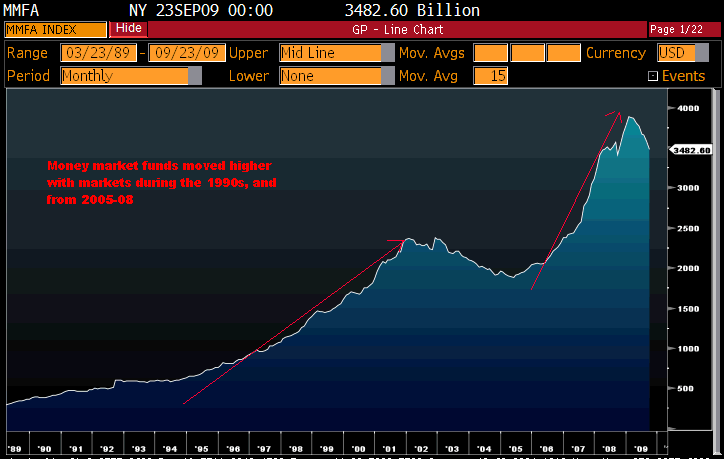
“Any time you hear a money manager say there’s $3.5 trillion dollars in cash on the sidelines, take your money away from them. Because he doesn’t know what he’s saying.”


bigger / vergrößerte Version H/T Barry Ritholtz

Will “Cash-on-the-Sidelines” Really Drive Stocks? MarketBeat WSJ
The “cash-on-the-sidelines” argument many market-watchers make to explain why stocks should move still higher shows no signs of losing traction.

MarketBeat: Jim, thanks for taking a few minutes to talk. You recently wrote a research piece saying the assets in money-market mutual funds won’t be moving into stocks anytime soon. How come?

Bianco: If you look at the mutual-fund flows there is a record amount going into bond funds. Forty-two billion dollars went into bond funds in August, which is an all-time monthly record. In fact, the all-time monthly record, I believe, for stock funds was $55 billion back in February of 2000. So it’s pretty close to the stock-fund record. But when you break it down, what you’ll find is that short-term muni funds, and short-term corporate funds, those are the funds that are getting huge, huge inflows.
17216.jpg - 4wk moving avg inflows US bond mutal funds - Bar Cap
The short-term corporate funds are up 12% this year. And as we talk right now, the S&P 500 is up around 16% this year and the Dow is up about 11% this year. That’s including dividends. So my conclusion was, “Yes, there’s a lot of money that’s built up in the cash on the sidelines. Yes, it is going to come out of that zero interest rate funds. And its going into short-term bond funds, which by the way are performing pretty much in line with the stock market. So don’t hold your breath. You’re going to be waiting a long time before you see that money ever matriculate into the stock market.”

MarketBeat: What about the cash-on-the-sidelines argument more broadly. Do you have problems with the fundamental logic of it?

Bianco: Now a couple things about that. The first one is I hate when they say, “There’s $3.5 trillion on the sidelines and that’s a whole lot of money.” It implies that all of that money should be put in investments like the stock market. That’s not true. The vast, vast majority is in transactional balances.

MarketBeat: What does that mean exactly?

Bianco: It’s money that is going to be needed in a very short period of time, like, within a year. It’s going to be spent on something. They’re almost like checking accounts, if you want to think of it that way. It’s like somebody saying, “You’ve got $10,000 dollars in your checking account, why don’t you $10,000 worth of stocks?” And the answer is, “Well because I’ve got to pay my credit card bill and my rent.”

Maybe $1,500, $2,000 or $1,000 of it, I might be able to peel out and put into an investment. But I can’t put the whole $10,000 into it.

MarketBeat: So who owns all this money in money-market funds?

Bianco: The way people say “$3.5 trillion in money-market funds,” they make it sound like $3.5 trillion of widows and orphans are out there irrationally taking a zero-percent return and not recognizing that they should be plowing their money into the stock market.

Well, first of all 65-70% of the money isn’t widows and orphans. It’s institutional money, and the majority of it is transactional balances. So once you stripped all of that out, how much retail money is hiding away from the stock market? The answer is, it’s not very much. It’s probably in the range of a couple of hundred billion dollars.

So there’s a few hundred billion dollars — not $3.5 trillion — that could potentially move back into a longer term investment. My argument is that most of it is already moving. It is moving into short-term bond funds. And those short term bond funds have performed in line with the stock market.

So, what you would need is a massive divergence of those short-term bond funds underperforming — with the stock market not going down — in order to start pushing people out the risk curve even more and into stocks.

So when people say, “Look at all this money. it’s an all-time high in money market funds. And these people are stupid for being in money funds.” Well, money funds have outperformed the stock market for the last 12 years. So shouldn’t money funds have a lot of assets relative to stocks right now? Because we all know that everybody chases performance. So the fact of the matter is there should be a lot of money there because stocks have not performed well. The high-falutin’ technical term for that is “stocks have sucked.”

“Well, they’ve been outperforming cash since March,” would be the argument. Yes, but not over the last two years. People do remember what the stock market did to them last year.

MarketBeat: So, in short you don’t buy the cash-on-the-sidelines argument.

Bianco: No. You know I started in this business in 1986 and there was a ton of cash on the sidelines. And every single day since 1986 everybody has told me that there’s large amounts of cash on the sidelines.

MarketBeat: What do you mean?

Bianco: That’s been a constant argument that’s never gone away. There’s never been a point where anybody has argued that there’s been too little cash on the sidelines. That’s just background noise is all that argument is. Especially when somebody says there’s $3.5 trillion on the sidelines. I was kidding around with some guys in the office here and said, “Any time you hear a money manager say there’s $3.5 trillion dollars in cash on the sidelines, take your money away from them. Because he doesn’t know what he’s saying.”

Equity managers want you to believe that in reality there should be no such thing as a money-market fund. And they should all be closed down and all that money should be put into the stock market.

UPDATE: Quote Rosenberg

"Another way to look at the situation is that when you hear and read about "liquidity" driving the market, it is usually a catch-all phrase for "we have no clue" but it sounds good. "
News from 1930 Daily summary based upon my reading of the Wall Street Journal from the corresponding day in 1930

There's a large amount of money on sidelines waiting for investment opportunities; this should be felt in market when “cheerful sentiment is more firmly intrenched.”
Sounds familar.....? ;-)

Kommt Euch das irgendwie bekannt vor...... ? ;-)

Labels: , , ,

Sunday, September 27, 2009

We're Speaking Japanese Without Knowing It - John Hussman

Good reminder from Hussman that we still havn´t make any meaningful progress with the main issue of all the toxic debt & the impaired bank balance sheets ( click here & here for just a few example )..... He is spot on that it is a scandal that so far the bondholders have been "protected"at the expense of the taxpayer ( rip off still expanding on a daily basis / see The Talf that keeps on taking (CMBS) ,Let’s say RIP to PPIP , Spain to approve EUR 64bln of guarantees for bank debt sales & "Today I Think Of Myself As A Government Contractor......" etc.) ...... The Great "Cover-Up" is still in full force without significant consequences for the "participants"........" Where is the debt to equity swap ?"

Schön zu sehen das es zumindest noch einzelne Rufer in der Wüste wie Hussman gibt die sich erlauben darauf hinzuweisen das der wichtigste Punkt der Krise, die sich unter Wasser befindlichen Bankenbilanzen, noch immer nicht mal ansatzweise gelöst worden ist ( Hier & hier nur einige Beispiele ). Unglücklicherweise ist die Lage in Deutschland ebenfalls nach wie vor "instabil" siehe Oppenheim verpfändet Aktien & Neues Milliardenloch bei LBBW ) ........ Es ist gelinde gesagt ein Skandal das praktisch weltweit die Politik in Verbindung mit den Notenbanken entschieden hat die Anleiheinvestoren zu schützen und stattdessen den Steuerzahler in Risiko gehen zu lassen ( verweise stellvertretend auf The Talf that keeps on taking (CMBS) , Let’s say RIP to PPIP, Spain to approve EUR 64bln of guarantees for bank debt sales & "Today I Think Of Myself As A Government Contractor......" usw.)..... Es sieht ganz so aus als wenn bis auf weiteres The Great "Cover-Up" ohne größere Konsequenzen für die "Beteiligten" auszugehen scheint..... Habe zu diesem Thema unter dem Label "Where Is The Debt To Equity Swap" bereits öfter meinem "Unverständnis" Luft gemacht.....


H/T Option ARMageddon / R. Winkler

We're Speaking Japanese Without Knowing It Hussman

If one seeks analysis about the recent financial crisis, and what most probably lies ahead, it would be wise to place particular weight on the views of economists who saw it coming (and ideally those who provided careful analysis rather than hyperbole

.....At a speech at the Princeton Club last week, economist Carmen Reinhart eiterated that by propping up unhealthy banks, the U.S. is unwittingly committing the same mistakes as the Japanese did in their decade-long stagnation, saying, “These are not zombie loans. They're just non-performing. We're speaking Japanese without knowing it.”

Historically and across countries, according to the IMF, 86% of systemic banking crises have ultimately required government restructuring plans that included closing, nationalizing and merging banks.

Yet the policy response of the U.S. has been akin to putting a band-aid on an untreated infection. Worse, not only has the underlying infection been overlooked, but thanks to the easing of FASB mark-to-market rules early this year, we have at least temporarily stopped reporting on the status of that infection.
After the bubble burst in Japan in 1990, Japanese banks were not compelled to properly disclose their losses either. The predictable result is that the problems resurfaced later, but worse, because they had not been addressed.

This sort of “regulatory forbearance” – setting aside requirements for large loan loss reserves and timely loss disclosure - was helpful during the Latin American debt crisis of the 1980's, but largely because it allowed time for negotiations with countries to restructure debt, first by rescheduling payments, and then ultimately through debt-equity swaps, exit bonds, and other major debt restructuring under the Brady Plan.

Forbearance only works, however, if you're buying time to do something to restructure debt. Instead, we've celebrated bailouts and the easing of reporting requirements as if they are a substitute for restructuring. In my view, this is a mistake that will haunt us.
Our response to the recent crisis has thus far repeated the mistakes made during the Japanese and S&L debacles.

The continued urgency of debt restructuring

With the financial markets cheerily celebrating the end of the recession, credit spreads back to 2007 levels, and analysts referring to the mortgage crisis as largely a thing of the past, it is natural to ask why I would start pounding the tables again about debt restructuring. Old news. Problem solved. Why even bring it up?

The simple answer is that we have not solved the mortgage mess. We have temporarily buried it under a pile of public money, bailing out bank bondholders at public expense. As I've noted before, the best time to panic, in the financial markets, is before everyone else does
Similarly, the best time to consider responses to credit strains is before they surface.

My sincere hope is that if, and I believe when, financial trouble resurfaces, we will be wise enough as a nation to prevent policy makers like Geithner and Bernanke from making the same bailout mistakes twice, protecting irresponsible lenders, and further burdening the nation with debt in the process.
With regard to the banking system, we still have no mechanism by which large undercapitalized banks would be able to absorb large losses with their own balance sheets, in lieu of going into receivership or default. The problem is that there is too much on the balance sheets in the form of debt, and not enough in terms of equity. Citigroup, with about $2 trillion in assets, continues to fund about $600 billion of that through debt to its own bondholders. Customers would never be at risk of loss in the event that Citigroup was to “fail.” The bondholders would.

But we have chosen to defend the bondholders. A cushion on the balance sheet that can't be touched is no cushion at all.

The proper solution is not to bail out the banks, but to create a regulatory structure that allows losses to be absorbed from the capital of bondholders.

UPDATE:

Andy Xie: Why One Bubble Burst Deserves Another Caijing

The lesson from the Lehman collapse seems to be, "Take whatever you can and, when it crashes, you get to keep it." How governments and central banks have dealt with this bubble will encourage more people to join bubble making in the future.
Chris Whalen: The Global Carry Trade And The Crimes Of Patriots via ZH

Since the October 1987 financial crisis, the Federal Reserve System has not denied the Street either liquidity or collateral. The objective goal of policy, it seems, has been to keep the ability of Congress to issue debt intact all the while keeping the casino part of the banking system operating at full steam regardless of the impact on inflation and, more important, investor behavior.....

The EU also has killed any entrepreneurial activity in private banking as well. There is virtually no private capital inflows into the EU banking sector and, in many markets, private and public sector EU banks mostly are insolvent. The EU member states now are the last redoubt for entire nations when it comes to credit.

One wonders how the EU will participate in the stated intention of the G-20 to raise bank capital for riskier activities when many EU banks cannot meet current capital requirements and are facing losses that are equally as large as those unrealized losses facing US banks.

Janet Tavakoli : Wall Street's Fraud Solutions For Systemic Peril ZH

Massive fraud damaged the U.S. economy. (Housing prices didn’t just fall; they plummeted as the fraud unraveled.) U.S. taxpayers became unwilling unsophisticated investors funding Wall Street’s bailout. The Fed uses tax dollars to keep some of our largest banks—weakened by reverse‐Glass‐Steagall mergers with troubled entities—from collapsing under heavy loan losses.

Wall Street’s huge bonus payments were based on suspect accounting. Failure should not result in fortune. Yet, Wall Street once again proposes to pay out exorbitant bonuses.

Many banks’ current illusion of profitability is only made possible by taxpayers’ enormous subsidies including low cost borrowing, higher interest payments on bank capital deposits, a credit line for the FDIC (to be repaid with banks’ subsidized profits), and continued government debt guarantees on bank debt. A large share of certain banks’ tax‐subsidized profits is due as reparation to unsophisticated investors, the U.S. taxpayers.

Troubled financial entities should be put into receivership and restructured. Old shareholders will be wiped out. Debt‐holders will take a haircut (discount) along with a debt for new equity swap to recapitalize the entity.

But the job won’t be complete until we separate high risk activities from traditional banking in a return to a Glass‐Steagall like structure with regulators that indict fraudsters, snuff out systemic fraud, and allow honest bankers to prosper.

Volcker to Banks: Stop Trading with Taxpayer Money WSJ
....the fact that commercial banks that have taken billions in government assistance and whose deposits are now insured by the federal government, continue to take trading risks that Volcker finds unacceptable.

Commercial banks “lend money to businesses, and that’s still a very important function….And that’s why we protect them. I don’t want to see those banks, however, taking a lot of unnecessary risk. It’s risky enough lending money. They don’t have to do a lot of trading on speculative reasons,’’ Volcker says in an interview on “Charlie Rose,”

In other words, Volcker said banks should not be allowed to act like hedge funds trading everything from commodities to debt instruments

The problem is that proprietary trading is a major revenue generator for many commercial banks today. On some levels this could be good for taxpayers because the banks can use their trading profits to help pay back government bail out funds.

Not surprisingly, Volcker admitted during the interview with journalist Charlie Rose, which will be rebroadcast by Bloomberg TV, that he hasn’t found any takers in the Obama administration for his call to separate commercial banking from trading.
In Harsh Reports on S.E.C.’s Fraud Failures, a Watchdog Urges Sweeping Changes
Many on Wall Street and in Washington were surprised that some of Mr. Kotz’s proposals, like recording interviews with witnesses and creating a database for tips and complaints, were not already part of the S.E.C.’s standard practice.
Too Big To Jail :-)

Labels: , , , , , , , , , , ,

Monday, August 24, 2009

Bernanke Sees A Recovery - How Would He Know? Hussman

Just in time for the reappointment of Bernanke.......I´ve put some updates to the original Hussman piece..... "Yes, We Can´t".....

Paßt hervorragend zur Wiederernennung von Bernanke.....Habe ein paar Updates zum ursprünglichen Hussman Artikel hinzugefügt...."Yes, We Can´t...."


Bernanke Sees A Recovery - How Would He Know? Hussman

“Our forecast is for moderate but positive growth going into next year. We think that by the spring, early next year, that as these credit problems resolve and, as we hope, the housing market begins to find a bottom, that the broader resiliency of the economy, which we are seeing in other areas outside of housing, will take control and will help the economy recover to a more reasonable growth pace.”
Ben Bernanke, Federal Reserve Chairman
On Friday, investors took great cheer in an optimistic statement by Ben Bernanke suggesting good prospects for economic growth ahead.

We might be inclined to place a sliver of credibility in Chairman Bernanke's assessment – if not for the fact that the quote above wasn't from last week at all, but rather, hails back to November 8, 2007, just before the recent recession began.
> I have also found this ( see What? Did Bernanke Really Say This ? ) from Nov 2007..... UPDATE: OECD June 2007 Outlook via Mish...... Suddenly Bernanke is looking less "dumb"......

> Habe im "Blogarchiv" noch dieses Sahnestück ( siehe What? Did Bernanke Really Say This ? ) von Bernanke gefunden..... UPDATE: Verhlichen mit dem OECD June 2007 Outlook könnte man sogar behaupten das Bernanke unter den Einäugigen König ist......

You might recall that the S&P 500 was pushing 1500 at the time. The implosion of the global credit markets was still just a slight rumble

Solving economic problems, to our Fed Chairman, is as easy as throwing money out of helicopters. Not surprisingly, throwing money out of helicopters has been the basic core of his strategy during this crisis.

This does not involve complex thought about debt restructuring, moral hazard, incentives, equitable distribution of resources, or other factors.

All it requires is the three second tape playing in Bernanke's head - "We let the banks fail in the Great Depression, and look what happened." And then the tape repeats.

Never mind that the cause of the upheaval was not the failure of banks per se, but the disorganized Lehman-style failure of banks. The tape isn't long enough to encompass such nuances.

Ben Bernanke (like Tim Geithner and his predecessor Hank Paulson), shows no hesitation in diverting the real resources of the American public to defend and compensate the bondholders of mismanaged financial companies who made reckless loans and who should have (and equally important, could have) been expected to write down principal or swap debt for equity as an alternative to receivership.

This is not decisiveness. It is timidity and poor stewardship. Worse, the underlying problems are not healed - only band-aided temporarily by a flood of public money.

Unfortunately, the resources used in the recent bailout were not just free money tossed out of a helicopter. Only a partial-equilibrium economist thinks that way.

No, this was an allocation of trillions of dollars of real resources that could be spent improving access of poor families to health care, finding cures for life-changing diseases, providing better education, and reversing the crowding-out of productive private investment.

A public servant willing to act this carelessly with the resources entrusted to him, and so strongly in defense of fellow bankers, frankly does not deserve the job. Most likely, we will face the same credit issues a few quarters from now, given that the lull in the adjustable-rate reset schedule is near its end. We continue to expect a fresh acceleration of credit losses as we enter 2010. It would be best if we faced these challenges with more thoughtful leadership.

> Another Bernanke quote via Rosenberg

Then again, he told us in June 2008 that “although downside risks to growth remain, they appear to have diminished somewhat, and the upside risks to inflation and inflation expectations have increased.”

Nice call. Those supporting Mr. B's reappointment should take this forecast into consideration. It's not quite like Chamberlain's “peace in our time”, but it's not that far off either.

> I have never heard the usually calm Farrel ranting...... I like it......

> Habe den ansonsten besonnene Farrel bisher nicht mal im Ansatz so "explodieren hören"......

Dismantle Bernanke's 'Happy Conspiracy' ... now! Paul B. Farrell

(MarketWatch) -- At last week's annual Jackson Hole meeting of Fed execs, Boss Ben Bernanke's braggadocio about saving the world from another Great Depression had the feel of an egomaniacal dictator trying to cement his legacy in history.

Any good behaviorist would tell you Bernanke's got some dangerous biases isolating him from reality (remember two years ago when he was denying the meltdown). His brash claims and radical, secretive policies present a grave danger to American capitalism and democracy.

The Case Against Ben Bernanke Stephen Roach via Kedrosky

He argues three points about the pre-Lehman incarnation of Bernanke:

He was deeply wedded to the philosophical conviction that central banks should be agnostic when it comes to asset bubbles.

He was the intellectual champion of the “global saving glut” defence that exonerated the US from its bubble-prone tendencies and pinned the blame on surplus savers in Asia.

He is cut from the same market libertarian cloth that got the Fed into this mess.

Finally, and this is a broader point, Roach argues that it is too soon to grant Bernankeas having saved the day: “It would be the height of folly to reward Mr Bernanke for the recovery that never stuck. “

6 Bad Calls By Ben Bernanke Clusterstock Slideshow

Dean Baker via Tim

"Reappointing Ben Bernanke because of how he has dealt with the crisis is like giving another command to the captain of the Titanic, based on how effectively he got people into the life boats".

Rolfe Winkler

That said, I think Fed policy under Bernanke has been terrible. The Greenspan interventions he supported inflated the largest credit bubble in 80 years; the de-leveraging that needs to happen to correct the damage has been delayed indefinitely by Bernanke’s own interventions.

His supporters say he averted a second Great Depression. I disagree. He’s merely delayed it.

The liabilities of the financial and consumer sectors haven’t gone away, they’ve merely been absorbed by the public balance sheet. This is as much Hank Paulson’s and Tim Geithner’s fault as it is Bernanke’s. I’m not thrilled with their leadership either.

> I agree....

> Hätte es besser nicht sagen können......

Labels: , , , , , , , , , ,

Saturday, July 04, 2009

Hussman "High Loan-to-Value + Trigger Event (Unemployment) = Default"

As predicted..... The comeback of the retail investor has marked the top..... Time for Abby Joseph Cohen to adjust her S&P 500 target of 1050 ( Quote Cohen "Fair value based on recession earnings" ). Wouldn´t surprise me if she will revise it upwards.....Maybe this time her model is based on some Goldman insights of the very strange "Robotrading" ( see also a very disturbing "Robotrading" Chart / WSJ ) accounting for well over 50% percent of overall US equity trading volume lately...... This would be as credible as her/Goldman recession proof earnings call.....;-)

For a "slightly" less optimistic ( aka realitic ) view use your common sense, read a link on my blogroll or just take a look at Doomsville via FT Alphaville..... For a daily dose of excellent "ANTI SPIN" i highly recommend to subsribe to the free daily update from David Rosenberg!!! ( Here are some examplesvia Zero Hedge ). I´m taking a much needed break. So posting on this blog will be very light during the next few weeks.

Wie bereits befürchtet hat zumindets in den USA die Rückkehr der Kleinanleger erneut das Top markiert. Wenn man über Wochen halt jeden Tag vermeintliche "Green Shoots" , lächerliche "Stresstest", astronomisch hohen S&P 500 Ziele, aberwitzige Gewinnausweise die mit GAAP nichts zu tun haben, ein Markt der zu über 50% durch computergestützes Handelssysteme kontrolliert wird ( siehe "Robotrading" bzw. einen wenig vertrauenserweckenden "Robotrading" Chart / WSJ ) usw. vorgesetzt bekommt fällt es einigen Anlegern oftmals schwer den gesunden Menschenverstand walten zu lassen bzw den Überblick zu behalten...... Freue mich jetzt schon auf die Revision von Abby Joseph Cohen und Ihrem S&P 500 Ziel von 1050..... Nur gut das bereits dieses Ziel den Fair Value anhand von Rezessionsgewinnen ermittelt hat. ( Zitat Cohen "Fair value based on recession earnings" ) .

Für einen etwas weniger optimistischen ( andere würden auch sagen realistischeren ) Ausblick empfehle ich wahlweise mehr auf den gesunden Menschenverstand zu hören, einen der Links auf meiner Blogroll oder Doomsville via Ft Alphaville. Wer die momentan wohl beste tagtägliche Analyse frei Haus geliefert haben möchte der sollte sich hier registrieren lassen!!!! David Rosenberg unterscheided sich nicht erst seit seinem Wechsel von Merrill Lynch zu Gluskin Sheff wohltuend von den üblichen Verdächtigen ( siehe Cohen ). Hier einige Beispiele via Zero Hedge. Ich werde mir die nächsten Wochen eine dringend benötigte Auszeit nehmen. Die Postingfrequenz wird also stark zurückgehen.

Hussman

It is very important to recognize that the increasing unemployment rate is likely to exert a different dynamic in this economic downturn than it has in prior downturns, because of the high ratio of household debt-to-income, and the high ratio of mortgage loan-to-value at present.

In normal downturns, unemployment does trigger a certain amount of loan losses, but the general tendency is for unemployment to behave as a lagging indicator.

In the current cycle, high debt-to-income and loan-to-value ratios create a situation where unemployment can easily be the trigger event for further defaults, and could therefore create a tendency for job losses to lead economic weakness (rather than just lagging it).
> Especially when this time the job picture is looking like this.... And lets not forget these already ugly numbers are based on the (Black Box ) BLS numbers.....

> Besonders dann nicht wenn der Arbeitsmarkt im Vergleich zu anderen Rezessionen so aussieht...... Möchte nur noch darauf hinweisen das slebst dieser Blick noch geschönt ist ( da diese Daten auf den teilweise aberwitzigen Statistiken des BLS basieren )......

bigger / größere Version H/T Calculated Risk

I don't think that the feedback will be strong enough to lead to a self-reinforcing collapse, but I do think that it is naïve to expect that the economy will just “shake off the blues” and roar ahead.

At the same time, bank chargeoffs continue to lag the deterioration in credit. The FDIC notes “The high level of chargeoffs ($37.8 billion) did not stem the growth in noncurrent loans in the first quarter. On the contrary, noncurrent loans and leases increased by $59.2 billion (25.5 percent).
The percentage of loans and leases that were noncurrent rose from 2.95% to 3.76% during the quarter. The noncurrent rate is now at the highest level since the second quarter of 1991. The rise in noncurrent loans was led by real-estate loans, which accounted for 84 percent of the overall increase.”

> Click through some of the charts/tables from T2 Partners or just take a look at this chart showing the crash in CRE and it should be clear that the entire US banking system is insolvent. Very frustrating to see that after 12-18 month into the crisis & trillions of taxpayers money wasted that still no progress ( outside of Goldman Sachs...... ) has been made. But with Bernanke, Geithner & Summers in charge...... Unfortunately the situation in Germany & others parts like China, Europe / Emerging Europe, Dubai / Middle East, Japan etc of the world isn´t much better....... Wouldn´t surprise me if the Depression Index will be quite popular in the coming years...

> Klickt Euch wahllos durch die nachfolgende exzellente Präsentation von T2 Partners oder schaut Euch diesen Chart zum Thema gewerbliche Immobilien an und es dürfte klar sein das trotz aller PR, Spinversuche & Bilanzierungsverrenkungen das gesamte US Bankensystem noch immer heftigst insolvent ist. Das mit Billionen von Steuergeldern bisher nicht mehr erreicht worden ist haben wir in erster Linie Bernanke, Geithner und Summers zu verdanken. Leider spielt Obama ebenfalls eine wesentliche Rolle in diesem Drama. Wer trotz desaströser Vergangenheit dieser Leute weiterhin Vertrauen in die Mitarchitekten der Misere setzt macht sich "strafbar".... Da besonders wir hier in Deutschland aber im Glashaus sitzen und es in anderen Teilen der Welt wie z.B. China Europa / Osteuropa , Dubai / Mittlerer Osten , Japan usw. nicht viel besser aussieht dürfte das Wort der "Depression" früher oder später in starker Konkurrenz zur "Rezession" stehen......Unglücklicherweise besteht dieses Mal eine recht große Chance das der Depression Index zukünftig längere Zeit stark erhöht sein wird......T2 July 3 Whitney Tilson: Why There Is More Pain To Come


> Back to Hussman

Now, note that the $59.2 billion figure is the increase, not the total value, of noncurrent loans for the first quarter alone. In a banking system where total capital only represents 10% of total assets (and even that level only thanks to TARP infusions), 3.76% of total loans in the noncurrent category is not a small figure.
> Time for another accounting change......

> Höchste Zeit für eine neue Bilanzierungsregel......

Labels: , , , , , , , , , ,