Monday, February 19, 2007

freddie and fannie

more evidence the risk premiums are a little bit out of control or as jeff saut would say he feels like more and more using the "Jessica Simpson model of investing" ....

i give you this number from the latest fannie mae filing for the year 2003!(watch under the fannie logo)!. http://ccbn.mobular.net/ccbn/7/595/644/ / pdf (they restated the numbers numerous times and have put up some number for 2004. i don´t remember how many billions they have found in accounting errors.......if you want to get angry you should read the link with the letter to shareholders with the smiling raines......page 3. since then they had to reduce their portfolio. but the proportion is still unbelievable) maybe their headquarter is located in ...........


ein beispiel mehr das in sachen risikoaufschlägen irgendetwas nicht ganz stimmig ist. jeff saut würde es wohl das "jessica simpson model of investing" nennen.........

ihr braucht euch dafür nur die datenreihe von fannie mae aus dem jahr 2003 ansehen. die haben danach die zahlen diverse male korrigieren müssen und wohl auch noch teilweise nummern für 2004 veröffentlicht. etliche mrd an buchhaltungsfehlern wurden gefunden. in den letzten jahren mußte fnm ihr portfolio reduzieren. die proportionen von eigenkaiptal und garantierten anleihen ist aber immer noch atemberaubend.


Outstanding MBS1 . . . . . . . . . . . . . . . . . . . . . . . . . . . . . . . . . . . 1,300,166

1 Unpaid principal balance of MBS guaranteed by Fannie Mae and held by investors other than Fannie Mae.


größer/bigger page 1 http://www.fanniemae.com/ir/pdf/annualreport/2003/2003annualreport.pdf (pdf)


outstanding guaranteed mbs $ 1.300.000.000.000 trillion!

core capital 34.000.000 billion! (2003)

spread today 0,24 over us bonds!!!!!!!

relations at freddie are not much better/ die relationen bei freddie sind nicht viel besser


Feb. 19 (Bloomberg) -- Freddie Mac, the second-largest source of money for U.S. home loans, said ``strong, steady'' demand among Asian investors will support the mortgage-backed bond market.

``There's strong, steady demand for Freddie Mac securities in this area of the world,''

Investors in Asia hold $3.1 trillion, or about two-thirds, of the world's foreign reserves. They increased purchases of U.S. agency debt for a third year in 2006 as they shifted from Treasuries in search of higher yields and returns, (lets hope that this will continue..../ man kann nur hoffen das die das beibehalten....)


Freddie Mac notes returned 4.1 percent last year, the most since 2002, compared with 3.1 percent for Treasuries

that makes sense.....read this stat http://immobilienblasen.blogspot.com/2006/09/fannie-mae-could-be-hit-hard-by.html (much more infos!/jede menge mehr infos)

Fannie and Freddie bought 25.2% of the record $272.81 billion in subprime MBS sold in the first half of 2006, according to Inside Mortgage Finance Publications, a Bethesda, Md.-based publisher that covers the home loan industry.

In 2005, Fannie and Freddie purchased 35.3% of all subprime MBS, the publication estimated. The year before, the two purchased almost 44% of all subprime MBS sold.
Three big lenders, NovaStar Financial , Deutsche Bank and BNC Mortgage, part of Lehman Brothers , sold more than half of their subprime MBS to Fannie and Freddie this year, said Andrew Analore, editor at Inside Mortgage Finance (looks like things are doing well for nova(nfi) and the other subprime players ........./sieht so aus als wenn bei nova /nfi und den anderen im subprimesektor alles bestens läuft....http://immobilienblasen.blogspot.com/2007/02/novastar-noise-saga-continuesgreenberg.html

but no worry....../ aber keine angst......


Other experts noted that when Fannie purchases subprime MBS, it usually only buys triple-A-rated tranches. In the event of losses, the triple-A (chart above) bits are the last ones affected. Ed Groshans, an analyst at Fox-Pitt, Kelton, estimated that if losses in these pools of mortgages reached 10%, investors in the triple-A tranches would still get all their interest and principal back ( well at least the a tranches are starting to show some sign of stress lately........../ die einfach a papiere zeigen immerhin ernste anzeichen von problemen.......)

Higher interest rates will cause more people to go delinquent on their mortgages, but not enough to push losses on these pools over 6%," the analyst said.

At the end of June, the loan-to-value ratio on Fannie's book of business was 54%, he added. ( i doubt that this can be said about the data for the last 3 years of subprime purchases...kann wohl nicht für die letzten 3 jahre der subprimekäufe gelten)

chart single a

and the bbb- is already diving......und die unterste stufe ist bereits im freien fall


The extra yield, or spread, investors demand to own Freddie Mac's notes over similar-maturity U.S. notes narrowed to 24 basis points on Feb. 16 from 32 basis points six months ago,.... (with the underlying assets depreciating and the homeowner refinancing at a record pace "2006 Cash-out refinancing hits 16-yr peak in Q3-Freddie "http://immobilienblasen.blogspot.com/2006/11/refinancing-freedie-mac-1994-vs-2006.html. und in derselben zeit fallen die zugrundeliegenden immobilienwerte und die hauseigentümer refinanzieren immer höhere hypotheken) Buying Support
Freddie Mac sold 35 percent of its reference notes to investors in Asia in the 12 months ended Sept. 30, compared with about 16 percent in 2001,


``Continued interest will support that sort of level,'' in the coming months, said Cook.

Asian investors bought about $135 billion net of U.S. agency debt last year, compared with net purchases of around $66 billion in government notes and bonds, according to Treasury Department figures. Buying of agency debt increased from $118 billion in 2005.
``From the perspective of central banks, it would make sense to shift to non-Treasuries because they probably want any bit of spread,''

China holds $1.07 trillion of the world's $4.99 trillion foreign reserves, the largest holding of any country. The next biggest holder globally is Japan, with $875 billion.

Freddie Mac had $776.9 billion in debt outstanding on Dec. 31, according to the company. Congress created McLean-based Freddie Mac and Washington-based Fannie Mae, the biggest mortgage finance company, to expand homeownership by increasing financing, and to provide market stability. (that really has worked well......./ man sieht gerade wie toll das gelungen ist.....) and with their creative handling on delinquencies the market looks more stable than it is.... thanks to mish! dank der eigenartigen handhabung von kreditausfällen sieht das ganze besser aus als es wirklich ist....)
i´m really no expert on accounting etc and i´m sure that the (by far) majority of the mbs backed by fannie and freddie are well protected and safe. but the proportion of the numbers and the fact that fnm could not provide correct numbers in the past and the almost non existent spread combined with the unravelling of one of the greatest bubbles of all times makes me wonder.......

lets hope the asians/the oil exporters will buy and buy and buy.........(and not just a few billions...)


bin sicher nicht ansatzweise ein experte in sachen bilanzierung etc. und ich bin ebenfalls überzeugt davon das der mit abstand größte teil der mbs gut abgesichert ist. aber die gewaltige diskrepanz zwischen ek und garantierten mbs und die tatsache das jahrelang keine bilanzen erstellt werden konnten kombiniert mit nicht vorhandenen risikoaufschlägen und nebenbei dem einbruch der größten blase der letzten zeit können einen nachdenklich werden lassen...
wünschen wir uns das die asiaten und die ölexportierenden länder weiter fleißig kaufen und kaufen und kaufen........

Labels: , , , , , ,

Friday, December 01, 2006

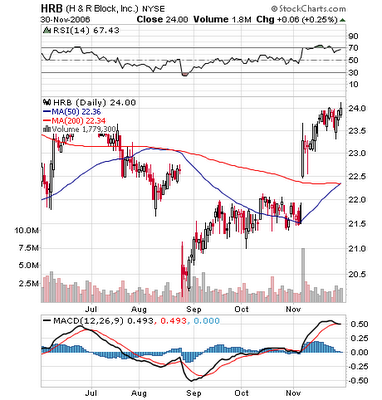
h&r block / hrb desaster reloaded

this data from hrb shows you that the mbs market is finally demanding higher premiums and is doing the due dilligence more seriously! and remember hrb has no option arms! in the options arm segment the picture should be even worse......more on mbs and other warnings http://immobilienblasen.blogspot.com/search?q=mbs


diese date von hrb zeigt eindeutig das der mbs markt wacht endlich auf und verlangt höhere risikoprämien und prüft die angebotenen pakete genauer. und das obwohl hrb keine der riskantesten kredite mit negativer tilgung anbietet. dort dürfte es um einiges schlimmer aussehen......... mehr zu mbs und warnungen http://immobilienblasen.blogspot.com/search?q=mbs


here the details from the warning in september./ hier die fakten zur warnung vom september http://immobilienblasen.blogspot.com/2006/09/update-conference-call-hr-block-hrb.html#links


off course the stock is ways higher (in part due to the sale of anounced sale of "option one") than before the warning in september and afterhours the stock stayed at 24$ after the secound massive warning. wall street is on steroids.........the new guidance is 1,20$-1,45$ (very optimistic and off course ex massive charges!. makes a pe around 18 without charges....! with fundamentals worsening. maybe private equity can makes an offer............please.......)


selbstredend ist die aktie höher als zur letzten warnung im september (teilweise durch die ankündigung des verkaufs von "option one") und der warnung von gestern. nachbörslich weiter stabil bei 24$. wall street ist auf speed.......die neue schätzung beläuft sich auf optimistische 1,20-1,45. natürlich ohne die massiven "sonderbelastungen". macht ex restrukturiereungen ein kgv von 18. inkl. kosten wahrscheinlich eher 30-50!. und das bei sich verschlechternden fundamentals. evtl. kann ja private equity einspringen........


http://biz.yahoo.com/bw/061130/20061130005939.html?.v=1
Mortgage Services revenues decreased to $140.6 million in the fiscal 2007 second quarter from 235.8 million (down 40%!) last year. The decrease was driven by lower originations and by a decrease in gains on sale due to lower than expected loan sale premiums and higher provisions for loan losses. The business posted a pretax loss of $39.0 million versus pretax income of $48.8 million a year ago. (looks like a desaster!!!)


Non-prime loan origination volume was $6.6 billion versus a record $12.2 billion(down 46%) in the year-ago quarter and $7.8 billion (down 15% qoq) in the first quarter of fiscal 2007, as softness in the U.S. housing market and tightened loan underwriting continued to suppress loan volume.

Net gain on sale-gross margin for Mortgage Services was 37 basis points compared with 81 basis points in the fiscal year's first quarter, reflecting losses on derivatives and lower loan sale premiums.

Loan loss provisions totaled 69 basis points in the second quarter due to continued high default rates and greater loss severity. As a result of changes in loss severity estimates, the second quarter provision includes approximately 19 basis points related to production in prior periods.

Option One's mortgage servicing portfolio was $73.0 billion at the end of the quarter

......The company incurred $12.2 million in residual asset impairments, which were recorded as a reduction in gains on sale of mortgage assets in the income statement. The company also realized a net write-up to residuals of $7.6 million in the second quarter, ......

For the first six months of fiscal 2007, revenues decreased to $310.3 million from $540.8 million in the prior year period, and a pretax loss of $44.0 million compared with pretax income of $179.5 million last year.

During the six months, the company reacquired 8.4 million shares of its common stock at a total cost of $186.6 million, or an average purchase price of $22.26 per share.(22.4 mio shares left)/ no further repurchase of shares in the 2nd. half planned!

from their webcastpresentation (pdf) http://media.corporate-ir.net/media_files/irol/76/76888/Presentations/FINAL2Q07EarningsSlides.pdf

the loan to value ratio in their nonprime servicing portfolio is 82%, fico 611, 40 year accounts for 31% of their origination volume, interest only for 14% (page 8)

loan sale repurchase reserve from 0,16% in 2006 to 0,69% (plus 331%!!!!) and up from the guidance of 0,4% just given a few weeks ago. wow!!!!

75% higher than the guidance from september!!!!!!!!!!!! the mbs market is waking up!

update minyanville on hrb earnings
http://www.minyanville.com/articles/index.php?a=11705

Labels: ,

Monday, September 18, 2006

Fannie Mae could be hit hard by housing bust

keine frage. der investor berg redet heir ganz klar sein buch, heißt er hat ein interesse daran das fnm unter druck kommt. finde aber die aufgeführten punkte erwähnenswert und allen sollte klar sein wenn fnm in den strudel von kreditschieflagen im zusammenhang mit dem bubble kommt dann ist das die "mutter aller schieflagen"
http://immobilienblasen.blogspot.com/2006/08/faennie-mae-fnm.html
http://immobilienblasen.blogspot.com/2006/08/fnm-und-der-staat.html
http://immobilienblasen.blogspot.com/2006/08/andere-sind-gleicher-fannie-mae.html


Mortgage giant could lose $29 bln, long-term bear argues in investor letter

The worst of Fannie Mae's regulatory troubles may be behind it, but one longtime skeptic of the mortgage giant thinks it could face bigger problems from trouble in the U.S. housing market.

Gilchrist Berg, founder of $2 billion Jacksonville, Fla.-based hedge-fund firm Water Street Capital, said in a recent letter to investors that Fannie Mae could lose $22 billion to $29 billion if, as he expects, the housing bubble bursts and foreclosures increase

We are not sure the folks running the show fully embrace the risk of declining house prices," Berg wrote in the letter, a copy of which was obtained by MarketWatch. If the housing market continues to decline "a major portion of Fannie Mae's value could be wiped out." He declined to comment for this story.

Fannie Mae spokesman Alfred King said the company protects itself from housing-market volatility in many ways, including maintaining a geographically diverse book of business and focusing on mortgages that have a high percentage of equity in them.

Berg is considered a leading practitioner of short selling, a trading technique used to bet against stocks

Berg has been shorting Fannie stock since the summer of 2003, when questions emerged about its accounting. Earlier this year, the company agreed to pay a $400 million fine after its regulator, the Office of Federal Housing Enterprise Oversight, accused executives of manipulating results.
The stock has dropped roughly 15% since the beginning of August 2003. It's up more than 10% so far this year.


Fannie's main business is buying mortgages from banks and other lenders, packaging them into so-called mortgage backed securities (MBS) and selling them on to other investors. The company gets fees for providing credit guarantees on these pools of loans. Fannie is currently responsible for more than $1.6 trillion of MBS and is involved in the financing of roughly a fifth of all U.S. mortgages.

By taking mortgages off the hands of other lenders, Fannie helps them free up more capital so they can sell more mortgages.

Fannie also invests in bits of MBS that have been put together and sold by other mortgage companies like Countrywide Financial and Washington Mutual . It held a little more than $730 billion in mortgage-related securities on its balance sheet at the end of June.

Subprime exposure

Fannie has traditionally specialized in higher-quality, fixed-rate mortgages, which are less vulnerable to interest-rate fluctuations and volatility in the housing market.

But the company has been investing more in subprime MBS in recent years. Subprime loans are sold to home buyers who fail to meet the strictest lending standards, so this area of the mortgage market is expected to be hit harder by any housing downturn.

Fannie and Freddie bought 25.2% of the record $272.81 billion in subprime MBS sold in the first half of 2006, according to Inside Mortgage Finance Publications, a Bethesda, Md.-based publisher that covers the home loan industry.

In 2005, Fannie and Freddie purchased 35.3% of all subprime MBS, the publication estimated. The year before, the two purchased almost 44% of all subprime MBS sold.

Three big lenders, NovaStar Financial , Deutsche Bank and BNC Mortgage, part of Lehman Brothers , sold more than half of their subprime MBS to Fannie and Freddie this year, said Andrew Analore, editor at Inside Mortgage Finance

Ofheo, Fannie's regulator, has noticed that the company has increased its subprime exposure.
"They've expanded in that area in recent years, but it's still not an enormous part of their business," Andrew Lawler, chief economist at Ofheo, said. "It's an area we're increasingly looking at because they're increasingly involved in it."
An Ofheo report due out later this year is expected to show Fannie's subprime exposure is "generally moving up," he added.
Given those recent moves, Berg said it's not implausible that 15% of Fannie's mortgage exposure is subprime.
If a housing slowdown causes subprime foreclosure loss rates to rise to between 6% and 8%, Fannie could lose $22 billion to $29 billion, Berg estimated in his letter.
That's more than half of the roughly $40 billion in capital that Fannie had at the end of March, according to Ofheo
Foreclosure loss rates on subprime mortgages are currently lower than Berg's theoretical range, but some experts are worried that foreclosures could increase in coming years.

"There's a high probability of a sharp increase in credit losses in the second half of 2007 and into 2008," said Robert Lacoursiere, an analyst at Banc of America Securities. "This will be more pronounced in subprime and will hit earlier in that area, too." http://immobilienblasen.blogspot.com/2006/09/delinquencies-foreclosure.html, http://immobilienblasen.blogspot.com/2006/09/delinquency-rate-in-home-equity-loan.html, http://immobilienblasen.blogspot.com/2006/09/subprime-delinquency-rate.html
Subprime stress

Early signs of stress are beginning to appear.
H&R Block announced an unexpected $102 million charge in late August related to its Option One mortgage business, which specializes in home loans to borrowers with credit scores at the lower end of the spectrum. The company said the losses cover loans it could be required to buy back should a borrower default on the first payment. http://immobilienblasen.blogspot.com/2006/09/update-conference-call-hr-block-hrb.html,

Mortgage-lender National City said recently that, while it has refrained from entering the riskier areas of lending, it has seen a marked increase in first-payment defaults on loans. http://immobilienblasen.blogspot.com/2006/09/notverkauf-bei-subprime-new.html
In California, one of the hot markets where home prices soared in recent years, defaults surged 67% in July from a year earlier.

Mortgage-insurance specialist MGIC Investment reported a 17.35% delinquency rate on A- rated and subprime loans as of the end of June. That's up from 12.38% in late 2002.
Fannie may have increased exposure to the subprime market in response to restrictions on its growth by regulators, Lacoursiere explained.

Subprime mortgage debt offers higher yields than better-quality loans. So one way for Fannie to generate more profit in the midst of restrictions on its portfolio is to invest in higher-yielding debt, he said.

"They've been getting into asset classes that haven't been a big specialty for them in the past," the analyst added. "Combine that with a credit environment in the mortgage market that is fundamentally deteriorating, and you start to wonder whether they're doing something that they may regret."

The problem is exacerbated by the fact that Fannie Mae hasn't disclosed financial statements for more than two years, Berg said in his letter. That makes it hard to gauge Fannie's true exposure to subprime mortgages and the housing market as a whole.

"Simply writing down these points in summary fashion illustrates the unprecedented and complex puzzle of a $46 billion market cap company that doesn't file financial statements," he wrote. "Moreover, the company has instituted a share buyback for the benefit of employees in the midst of this void! You can't make this stuff up."


Fine on subprime

Fannie doesn't disclose what percentage of its mortgage exposure is subprime, King, the company's spokesman, said.

However, Fannie's chief economist, David Berson, said in an interview that the company has "very little exposure to the subprime market."

Fannie also protects itself from a possible downturn in the housing market in a number of different ways, including maintaining a geographically diversity book of business and focusing on mortgages that have a high percentage of equity in them, King noted.

At the end of June, the loan-to-value ratio on Fannie's book of business was 54%, he added.
Other experts noted that when Fannie purchases subprime MBS, it usually only buys triple-A-rated tranches. In the event of losses, the triple-A bits are the last ones affected.


Ed Groshans, an analyst at Fox-Pitt, Kelton, estimated that if losses in these pools of mortgages reached 10%, investors in the triple-A tranches would still get all their interest and principal back.

"Higher interest rates will cause more people to go delinquent on their mortgages, but not enough to push losses on these pools over 6%," the analyst said.

Indeed, Lacoursiere of Banc of America Securities said other mortgage companies, such as Countrywide, Washington Mutual and IndyMac , are much more exposed to trouble in the subprime market than is Fannie Mae.

But Berg said most analysts and investors are underestimating the impact of the unwinding of what he called a "historic housing and mortgage bubble."

"We are only postulating that the subprime book could get in trouble and experience normal losses," he added. "Things could get far worse than our mildly bearish assumptions."

daumen drücken das diese prognose nicht eintreffen wird. bin mir auf der anderen seite sicher das der staat im zwiefel eingreifen wird wie er es mit der aussetzung der bilanzierungspflicht in den letzten 3 jahren ja bereist gemacht hat.

jan-martin

Friday, August 25, 2006

mehr zu mbs / mbs bubble?

der nachfolge artikel paßt so gar nicht in das zuletzt gezeichnete bild in sachen verbrifungen/mbs/cdo. wenn man sich die anderen berichte zu den mbs ansieht stellt man fest das ab dem 2.quartal die rückkäufe bzw. geplatzen mbs explodiert sind. http://immobilienblasen.blogspot.com/2006/08/hr-block-mbs-bad-loans.html. auf der anderen seite zeigt es das der anlagedruck ungeachtet der risiken immer noch gigantisch sein muß. i.d.r. enden solche vernachlässigungen des risikos nicht glimpflich.

dank ghet an mish und sein markettraderforumhttp://www.markettradersforum.com/forum1/1567.html

Home loan securities near record
By Saskia Scholtes in New Yorkhttp://msnbc.msn.com/id/14504337/

Investors are pushing prices for securities backed by mortgages and home equity loans to near record levels, in spite of data pointing to a slowdown in the US housing market.

The rising prices – and falling yields – for these securities are an example of how the financial markets have been affected by the rising popularity of collateralised debt obligations (CDOs) – investment vehicles that sell bonds which are backed by portfolios of other bonds.

These portfolios can include various loans but many are backed by consumer debts, of which housing-related loans are the most common.

Analysts say that CDO structurers such as asset managers and investment banks are continuing to snap up bonds backed by mortgages and home equity loans, leading to a counter-intuitive rally in an asset class that has been a source of growing public concern. (logisch, oder?, logical?!)

Christopher Flanagan, structured finance analyst at JPMorgan, said: "Support [for residential mortgage-backed securities] is in the form of heavy CDO issuance and a pipeline of future deals that keeps refilling.

"We have been consistently surprised at the resilience of structured-finance CDO [issuance], given negative [home equity loan] fundamentals and [home equity loan] spreads at or near all-time tights," he added.(ist ein bubble)

CDOs work by pooling payments from the underlying securities and distributing the money to investors who take on different levels of risk. The CDO structurers often play the riskiest role – holding the so-called equity tranche or first-loss position – meaning that their appetite for housing-related securities is particularly significant.

Figures released this week on weak new and existing home sales during July underscored the mounting evidence this year of a gloomy outlook for the US housing sector.

There also are signs that home-owners are starting to have difficulties making repayments.
(sogar die ersten raten / first payment defaults)

Rating agency Moody's reported that the quarterly delinquency rate on the riskiest layer of the mortgage market increased by 9 per cent in the first quarter of 2006, the first time that the figure has gone up since 2002.

Analysts say that CDO structurers and buyers are taking comfort from the belief that a slowdown in house price appreciation will not lead to a doomsday scenario of widespread house price declines. (naiv)

Karan Chabba, CDO analyst at Bear Stearns, said: "The housing numbers are worrisome to the extent that there could be some losses on the underlying pools [of the CDOs]."

gruß
jan-martin

Tuesday, August 08, 2006

geplatze mbs / buyback mbs

mann oh mann. die meldungen schlagen in immer kürzeren abständen ein. dazu auch
heute gibt ne kleine bank die netbank (ntbk) zahlen bekannt.
NetBank, Inc. Reports Loss of $.68 per Share for the Second Quarter
highlights:
Heightened Mortgage Repurchase Activity. Our indirect conforming and non-conforming mortgage operations experienced markedly higher repurchase requests on loans previously delivered to investors. Provision expense within our Financial Intermediary segment totaled $20.3 million this quarter, an increase of $13.2 million from last quarter. (anscheinend sind auch hier bei bereits vertickerten krediten die ausfallraten exoplodiert und die käufer nutzen jetzt ihr rückgaberecht. wird dazu führe das sich die kreditbedingungen unabhängig von der fedentschedung weiter verschärfen)
Negative Net Servicing Results. Net servicing losses steepened from $5.8 million, pre-tax, a quarter ago to $16.7 million, pre-tax, this quarter. This quarter's results include a $15.0 million pre-tax charge to the carrying value of the company's portfolio of mortgage servicing rights ("MSRs") that the company is actively marketing for sale. Management recorded the impairment charge based on market data it has gathered during the sales process. The adjustment brings our valuation into closer alignment with the valuation estimates observed in the third-party marketing data.
Goodwill Impairment. Management wrote off goodwill on the company's recreational vehicle, boat and aircraft lending business following the second quarter, which tends to be the operation's busiest season. Production and performance within the channel remained below historical results and our internal projections. The business continues to be adversely impacted by rising fuel costs and slower boat sales following the severe hurricane season of 2005. We concluded that the existing level of goodwill no longer accurately reflected the value of the operation's brand and other market intangibles in today's more challenging environment and that a pre-tax impairment to goodwill of $6.4 million was warranted.
(abschreibungen wohin man blickt)
``Quarterly results remain unacceptable,"
We are also pursuing a sale of our mortgage servicing platform and portfolio of mortgage servicing rights. This process is ongoing, and we remain optimistic in our ability to get a deal done to free up capital currently allocated to this asset
``Our efforts do not end there,'' Freeman continued. ``We made a number of changes in our non-conforming operation during the quarter. We moved our focus to a set of products that tend to carry better margins and less repurchase risk. This change allowed us to cut staffing by approximately 16%. We are also evaluating other opportunities for this business since we are increasingly concerned that the non-conforming environment will remain under duress for a protracted period. Other institutions announced similar concerns along with their intent to explore alternatives for their non-conforming operations. (anscheinend hat der mbs markt zumindest was die darlehen der ntbk angeht die schnauzu voll von den "kreativen" finanzierungen. verständlich)
auch hier wieder kar zu erkennen. für die geplatzen mbs ist keinerlei ausreichende risikovorsorge getroffen worden. jede wette das hier in den nächsten monaten noch ne lawine auf die banken zurollt die jegliche gewinnprognose in luft auflösen wird.
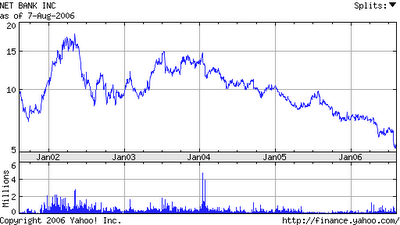
man sollte bedenken das die ntbk ein winziger spieler und schwacher spieler in dem markt ist. der chart spricht bände.
gruß
jan-martin
update conference call:
dre kreative finanzierungsektor soll aufgrund der desaströsen aussichten und der drohenden mbs rückkäufe verlassen werden.
es platzen haufenweise kreative kredite (ohne einkommensnachweis, niedrige bonität, hohe beileihungsgrenzen) befor die ersten raten eingehen!!!!!!!! tolle underwritiungstandarts.
selbst im traditionellen kreditbereich häufen sich die rückkäufe der mbs.
das boot und wohnmobilfinanzierungsgeschäft hat in der hochsaison keine kohle verdient! daher die abschreibung. da kommt sicher nicht mehr.
versteht sich von selbst das das management diese "überraschenden" risiken/rückkäufe nicht hat kommen sehen.
mann war das deprimirend
gruß
jan-martin

Saturday, September 23, 2006

Bad Blood Over Bad Loans / mbs

entscheidend wie bei fast allen märkten ist letztendlich der zugang zur liquidität sprich kredit.
die schlüsselrolle spielt besonders in den usa der bereich des sog. "secoundary market" wo kredite als mbs verbrieft und aus den eigenen büchern weiter an investoren weitergereicht werden. hier haben sich aufgrund des einbruches am immomarkt die ersten probleme eingeschlichen.

sollte sich das weiter verschlechtern werden diese investoren (hoffentlich) wenn sie klar bei verstand sind höhere risikoprämien verlangen. das sollte den markt zumindest nicht weiter stark anwachsen lassen und normalerweise auch langsam austrocknen lassen. dürfte dann in letzter konsequenz den immomarkt ernsthaft belasten.

Bad Blood Over Bad Loans
http://www.businessweek.com/magazine/content/06_40/b4003063.htm?chan=top+news_top+news+index_businessweek+exclusives

Mortgage defaults are rising. Wall Street thinks banks should mop up the mess

Everyone involved in the mortgage business got rich during the housing boom, including Wall Street. The biggest firms bought all the loans they could get their hands on, repackaged them, and sold them for a fee to hedge funds and other investors. Mortgage-backed securities issuance soared from $184.5 billion in 2000 to nearly $1 trillion in 2005, generating more than $1 billion in fees last year.

But now that the real estate tide is ebbing, trash is starting to wash up on shore. Mortgage delinquencies are zooming -- bad news for the banks, Wall Street firms, and investors holding loans.http://immobilienblasen.blogspot.com/2006/08/subprime-in-trouble.html#links
http://immobilienblasen.blogspot.com/2006/09/delinquencies-foreclosure.html
http://immobilienblasen.blogspot.com/2006/09/subprime-delinquency-rate.html

In some cases, the original lenders are taking the biggest hits. In typical deals, banks agree to buy mortgages back from Wall Street in the case of a payment default within the first 90 days. Now some are writing big checks. H&R Block Inc. (HRB )http://immobilienblasen.blogspot.com/2006/09/update-conference-call-hr-block-hrb.html, owner of Option One Mortgage Corp. (HRB ), reported a fiscal 2007 first-quarter loss of $219 million as it set aside cash for buybacks. Defaults forced NetBank Inc. (NTBR ) http://immobilienblasen.blogspot.com/2006/08/geplatze-mbs-buyback-mbs.htmland Fremont General Corp. (FMT )http://immobilienblasen.blogspot.com/2006/08/buyback-mbs-geplatzte-mbs.html to buy back more loans as well. Fremont paid $238.4 million in the second quarter, up from $67.7 million a year earlier.

But Wall Street is feeling the sting, too. A few lenders have refused to buy back loans, prompting arbitrations and lawsuits. Bear, Stearns & Co.'s (BSC ) mortgage affiliate, EMC Mortgage Corp. of Irving, Tex., is suing New York lender MortgageIT over $70.5 million in disputed buybacks. (Deutsche Bank (DB ) said in July it would buy MortgageIT Holdings Inc. (MHL ) for $429 million; it declined to comment.) And Lehman Brothers Inc. (LEH ) is trying to recoup $20 million on toxic loans bought years ago from Beverly Hills Estates Funding Inc., whose principal, Charles Elliott Fitzgerald, is believed to have fled the country to a South Pacific island. "While the speculation is that he's offshore, we don't have any leads to his whereabouts," says Michael Wachtell, an attorney for the receiver overseeing Beverly Hills Estates Funding's liquidation.

SMALL-SHOP WIPEOUT

The losses could get much worse. Precise estimates are hard to come by, but D. Keith Johnson, chief operating officer of Clayton Holdings Inc. (CLAY ), a loan-risk analysis outfit, says his firm alone has evaluated some $3 billion in potential buyback transactions this year. There's no telling how much of that will go sour. Smaller shops that feasted on shaky loans during the boom could be wiped out. "They popped up like mushrooms after a rainstorm," says Michael Robert Cavendish, an attorney at Boyd & Jenerette in Jacksonville, Fla., a firm that has won some arbitrations recently. "But many are undercapitalized." Analysts say buybacks were a major factor in the collapses of Acoustic Home Loans, an affiliate of California lender Metrocities Mortgage, and Texas-based QuoteMeARate.com. Metrocities declined to comment. QuoteMeARate.com's Web site and phone number are no longer in service.

Wall Street's latest strategy: Improve quality control by acquiring lenders. On Sept. 5, Merrill Lynch (MER ) said it would pay National City (NCC )http://immobilienblasen.blogspot.com/2006/09/notverkauf-bei-subprime-new.html $1.3 billion for its First Franklin Financial Corp. unit. On Aug. 9, Morgan Stanley (MS ) said it had agreed to buy Saxon Capital Inc. (SAX ) in Glen Allen, Va., for $706 million. Analyst David A. Hendler of New York bond research shop CreditSights says New Century Financial, KKR Financial (KFN ), American Home Mortgage (AHM ), and a handful of other lenders could soon come on the block. Deals made now will leave buyers with plenty of time to clean house before the next real estate boom

jan-martin

Tuesday, August 22, 2006

buyback mbs / geplatzte mbs

mal wieder ein beweis mehr das die kreditqulität der in den letzten jahren vergebenen krdeite grausam gewesen sein muß und das nur durch die steigenden immobilienpreise kaschiert worden ist.

das hier ist ein ausschnitt von der superben seite von russ winter.
http://www.xanga.com/russwinter/521699581/chink-in-the-armor.html?nextdate=last
bitte unbedingt den vollen artikel lesen/ read the whole post on the site from russ)

At subprime lender Fremont General, the amount of home loans repurchased and re-priced reached $238.4 million in the second quarter, up from $67.7 million in the year-ago quarter and $107.7 million in the first quarter of this year. The Santa Monica, Calif., company said it had cut back on "certain higher loan-to-value products and lower FICO" loans during the second quarter to reduce early payment defaults and thereby loan repurchases from investors. (das nenne ich mal steigerungen. dagegen verblassen slebst die wachtumsraten von google.....)


http://immobilienblasen.blogspot.com/2006/08/geplatze-mbs-buyback-mbs.html
http://immobilienblasen.blogspot.com/2006/08/mehr-zu-arms-und-mbs.html

gruß
jan-martin

Wednesday, August 09, 2006

subprime in real trouble

so sieht es im chart aus wenn dank der zurückgekauften mbs und wenn so gut wie keine reserven zurückgelegt worden sind.


i
gruß
jan-martin

Tuesday, July 11, 2006

risikovorsorge nicht notwendig?

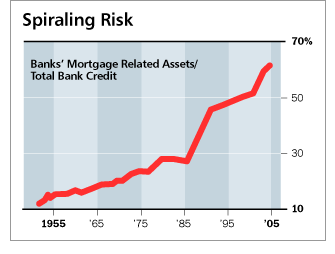
in meinem eröffnungspost habe ich geschrieben das hinsichtlich des kreditrisikos ein großteil der hypotheken in sog. mortage backed securities (mbs) verpackt wird.

das hätte zur folge das das kreditrisko auf pensionsfonds, hedgefonds usw abgewälzt wird. dummerweise landet der großteil dieser mbs (wenn auch nicht der identischen) wieder in den büchern der banken.

folgerichtig hat der anteil von hypothekenbezogenen (direkt oder mbs) darlehen dank der immoblase in den letzten jahren neue rekordstände erreicht.

der dank gilt charles hugh smith mit seinen erstklassigen blog
http://www.oftwominds.com/index.html


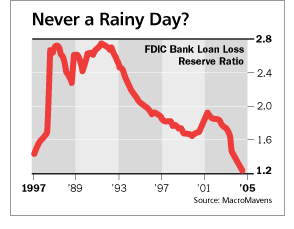
man sollte meinen das bei den unbetsreitbaren risiken nach 5-6 jahren nie dagewesenen wertzuwachs bei den us immobilien die rückstellungen für "faule kredite" (bad loans)
entsprechend großzügig bemessen sein müßten. das gegenteil ist der fall. de facto ist trotz des explodierenden risikos die quote auf oder nahe eines allzeittiefes gefallen. klingt logisch, oder?


anscheinend sind die banken aufgrund der ewig steigenden immopreise was die risikobewertung angeht in einen tiefschlaf gefallen.
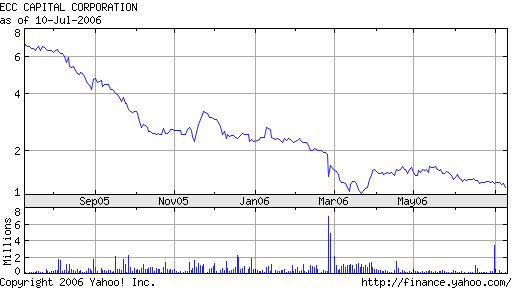
charles bzw. einer seiner leser (albert t.) sich das ganze mal bei der größten nationalen (und nach der citgroup weltweit zweitgrößten bank) "bank of america"(bac) angesehen.

die bac hat in 2005 ausfälle von etwa 0.006% für privat genutze wohnimmobilien. von diesem fast nicht vorhandenem betrag gibt es nur eine richtung. da meiner meinung nach die blase bereits am platzen ist und die zwangsvollstreckungen aufgrund der einsetzenden anpassungen der "arms" explodieren wird das zu massiv verhagelten ergebnissen der banken führen müssen. evtl. auf jahre hinaus (fragt mal bei der hypobank oder der berliner bank nach.... die haben diverse jahre nach dem bauboom im osten zur sanierung gebraucht).

denke das besonders die (kleinen) banken zu leiden haben werden die ihr geschäft ausschließlich in den usa und besonders in den hotspots (californien, florida, las vegas usw) generieren.

gruß

jan-martin

update: http://www.xanga.com/russwinter

dort wird ecr capital (subprime/besonders riskante schuldner) hinsichtlich der o.g. problematik beschrieben. zusammenfassung:

hypotheken in den büchern 3,75 billion $(in euro mrd)

rückstellungen für faule kredite 6,1 mio!$

ecr ist hauptsächlich im epizentrum californien tätig. die schuldner muß durchschnittlich 41% seines gehaltes für den schuldendienst aufbrigen und der beleihungswert (loan to value) beträgt bei preisen auf bubblelevel satte 80%! es wird noch besser!

30 tage zahlungsaufforderung: für 222 mio$ (knapp 6% des portfolios)

90 tage zahlungsaufforderung:für 113 mio$ (ca, 3% des portfolios)

zudem versuchen sie 2,42billion als mbs zu vertickern. in diesem markt nimmt den das keiner zu 100% ab.

schon klar das bei dem gesunden kreditbuch 6,1 mio als reserve ausreichen.................

der chart sagt auch hier weider mehr als alle worte


gruß
jan-martin

Friday, August 25, 2006

h&r block / mbs / bad loans

nachfolgend ein exemplarisches beispiel wie blauäugig die großen hypothekenfinanzierer die lage am markt eingeschätzt haben. das trifft besonders auf die subprime kreditgeber zu. die operieren traditionell in der höchsten risikokategorie in sachen kreditnehmer. hinzu kommt das damit verbunden oftmal die art der kredite oft von "kreativen" krediten dominiert wir. hier zum beispiel mit einem anteil von 80% variabler kredite und zugleich einem großteil der kreditvergabe in bubblezentren wie californien, florida etc.

gleichzeitig waren die reserven für die als mbs verbriefte kredite in den letzten jahren fast nicht vorhanden. der wertzuwachs der immobilien kaschierte das risiko.

seit dem 2. quartal hat sich das speil gedreht und die lender werden aufgrund von zahlungsausfällen gezwungen ihre mbs zurückzukaufen. die reserven die bisher nicht nötig waren werden explodieren. die auswirkungen auf die bilanzen/ergebnisse dürften wenig erfreulich sein.
http://immobilienblasen.blogspot.com/2006/08/buyback-mbs-geplatzte-mbs.html


H&R Block Expects to Report Provision for Losses Related to Increase in Loan Repurchases
http://biz.yahoo.com/bw/060824/20060824005676.html?.v=1


KANSAS CITY, Mo.--(BUSINESS WIRE)--Aug. 24, 2006--H&R Block Inc. (NYSE: HRB - News) today announced that it expects to record a provision for losses of $102.1 million (after-tax amount of $61.3 million or 19 cents per share) reflecting an increase to the estimated recourse liability recorded by Option One Mortgage Corporation for loan repurchases and premium recapture reserves. The expected provision includes $46.1 million related to loans sold during the quarter ended July 31 and an increase of $56.0 million related to loans sold in previous quarters. The Company expects to increase the estimated recourse liability primarily as a result of recent increases in loan repurchases from its loan sale transactions. The increased level of loan repurchases, which have been noted industrywide, are primarily due to a higher level of repurchase requests from loan buyers and an increase in early payment delinquencies

"It's a large amount, and a sign that subprime borrowers might be having more difficulties making payments," said Kartik Mehta, a senior analyst at FTN Midwest Securities Corp., who has a "buy" rating on the company. "They will have to buy back loans they made and subsequently sold."

"Because of increases in early payment delinquencies, we've had a recent increase in loan repurchases," H&R Block spokesman Nick Iammartino said. "We sell these loans later, but at a lower value."

nachfolgend daten aus dem letzten 10k filing
http://yahoo.brand.edgar-online.com/fetchFilingFrameset.aspx?dcn=0000950137-06-007517&Type=HTML

das sind die reserven für die jetzt explodierenden rückkäufe in den jahren (geschäftsjahr hat am 30.4. geendet) 2006 2005 2004

Loan sale repurchase reserves
(0.18 %) (0.13 %) (0.20 %)


man beachte die lächerlich niedrige reserve die vorgehalten worden ist. in den letzten jahre man der bubble das ja noch kompensiert haben. wie die meldung oben zeigt fliegen ihnen diese niedrigen vorsorgen bereits in den ersten monaten um die ohren. bin gespannt wo wir den prozentsatz am ende des jahres sehen werden. tippe auf ne vervielfachung.


We originated $40.8 billion, $31.0 billion and $23.3 billion in mortgage loans during fiscal years 2006, 2005 and 2004, respectively. Information regarding our non-prime loan originations is as follows 2006 2005 2004
(fiscal year endet 30.04.)

Loan type:
2-year ARM
43.9% 61.6 % 63.4 %
3-year ARM
1.9% 4.0 % 5.2 %
Fixed 1 st
12.7% 17.7 % 28.7 %
Fixed 2 nd
4.9% 3.8 % 1.6 %
Interest only 1 st
21.1% 12.6 % 0.7 %
40-Year
13.4% 0.0 % 0.0 %
Other
2.2% 0.3 % 0.4 %
Percentage of fixed-rate mortgages
20.0% 22.1 % 30.4 %
Percentage of adjustable-rate mortgages
80.0% 77.9 % 69.6 %
Percentage of first mortgage loans owner-occupied
91.7% 92.6 % 92.9 %
Loan purpose:
Cash-out refinance
60.2% 63.5 % 67.1 %
Purchase
35.0% 30.8 % 26.0 %
Rate or term refinance
4.8%

The following table details the percent of non-prime loan origination volume and our loan origination branches by state, excluding our Retail channel, for fiscal years 2006 and 2005:

2006 2005
Percent of Number of Percent of Number of
State Volume Branches Volume Branches
California
24.5 % 6 21.8 % 8
Florida
10.7 % 3 7.2 % 4
New York
9.1 % 2 11.5 % 2
Massachusetts
6.7 % 2 8.4 % 2
New Jersey
5.1 % 1 5.3 % 3
Other
43.9 % 20 45.8 % 23
Loan sale repurchase reserves
(0.18 %) (0.13 %) (0.20 %)

a desaster in the making!

bleibt noch nachzutragen das die erhöhung der reserven mal eben satte 10% des erwarteten jahresgewinns gekostet hat. soviel zu günstigen bewertungen.....

denke bei der betrachtung dieser daten kann es kaum glimpflich enden.

gruß

jan-martin

upadte von herg greenberg/marketwatch

With H&R Block's (H&R Block) disclosure of loan losses at its subprime-mortgage unit, as it's forced to repurchase deadbeat loans, I think back to a story I did in 2002 on their loan business. At the time, Block execs and the guys at the top of Option One, its loan division, were telling me that world of subprime is misunderstood because it actually gets better the worse the economy gets. And, besides, they said they were conservative in their underwritings. To which I say (and said at the time, to myself, at least: ) "Uh-huh! And don't try to sell me that bridge!" You can only wonder when the ripple effect will hit the other sub-prime lenders, including NovaStar , which is no stranger to this column.

gruß

jan-martin

Sunday, December 03, 2006

Mortgage Bonds Hurt by Delinquencies, Housing Slump

finally......./endlich.........

http://tinyurl.com/y43usm Dec. 1 (Bloomberg) -- The mortgage bond market is beginning to buckle under the weight of the worst U.S. housing slump in six years.

Yields on so-called sub-prime mortgage securities rated BBB have risen to 6.52 percent on average from 6.28 percent on Sept. 5, data compiled by Bank of America Corp. show. The yield premium, or spread above the one-month London interbank offered rate, a lending benchmark, rose to a seven-month high of 1.2 percentage points.

that is the key! even if i do not compare apples with apples but the 10 year has fallen almost 350 baisipoint in the meantime! this is out of the reach for the fed. when you read the latest warnings from h&r block or fith thirs bancorp you see the impact on earnings
http://immobilienblasen.blogspot.com/search/label/mbs. endgame could be that even if the fed lowers rates the subprimeborrower has to pay the same or higher rates.

das ist der entscheidende faktor. das liegt ausserhalb der kontrolle der fed. im gleichen zeitraum wo die vom mbs markt verlangten risikoprämien angestiegen sind hat die 10jahresrendite 350 baisipunkte abgegeben (selbst wenn nicht die identische grundlage aber der trend ist eindeutig). die auswirkungen auf die ergebnisse der banken/kreditgeber sind täglich zu beobachten.
http://immobilienblasen.blogspot.com/search/label/mbs. im enddefekt könnte bzw wird das dazu führen das selbt wenn die fed die zinsen senken wird/muß die subprime kreditnehmer davon nichts spüren werden.


About 3.3 percent of the $160 billion in sub-prime loans made this year through July have payments that are more than two months late, the highest ever for mortgages in their first year, ..

``The higher delinquencies do set off an alarm for many people and make us more conservative,'' ..
Delaware Investments, which has about $100 billion in bonds including mortgages, is buying more asset-backed bonds with top credit ratings such as AAA and less of those rated BBB, which are more sensitive to delinquencies and defaults, Wei said. The higher-rated bonds yield about 1.1 percentage points less than BBB debt.

Housing Slump
Most sub-prime mortgages -- to borrowers with poor or limited credit histories, or with higher-than-average debt levels -- pay fixed rates for the first two to three years and then adjust to market rates. They made up 19 percent of all U.S. mortgages in the first half of 2006,

......... last year, securities backed by floating-rate sub-prime mortgages returned 3.9 percent including reinvested interest, almost double the 1.97 percent gain for investment-grade corporate bonds, .... (these days are gone....! die zeiten sind vorbei...!)

Interest Costs
Sub-prime mortgage securities have returned 1.38 percent in the past three months, less than half the 3.63 percent return for corporate debt. The difference between yields on the mortgage bonds and Libor widened 0.25 percentage point in the past three months while the gap for similarly rated corporate debt narrowed 0.05 percentage point. Prime mortgages have returned 2.78 percent.

Sub-prime lenders New Century Financial Corp. of Irvine, California, Accredited Home Lenders Holding Co. in San Diego and Columbia, Maryland-based Fieldstone Investment Corp. are paying more in interest on the bonds they sell to fund mortgages.

Interest expense for New Century rose 29 percent to $375 million in the third quarter from a year earlier. Accredited's jumped 62 percent to $138 million. Fieldstone's payments climbed by 57 percent to $91 million.

Less Stringent
Late payments are accelerating after lenders began to require less documentation for loans and financed more homes without down payments, (what a surprise..../ was wunder....)

About 38 percent of the most common sub-prime mortgages this year were for the full value of the home, up from 31 percent in 2005 and 21 percent in 2004.....45.5 percent of the loans this year required ``low documentation'' of borrower income and net worth, up from 44.5 percent in 2005 and 40.1 percent in 2004.

The data reflect ``common methods of allowing first-time homebuyers to borrow more than they can afford,'' Sinha said. ....

Yield Premium
The yield premium on AAA rated securities has stayed at about 5 basis points over Libor the past three months, Bank of America data show. The 5.07 percent total return on all sub-prime mortgage securities this year is better than each of the last six years

Moody's on Nov. 14 said it may cut the ratings on $7.16 million of debt rated Ba2 sold by Anaheim, California-based Fremont Investment & Loan.

Fitch is considering whether to put ``a few'' sub-prime issues on review for a possible ratings cut..

``There's no doubt that there is going to be some increased credit risk,''

......Bill Gates, the world's richest person, bought shares of seven U.S. homebuilders through his philanthropic organization, a regulatory filing showed on Nov. 15. Homebuilder shares are up 15 percent on average since July after falling 30 percent in the first half of the year, according to the Standard & Poor's Supercomposite Homebuilding Index ( i am betting agninst gates/ich wette dagegen...)

Labels: , ,

Friday, December 08, 2006

crash boom bang! / subprime

this event is really an importend one. looks like the dots are connecting........ lets hope that all the mbs are "insured" by derivatives/cds... :-)! i´m sure the hedgefunds and pensions plans etc. have done this...... no wonder the risk premiums in this segment are starting to spike. thanks to russ winter for the chart http://wallstreetexaminer.com/blogs/winter/

dieses beispiel zeigt eindrucksvoll wie schnell der markt an die wand gefahren ist und so langsam aber sicher die fakten nicht mehr zu leugnen sind. man kann nur hoffen das alle hedge fonds und pensionkassen die diese mbs gekauft haben und nun nicht mehr zurückgeben können ihr risiko über derivate/cds abgesichert haben.... :-). guckt euch den chart an und ihr seht wie schnell diese art der mbs crashen. nach der meldung wird sich das ganze sicher beschleunigen. dank für den chart an russ winter http://wallstreetexaminer.com/blogs/winter/
Subprime lender Ownit Mortgage shuts down http://tinyurl.com/yzkcne

Ownit Mortgage Solutions, a California company that described itself as one of the top 15 lenders to homeowners with weak or no credit histories, has shut down, citing "the current unfavorable conditions of the mortgage industry."

Merrill Lynch & Co. (MER) and private equity firm CIVC Partners hold stakes in Ownit, which built its book of new loans to $8.3 billion in 2005 from $1.1 billion in 2003, in part by introducing products like 45-year mortgages, according to its Web site. Ownit's demise comes as subprime mortgage lenders are being squeezed by higher funding costs, weakening loan demand and rising delinquencies.


"Effective Dec. 5, Ownit closed its doors, and we are no longer able to fund or process your loans," the company said on a recorded telephone message. "We apologize for any inconvenience."

Ownit ran out of cash needed to meet its obligations to repurchase loans from investment banks and others (like hedge funds, pesnsion plans etc......) who bought them in the secondary market, people in the industry said. The banks, which convert the loan payments into mortgage-backed securities for sale to investors, can force the original lenders to repurchase loans if the mortgage borrowers default. ....

The end came quickly for Ownit.

"We were all working yesterday, assuming we were fine," Dave Hanthorn, a New Jersey-based employee who sells the firm's loans to mortgage brokers, said Wednesday evening. "At 5:15 last night we got the call that we were ceasing operations." He said the company gave no explanation for its funding problems.

..... The company took down the site - ownitmortgage.com - Wednesday afternoon so as "not to confuse" clients, said Dickinson.

Ownit laid off all its staff......

much more details ind insights on this topic / mehr hierzu :

mish http://globaleconomicanalysis.blogspot.com/2006/12/demise-comes-quickly.html
sacalmtgguy http://housingbubblecasualty.com/?p=50
aaron
http://www.autodogmatic.com/index.php/sst/2006/12/08/housing_finance_breakdown_begins
roubini http://www.rgemonitor.com/blog/roubini/162056

Labels: , , ,