Monday, May 05, 2008

Reasuring Phony Mae & Fraudie Mac Facts.......

Schould be an interesting call today........ Got gold? UPDATE: Stock under pressure premarket......... No wonder when you read through the Q1 Investor Summary Fannie Mae ( especially the delinquency rates starting page 22 ). Now up over 5 percent!

Sind das nicht beruhigfende Daten und Fakten zu den wohl wichtigsten Finanzinstituten weltweit...... Wird sicher eine interessante Telefonkonferenz........Got Gold? UPDATE: Aktie vorbörslich stark unter Druck. ......Sollte bei Durchsicht der folgenden Präsentation Q1 Investor Summary Fannie Mae nicht weiter verwundern. Lege Euch besonders die Charts zu den notleidenden Krediten ab Seite 22 ans Herz. Inzwischen über 5% im Plus!

Doubts Raised on Big Backers of Mortgages NYT
Fannie Mae and Freddie Mac now overwhelmingly dominate it, handling more than 80 percent of all mortgages bought by investors in the first quarter of this year. That is more than double their market share in 2006.

But some financial experts worry that the companies are dangerously close to the edge, especially if home prices go through another steep decline. Their combined cushion of $83 billion — the capital that their regulator requires them to hold — underpins a colossal $5 trillion in debt and other financial commitments.

The companies, which were created by Congress but are owned by investors, suffered more than $9 billion in mortgage-related losses last year, and analysts expect those losses to grow this year. Fannie Mae is to release its latest financial results on Tuesday and Freddie Mac is to report earnings next week.

bigger/größer

The companies are sitting on as much as $19 billion in additional losses that they have not yet fully acknowledged, analysts say. If either company stumbled, the mortgage business could lose its only lubricant, potentially causing the housing market to plummet and the credit markets to freeze up completely.

By the end of last year, the companies had guaranteed or invested in $717 billion of subprime and Alt-A loans, up from almost none in 2000.

Last year, in return for buying billions of dollars of subprime mortgages to help stabilize the market, executives won the right to expand their investment portfolios. In March, the companies agreed to raise more capital within the year. In exchange, they received an additional $200 billion in purchasing power.

UPDATE:

I think you can add another $ 200 bilion..... Party on.....

Nach diesen Meldungen dürfte wohl noch mal eine ähnliche Summe hinzukommen.... Die Party geht weiter.....

Marketwatch Fannie Mae's federal regulator said on Tuesday it will reduce the company's capital-surplus requirement to 15% from 20% when Fannie Mae completes a new capital-raising plan. Fannie said Tuesday it is planning to raise $6 billion in new capital. The mortgage-finance giant reported a first-quarter loss of $2.2 billion on Monday, or $2.57 a share, citing credit-related expenses

> On top of this Fannie is hinting that another 5 percentage point reduction to 10 will be in place in September 2008 ( see end of page 1 Press Release!)

> Darüberhinaus wird angedeuted das eine weitere Reduzierung um 5 Punkte auf dann 10% wohl Ende September kommen wird ( siehe Ende Seite 1 Press Release )

“We’ve taken tremendous risks by loosening these companies’ purse strings,” said Senator Mel Martinez, Republican of Florida and a former secretary of housing and urban development. “They could cause an economywide meltdown if they got into real trouble and leave the public on the hook for billions.”

> When watching this tiny spread it should be clear that the market is already assuming that there will the biggest bailout ever....

> Beim Betrachten dieser lächerlichen Risikoaufschlägen sollte jedem klar sein das hier der gigantischte Bailout der Geschichte bereits als gegeben hingenommen wird. Leider wohl mal wieder zurecht.....

Last month, the companies promised to pump money into the more expensive reaches of the housing market. In return, Congress temporarily raised the cap on the size of the mortgages they can buy to almost $730,000 from $417,000

> Here is more on Phony & Freddie from Contrary Investor

Again, please remember that the important numbers to focus upon are the twelve month moving average amounts. These are the numbers that are really showing us trend and potentially important trend change from a historical perspective. In fact, although it's just our opinion, we believe what you'll see below is not being given enough attention in financial market circles these days. First up is foreign purchases of US government agency securities. In the past, what has attracted foreign interest, at least we believe so, has been the yield spread differential between government agency paper and Treasuries. You can clearly see that since the summer of last year, foreign community purchasing of US government agency paper has cooled down meaningfully. The last time we saw this type of a drop off was when it became known that Freddie, and then Fannie a short while later, were no longer able to file audited financial statements

Remember, these are numbers through February. What had not yet transpired when these numbers were reported was the revelation of increased lending limits for Fannie and Freddie in conventional mortgage lending from $417K to $729K. Moreover, the OFHEO had also not yet allowed lowered capital requirements for these two mortgage paper behemoths, further allowing them to mushroom their balance sheets relative to total capital should they choose to do so in the future (which they will choose to do so - count on it). The question becomes, what will foreign community reaction to these two news items be come the March and April numbers for foreign purchases of US agency paper? Implicit with the hike in nominal dollar lending limits and the allowance of balance sheet growth on what will be a defacto smaller capital base is increased financial risk. You already know we'll be sure to let you know foreign reaction vis-à-vis forward purchasing of agency paper. The bottom line being? The answer will be a matter of confidence. And it sure as heck appears clear that confidence in US financial paper has already become a very meaningful issue for the foreign community really since last summer.

As you'll see below, to suggest that the foreign community has been an important support to cost of capital at the government agency level, and ultimately the cost of mortgage debt in the US over time, is a wild understatement.

> The US should be very fortunate that they have found enough "dump" money to accumulate these kind of secirities..... CHAPEAU ( no kidding )!

> Die US können sich in der Tat wirklich glücklich schätzen das es Ihnen gelungen ist soviel ausländischen Kapital in solch Papiere zu lotsen. Ziehe aufrichtig meinen Hut vor solch guter PR!

AddThis Feed Button

Labels: , , ,

Tuesday, December 04, 2007

Freddie Mac's Accounting Evokes Shades of Enron: Jonathan Weil

It´s no surprise some call them "Phony Mae and Fraudie Mac".... Just in time Fannie is also out with some news. Fannie Mae Cutting Dividend 30 Percent, Selling $7 Billion in Preferred Stock to Raise Capital

Sie werden nicht umsonst auch "Phony Mae and Fraudie Mac"genannt....... Passend hierzu ist auch Fannie mit einer Meldung draussenFannie Mae Cutting Dividend 30 Percent, Selling $7 Billion in Preferred Stock to Raise Capital

Dec. 5 (Bloomberg ) -- You have to wonder if a company is playing games when its earnings hinge on predictions no mere mortal is capable of making. That's one of Enron Corp.'s great lessons. And it's one that Freddie Mac investors might heed now.

Before it collapsed in 2001, Enron recorded large profits by estimating the values of its future cash flows from energy contracts that extended 20 years or longer. It then booked those amounts as current earnings. Even if Enron's executives had been acting in good faith, which they weren't, the forecasts they made weren't humanly possible.

Freddie's results depend on similar predictions, with a twist. The Mclean, Virginia-based company is using far-out forecasts of future cash flows to avoid recognizing large losses in its net income and capital. To believe Freddie's financial statements, you must believe the government-sponsored mortgage financier can make prognostications about its cash flows and debt issuances as long as 26 years from now.

Here's how the accounting works. Freddie's Sept. 30 balance sheet shows $4.3 billion of pent-up losses on derivatives called cash-flow hedges. Companies use these side bets to guard against interest-rate fluctuations on, for example, variable-rate debt.

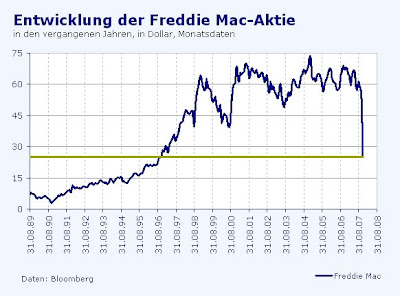
Changes in the hedges' values don't hit net income immediately. Instead, they go into a line in shareholder equity called accumulated other comprehensive income, or AOCI. From there, they are released gradually into net income as payments come due.

Doesn't Count
These losses also don't count in the primary gauge the government uses to measure Freddie's capital, the financial cushion that helps any company absorb losses. Had Freddie counted them in net income, it would have fallen $3.7 billion short of its minimum capital requirement at the end of the third quarter.

Freddie says it has closed out almost all its cash-flow hedge positions, meaning the losses are now fixed. It says about 70 percent of its AOCI will be released into earnings over the next five years. The rest will take longer.

So what's getting hedged? Many of the hedged items don't exist yet. That's because they are ``forecasted transactions,'' primarily future issues of debt. The company says it has hedged the cash-flow risks on such deals as far out as 2033.

Under the accounting rules for derivatives, a future deal must be ``probable'' to qualify as a hedged transaction. So must the deal's terms, such as size and timing. This is where the forecasts get tricky.

Think Back
Consider how hard it would have been for a company in 1981 to envision and hedge its cash-flow risks on a debt sale it thought back then that it would make in 2007.

``Who could have predicted the Internet being where it is today?'' Ketz says. ``Who could predict that China would be the economic power that it is? Even in the U.S., the decline of, say, General Motors -- I don't think anyone would have predicted that in 1981. These are structural changes that affect the society and economy, and they can affect the cash flows that occur.''

Predictions even a few years out are tough. Will the next president be a Democrat friendly to Freddie and Fannie Mae, or a Republican who's not? How much more will home prices fall in the next year? Where will interest rates be? And wouldn't these developments affect Freddie's business and plans?

Consider the History
A Freddie spokeswoman, Sharon McHale, says the company knows its forecasted transactions are probable because it ``has a history of issuing significant amounts of debt instruments, well in excess of amounts hedged.'' The mortgages and mortgage securities it purchases stretch over 15 to 30 years, she notes, while the longest maturity for Freddie's debt is 10 years. Therefore, ``we know there is a need for debt issuances in the future to fund existing and future mortgage securities that have not fully prepaid prior to their stated maturity.''

Still, knowing the need will exist isn't the same as knowing what the terms and risks will be.

Judging by Freddie's $34.6 billion of so-called core capital at Sept. 30, which was about $600 million above the government-set minimum, Freddie already was adequately capitalized. And by keeping its $4.3 billion of losses in the AOCI holding tank, Freddie is signaling that a like amount of benefits will materialize in years to come.

Nonetheless, after posting a $2 billion net loss for the third quarter, Freddie last week had to raise $6 billion through a preferred-stock offering and cut its dividend by half to shore up its dwindling capital. That undercuts the notion that its cash-flow hedges are working properly. If they were, then Freddie should be getting around $4.3 billion of gains over the next 26 years. So there would be no need for a capital infusion.

Yet there was such a need. And until just recently, Freddie didn't see it coming. The lesson for investors: Freddie's crystal ball is no better than yours.

> Got gold......?

AddThis Feed Button

Labels: , , , , ,

Tuesday, November 20, 2007

Jim Rogers On "Phony Mae and Fraudie Mac"

Make sure you hear the "amusing" Bloomberg Interview with one of my heros Jim Rogers. Here my take from yesterday Freddie Needs Fresh Capital...... It´s funny to see how the reporter tries to defend Freddie & Fannie.... But he is by far better than this must see example from FOX Business News. They even make Mark Haines look smart......

Hier das extrem amüsante Bloomberg Interview mit einem meiner Helden Jim Rogers sowier mein gestriges Post zu diesem Thema Freddie Needs Fresh Capital...... Man kann fast das Gefühl haben das der Reporter sich vor Angst fast überschlägt. Aber in jedem Fall besser als dieses Beispiel vom angeblichen Wirtschaftssender FOX Business News

Freddie, Fannie Shares Will Continue to Slide, Jim Rogers Says
Nov. 20 (Bloomberg) -- Freddie Mac, which today dropped the most ever after posting a record loss, and rival mortgage lender Fannie Mae will continue to tumble because of bad home loans, investor Jim Rogers said.

``I'm still short those companies, they both have a long way to go as far as I'm concerned,'' Rogers said in an interview. ``Neither one has a clue what's on their balance sheets.''

Freddie Mac, the second-largest U.S. mortgage company, warned of a possible cut in the dividend and the need for additional capital. The worst housing slump in 16 years caused ``significant deterioration'' in the third quarter that will continue through year-end, Freddie Mac said after reporting a net loss of $2.02 billion, or $3.29 a share, three times what some analysts estimated.

Rogers, who predicted the start of the global commodities rally in 1999, advised in a Nov. 5 interview with Bloomberg that investors should avoid financial stocks. In March 2006, he said Fannie Mae shares would decline.

Make sure you read Drilling Deeper into the Freddie Fiasco from Greenberg!

Laßt Euch auf keinen Fall Drilling Deeper into the Freddie Fiasco von Herb Greenberg entgehen!

Thanks to Rodger Rafter for the term "Phony Mae and Fraudie Mac"

AddThis Feed Button

Labels: , , , , , ,

Freddie Needs Fresh Capital.....

When you read this quote from Freddie or Fannie you know something is brewing.......I suggest to read the entire Freddie Mac Presentation including lots of details on the billions of losses, mark to market, cure rates etc....

Wenn man diese Ausführung von Freddie oder Fannie zu hören bekommet weiß man das Ungemach nicht lange auf sich warten läßt..... Ich empfehle die gesamte Freddie Mac Präsentation zu lesen. Die geben u.a. Hinweise wo genau diie Mrdverluste sich angehäuft haben und was evtl. noch so alles kommen könnte......

Considering a variety of options to manage to the mandatory target capital surplus and respond to regulatory concerns

From the Press Release

Freddie Mac's regulatory core capital was estimated at $34.6 billion at September 30, 2007, which represented an estimated $8.5 billion in xcess of the regulatory minimum capital requirement, and an estimated $0.6 billion in excess of the 30 percent mandatory target capital surplus directed by the Office of Federal Housing Enterprise Oversight OFHEO).

Bloomberg Freddie Has 3rd-Quarter Loss, Seeks to Raise Capital

Freddie Mac hired Goldman Sachs Group Inc. and Lehman Brothers Holdings Inc. to advise it on capital options.

Bloomberg Freddie Mac May Need to Raise $6 Billion to Stem Capital Slide

Freddie Mac, the second-largest U.S. mortgage-finance company, may need to raise as much as $6 billion to bolster its capital amid the worst housing slump in at least 16 years.

AddThis Feed Button

Labels: , ,

Friday, November 09, 2007

What? Did Bernanke Really Say This ?

The piece from the WSJ is for real.... I´ve heard him say this during yesterday lousy performance before Congress' Joint Economic Committee. I think after this even the single person left that still took Bernanke seriously has now some doubts. Even i wouldn´t have thought that he is morphing into Greenspan at almost warp speed..... Cramer will be proud....And some still wonder why the $ in tanking.....

Ich kann die Geschichte des WSJ bestätigen.... Ich habe dieses Zitat während des erbärmlichen Auftrittes von Bernanke vor dem Congress' Joint Economic Committee selber gehört. Ich denke das spätestens jetzt die wenigen die noch immer eine hohe Meinung von Bernanke haben jetzt doch langsam Zweifel bekommen. Und selbst ich hätte es für unmöglich gehalten das Bernanke sich in Lichtgeschwindigkeit in Greenspan verwandelt.... Und einige Fragen sich immer noch warum das Vertrauen in den $ im freien Fall ist....


Thanks to Cox & Forkum

Idea of Jumbo-Loan Guarantee Is Floated
WASHINGTON -- Federal Reserve Chairman Ben Bernanke yesterday floated a new idea to fix the troubled market for mortgages too large for Fannie Mae and Freddie Mac to buy: Allow the companies to securitize jumbo-size mortgages but have the federal government guarantee them


Fannie and Freddie currently can buy mortgages only up to $417,000, and Congress -- so far -- hasn't acted to lift that limit despite distress in that market that has made jumbo mortgages at "somewhat tighter terms and higher prices," as Mr. Bernanke put it.

As an alternative to lifting that $417,000 cap, Mr. Bernanke offered a surprise answer to questions on Capitol Hill. He suggested that Congress could consider allowing the companies, known as "government sponsored enterprises," buy mortgages of as much as $1 million from lenders, pay the government a fee for guaranteeing them and then turn them into securities to be sold to investors.

"That would be, I think, of some assistance to the mortgage market," the Fed chairman said. "From the federal government's point of view, it would be taking on some credit risk, which you may or may not be willing to do." He added, "It would be a good idea to make the GSEs ultimately responsible for some, any excess losses, or some part of excess losses, relative to the premiums that are paid."

Mr. Bernanke's idea is significant because it could potentially extend the government's support and exposure to the mortgage market.... For years, the Fed and the Bush Treasury have complained that investors believe the companies have an implicit government guarantee of their debt. Fannie Mae and Freddie Mac purchase loans on the secondary market and either package them into securities or hold them in their portfolios, which now total $1.4 trillion.

> I can smell fear.......

AddThis Feed Button

Labels: , , , ,

Tuesday, October 30, 2007

Federal Home Loan Banks Act As A Lender Of Last Resort......

You already know what is coming when you read this statement from FHLB ......

Jeder der diese Zielsetzung der FHLB liest weiß was kommen muß........

The mission of the Federal Home Loan Banks is to improve access to housing for all Americans by providing FHLBank members with lowcost mortgage funding and by supporting community development.
Everytime you think the fallout from the housing debt will hit the banks another "vehicle/institution" shows up that acts as a lender of last resort. Maybe the Bank of England should use this as a blueprint to solve their "problems". Stories like this remind me why i´m bullish on gold.......

Immer wenn man glaubt alles gesehen zu haben kommt der nächste Hammer und man fragt sich ob das wirklich stimmen kann. Schon praktisch wenn man sich bei Problemen praktisch unbegrenzt zu AAA Konditionen unabhängig vom Risiko mit Liquidität eindecken kann. Evtl. sollte die Bank of England dieses Modell zur Lösung Ihrer Probleme übernehmen. Solche Nachrichten bestätigen mich Tag für Tag in meinem bullishen Ausblick für Gold......

U.S. Tosses Lifeline to Lenders Using Home Loan Banks
Oct. 30 (Bloomberg) -- Banks shut out of the market for short-term loans are finding salvation in a government lending program set up to revive housing during the Great Depression.

Countrywide Financial Corp., Washington Mutual Inc., Hudson City Bancorp Inc. and hundreds of other lenders borrowed a record $163 billion from the 12 Federal Home Loan Banks in August and September as interest rates on asset-backed commercial paper rose as high as 5.6 percent. The government-sponsored companies were able to make loans at about 4.9 percent, saving the private banks about $1 billion in annual interest.

To meet the sudden demand, the institutions sold $143 billion of short-term debt in August and September, according to the FHLBs' Office of Finance. The sales pushed outstanding debt up 21 percent to a record $1.15 trillion, an amount that may become a burden to U.S. taxpayers because almost half comes due before 2009.

> The graph for 2007 is only including September. If this pace continues the numbers should be even more shocking.........

> Bedenkt bitte das diese Grafik nur die Zahlen bis einschließlich September beinhaltet. Leicht auszurechnen wie das am Ende des Jahres aussieht.......

The government is ``taking a lot of risks through the Federal Home Loan Banks that are unnecessary,'' according to Peter Wallison, a fellow at the American Enterprise Institute, a Washington-based organization that analyzes public policy, and general counsel at the Treasury Department from 1981 until 1985.

The home loan banks, known as FHLBs, are increasing risks to taxpayers by assuming the role as a lender of last resort, said Wallison. That's the job of the Federal Reserve, he said.

System Shock
A loss of confidence in the companies could prompt investors to dump FHLB debt, potentially causing the collapse of one or more banks, according to Wallison and lawmakers including Representative Richard Baker of Louisiana. If others were unable to meet the liabilities, taxpayers would be on the hook, they said.

The FHLBs are cooperatives created by President Herbert Hoover in 1932 to spur mortgage lending. The system's 8,100 owners and customers range from New York-based Citigroup Inc., the largest U.S. bank, to the single-branch Custer Federal Savings & Loan in Broken Bow, Nebraska. Their government ties support top AAA ratings from Standard & Poor's and Moody's Investors Service.

Bigger Than Government
They borrow in the bond market and lend the money to their members. Federal Home Loan Bank obligations, when combined with the $1.5 trillion debt and $4.7 trillion in bond guarantees of Washington-based Fannie Mae and Freddie Mac in McLean, Virginia, are 46 percent more than the $5.04 trillion of Treasury debt held by the public.

Lenders turned to the FHLB as two main sources of funding, short-term IOUs backed by mortgages and mortgage-bond sales, began to dry up in August. That's when losses on securities tied to subprime home loans began to spread throughout the credit markets and investors retreated to the relative safety of Treasuries and their equivalents.

Asset-backed commercial paper outstanding fell 25 percent to $883.7 billion as of last week from $1.18 trillion on Aug. 8, data compiled by the Fed show.

Sales of mortgage bonds, excluding those issued by Fannie Mae and Freddie Mac have tumbled by 66 percent to a monthly average of $39 billion from $115 billion in 2006, according to Friedman Billings Ramsey Group Inc., a securities firm in Arlington, Virginia.

`Only Game'
The home loan banks ``were the only game in town for a lot of borrowers,'' said Jim Vogel, head of agency debt research at FTN Financial a securities firm in Memphis, Tennessee. They are ``like an old watch your grandfather left you years ago, and you pull it out of the drawer and find it's the only timepiece you have.''

In July, lenders could raise funds by issuing one-month asset-backed commercial paper that yielded 1.8 basis points less on average than the one-month London interbank offered rate. A basis point is 0.01 percentage point.

In September, the asset-backed commercial paper, when it was available, cost as much as 51 basis points more than Libor. At the same time, the Federal Home Loan Bank of New York offered one-month funds at an average of 48 basis points below Libor, making their loans more attractive.

The FHLB's outstanding discount notes rose to a record $311 billion in the first three quarters, the most since 2001, according to data compiled by Zurich-based Credit Suisse Group.

Government Ties
FHLB loans probably will continue to grow in the next few months, though at a slower rate than during August and September, said Margaret Kerins, an agency debt strategist at RBS Greenwich Capital in Greenwich, Connecticut.

``Each day we seem to have new financial institutions announcing losses and so this probably isn't over,'' she said.

The home loan banks can lend at below-market rates because their government charter enables them to borrow more cheaply than other financial institutions. The ties to the government suggest the U.S. will bail them out in times of trouble.

The system sold $3 billion of two-year notes on Oct. 26 at a yield of 4.26 percent, or 46 basis points more than Treasuries of similar maturity. Stamford, Connecticut-based General Electric Co., also rated AAA, has $1 billion of notes due a month later that yield 4.6 percent.

Syndicated Global Bond Distribution
For bullet issues –September 1, 2006
thru October 5, 2007

> I would like to see which central bank is buying....

> Ich würde gerne wissen welche Zentralbank da kauft......

Some lawmakers said they are concerned the FHLBs are taking on too much debt after they were unable to account properly for their own risks.

Stricter Oversight?
Five of the banks, including the Atlanta and Pittsburgh branches, restated earnings from 2001 through 2004, while the Chicago and Topeka branches corrected mistakes from 2001 through 2003. All of them fixed accounting errors for financial contracts used to protect against swings in interest rates.

The mistakes at the home loan banks, as well as those at Fannie Mae and Freddie Mac, prompted Republican lawmakers to spend the past four years pushing for legislation to create a tougher regulator for the government-chartered enterprises. While the House passed legislation in May, the Senate Banking Committee has yet to do so.

The failure to create new laws ``is predicting disaster,'' Baker, a Republican on the financial services panel, said in an interview. The FHLBs ``have the potential for adverse economic impact if not properly administered,'' he said.

No Losses
The banks require borrowers to put up mortgages, mortgage bonds and other assets as collateral. None has experienced ``a credit loss on an advance to a member, ever,'' Ronald Rosenfeld, chairman of the Federal Housing Finance Board, the Washington- based regulator of the FHLBs, said in an e-mail.

The New York bank looks at detailed data on each asset when deciding how much to extend against it and doesn't accept delinquent loans or non-AAA rated bonds as collateral, Paul Heroux, its head of member services said in an interview.

``The home loan banks are extremely low-risk institutions,'' Allan Mendelowitz, one of five directors of the Federal Housing Finance Board, said in an interview. ``There is probably no contingent risk to the taxpayer.''

Investors said the same about mortgage securities, which had home loans as collateral and were given top AAA ratings by S&P and Moody's. Then defaults soared for loans to people with poor credit and some securities fell as much as 80 cents on the dollar.

A collapse would create ``tremendous pressure to have the taxpayer bear the cost of a bailout,'' said Representative Ed Royce, a Republican from California on the House Financial Services Committee.

Maturing Debt
The FHLBs have $276 billion of bonds maturing in 2008 and $174 billion in 2009, according to data compiled by Bloomberg. The system last week began to refinance about $144 billion of its so-called discount notes sold in August and September with maturities ranging from eight to 12 weeks, FTN's Vogel said.

Borrowing from the system during that period was probably a record for a two-month span, Vogel said. The FHLBs disclose their borrowing at the end of each quarter.

Calabasas, California-based Countrywide, the largest U.S. mortgage lender, almost doubled borrowings from the Federal Home Loan Bank of Atlanta to $51 billion during the quarter, the company said in a statement last week.

Countrywide began to use the FHLBs in August as analysts at New York-based Merrill Lynch & Co. raised the possibility that the company could go bankrupt after it had trouble raising funds in the commercial paper market. Countrywide later sold a $2 billion stake to Charlotte, North Carolina-based Bank of America Corp., the second-biggest in the U.S. after Citigroup.

Out of Business?
``You don't want to use the phrase `going out of business' in the press, but they would be in a much, much worse liquidity position if they didn't have the Federal Home Loan Bank system sitting out there,'' said Paul Miller, an analyst at Friedman Billings Ramsey Group Inc., a securities firm in Arlington, Virginia.

Washington Mutual, the largest U.S. savings and loan, boosted its borrowing from the FHLBs by $31 billion, the company said this month.

The Seattle-based lender's ``funding flexibility'' put it in ``a much stronger position to withstand the market disruptions of the third quarter,'' Chief Financial Officer Thomas Casey said on a Oct. 17 conference call with investors. Washington Mutual spokeswoman Libby Hutchinson declined to comment further.

Paramus, New Jersey-based Hudson City Bancorp, the third- largest thrift in the U.S., borrowed $800 million from the FHLBs in the third quarter, 25 percent more than a year earlier, said Chief Executive Officer Ronald Hermance.

``Even AAA rated credits were having a tough time issuing paper,'' Hermance said. ``It took everybody back to the Federal Home Loan Banks.''

AddThis Feed Button

Labels: , , , , , , ,

Saturday, March 10, 2007

Crisis Looms in Mortgages / NYT

good summary. too bad that most of the newspaper havn´t done stories like this one in advance. so it is only good reporting but they should have done better ......

when you want more infos please click on the labels at the end of the post. skip the first (this) article and you get older post on the topic

gute zusammenfassung. warum ´die story nicht in den letzten jahren erzählt worden ist muß man die journalisten fragen.

wenn ihr mehr zu den einzelnen punkten lesen wollt bitte am ende des post auf die labels klicken und den ersten (diesen) bericht ignorieren und zum 2. scrollen.


On March 1, a Wall Street analyst at Bear Stearns wrote an upbeat report on a company that specializes in making mortgages to cash-poor homebuyers. The company, New Century Financial, had already disclosed that a growing number of borrowers were defaulting, and its stock, at around $15, had lost half its value in three weeks.

What happened next seems all too familiar to investors who bought technology stocks in 2000 at the breathless urging of Wall Street analysts. Last week, New Century said it would stop making loans and needed emergency financing to survive. The stock collapsed to $3.21.


The analyst’s untimely call, coupled with a failure among other Wall Street institutions to identify problems in the home mortgage market, isn’t the only familiar ring to investors who watched the technology stock bubble burst precisely seven years ago. (looks like this cartoon is proven wrong..../ sieht ganz so aus las wenn dieser cartoon überholt ist.....)

thanks to http://www.wallstreetfollies.com/

Now, as then, Wall Street firms and entrepreneurs made fortunes issuing questionable securities, in this case pools of home loans taken out by risky borrowers. Now, as then, bullish stock and credit analysts for some of those same Wall Street firms, which profited in the underwriting and rating of those investments, lulled investors with upbeat pronouncements even as loan defaults ballooned. Now, as then, regulators stood by as the mania churned, fed by lax standards and anything-goes lending.

Investment manias are nothing new, of course. But the demise of this one has been broadly viewed as troubling, as it involves the nation’s $6.5 trillion mortgage securities market, which is larger even than the United States treasury market. ....


“The regulators are trying to figure out how to work around it, but the Hill is going to be in for one big surprise,” .... “This is far more dramatic than what led to Sarbanes-Oxley,” he added, referring to the legislation that followed the WorldCom and Enron scandals, “both in conflicts and in terms of absolute economic impact.”

While real estate prices were rising, the market for home loans operated like a well-oiled machine, providing ready money to borrowers and high returns to investors like pension funds, insurance companies, hedge funds and other institutions. Now this enormous and important machine is sputtering, and the effects are reverberating throughout Main Street, Wall Street and Washington.

Already, more than two dozen mortgage lenders have failed or closed their doors, and shares of big companies in the mortgage industry have declined significantly. Delinquencies on loans made to less creditworthy borrowers — known as subprime mortgages —recently reached 12.6 percent. Some banks have reported rising problems among borrowers that were deemed more creditworthy as well. ....

“I guess we are a bit surprised at how fast this has unraveled!....

Even now the tone accentuates the positive. In a recent presentation to investors, UBS Securities discussed the potential for losses among some mortgage securities in a variety of housing markets. None of the models showed flat or falling home prices, however. ( can you believe this?!?, nicht zu fassen!?!, no wonder ubs also upgraded new century.....)


The Bear Stearns analyst who upgraded New Century, Scott R. Coren, wrote in a research note that the company’s stock price reflected the risks in its industry, and that the downside risk was about $10 in a “rescue-sale scenario.” According to New Century, Bear Stearns is among the firms with a “longstanding” relationship financing its mortgage operation. ....( he is not alone.....)

Like worms that surface after a torrential rain, revelations that emerge when an asset bubble bursts are often unattractive, involving dubious industry practices and even fraud. ( i think the worms may look like this one.../ die würmer sehen wohl aus wie....)
In the coming weeks, some mortgage market participants predict, investors will learn not only how lax real estate lending standards became, but also how hard to value these opaque securities are and how easy their values are to prop up.

Owners of mortgage securities that have been pooled, for example, do not have to reflect the prevailing market prices of those securities each day, as stockholders do. Only when a security is downgraded by a rating agency do investors have to mark their holdings to the market value. As a result, traders say, many investors are reporting the values of their holdings at inflated prices.

“How these things are valued for portfolio purposes is exposed to management judgment, which is potentially arbitrary,” Mr. Rosner said.

At the heart of the turmoil is the subprime mortgage market, which developed to give loans to shaky borrowers or to those with little cash to put down as collateral. Some 35 percent of all mortgage securities issued last year were in that category, up from 13 percent in 2003.

Looking to expand their reach and their profits, lenders were far too willing to lend, as evidenced by the creation of new types of mortgages — known as “affordability products” — that required little or no down payment and little or no documentation of a borrower’s income. Loans with 40-year or even 50-year terms were also popular among cash-strapped borrowers seeking low monthly payments. Exceedingly low “teaser” rates that move up rapidly in later years were another feature of the new loans.


The rapid rise in the amount borrowed against a property’s value shows how willing lenders were to stretch. In 2000, according to Banc of America Securities, the average loan to a subprime lender was 48 percent of the value of the underlying property. By 2006, that figure reached 82 percent.

Mortgages requiring little or no documentation became known colloquially as “liar loans.” An April 2006 report by the Mortgage Asset Research Institute, a consulting concern in Reston, Va., analyzed 100 loans in which the borrowers merely stated their incomes, and then looked at documents those borrowers had filed with the I.R.S. The resulting differences were significant: in 90 percent of loans, borrowers overstated their incomes 5 percent or more. But in almost 60 percent of cases, borrowers inflated their incomes by more than half.


A Deutsche Bank report said liar loans accounted for 40 percent of the subprime mortgage issuance last year, up from 25 percent in 2001.

Securities backed by home mortgages have been traded since the 1970s, but it has been only since 2002 or so that investors, including pension funds, insurance companies, hedge funds and other institutions, have shown such an appetite for them.
Wall Street, of course, was happy to help refashion mortgages from arcane and illiquid securities into ubiquitous and frequently traded ones. Its reward is that it now dominates the market. While commercial banks and savings banks had long been the biggest lenders to home buyers, by 2006, Wall Street had a commanding share — 60 percent — of the mortgage financing market, Federal Reserve data show. .....

The profits from packaging these securities and trading them for customers and their own accounts have been phenomenal.
The issuance of mortgage-related securities, which include those backed by home-equity loans, peaked in 2003 at more than $3 trillion, according to data from the Bond Market Association. Last year’s issuance, reflecting a slowdown in home price appreciation, was $1.93 trillion, a slight decline from 2005.

In addition to enviable growth, the mortgage securities market has undergone other changes in recent years. In the 1990s, buyers of mortgage securities spread out their risk by combining those securities with loans backed by other assets, like credit card receivables and automobile loans. But in 2001, investor preferences changed, focusing on specific types of loans. Mortgages quickly became the favorite.

Another change in the market involves its trading characteristics. Years ago, mortgage-backed securities appealed to a buy-and-hold crowd, ...... “Now it has become much more of a trading market, with a mark-to-market bent.”

The average daily trading volume of mortgage securities issued by government agencies like Fannie Mae and Freddie Mac, for example, exceeded $250 billion last year. That’s up from about $60 billion in 2000.

Wall Street became so enamored of the profits in mortgages that it began to expand its reach, buying companies that make loans to consumers to supplement its packaging and sales operations. In August 2006, Morgan Stanley bought Saxon, a $6.5 billion subprime mortgage underwriter, for $706 million. ( great timing, driving/buying looking in the rear view mirror...../ gutes timing , fahren/kaufen mit tunnelblick in den rückspiegel ist selten gesund......)


And last September, Merrill Lynch paid $1.3 billion to buy
First Franklin Financial, a home lender in San Jose, Calif. At the time, Merrill said it expected First Franklin to add to its earnings in 2007. Now analysts expect Merrill to take a large loss on the purchase.....

As prevailing interest rates remained low over the last several years, the appetite for these securities only rose. .... Mortgage securities participants say increasingly lax lending standards in these loans became almost an invitation to commit mortgage fraud. It is too early to tell how significant a role mortgage fraud played in the rocketing delinquency rates — 12.6 percent among subprime borrowers. Delinquency rates among all mortgages stood at 4.7 percent in the third quarter of 2006.


For years, investors cared little about risks in mortgage holdings. That is changing.

“I would not be surprised if between now and the end of the year at least 20 percent of BBB and BBB- bonds that are backed by subprime loans originated in 2006 will be downgraded,” ..

Still, the rating agencies have yet to downgrade large numbers of mortgage securities to reflect the market turmoil. Standard & Poor’s has put 2 percent of the subprime loans it rates on watch for a downgrade, and
Moody’s said it has downgraded 1 percent to 2 percent of such mortgages that were issued in 2005 and 2006. ( this is what it looks like when you wait for the downgrade to come. they are way behind the curve! so sieht das ganze aus wenn man auf die überfälligen downgrades wartet.)

Fitch appears to be the most proactive, having downgraded 3.7 percent of subprime mortgages in the period.

The agencies say that they are confident that their ratings reflect reality in the mortgages they have analyzed and that they have required managers of mortgage pools with risky loans in them to increase the collateral. ..... (read this!
http://immobilienblasen.blogspot.com/2007/02/rating-agencies-fallen-asleep-doug-kass.html )


Meeting with Wall Street analysts last week, Terry McGraw, chief executive of McGraw-Hill, the parent of S.& P., said the firm does not believe that loans made in 2006 will perform “as badly as some have suggested.”
Nevertheless, some investors wonder whether the rating agencies have the stomach to downgrade these securities because of the selling stampede that would follow. Many mortgage buyers cannot hold securities that are rated below investment gradeinsurance companies are an example. So if the securities were downgraded, forced selling would ensue, further pressuring an already beleaguered market.


Another consideration is the profits in mortgage ratings. Some 6.5 percent of Moody’s 2006 revenue was related to the subprime market.

Brian Clarkson, Moody’s co-chief operating officer, denied that the company hesitates to cut ratings..

Interestingly, accounting conventions in mortgage securities require an investor to mark his holdings to market only when they get downgraded.
( conservative as usual...)So investors may be assigning higher values to their positions than they would receive if they had to go into the market and find a buyer. That delays the reckoning, some analysts say.


There are delayed triggers in many of these investment vehicles and that is delaying the recognition of losses,” ... “I do think the unwind is just starting. The moment of truth is not yet here.”

On March 2, reacting to the distress in the mortgage market, a throng of regulators, including the
Federal Reserve Board, asked lenders to tighten their policies on lending to those with questionable credit. Late last week, WMC Mortgage, General Electric’s subprime mortgage arm, said it would no longer make loans with no down payments.

Meanwhile, investors wait to see whether the spring home selling season will shore up the mortgage market. ......


good luck ....../ viel glück........
disclosure : short new

to see how bad things are visit aarons / hier die ungeschminkte wahrheit
"mortgage lender implode-o-meter" http://mortgageimplode.com/

Labels: , , , , , , ,

Monday, February 19, 2007

freddie and fannie

more evidence the risk premiums are a little bit out of control or as jeff saut would say he feels like more and more using the "Jessica Simpson model of investing" ....

i give you this number from the latest fannie mae filing for the year 2003!(watch under the fannie logo)!. http://ccbn.mobular.net/ccbn/7/595/644/ / pdf (they restated the numbers numerous times and have put up some number for 2004. i don´t remember how many billions they have found in accounting errors.......if you want to get angry you should read the link with the letter to shareholders with the smiling raines......page 3. since then they had to reduce their portfolio. but the proportion is still unbelievable) maybe their headquarter is located in ...........


ein beispiel mehr das in sachen risikoaufschlägen irgendetwas nicht ganz stimmig ist. jeff saut würde es wohl das "jessica simpson model of investing" nennen.........

ihr braucht euch dafür nur die datenreihe von fannie mae aus dem jahr 2003 ansehen. die haben danach die zahlen diverse male korrigieren müssen und wohl auch noch teilweise nummern für 2004 veröffentlicht. etliche mrd an buchhaltungsfehlern wurden gefunden. in den letzten jahren mußte fnm ihr portfolio reduzieren. die proportionen von eigenkaiptal und garantierten anleihen ist aber immer noch atemberaubend.


Outstanding MBS1 . . . . . . . . . . . . . . . . . . . . . . . . . . . . . . . . . . . 1,300,166

1 Unpaid principal balance of MBS guaranteed by Fannie Mae and held by investors other than Fannie Mae.


größer/bigger page 1 http://www.fanniemae.com/ir/pdf/annualreport/2003/2003annualreport.pdf (pdf)


outstanding guaranteed mbs $ 1.300.000.000.000 trillion!

core capital 34.000.000 billion! (2003)

spread today 0,24 over us bonds!!!!!!!

relations at freddie are not much better/ die relationen bei freddie sind nicht viel besser


Feb. 19 (Bloomberg) -- Freddie Mac, the second-largest source of money for U.S. home loans, said ``strong, steady'' demand among Asian investors will support the mortgage-backed bond market.

``There's strong, steady demand for Freddie Mac securities in this area of the world,''

Investors in Asia hold $3.1 trillion, or about two-thirds, of the world's foreign reserves. They increased purchases of U.S. agency debt for a third year in 2006 as they shifted from Treasuries in search of higher yields and returns, (lets hope that this will continue..../ man kann nur hoffen das die das beibehalten....)


Freddie Mac notes returned 4.1 percent last year, the most since 2002, compared with 3.1 percent for Treasuries

that makes sense.....read this stat http://immobilienblasen.blogspot.com/2006/09/fannie-mae-could-be-hit-hard-by.html (much more infos!/jede menge mehr infos)

Fannie and Freddie bought 25.2% of the record $272.81 billion in subprime MBS sold in the first half of 2006, according to Inside Mortgage Finance Publications, a Bethesda, Md.-based publisher that covers the home loan industry.

In 2005, Fannie and Freddie purchased 35.3% of all subprime MBS, the publication estimated. The year before, the two purchased almost 44% of all subprime MBS sold.
Three big lenders, NovaStar Financial , Deutsche Bank and BNC Mortgage, part of Lehman Brothers , sold more than half of their subprime MBS to Fannie and Freddie this year, said Andrew Analore, editor at Inside Mortgage Finance (looks like things are doing well for nova(nfi) and the other subprime players ........./sieht so aus als wenn bei nova /nfi und den anderen im subprimesektor alles bestens läuft....http://immobilienblasen.blogspot.com/2007/02/novastar-noise-saga-continuesgreenberg.html

but no worry....../ aber keine angst......


Other experts noted that when Fannie purchases subprime MBS, it usually only buys triple-A-rated tranches. In the event of losses, the triple-A (chart above) bits are the last ones affected. Ed Groshans, an analyst at Fox-Pitt, Kelton, estimated that if losses in these pools of mortgages reached 10%, investors in the triple-A tranches would still get all their interest and principal back ( well at least the a tranches are starting to show some sign of stress lately........../ die einfach a papiere zeigen immerhin ernste anzeichen von problemen.......)

Higher interest rates will cause more people to go delinquent on their mortgages, but not enough to push losses on these pools over 6%," the analyst said.

At the end of June, the loan-to-value ratio on Fannie's book of business was 54%, he added. ( i doubt that this can be said about the data for the last 3 years of subprime purchases...kann wohl nicht für die letzten 3 jahre der subprimekäufe gelten)

chart single a

and the bbb- is already diving......und die unterste stufe ist bereits im freien fall


The extra yield, or spread, investors demand to own Freddie Mac's notes over similar-maturity U.S. notes narrowed to 24 basis points on Feb. 16 from 32 basis points six months ago,.... (with the underlying assets depreciating and the homeowner refinancing at a record pace "2006 Cash-out refinancing hits 16-yr peak in Q3-Freddie "http://immobilienblasen.blogspot.com/2006/11/refinancing-freedie-mac-1994-vs-2006.html. und in derselben zeit fallen die zugrundeliegenden immobilienwerte und die hauseigentümer refinanzieren immer höhere hypotheken) Buying Support
Freddie Mac sold 35 percent of its reference notes to investors in Asia in the 12 months ended Sept. 30, compared with about 16 percent in 2001,


``Continued interest will support that sort of level,'' in the coming months, said Cook.

Asian investors bought about $135 billion net of U.S. agency debt last year, compared with net purchases of around $66 billion in government notes and bonds, according to Treasury Department figures. Buying of agency debt increased from $118 billion in 2005.
``From the perspective of central banks, it would make sense to shift to non-Treasuries because they probably want any bit of spread,''

China holds $1.07 trillion of the world's $4.99 trillion foreign reserves, the largest holding of any country. The next biggest holder globally is Japan, with $875 billion.

Freddie Mac had $776.9 billion in debt outstanding on Dec. 31, according to the company. Congress created McLean-based Freddie Mac and Washington-based Fannie Mae, the biggest mortgage finance company, to expand homeownership by increasing financing, and to provide market stability. (that really has worked well......./ man sieht gerade wie toll das gelungen ist.....) and with their creative handling on delinquencies the market looks more stable than it is.... thanks to mish! dank der eigenartigen handhabung von kreditausfällen sieht das ganze besser aus als es wirklich ist....)
i´m really no expert on accounting etc and i´m sure that the (by far) majority of the mbs backed by fannie and freddie are well protected and safe. but the proportion of the numbers and the fact that fnm could not provide correct numbers in the past and the almost non existent spread combined with the unravelling of one of the greatest bubbles of all times makes me wonder.......

lets hope the asians/the oil exporters will buy and buy and buy.........(and not just a few billions...)


bin sicher nicht ansatzweise ein experte in sachen bilanzierung etc. und ich bin ebenfalls überzeugt davon das der mit abstand größte teil der mbs gut abgesichert ist. aber die gewaltige diskrepanz zwischen ek und garantierten mbs und die tatsache das jahrelang keine bilanzen erstellt werden konnten kombiniert mit nicht vorhandenen risikoaufschlägen und nebenbei dem einbruch der größten blase der letzten zeit können einen nachdenklich werden lassen...
wünschen wir uns das die asiaten und die ölexportierenden länder weiter fleißig kaufen und kaufen und kaufen........

Labels: , , , , , ,