Friday, October 09, 2009

Thank God There Is No Conflict Of Interest....... ;-)

Nothing really new but with the Dow probably hitting 10.000 on Monday i think it´s not a bad time to update the topic "Wall Street Finest" ....... Watch the red line......

Da der Dow wahrscheinlich am Montag die 10.000 knacken wird und auch ansonsten alle Märkte weltweit nahe Ihren Hochs stehen kann es nicht schaden erneut einen Blick die selbstverständlich "höchst wertvolle" Rolle der sog. Experten , oder wie von mir liebevoll als"Wall Street Finest" tituliert, zu werfen..... Man beachte die rote Linie....


‘Sell’ for Research Renegades Becomes Business Off Wall Street
Bloomberg

In October 2008, as the global financial system teetered on the brink of collapse, “sell” calls in U.S. markets constituted 6 percent of the total recommendations by analysts, with “buys” comprising 36 percent and “holds,” 58 percent, according to Bloomberg data.
Almost a year later, amid a stock market rally, the percentage of “buy” calls dropped: They made up 32 percent, with “holds” comprising 63 percent and “sells,” 5 percent, as of Oct. 8.

"Business as usual" ( across all segments ).....Now compare this kind of "wisdom" with the next report on valuations......

"Business As Usual" ( und das über alle Sektoren) ..... Vergleicht bitte die o.g. "Weisheit" mit dem folgenden Report zum Thema Bewertungen......

Special Report Valuation 100909


Mish

Even if one uses "operating earnings" a euphemism for "blatant lie" in which all "one-time losses" that recur like clockwork are ignored (along with everything else the companies want to ignore), the PE based clocks in at 29.64 as of the end of the third quarter according to S&P Earnings Data.

Forward Earnings Imply a Return To Near-Record Profit Margins Hester/Hussman

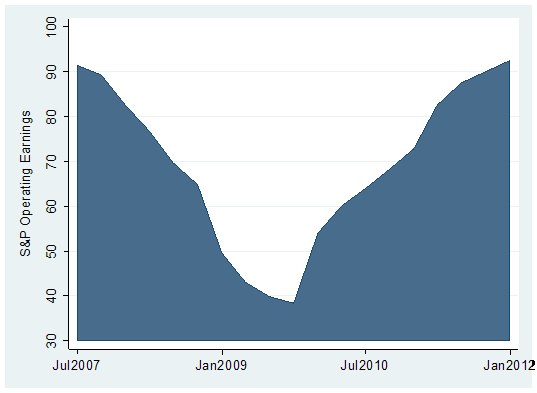
At these levels it seems that a full-blown V-shaped recovery is being priced in. There's no better example of a V-shaped forecast than for what is expected for the recovery in earnings over the next couple of years. The graph below shows the operating profit series, which includes actual results from the second quarter of 2007 – when earnings peaked – through this year's second quarter, and then continues with estimates through the end of 2011.

For operating earnings to get back to their peak levels, analysts have penciled in earnings growth of more than 40 percent over the next year, and then another 22 percent between 2010 and 2011

What is worth highlighting is that analysts expect that the typical company will soon achieve the same level of profit margin that they were able to deliver in the years leading up to 2007 – a period where leverage was preferred over balance sheet strength, a preference by company managements to focus on equity shareholders, during a political climate where labor lacked bargaining power, where consumer spending was fueled by mortgage equity withdrawals, and leverage ratios increased broadly because business and consumer credit was easy to come by.

To assume a return to peak profit margins is a bet that the economic and political landscape that emerges over the next year or two will match the pre-panic landscape perfectly.
But it is also important to keep this from Barry Ritholtz & Hester in mind......

In jedem Fall sollte man aber diesen Kernsatz von Barry Ritholtz & Hester im Hinterkopf haben.....

Barry: As noted previously, at times, things like “valuation” or the economy or earnings don’t matter — until they suddenly do.

Hester : While S&P earnings may not be able to rise to the lofty expectations of analysts over the next couple of years, this isn't a strongly bearish argument in itself. The link between near-term earnings and stock direction is tenuous. Outside of very large changes in earnings, there is essentially no correlation between year-over-year changes in earnings and changes in stock prices.

But if you're investor that is sensitive to valuation and your preference is to use forward earnings, then an understanding of the building blocks that create those earnings estimates is important.

Regardless of this rule the risk/reward ratio isn´t quite "favourable" ( i´m being polite ) right now...... But as long as the technicals are not breaking down it is still too dangerous to entry a short position...... Even if it is very tempting.... ;-) At least the first not insignificant signs are popping up that the party might be over rather sooner than later......At some point this kind of "wealth transfer" has to stop...... I´m pretty sure this guy will have lots of fun in 2010...... ;-)

Denke es bleibt in jedem Fall festzuhalten das das momentan vorhandene Chance/Risikoverhältnis nicht gerade vorteilhaft ( höflich vormuliert ) ist...... Solange die Markttechnik aber noch intakt ist sollte man auf jeden Fall der Versuchung widerstehen short zu gehen. Auch wenn das tagtäglich schwerer fällt...... ;-) Immerhin sind doch erste ernsthafte Anzeichen zu erkennen die andeuten das der Party bald der Treibstoff ausgeht.......Spätestens wenn diese Art von "Umverteilung notgedrungen Ihr Ende findet......Ich bin mir ziemlich sicher das dieser Typ spätestens im Jahr 2010 eine Menge Spaß haben wird...... ;-)

Labels: , , , , , , ,

Tuesday, October 28, 2008

Trump Needs A Bailout.....

At least in Chicago....... This is one prominent example that the problems in the commercial real estate market are growing rapidly on a daily basis ( see .CMBS Indices )....It is probably no coincidence that once again Deutsche Bank is involved .... At least this time their exposure seems to be minor compared to their Vegas adventure ( see Deutsche Bank Is Doubling Down In Vegas..... ).... Maybe this very possible blow up in Chicago will keep Trump from bragging for the next quarter.... SCHADENFREUDE!

Zumindest was sein Portfolio in Chicago angeht..... Dieses sehr prominente Beispiel zeigt recht anschaulich wie extrem schnell sich im gewerblichen Immobiliensektor die Risiken auftürmen (siehe CMBS Indices )....Irgendwie bekommt man dsa Gefühl das die Deutsche Bank extrem oft in solche Geschichten verwickelt ist. Immerhin scheint sich der zu erwartene Verlust ganz im Gegensatz zu dem wahnwitzigen Vegas Abenteuer (Deutsche Bank Is Doubling Down In Vegas..... ) in Grenzen zu halten. Uns bleibt die Hoffnung das der kaum zu ertragene Herr Trump seine Prahlerei nach der sehr wahrscheinlichen Chicagobauchlandung zumindest mal für ein Quartal einstellen wird...... Meine Schadenfreude ist ihm in jedem Fall gewiss.....

In Chicago, Trump Hits Headwinds WSJ

Donald Trump's tallest construction project ever is facing some tall challenges.

Many real-estate developers are under pressure these days as lenders and investors rush to cut their exposure to the market. But Mr. Trump's 92-story Trump International Hotel & Tower in Chicago, which will be the tallest building constructed in the U.S. since the Sears Tower opened in 1973, may be especially vulnerable because it's getting hit by a triple whammy of colliding forces: the credit crunch, the reversal in the housing market and weak retail sales.

The shiny glass skyscraper is one of the few that the brash Mr. Trump developed without partners. The situation also puts pressure on one of the project's major lenders, Fortress Investment Group LLC.

So far, Mr. Trump has lined up buyers for a bit less than $600 million of condo units and condo-hotel units in a residential market that has virtually seized up. Yet he owes lenders as much as $1 billion when the loans are due, according to public records and several people familiar with the project. He has closed around $200 million in sales so far, with roughly $380 million still in contract. The retail portion of the giant building is for sale, at a time of rising vacancies for retail space in Chicago and one of the worst eras for retailers in years. .....

Most urgently, to stay current on the project's biggest piece of debt, a $640 million senior construction loan, originated by Deutsche Bank AG, Mr. Trump must negotiate by Nov. 1 to exercise an extension provision contained in the original loan that he took out in 2005. To extend the loan, Mr. Trump must prepay additional interest charges to Deutsche Bank. Deutsche Bank declined to comment other than to say it syndicated the loan to several other banks and that its exposure is less than $50 million. Mr. Trump is confident that the extension will be agreed upon.

Adding to Deutsche Bank's leverage in the talks, Mr. Trump agreed to a $40 million recourse completion guarantee on the loan. That means Deutsche Bank can both foreclose on the property and go after Mr. Trump personally for that amount in the event he doesn't complete the building. Mr. Trump discounts the importance of the completion guarantee and is confident that he will complete the building next year. Other than the completion guarantee, Mr. Trump has no personal recourse on the project and any problems in Chicago are unlikely to affect his other businesses......

The issues don't end with the Deutsche Bank loan, according to loan documents. Mr. Trump borrowed $130 million in a mezzanine loan originated by a lending unit of private-equity firm Fortress Investment. That loan contains stiff terms, including a $50 million "exit fee" to be paid when the loan is due, in addition to accrued interest. A loan document says Mr. Trump could have to pay Fortress as much as $360 million, depending on how long the loan accrues interest. Combined with the Deutsche Bank senior loan, he would owe more than $1 billion in total. Should Trump fail to sell more units, Fortress would be on the hook to take over the project and could see a loss on its investment. .....

> Here is more on Fortress / Hier mehr zu Fortress Plundered Fortress / Pump & Dump At Its Best & Hedge Fund Hilarity: Fortress Jokes About Leaving Public Markets

During the last real-estate collapse in the early 1990s, Mr. Trump was pushed to the brink of bankruptcy because he was personally on the hook for hundreds of millions of dollars of debt. He later restructured his debt with the banks and worked his way back to doing real-estate deals, product endorsements and reality television.

The Chicago project is different. He has no partners, he arranged the financing, and his family is managing the construction and marketing. (In 2004, Bill Rancic, the winner of Mr. Trump's reality-television show, "The Apprentice," worked on the Chicago project for a year.)

Gail Lissner, vice president at Appraisal Research Counselors, a Chicago real-estate tracking firm, says contract signings on condos in downtown Chicago were down 72% the first half of the year from a year earlier. And the supply keeps coming. Downtown Chicago will see nearly 10,000 new condo units delivered in 2008 and 2009, a substantial portion of which haven't been presold.

Mr. Trump recently began marketing to sell the 100,000-square-foot retail space in the building, which will be the last part of the building to open, at the end of 2009. But given the wretched retail climate, and the almost complete lack of real-estate financings, finding a buyer could prove challenging. Mr. Trump's son Eric Trump, who is running the retail portion of the project, is confident the project will eventually sign leases with high-end retail tenants. He says the Trumps will sell the retail portion of the project only if a buyer presents a good price.

The 339-room hotel, of which the Trumps still own more than half the rooms, has generated revenue. The Trumps sold around 150 rooms to buyers who can choose to earn room revenue after paying Mr. Trump various fees and assessments, according to marketing documents.

But the hotel business is in rough waters as travelers cut back. Among the neighborhood's 12 luxury hotels, including Mr. Trump's, the percentage of vacant rooms has increased each of the past three months, compared with the year-earlier period, according to data provider Smith Travel Research. And revenue per available room, a common-industry measure, is down three consecutive months.

Adding to the project's stress, Mr. Trump is now in competition with his own customers. At least 30 buyers of the hotel units have put those rooms back on the sales market at substantial discounts to what Mr. Trump is charging for similar units, according to local sales brokers.

Local real-estate broker Andrew Glatz, of Crown Heights Realty, is representing two dozen hotel units and six condo units for resale in the Trump project. He's sold three so far. "All our units are 30% below Trump. We can't compete with his marketing, so we compete with his prices," he says. "It's the most fabulous property in Chicago. They didn't spare any expense," he boasts. His clients can afford to sell below Trump's prices because they bought their units in 2003, before Mr. Trump raised prices substantially.

UPDATE : Trump Files Suit Against Lenders WSJ Mr.

Trump has put $77 million of his own equity into the tower, which he would stand to lose in a potential foreclosure. Other than a $40 million guarantee to complete the project, Mr. Trump has no recourse obligations to the project. A Trump spokesman declined to comment.

Deutsche Bank originated the construction loan in 2005 and sold off most of it to others, retaining less than $10 million of exposure on that loan. The suit alleges that Deutsche Bank compromised the senior construction loan by selling pieces off to "so many institutions, banks, junk bond firms, and virtually anybody that seemed to come along," that the lending group is unable to come to a consensus on how to deal with the matter.

It also alleges Deutsche Bank created a "serious conflict of interest" by taking a separate stake in the project's so-called mezzanine loan that was originated by private-equity firm Fortress Investment Group. The mezzanine loan, which is junior to the senior construction loan, had an original principal of $130 million but will eventually accrue to $360 million. Deutsche Bank purchased roughly one-quarter of the mezzanine loan, according to people familiar with the matter.

AddThis Feed Button

Labels: , , , , ,

Monday, October 08, 2007

UFOs (or Unidentified Financing Objects) / FT

The FT should trademark the term UFOs (or Unidentified Financing Objects). Fantastic! This is a follow up on No Kidding.... More Off Balance Sheet Vehicles For Citigroup & Banks use discounts to tempt ‘vulture funds’ / FT.

Die FT sollte sich den Begriff UFOs (or Unidentified Financing Objects) urheberrechtlich schützen lassen. Genial! Das Ganze ist eine Ergänzung zu den vorherigen Posts No Kidding.... More Off Balance Sheet Vehicles For Citigroup & Banks use discounts to tempt ‘vulture funds’ / FT

The Real Deal: beware the banks’ UFOs / FT
Want to get rid of your leveraged loans quickly? Don’t sweat.

All you have to do is leverage up the leverage by creating a new vehicle. Let’s call them UFOs (or Unidentified Financing Objects).

These have a standard CLO structure, but they remain private, are controlled by the banks and are designed to help shift the catalogue of leveraged loans stuck on their balance sheets from financing deals.

Here’s how they work.

The bank holding the loans teams up with a hedge fund, or a buy-out group. Together, they create a UFO to buy selective loans at the current market discount, say 96 cents in the dollar, from themselves.

The bank, which owns the loans at par value, takes the write-off, but gets to hold on to the better quality debt tranches, which it can carry at a much lower cost of capital.

The hedge fund/buyout group takes the highly-leveraged “first loss” or an equity slice of the UFO, in the hope that it can make profit on the underlying loans when they return to par value at maturity or when the debt is refinanced.

The banks say these UFOs are a pure creative genius, that they do the market a favour by creating liquidity where there is none, and help lift the secondary prices of the loans by demonstrating demand.


Meanwhile, they can get a substantial return on the senior slices of debt - at least relative to their cost of funding and the risk capital they are required to hold.

But the credit squeeze means there are hardly any new CLOs to absorb the current loans on offer, so it’s only the bank-sponsored UFOs that can snap up these loans.

It’s like selling your house and giving the buyer the financing. Have you really offloaded it, and is the price a real market price?

These UFOs are not a reflection of real demand driving improving leveraged loan prices.

These new vehicles being created in a stagnant market are merely a stealthy way of financially-engineering the burden of costly risk away from the bank.

It all looks a bit like a close encounter with the wrong kind. Another leveraged solution to an already leveraged problem isn’t a way out of the credit crunch.

> AMEN!

AddThis Feed Button

Labels: , , , , , , ,

Friday, October 05, 2007

Banks use discounts to tempt ‘vulture funds’ / FT

If you now add news like this No Kidding.... More Off Balance Sheet Vehicles For Citigroup it should be clear that this is another way of "creative accounting" and is another blow to the quality of earnings & balance sheet. There is clearly a conflict of interest and i have the feeling that they are only delaying the ultimate solution. "Party on"....

Wenn man nun noch diese Meldung No Kidding.... More Off Balance Sheet Vehicles For Citigroup miteinbezieht wird ziemlich schnell klar das hier einmal mehr "kreative Buchführung" betrieben wird. Das hier ein klarer Interessenkonflikt besteht und damit das eigentlich Problem nicht gelöst sondern nur nach hinten verlagert wird düfte in den kommenden Quartalen und Jahren noch für einige unangenehme Meldungen sorgen und zeichnet einmal mehr ein wenig schmeichelhaftes Bild der Gewinn und Bilanzqualität. Bis dahin kann weiter die beste aller Welten abgefeiert werden.....

Banks use discounts to tempt ‘vulture funds’ / FT
Investment banks are offering finance to “vulture funds” on improved terms if the money is used to buy debt from them, according to bankers and managers of the funds.

Banks keen to shift a backlog of well over $200bn of leveraged buy-out debt are tying leverage for recovery, or vulture, funds run by hedge funds and private equity to the sale of the debt.

The financing amounts to a hidden discount, allowing the banks to minimise public discounts on LBO debt they are having to sell at below face value.

“The banks are offering different terms depending on whether you take their loans or other people’s loans,” said one hedge fund manager who has just raised a recovery fund.

“Most of the leverage being provided by banks is only being provided if you buy their loans,” said another.

AddThis Feed Button

Labels: , , , , , , , ,

Monday, October 01, 2007

No Kidding.... More Off Balance Sheet Vehicles For Citigroup

You really can´t make things up like the stuff you read and hear day in day out from Wall Street.

Es kommen fast täglich Sachen aus der Finanzwelt und besonders von der Wall Street bei denen man sich immer erstmal vergewissern muß ob nicht doch gerade der 1. April ist.

Thanks to Mike Calderon / Over The Edge Cartoons

While Citi teams up with KKR / FT
KKR and Citigroup are understood to have agreed to form an off-balance-sheet vehicle with about $5bn of equity and $10bn of debt to buy impaired loans, which could include some from Citi’s investment bank.

The joint venture brings together the private equity firm responsible for some of the biggest leveraged buyouts in the run-up to the credit crunch and the bank that agreed to finance many of those deals.

The vehicle could allow Citi to sell some leveraged buyout debt, which it has underwritten but is struggling to syndicate, as well as other troubled loans.

> "Could".... LOL! Conflict of interest...?

> "Könnte"....LOL! Interessenskonflikt......?

AddThis Feed Button

Labels: , , , , , , ,

Thursday, June 28, 2007

S&P, Moody's, Fitch ...Dumb, Blind Or Just A Conflict Of Interest ?

Oh boy! These Rating agencies are making it hard to give them some credibility. I´m pretty sure after all the damage is done there will be an investigation. If they don´t take action in the face of the obvious they should shut down their business. On the other hand it is too easy that investors blame the rating agencies when they havn´t done any due diligence. I don´t know what is better...That they are acting so slowly because there is a conflict of interest (bad for business) or they really believe in their models and are obviously blind to reality...... Maybe more competition will help to "update" their model.

Unfassbar. Spätestens mit diesem Debakel habe ich jeglichen Respekt vor den Ratingagenturen verloren. Ich denke das die Glaubwürdigkeit hier insgesamt nachhaltig schaden nehmen wird. Ich bin mir ziemlich sicher das wenn alles Scherben aufgekehrt sind es eine Untersuchung auch in diesem Punkt geben wird. Wenn diese angeblich so cleveren Agenturen nin einem so offensichtlichen Fall nicht erkennen können oder wollen das ihre Modelle null mit der Wirklichkeit zu tun haben dann fällt mir wirklich nichts mehr dazu ein. Ich weiß nur noch nicht was ich schlimmer finden würde....Das die notwendigen Herunterstufungen wegen eines möglichen Interessenkonfliktes (schlecht für das Geschäft) oder weil die wirklich sich stur an Ihren Modellen festhalten (selbst dann wenn rund herum die Immobilienwelt einstürzt...). Auf der anderen Seite ist echt von Investorenseite viel zu einfach die Schuld S&P und co in die Schuhe zu schieben wenn man selber offensichtlich keine genaue Prüfung vorgenommen hat. Mehr Konkurrenz würde denen sicher gut zu Gesicht stehen.....


June 29 (Bloomberg) -- Standard & Poor's, Moody's Investors Service and Fitch Ratings are masking burgeoning losses in the market for subprime mortgage bonds by failing to cut the credit ratings on about $200 billion of securities backed by home loans.

The highest default rates on home loans in a decade have reduced prices of some bonds backed by mortgages to people with poor or limited credit by more than 50 cents on the dollar and forced New York-based Bear Stearns Cos. to offer $3.2 billion to bail out a money-losing hedge fund. Almost 65 percent of the bonds in indexes that track subprime mortgage debt don't meet the ratings criteria in place when they were sold, according to data compiled by Bloomberg.

That may just be the beginning. Downgrades by S&P, Moody's and Fitch would force hundreds of investors to sell holdings, roiling the $800 billion market for securities backed by subprime mortgages and $1 trillion of collateralized debt obligations, the fastest growing part of the financial markets. ......

Loss Estimates
....Losses may rival the savings and loan crisis of the 1980s and 1990s. The Resolution Trust Corp., formed by the U.S. government to resolve the thrift crisis, sold $452 billion of assets at a cost to taxpayers of about $140 billion.

The current debacle threatens the growth of asset-backed bonds, securities that use consumer, commercial and other loans and receivables as collateral. That market, which includes mortgage securities, has doubled to about $10 trillion since 2000, according to the Securities Industry Financial Markets Association, a New York-based trade group.

Executives at New York-based S&P, Moody's and Fitch say they are waiting until foreclosure sales show that the collateral backing the bonds has declined enough to create losses before lowering ratings on some of the $6.65 trillion in outstanding mortgage-backed debt.

`Knee-Jerk Responses'
Homeowners may be delinquent on mortgage payments for at least three months before foreclosure proceedings begin, and the process can be delayed if a borrower files for bankruptcy or fights eviction. Even when lenders repossess a home, the value of the mortgage isn't written down until the house is sold. Bondholders only see a loss if the price of a house is lower than the loan used as collateral for debt securities.

``We're taking action as we see it,'' said Brian Clarkson, Moody's global head of the structured products in New York. ``We're not doing knee-jerk responses.''

Ratings companies are postponing the inevitable and are dumping securities as defaults by subprime borrowers increase, investors say.
Lehman Brothers Holdings Inc., the biggest underwriter of mortgage bonds, sold $2.43 billion of Structured Asset Investment Loan Trust bonds a year ago. An $18 million portion of the bonds rated BBB- fell to 43 cents on the dollar from 98 cents in January, according to prices compiled by New York-based Merrill Lynch & Co.

Increased Delinquencies
More than 15 percent of the mortgages in the securities are at least 60 days delinquent and another 8 percent are in foreclosure, according to the bond trustee. Moody's and S&P say they are considering downgrading the debt.
> Considering....in Betracht ziehen.....

A total of 11 percent of the loan collateral for all subprime mortgage bonds had payments at least 90 days late, were in foreclosure or had the underlying property seized, according to a June 1 report by Friedman, Billings, Ramsey Group Inc., a securities firm in Arlington, Virginia. In May 2005, that amount was 5.4 percent.

``The Petri dish turns from a benign experiment in financial engineering to a destructive virus,'' Gross, who oversees the world's biggest bond fund, said this week in a commentary on the firm's Web site. The companies gave the mortgage bonds investment-grade ratings, duped by the ``six-inch hooker heels'' of collateral that can't be trusted, he said.

No Disclosure
CDOs aren't required to disclose the contents of their holdings to the U.S. Securities and Exchange Commission and most can change them after the bonds are sold.

Demand for CDOs, first used in 1987 by bankers at now- defunct Drexel Burnham Lambert Inc., is drying up as mortgage bond losses spread. Planned sales of CDOs that rely on high- rated asset-backed debt dropped to $3 billion this month from $20 billion in May, according to analysts at JPMorgan, the third-largest U.S. bank.

The ratings companies point out they have downgraded bonds less than a year after they were sold, the first time that has ever happened. S&P has lowered a total of 15 subprime bonds sold in 2005, or 0.31 percent of the total, and 32 sold in 2006, or 0.68 percent.

``People are surprised there haven't been more downgrades,'' Claire Robinson, a managing director at Moody's, said during an investor conference sponsored by the firm in New York on June 5. ``What they don't understand about the rating process is that we don't change our ratings on speculation about what's going to happen.''

A sweeping downgrade of bonds would lead to sales of assets by investors, banks and pension funds who operate under rules that would cause them to adjust their portfolios to reflect the new ratings. S&P, Moody's and Fitch have restricted their ratings changes on BBB- rated mortgage bonds to 1.3 percent of those outstanding, according to Credit Suisse analyst Rod Dubitsky in New York. About 80 percent of the remainder will eventually have their ratings reduced, he said.

Abandoned Criteria
S&P abandoned seven-year-old criteria for determining a bond's protection against default in February.

Under the old guidelines, S&P said a bond's ``credit support'' must be twice the rolling 90-day average of the sum of value of mortgages delinquent by three months or in foreclosure plus real estate that has been seized by the lender.

Credit support for a bond is determined by looking at the number of lower-rated securities that would have to go bust before it suffered losses, the dollar amount of mortgages available to pay back the interest and the annualized interest the mortgages generate in excess of what needs to be paid to bondholders.

The measure was one of four tests used by S&P, said Chris Atkins, a spokesman for the company, a unit of New York-based McGraw-Hill Cos. A failure to meet the credit support standard wouldn't have automatically resulted in a downgrade, he said.

$200 Billion
Of the 300 bonds in ABX indexes, the benchmarks for the subprime mortgage debt market, 190 fail to meet the credit support standard, according to data released in May by trustees responsible for funneling interest payments to debt investors.

Most of those, representing about $200 billion, are rated below AAA. Some contain so many defaulted loans that the credit support is outweighed by potential losses. Fifty of the 60 A rated bonds fail the criteria, as do 22 of the 60 AA rated bonds and three of the 60 AAA bonds.

All but five of 120 securities in BBB or BBB- rated portions of the mortgage-backed securities would have failed S&P's criteria,
according to data compiled by Bloomberg.

None have been downgraded, though S&P and Moody's have parts of three pools of securities linked to the index under review for a downgrade. Fitch has downgraded parts of three mortgage pools tied to the ABX and put four on watch for downgrade.

``That's like saying these trees are just fine as there's a forest fire on the other side of the hill,''
AddThis Feed Button

Labels: , , , , ,