Saturday, March 03, 2007

the "cheap" market spin...relatively speaking.....

i want to change this warning sign in "please be safe! Do not listen to wall street, bubblevision and the other msm" .... :-)
others can say the same about bubble bloggers but thats up to them.....

man sollte dieses schild in sachen börse wie folgt abändern. "warnung! hört nicht nur auf wall street, bubblefernsehen und die anderen massenmedien" :-)
mir ist schon klar das diverse leute das gleich zu der familie der bubbleblogger sagen könnten......


mhhh, the spin has always been that stocks are cheap (maybe its true relative to other assets like real estate etc, but this is a very weak argument. i also remember back in 1999 that b2b stocks are cheap compared to b2c stocks and a screaming buy......relatively speaking......same today with xmsr and sirius etc. when bulls need to argue this way the best times are over....). as usual the spin is that this on a forward looking pe calculation when you look at a current pe around 17 that doesn´t look cheap to me.....


thanks to http://www.wallstreetfollies.com/

add to this that around 35-40% of the sp500 earnings is closely correlated to the financial sector (don´t forget that ge generates a major proportion from its financial segment gm also etc...).
tag ein tag aus wird permanent gepredigt das aktien günstig bewertet sind. das mag evtl. relativ zu anderen anlangeklassen wie immobilien etc gelten. halte ich aber insgesamt für ein ganz schwaches argument. den bullen sind dann in der regel andere argumente ausgegangen. ganz kritisch wird es wenn innerhalb der aktien vergleiche vorgenommen werden. kann mich schön an die vergleiche b2b gege b2c 1999 erinnern. demnach waren mal die einen dann die anderen drastisch unterbewertet...relativ gesehen..... der gerne verwendete trick geht dahin immer auf das folgende jahr das geschätze kgv zu berechnen. und selbstredend steigen die gewinne permanent zumindest die geschätzten/gewünschten.. ein aktuelles us kgv von 17 erscheint mir nicht als billig.
wenn man jetzt noch berücksichtigt das ca. 35-40% der gewinne dem finanzsektor zuzuordnen sind..man denke nur an ge die einen großteil aus ihrem finanzarm erzielen....(kredite,leasing , etc) bei uns genügt ein blick auf die autobanken die teilweise bei vw den gesamten gewinn in den letzten jahren generiert haben.


the loan loss reserves are close to historic lows and
"From 2004 to 2006, the nation's biggest banks received 37% of their
earnings growth from reductions in their loan-loss reserves
"
http://immobilienblasen.blogspot.com/2007/02/no-worries-loan-loss.html


we all know that the loss resreves will be climbing and i think they will spike........how you can call this market cheap is beyond me.
here is a chart that shows the cash flow valuations of the biggest european companies that are labeled as even cheaper than the us stocks......i guess the same could be said about the cashflow valuations on wall street. really cheap.... .here more on the "cheap" european and german stocks http://immobilienblasen.blogspot.com/2007/02/dax-7000-german-stock-market.html
guckt euch mal die o.g. nummer an wonach die us banken 37% ihrer ergebnisverbesserung nur dadurch erzielt haben das ihre rückstellungen für faule kredite praktisch gen null tendieren und schätzt mal was die nächsten jahre passieren wird. ich rechne nicht mit stiegneden sonders explodierenden anstiegen.(link oben)
auch das ständig wiederholte argument das europäische und spezeill deutsche aktien günstig sind kann man auch anders sehen. realtiv gesehen....sicher. aber auf basis der cash flow bewertung haben wir rekordbewertungen.(s 2. link oben)

Below we have updated our S&P 500 P/E ratio charts. As shown by the bottom chart, the P/E has been price driven in recent months, and has fallen quite a bit after this week's declines. It currently stands 16.85. (thanks to http://tickersense.typepad.com/ticker_sense/ )


other highlights/concerns are

margins are already at record highs (no wonder that 50% reported lower margins so far...http://immobilienblasen.blogspot.com/2007/01/50-reported-lower-profit-margins-so-far.html,

ein weiterer grund etwas skeptischer zu sein ist das die margen bereits jetzt rekordhöhen erreicht haben und gleichzietig 50% der firmen bereits niedrige margen zu brichten haben.


lots of the earnings growth is fueled from buybacks (sometimes financed with debt),

ein großteil des gewinnzuwachsen auf aktierückkäufen basiert ( zum teil kreditfinanziert) corporate profits % gdp are also at highs / die gewinne zum bsp ebenfall auf rekordhöhen sind "creative accounting" is spreading,/ das kreative bilanzierung wieder in mode kommt the unwinding of the biggest bubble ever spreading to economy,jobs, credit etc .....

das platzen der größten blase und die auswirkungenauf arbeitsplätze, kreditmärkte usw

lowest credit spreads ever fueling also the mania in private equity

die niedrigsten risikoaufschläge die unter anderem den wahnsinn in private equity erst ermöglicht haben

etc........
but one thing is for sure.. the spin will continue and it is always a good time to buy..........here is a start and a very good example (thanks to barry riholtz) http://www.thestreet.com/_tsccom/newsanalysis/investing/10342162.html.
in einem kann man sich sicher sein. der spin wird wohl ewig weitergehen und es ist selbstverstänlich immer ne gute zeit aktien zu kaufen..... (bitte den link oben lesen!)

maybe i´m a bit too harsh. the spin is of course not exlusive to wall street. we can see it on a daily basis in almost every corner... i hope that i will not end like one that tries to spin my bearish viewpoint....

please let me know!


evtl. bin ich auch zu kritisch. heutzutage wird ja alles mögliche in einem besonders positiven licht dargestellt.warum sollte wall street da die ausnahme sein? ich hoffe das ich zumindest nicht der gefahr erliege meinen eher pessimistischen standpunkt ebenfalls durch spin zu unterstützen.
wenn ja sagt mir bitte rechtzeitig bescheid!
by the way... this number is just one week old..../ diese nummer ist erst ne woche alt...http://immobilienblasen.blogspot.com/2007/02/merrill-survey-84-percent-said-equities.html
merrill survey: 84 percent said quities were fairly priced
or undervalued

since that statement the major inideces lost 5-10%. the irony is that i guess the next survey will show a lower number.

seit dieser umfrage haben die aktien weltweit zwischen 5-10% verloren....ironischerweise denke ich das trotzdem die nächste zahl niedrigen sein wird.

here is a very good post on this topic from hussman http://www.hussmanfunds.com/wmc/wmc070305.htm

Labels: , , ,

Monday, November 27, 2006

a lot of room for disappointments / Investors Are Turning Optimistic

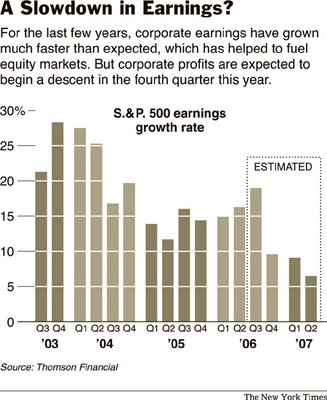
only wall street can judge this kind of data and expect more gains...... . the wonderful thing is that that leaves a lot of room for disappointments.......

bei der faktenlage kann wohl nur wall street mehr gewinne erwarten. das positive daran ist das heir sehr vile enttäuschungspotential lauert......

dank geht an mish und sein http://www.markettradersforum.com/

http://www.nytimes.com/2006/11/26/business/yourmoney/26fund.html?_r=1&oref=slogin
.. 59 percent of fund managers now say they believe that the economy next year will remain as strong as it is now or will improve, according to a recent survey by Merrill Lynch. That’s up from 32 percent of fund managers who thought so in October

The percentage of investors who think that the economy is likely to slip into recession, meanwhile, has shrunk to 8 percent from 20 percent last month.

That’s not the whole story. Investors are also growing more bullish about the outlook for corporate profits. Today, half of all domestic fund managers think that earnings will remain steady or improve in the coming 12 months. A similar survey in September showed that only 18 percent felt that way....


IN reality, profits for most S.& P. 500 companies are growing much slower than 9.6 percent this quarter. If you stripped out the financial sector, where a profit surge of 32 percent is expected, corporate earnings would be likely to grow by only 3.1 percent......


remember when you see this kind of data that a lot of the eps growth comes in the form of (often) debt fueled buybacks. the earningsquality isn´t always as good as wall street wants to make us believe.

bedenkt bitte bei betrachtung dieser grafiken das ein großer teil dieser gewinnzuwächse auf (oft) schuldenfinanzierten aktienrückkäufen basiert. die gewinnqualität ist also nicht immer so gut und schön wie wall street gerne unterstellt.

Labels: ,

Monday, November 20, 2006

jeff saut / Roger Real Estate, Larry Leverage, Jimmy Junk bond, and the over-leveraged dance continues

what a summary!. great read and very interesting charts!/ tolle zusammenfassung und wirklich klasse charts.

dank geht an jeff saut http://www.raymondjames.com/inv_strat.htm
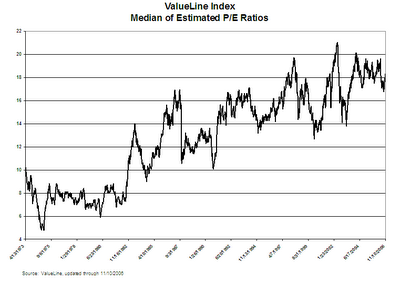
......Speaking first to valuations, we have often stated that the best representative index for the average stock is not the S&P 500, but the ValueLine Index. At its peak the median P/E ratio of the ValueLine Index was 20.9x (see chart 1).

Currently its P/E ratio is 18.3x, and while not as expensive as it was at its zenith, it is certainly not “cheap” by historic standards.

Second, as for earnings momentum, if you deduct share repurchases, and seasonally adjust earnings, one finds that earnings momentum has been slowing since 4Q05 and is currently tracking toward mid-single digits.

Third, recent reports leave little doubt that the economy is slowing. Indeed, GDP, capex shipments, ISM, private payrolls, Industrial Production, Existing Home sales, retail sales, et all, have been contracting. The lone stand-out arguing for economic strength remains governmental tax receipts, which continue to record low double-digit growth readings. Plainly that just does not “foot” with the recent 1.6% GDP report.

größer/bigger http://www.raymondjames.com/images/inv_strat/inv_strat_061120_1lrg.gif

Other “non-footers” include:

1) a personal U.S. savings rate that appears to have bottomed, implying that Americans are saving more. This is not an unimportant observation, for it can be argued that for every 1% increase in the nation’s savings rate the business sector loses roughly $100 billion in profits;

2) reinforcing point one is a rare event that saw consumer credit actually get paid down in September with a concurrent reduction in bank lending to households during the month of October;

3) that begs the question, “following the Goldman Sachs-induced crash in gasoline prices, which have subsequently rebounded now that the gasoline weighting has been cut from 7.3% to 2.5% in Goldman’s much indexed commodity index, why have the retail stocks held up so well?!;”

4) evidently Amazon (AMZN/$42.55) and Wal-Mart (WMT/$47.50) don’t believe the retail rebound is sustainable since they are cutting their respective capex spending budgets;

5) and why, pray tell, does the U.S. Dollar Index remain amazingly resilient in light of low interest rates and given the fact that China, Russia, the United Arab Emirates, Saudi Arabia, Switzerland, New Zealand, etc. all telegraphed that they are reducing their weightings of U.S. Dollar reserves?;

6) why did the SEC, in mid-October, reduce margin requirements for select investments by hedge funds?;

7) how in the world can “guest workers” sue U.S. companies for under-paying them ( USA Today 11/15/06)?;

8) we could go on, but you get the idea . . .there are a lot of disconnects currently.

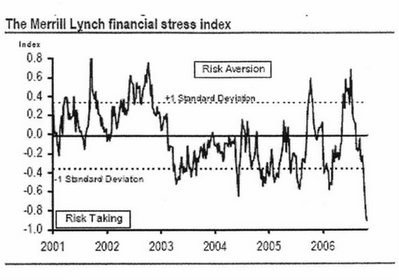
Meanwhile, participants have continued to increase their “risk profile,” as seen in the nearby chart from Merrill Lynch (chart 2), with an attendant parabolic rise in the D-J Industrial Average (DJIA). We have seen such parabolic rises before, most recently in gold’s upside blow-off between March and May of this year (we were sellers of gold back then), and historically such moves have tended to end badly. Verily, since the July “lows” the DJIA has truly gone parabolic. Interestingly, of the Dow’s 1500-point gain over those 87 sessions, roughly 1300 points have come during only 12 sessions where the often mentioned “mysterious buyers” showed up in the futures markets. This unnatural sequence has left the DJIA residing at nearly an unprecedented 1000 points above its 200-day moving average (@ 11341 DMA) and well over-bought relative to its MACD and Relative Strength Indicators (RSI)......
größer/bigger http://www.raymondjames.com/images/inv_strat/inv_strat_061120_2lrg.gif

The call for this week: We were aggressively bullish at the mid-June trading lows, and currently we are aggressively cautious. While that stance has cost us relative performance points recently, we continue to believe that you should not put in your “Rent-a-Kid” application right here because we think we are well past the hiring stage in this bull phase. Indeed, some of the “kids” are well on their way to going broke, like Armand Amaranth, Roger Real Estate, Larry Leverage, Jimmy Junk bond, and the over-leveraged dance continues. Our ideal trading pattern calls for a trading “top” during this holiday week, leading to a correction into the second week of December, which would set up the fabled year-end rally. Whether this plays or not only time will tell, but we have learned the hard way it is difficult to break the markets “down” during the latter half of December. However, when the markets do break down in December it can be significant . . . hello 2002, which saw the DJIA fall from its December high of 9000 into its March 2003 low of 7400.

Consequently, we find ourselves left with a George Soros quote from the year 2000 – “Maybe I don’t understand the market, but I prefer not to have the same kind of continued exposure I’ve had up until now. In some ways I think the music has stopped only most people are still dancing.” (what a great quote!)

Labels: , , , ,

REITS going GAGA ..../ Blackstone to Buy Equity Office for 36 billion$ (incl. debt)

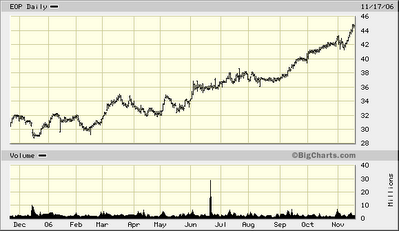
every week a new rekord on the lbo front...... 36 b$ including debt! to buy peak price assets like real estate looks crazy ......no bargain for sure.... but with high leverage everything seem possible..... who will buys those bonds?!
http://immobilienblasen.blogspot.com/search?q=lbo, http://immobilienblasen.blogspot.com/search?q=private+equity

es scheint fast so als wenn jeder woche neue rekorde bei lbo gebrochen werden. für 36 mrd $ auf absoluten spitzenpreislevel immobililien in den usa zu erwerben kann man als tollkühn bezeichnen. mit nem genügend großen finanzierunglevel scheint aber alles zu gehen..... bin gespannt wer diese bonds kaufen wird.....


here is the script from the last conference call from eop
with this quote from the ceo
" it´s a little crazy out there" deals are in the making that makes no sense. (he was right!)
http://immobilienblasen.blogspot.com/2006/10/why-is-this-not-ongoing-business-for.html#links


more on reits
http://immobilienblasen.blogspot.com/search?q=reit

http://tinyurl.com/yey3un (businessweek)
Litt notes, though, that Zell isn't the only veteran real-estate magnate selling out these days, suggesting that insiders believe today's valuations cannot last. REIT stocks are trading at a multiple of future earnings two percentage points higher than the Standard & Poor's 500-stock index today. Historically, they've traded at a seven-point discount. Why quibble with a sure thing? Litt says: "Take the money and run."

commercial real estate
http://immobilienblasen.blogspot.com/search?q=commercial+real+estate


http://tinyurl.com/yx4qjm
Nov. 20 (Bloomberg) -- Blackstone Group LP, manager of the world's largest buyout fund, agreed to acquire billionaire Sam Zell's Equity Office Properties Trust, owner of 580 office buildings, for about $20 billion in the biggest takeover of a real estate company.


Equity Office shareholders will receive $48.50 a share, 8.5 percent more than Friday's closing price, the companies said in a statement yesterday. Including debt, the transaction is worth $36 billion, exceeding this year's $33 billion purchase of hospital chain HCA Inc. to become the biggest leveraged buyout in history.

The acquisition will give Blackstone office space stretching from New York and Washington to Los Angeles as U.S. vacancy rates drop and rents climb to a record. Takeovers of property companies have doubled this year to $189 billion as investors including shareholder activist Carl Icahn and real estate developer Larry Silverstein pursue deals,

``Demand for office space and commercial property in the U.S. has been firm,'' said Hans Kunnen, who helps oversee $70 billion at Colonial First State in Sydney, including property stocks. ``With office properties, you get the rental income and that generates a nice stable yield.'' (really...?)

read this story from mike larson about the reits and the yields.
http://www.moneyandmarkets.com/press.asp?rls_id=433&cat_id=6

Blackstone has acquired 10 publicly traded real estate companies in the past two years, including CarrAmerica Realty Corp. and MeriStar Hospitality Corp. The New York-based company, founded by Stephen Schwarzman and Pete Peterson, raised a $5.25 billion fund to make property acquisitions in June.
U.S. office vacancy rates fell in the third quarter to 12.96 percent from 14.13 percent a year earlier, and rents for so- called Class A space in Manhattan rose last month to a record $63.26 per square foot, according to Colliers International. New construction has lagged behind an increase in demand as the economy adds jobs, pushing up rents. .....

Buyout firms more than doubled their acquisitions of property companies to $16.5 billion this year before the Blackstone announcement, Bloomberg data show.

Share Performance
Shares of Equity Office gained 47 percent this year, almost double the advance of the Bloomberg REIT Index.....

.....Equity Office in August said it planned to sell as much as $3.5 billion of real estate by the end of next year to reduce debt. Company spokeswoman Terry Holt said the decision wasn't intended to be part of a broader effort to sell the entire company.


Biggest LBOs
LBO firms including Blackstone, which finance the bulk of their takeovers using the target company's cash flow, have announced $600 billion of acquisitions so far this year, up from $241 billion in 2005, according to Bloomberg data. Total mergers and acquisitions have reached $3.1 trillion this year, surpassing 2000 as the busiest ever.

The biggest LBO to date was the purchase announced in July of HCA, the largest U.S. hospital chain, by Bain Capital LLC, Kohlberg Kravis Roberts & Co., Merrill Lynch & Co. and HCA co- founder Thomas F. Frist Jr. That topped the $31.3 billion that KKR paid in 1989 for RJR Nabisco Inc.

Labels: , ,

Thursday, November 16, 2006

another private equity pos ipo "hertz"

pos is probably a bit harsch. but i like to know what are buyers of this ipo thinking. they buy a debt burdened company with almost no safetynet or marin of error when things slow down or rates or riskpremiums are going up.

"stück dreck" ist sicher zu hart. aber ich frage mich wirklich was die käufer des ipo denken. sie bekommen eine kreditüberladene firma mit null sicherheitsnetz wenn die wirtschaft nachläßt oder sich kreditbedingungen verteuern (zinsen oder risikoaufschläge)

from http://immobilienblasen.blogspot.com/2006/10/buyout-firms-punish-bondholders-by.html#links
Hertz Bonds
The debt of companies owned by buyout firms has risen to the equivalent to 5.4 times their cash flow, the most ever, S&P says. ...Payouts to buyout firms were partly to blame for the lagging performance of bonds sold by Hertz Corp., Brake Bros Plc and Impress Holdings BV.

Their bonds trailed the 8 percent average return this year for securities with junk ratings, costing holders about $70 million in total,

Hertz pummeled bondholders after the rental-car company said in September 2005 it was being acquired for $15 billion. Its $175 million of 7.625 percent notes due 2012 lost as much as 10 percent of their face value. S&P cut the ratings on the Park Ridge, New Jersey-based company to BB- from BBB-.

more on private equity http://immobilienblasen.blogspot.com/2006/11/leverage-buy-outs-lbos-private-equity.html#links,http://immobilienblasen.blogspot.com/search?q=private+equity

Hertz IPO Falls Short as Some Investors Balk Over Owner Payout http://tinyurl.com/ygkjfy


Nov. 16 (Bloomberg) -- Hertz Global Holdings Inc.'s initial share sale raised less than the company planned as some investors were unwilling to reward owners who more than doubled their investment.

Hertz, the world's largest rental-car company, raised $1.32 billion by selling 88.2 million shares for $15 each, the company said today in a statement. Park Ridge, New Jersey-based Hertz intended to sell as much as $1.59 billion of shares at $16 to $18 each.

Owners Clayton Dubilier & Rice Inc., Carlyle Group and Merrill Lynch & Co., put up $2.3 billion of the $15 billion they paid for Hertz in December. The firms rattled potential investors by adding debt, raising the company's interest costs and pushing down profit.

The owners have received a dividend of $1 billion and plan to get another payout of about $420 million. Coupled with the group's remaining 72 percent stake valued at $3.46 billion, the owners more than doubled their investment. (since december 2005!!!)

The share sale represented about 28 percent of the company. ......, have an additional 13.2 million shares available to sell.

Since buying Hertz, the Clayton Dubilier ownership group has raised debt by $3.4 billion and shaved cash and cash equivalents almost in half.

In a leveraged buyout, the acquirer borrows most of the purchase price and uses the target company's cash flow to repay lenders.

The ownership group bought Hertz from Ford Motor Co., the second-largest U.S. automaker, in December for $15 billion.

Net Income Falls
For the nine months through Sept. 30, Hertz's net income slumped 77 percent to $76.1 million, or 33 cents a share, from $325.3 million, or $1.42, a year earlier. Sales rose 7.8 percent to $6.07 billion,


The group also arranged new debt and refinanced existing debt at higher interest rates. Total debt increased 32 percent to $14 billion. Interest expense almost doubled to $672.6 million. Betsy Snyder, a fixed-income analyst with Standard & Poor's in New York, said the company paid higher rates on the new debt. ( what a refinance.....)

Labels: , ,