Thursday, October 18, 2007

Credit Excess / Baltics

Wow! We have a clear winner in the category "easy credit". beforeThe the following charts and data are just breathtaking. .....The credit explosion explains why the Baltic Real Estate market is so "frothy".

Anschnallen! Wir haben den eindeutigen Gewinner in Sachen "Easy Credit" gefunden. . Die nachfolgenden Charts und Daten verschlagen einen aber wirklich den Atem....... Das erklärt natürlich auch diesen Bericht über den baltischen Immobilienmarkt.


Banking Risks Rise in Eastern Europe
Credit to the private sector has expanded at a fast clip in central and eastern Europe during the past decade, outpacing most other regions of the world.

Rapid credit growth (see Chart 1) reflects a number of factors:

• low levels of financial development and pent-up demand pressures following decades of socialist economic management;

• good macroeconomic discipline and membership in the European Union (EU), which lowered country risk premiums; and

• improved access to foreign capital following the entry of foreign banks and the opening of capital accounts.

Assessing the risks
Rapid credit growth has brought important benefits, helping channel domestic and foreign savings to households and investors and supporting financial sector development and economic growth in the region. But the brisk expansion of credit is raising concerns about macroeconomic and prudential risks (that is to say, whether banks remain sound).


Quantifying these risks is a challenge because countries in central and eastern Europe have not gone through a full credit cycle yet, and financial soundness indicators tend to improve in the upward phase of the credit cycle.

But experience in industrial and emerging market countries suggests that credit booms can be associated with unsustainable domestic demand booms, overheating, and asset price bubbles. Financial sector difficulties also cannot be ruled out—for example, loan losses may occur during a deep recession or following a large exchange rate depreciation if loans are denominated in foreign currency.

> from Baltic blues / Economist

How significant these risks are in central and eastern Europe and what role public policy should play in containing them are key questions facing policymakers.

Banking risks on the rise
On the surface, rapid credit growth in central and eastern Europe does not appear to have weakened banks. (It remains to be seen how the current turmoil in financial markets will affect banks in the region, but so far there have been no signs of a major fallout.) However, the reason financial soundness indicators are not yet pointing to a deterioration in credit quality could be that they are based on systemwide statistics rather than reflecting assessments of data from individual banks and there is a lag before bank data become publicly available.

Our analysis suggests that the granting of credit is becoming increasingly divorced from bank soundness—all banks, including weak ones, seem to be expanding at an equally rapid pace. This suggests that prudential risks are on the rise.

Our findings underscore the importance of forward-looking and risk-based supervision to keep the risks associated with rapid credit growth at manageable levels while maximizing the benefits of credit for financial development and economic growth.

In particular, supervisors need to give more attention to weaker banks that are growing rapidly. This would also be consistent with the risk-based approach to supervision that central and eastern European countries are moving to as they implement the new capital adequacy accord, known as Basel II.

Increased prudential risks are most apparent in the fastest-growing credit markets. These markets include lending to households, foreign currency-denominated or indexed lending, and lending in the three Baltic countries, where weaker banks are expanding at a faster rate than sounder banks (see Chart 2). A stronger policy response is thus warranted in each of these markets. Such a response may involve, for example, higher capital requirements and tighter loan classification and provisioning rules, differentiated on a bank-by-bank basis

But experience in industrial and emerging market countries suggests that credit booms can be associated with unsustainable domestic demand booms, overheating, and asset price bubbles. Financial sector difficulties also cannot be ruled out—for example, loan losses may occur during a deep recession or following a large exchange rate depreciation if loans are denominated in foreign currency.

How significant these risks are in central and eastern Europe and what role public policy should play in containing them are key questions facing policymakers.

Banking risks on the rise
Our analysis suggests that the granting of credit is becoming increasingly divorced from bank soundness—all banks, including weak ones, seem to be expanding at an equally rapid pace. This suggests that prudential risks are on the rise.

Increased prudential risks are most apparent in the fastest-growing credit markets. These markets include lending to households, foreign currency-denominated or indexed lending, and lending in the three Baltic countries, where weaker banks are expanding at a faster rate than sounder banks (see Chart 2). A stronger policy response is thus warranted in each of these markets. Such a response may involve, for example, higher capital requirements and tighter loan classification and provisioning rules, differentiated on a bank-by-bank basis

AddThis Feed Button

Labels: , , , , , ,

Saturday, October 13, 2007

Maxed Out

Have a nice weekend

Allen ein schönes Wochenende


AddThis Feed Button

Labels: , , , , ,

Monday, September 10, 2007

Unmasking Greenspan Vol. XXIII....

SCHADENFREUDE! I can´t wait to see his new book (already at a 34% discount) to become a major flop. This guy is the most overrated person in the financial history. But this will change very soon. The timing couldn't have been much worse. For more "Greenspan Watch" i recommend Tim´s blog The Mess That Greenspan Made .

Tut mir leid, aber ich kann meine Schadenfreude nicht wirklich unterdrücken. Ich kann es nicht erwarten zu sehen wie das neues Buch ( bereits jetzt mit einem Abschlag von 34% zu erhalten) von "Easy Al" in den Regalen verstaubt oder aber zumindest in alle Einzelteile zerlegt wird. Das Timing hätte schlechter nicht sein können. Der wohl am meisten überschätze Notenbänker aller Zeiten (wird sich sicher in Rekordgeschwindigkeit ändern). Mehr über die Entzauberung von Greenspan findet Ihr regelmäßig auf The Mess That Greenspan Made

Taken from Bush, Bernanke and a bad bailout / Fleckenstein
Of course, as the mortgage-for-anyone-with-a-pulse party was in full bloom, Greenspan was busy cheerleading. In a speech April 8, 2005, Greenspan extolled the virtues of sublending:

"With these advances in technology, lenders have taken advantage of credit-scoring models and other techniques for efficiently extending credit to a broader spectrum of consumers. . . . As we reflect in the evolution of consumer credit in the United States, we must conclude that innovation and structural change in the financial-services industry have been critical in providing expanded access to credit for the vast majority of consumers, including those of limited means. . . . This fact underscores the importance of our roles as policymakers, researchers, bankers and consumer advocates in fostering constructive innovation that is both responsive to market demand and beneficial to consumers."

Naturally, it was not until after the debacle unfolded that Greenspan warned banks about imprudent lending standards.

> Another example of how the times have changed is the fact that the book from Hyman Minsky is only available within within 4 to 6 weeks. If you want to buy it now you have to buy a used one and pay at least $167,85 / 34% premium....... ;-)

> Ein praktisches Beispiel das zeigt wie sehr sich die Zeiten geändert haben ist die Tatsache das für das Buch von Hyman Minsky zur Zeit Lieferfristen von 4-6 Wochen in Kauf genommen werden müssen. Wenn man es sofort kaufen möchte muß man auf ein gebrauchtes Exemplar zurückgreifen und mindestens $167,85 / 34% Aufschlag zahlen..... ;-)

> The NYT is reporting in "Greenspan Blogs? Not for Long!" that Greenspan has shut down his blog to promote his new book after only one post....

> Passend dazu berichtet die NYT in "Greenspan Blogs? Not for Long! " das Greenspan seinen Blog zur Promotion seines Buches nach nur einem Post eingestampft hat ......

AddThis Feed Button

Labels: , , , , , , , ,

Thursday, July 19, 2007

Subprime Shockwaves / Bloomberg Special with Faber, Rogers, Shiller etc..

Excellent summary ! Unfortunately is the quality of the streaming also subprime......Click on the headline to start the video. Quick summary including Syron, Chanos and Faber

Das ganze Debakel klasse zusammengefaßt. Leider paßt sich die Qualität der Übertragung dem Thema an.....Klickt bitte auf die Überschrift um das Video zu starten. Hier die Zusammenfassung der Meinungen von Syron, Chanos und Faber


AddThis Feed Button

Labels: , , , , , , , , , , ,

Tuesday, July 17, 2007

Goldman, JPMorgan Stuck With Debt They Can't Sell to Investors

Schadenfreude! Almost on a daily basis news are coming out that the "golden era" that Henry Kravis has described just a few month ago is not so golden anymore......

Kann meine Schadenfreude nicht wirklich unterdrücken. Es kommen momentan fast täglich Meldungen das das sog. "goldene Zeitalter" (Zitat Henry Kravis) für Private Equity bereits einige Monate später weniger golden ist.....

July 17 (Bloomberg) -- Goldman Sachs Group Inc., JPMorgan Chase & Co. and the rest of Wall Street are stuck with at least $11 billion of loans and bonds they can't readily sell.

The banks have had to dig into their own pockets to finance parts of at least five leveraged buyouts over the past month because of the worst bear market in high-yield debt in more than two years, data compiled by Bloomberg show.

Bankers, who just a few months ago boasted that demand for high-yield assets was so great that they would have no problem raising debt for a $100 billion LBO, are now paying for their overconfidence. The cost of tying up their own capital may curb earnings and stem the flood of LBOs, which generated a record $8.4 billion in fees during the first half of 2007, according to Brad Hintz, the former chief financial officer at New York-based Lehman Brothers Holdings Inc.
``The private equity firms, being very tough negotiators, are unlikely to let the banks off the hook,'' said Martin Fridson, chief executive officer of high-yield research firm FridsonVision LLC in New York. ``They'll say that's your problem and that's why we're paying you: To take risk.''

As the market began to turn sour last month, Goldman Sachs, Citigroup Inc., Lehman and Wachovia Corp. had to buy $725 million of bonds that Goodlettsville, Tennessee-based Dollar General Corp. was selling to finance Kohlberg Kravis Roberts & Co. purchase of the company for $6.9 billion.

Bonds Tumble
Those bonds are probably worth 94 cents on the dollar, or $43.5 million less than when they were sold on June 28,

Bear Stearns Cos. strategists estimate that about $290 billion of deals still need to get funded, including those of Greenwood Village, Colorado-based credit-card processor First Data Corp. and energy company TXU Corp. of Dallas. ...
>Here are the details from the TXU Deal and i have the feeling that the pricing of the debt could be lots of fun.....

Record Sales
Acquisitions by private equity firms such as New York's KKR and Blackstone Group LP helped push sales of high-yield bonds and loans worldwide up more than 70 percent during the first half of the year to a record $708 billion,

The investment banking fees generated by LBOs in the first half amounted to almost two-thirds of the $12.8 billion paid by LBO firms to Wall Street in 2006, data compiled by Freeman & Co. and Thomson Financial show. In the race to win deals, the five largest U.S. investment banks more than tripled their lending commitments to non-investment grade borrowers during the past year to $174 billion, according to their regulatory filings.

KKR co-founder Henry Kravis in May called it the ``golden era'' of buyouts at a conference in Halifax, Nova Scotia. The extra yield investors demanded to own junk bonds rather than Treasuries shrank to a record low of 2.41 percentage points in June from the peak of more than 10 percentage points in 2002, according to index data from New York-based Merrill Lynch & Co.

No Escape
For loans rated four or five levels below investment grade, the spread over the London interbank offered rate shrank to 2.12 percentage points in February from more than 4 percentage points in 2003. It has since widened to 2.72 percentage points.

Some bankers even speculated that $100 billion LBO was possible, a scenario that is now ``definitely'' off the table,

Just three of the 40 biggest pending LBOs have an escape clause that lets the buyer back out if funding can't be arranged, . A couple of years ago, a majority of deals included a financing contingency, Belin said, based on his research.

Market Cracks
The market for high-yield bonds and junk-rated, or leveraged loans began to crack in June as concerns that LBOs were becoming too risky coincided with a slump in the market for subprime mortgages that caused the near-collapse of two Bear Stearns hedge funds.

Junk bonds lost 1.61 percent last month, the most since March 2005 when General Motors Corp. forecast its biggest quarterly loss since 1992 and the debt lost 2.73 percent, according to Merrill Lynch.

In most deals, investment banks promise to provide loans to the buyer. They then seek other lenders to take pieces of the loans and find buyers for bonds. When buyers vanish, the banks must either buy the bonds themselves or provide a bridge loan to the borrower, tying up capital that would otherwise be used to finance more deals. The banks typically parcel out portions of bridge loans to reduce their risk.

Lending Commitments
Citigroup, the biggest U.S. bank, reported that its securities and banking division recorded an expense of $286 million in the first quarter to increase loan-loss reserves to account for higher commitments to leveraged transactions and an increase in the average length of loans.

Lehman reported on July 10 that its commitments for ``contingent acquisition facilities'' more than doubled in the quarter ended May 31 to $43.9 billion, exceeding its stock market capitalization of $39.1 billion. Lehman said its commitments contain ``flexible pricing features'' that allow it to charge more if market conditions deteriorate.

Goldman Sachs more than doubled its lending commitments to non-investment grade borrowers to $71.5 billion in the year ended May 31.

The biggest concern is ``hung deals,'' where a lender is left holding a large loan to a single borrower, said Azarchs. ``Those traditionally in all the prior credit cycles have caused the greatest amount of grief for the large syndicating banks,'' Azarchs said.

For firms such as KKR or Blackstone, both based in New York, the tighter credit environment may make their acquisitions less profitable and even change the way they go after future targets. Mark Semer, a spokesman for KKR, declined to comment.

``The underwriters are going to be forced to provide bridge loans and it's getting pretty ugly, but Wall Street deserves to get smacked around a little,'' said William Featherston, managing director in high-yield at J. Giordano Securities LLC in Stamford, Connecticut. ``It's been easy for so long.''
Disclosure: short GS, long UBS
AddThis Feed Button

Labels: , , , , , ,

Thursday, July 12, 2007

Debt markets "Another pounding" Economist

Excellent stuff from the Economist ! The irony is that just 2 days after the small bump caused from subprime fears the markets are at new highs. The animal spirit of the market is unbelievable ( at least to me).

Mal wieder wunderbares vom Economist. Die Ironie der ganzen Geschichte ist das nur 2 Tage nachdem es ein kurzes absacken im Zuge der Subprimeproblematik gekommen ist gerade neue Rekorde gefeirt werden. Der sog. "animal spirit" ist wirklich ( zumindest für mich) kaum zu glauben.

Problems in America's housing market begin to undermine confidence in the global credit bubble

WHEN the man approaching you is wearing boxing gloves, it makes sense to duck. The crisis in the American subprime-mortgage market was clearly visible months ago. Too many homebuyers with a poor or non-existent payment record were lent too much money. But when the rating agencies on July 10th finally got round to acknowledging the problem, investors were clobbered. Shares briefly wobbled and the dollar sank. Swap spreads, a measure of risk aversion, reached their highest point since 2003. Credit derivatives, where much of the financial innovation in recent years has taken place, recoiled (see chart). Investors flocked to the haven of Treasury bonds.

Why were investors so slow to react? It seems they have been consistently blindsided by how widespread the subprime problems have become—as well as complacent about the potential spillover into other areas of the debt markets

At first, investors thought the subprime issue was confined to a few lenders, but the forthright website http://www.lenderimplode.com/ suggests that 97 of them have now been hit. Then they thought that defaults would be confined to a few states in the Midwest but the crisis has spread to heavily populated California and Florida.

The second delay was caused by the way that mortgages had been repackaged and sold. Initially they were bundled into residential mortgage-backed securities or RMBSs; Moody's, a rating agency, downgraded 399 of these bonds, while Standard & Poor´s, a rival, indicated it was preparing to downgrade some 612 bonds, worth $12 billion. These bonds are only a small portion of the mortgage-related market.

The RMBSs are in turn divided up and placed in instruments called collateralised debt obligations or CDOs. These were sold to a wide range of investors, depending on their tolerance for risk. One set of securities, known as an equity tranche, pays the highest returns but is the first to suffer if the underlying bonds default; other securities offer a much lower yield but a triple-A credit rating, because a lot of defaults would be needed to trigger losses.

The result of this process has, in theory, helped the market. Bank failures have been at the heart of most financial crises. But instead of the banks taking the first hit from mortgage defaults, the pain will be spread round the financial system.

However, nobody knows where the risk now lies. Many of these securities are illiquid, so regular prices are not available. Indeed, highly rated CDO tranches may still be owned by banks that do not have to put a value on these securities. They may not recognise the problem until they are forced to by auditors or by ratings downgrades. On July 11th Moody's said it may cut its ratings on tranches of 91 CDOs worth about $5 billion. “My initial analysis suggests we could see massive cumulative losses into the double-A tranches of many RMBS-backed CDOs,” says Mr Rosner. (Double-A tranches, as their name suggests, are just below triple-A.) .....
> Here the up to date charts from AAA to BBB-

This problem cropped up when two hedge funds run by Bear Stearns, an investment bank, got into trouble in June. The Bear funds had borrowed to enhance returns, and in doing so had to post collateral with lenders, known as prime brokers. When things went wrong, one of the brokers, Merrill Lynch, tried to sell its collateral but soon stopped when it transpired it was only succeeding in driving prices sharply lower. Eventually, Bear Stearns pledged some of its own money to fill the gap.

But prime brokers may also be shrinking the investor pool by increasing the margin that funds must put up when buying CDO assets; according to Matt King of Citigroup, the margin requirement on paper rated at the lowest level of investment grade has risen from 10-20% to 50%. That is bound to discourage some hedge funds.

All this may reduce the pool of potential mortgage investors. This effect may be reinforced by other developments. In recent years, there has been a concerted effort to increase the share of homeowners in America from the post-war average of around 63% to 70%. Lending standards were relaxed and deposits were no longer required. The extreme was reached with so-called NINJA loans (borrowers needed no income, job or assets). The influx of new buyers pushed up house prices, which made lenders even more eager.
But as the rating agencies have now discovered, fraud played a part too. Everybody had an incentive to do a deal, almost regardless of the homebuyers' ability to repay; the buyer hoping for a quick profit, the real-estate agent and mortgage broker hoping for a fee. And the banks did not need to be as concerned about creditworthiness as they used to be, given they would be quickly selling the loan.

Now that defaults have shot up, particularly on loans taken out last year, lending standards are being tightened. That will reduce the number of potential buyers and put downward pressure on prices.
Many homeowners are already in trouble. Figures from MacroMavens, an economic consultancy, suggest that 23% of adjustable-rate mortgages, covering loans with a value of $693 billion, are already in negative equity, where the loan is worth more than the property. But the full impact of defaults may not be felt until the low “teaser” rates on mortgages expire and push up borrowing costs. These teaser loans were done on a “two and 28” basis (with low rates applying for the first two years, and higher rates for the next 28). So the worst news from the 2006 vintage may not be felt until 2008.
Nor does default necessarily mean the end of the road. Few lenders want to foreclose, a process that takes ages, incurs massive costs and often causes the departing residents to trash the house. It is better to agree on a quick sale. But too much selling will force prices lower, weakening the rest of the portfolio.
> Much more details and a bigger version at real estate charts

>How big the problem already is and how slow the banks are offloading the properties shows the example of Countrywide. Dimitris from the Countrywide Foreclosures Blog has put up a breathtaking chart.......

> Wie schwerwiegend die Probleme der Banken inzwischen sind die ganzen Immobilien am Markt zu platzieren zeigt der o.g. Link von Countrywide.....

So it may take a while for the property of struggling borrowers to trickle onto the market. Jeffrey Kirsch of American Residential Equities, a company specialising in buying delinquent loans, says foreclosing a property can take more than three years. He doubts the housing market will bottom out until the first quarter of 2009.

The current fear is not so much that the housing market could drive America into recession, although that could still happen. The worry is more that credit conditions may get tighter. The spread paid by higher-risk European firms has increased by almost a percentage point since mid-June. Investors are shying away from some loans being offered to finance leveraged buy-outs. A slowdown in such private equity-driven bids would hit the stockmarket.

Richard Bernstein, a Merrill Lynch strategist, says excessive lending has been fuelling the growth in financial markets in recent years. But he fears that now liquidity is drying up. That means no cushion when the punch lands.
Disclosure: Short KBW Mortgage Finance Index (including Countrywide)

AddThis Feed Button

Labels: , , , , , , , ,

Tuesday, July 03, 2007

Global M&A volume a record $2.88 trillion in first half

Global mergers and acquisitions volume surged to $2.88 trillion in the first half of 2007 up 55% from the same period a year ago, according to Dealogic. A 133% increase in financial sponsor-led buyouts fueled the increase and M&A in the U.S. surged past $1 trillion, a 75% increase above the same period last year. The average deal size rose 58% to $298 million


The main force that is keeping stocks alive and driving equities to lofty levels. How important the debt market this time with ultra low borrowing cost is shows the following graph. Back during the tech bubble the majority of big mergers were stock deals with no money flowing from the debt to the stock market. At the margin these stock deals were a zero sum game and didn´t pump new money to equities. Today this changed significantly. I´ll expect that with more risk aversion coming back to the market and spreads widening we will see a swing back to a much higher equity component. That doesn´t mean that the $ amount will be lower. I think the opposite is true. When you can pay with inflated stocks the original announced price will increase. But for how long......See AOL/Time Warner.....

M&A sind die wirklich treibende Kraft die Aktien zu immer neuen Höhen pushen. Wie wichtig hierbei inzwischen die ultrabilligen Kreditmärkte geworden sind zeigt sich an der nachfolgenden Grafik. In den wilden Zeiten der Nasdagblase wurden die meisten Übernahmen anhand von reinen Aktientransaktionen abgewickelt. Diese Deals haben den Aktienmärkten unterm Strich keine neue Liquidität seitens der Kreditmärkte übermittelt. Es ist also kein neues Geld in den Markt geflossen. Heute passiert das genaue Gegenteil. Ich bin mir aber sicher das sich das mit der steigende Risikoaversion die mit höheren Finanzierungskosten einhergeht ziemlich bald ändern wird und wir wieder eine deutlich höhere Aktienkomponente sehen werden. Das muß nicht zwangsweise zu niedrigen M&A Zahlen führen. Vermutlich wird die angekündigte Summe sogar ansteigen. Es ist halt viel einfacher mit hoch und überbewerteten Aktien zu zahlen. Es bleibt nur abzuwarten wie lange sich der ursprünglich angekündigte Preis halten kann......Bestes Beispiel hier sicher AOL/Time Warner.....

Some people try to spin the recent M&A number and point out that the average premium paid is stilll far below the peak in 1999 and implying that there is still more to come. Sounds desperate to me. As i´ve written above AOL and others have paid with almost worthless paper/stocks. I can remember a deal from JSDU that bought SDLI with a huge premium for over $35 billion. No wonder that premiums were high......

Einige Marktbeobachter un Kommentatoren verweisen bdei den M&A Zahlen immer auf den Punkt das die momentan gezahlten Prämien noch nicht annähernd die Höhen von 1999 erreicht haben und somit immer noch Luft nach oben ist. Klingt mir eher wie das Argument eines Verzweifelten. Wie bereits oben beschrieben wurden damals Deals mit nahezu wertlosen Aktien bezahlt. Ich persönlich kann mich sehr gut an die Übernahme von SDLI von JDSU über satte 35 mrd$ inklsuive einer satten Prämie erinnern. Alles Aktien.....

Here comes the real story! This graph show the purchase price (including debt) on a cash flow basis (ebitda). This parameter is hitting new historic highs! The fact that at the same time margins are also at all time highs makes this number even more worrysome.....We will see down the road how many of the recent deals were/are "smart" deals. But one thing is for sure....the deals are not cheap!

Diese Grafik umschreibt die eigentliche Geschichte. Nach dieser Kennziffer sind Deals noch nie so teuer eingekauft worden wie z.Zt. Hinzu kommt das die Margen der Firmen momentan überall ebenfall neue Allzeithochs erreichen....Wir werden es in naher Zukunft erleben ob die ganzen Übernahmen wirklich "clever" waren. Eines ist in jedem Fall sicher...billig sind sie nicht.

UPDATE:
Hilton Hotels Sells Itself to Blackstone Group for $20 Billion in Cash
AddThis Feed Button

Labels: , , , , ,

Monday, June 25, 2007

Who Cares ? / Minyanville

Not a pretty picture. Especially the credit markets are not on a stairway to heaven.....Click on the headline to read the other 3 things you need to know.

Ein trübes Bild. Beosnders die Kombination im Kreditmarkt sieht nach einem in Stein gemeißelten Desaster aus. Klickt bitte auf die Überschrift um den kompletten Bericht zu lesen.

Who Cares? Part I
Jon Markman on the Minyanville Buzz and Banter this morning pointed out a Gallup Poll showing that the general public is more pessimistic about the future today than at any time in the last 15 years.
In a poll last week asking, "In general, are you satisfied or dissatisfied with the way things are going in the U.S. at this time?" a whopping 74% reported dissatisfaction, while only 24% reported satisfaction.

Who Cares? Part II

Question: Why is it lenders don't really seem to care about anything - subprime mortgage woes, potential derivatives dislocations, Bear Stearns?

Answer: Because of a seemingly endless supply of cheap money.

This is generally what is meant when someone says "excess liquidity."

What does such availability of money look like? How does it influence asset prices?

Consider the following from a recent Wall Street Journal Op-Ed piece written by Steven Rattner, managing principal of the private investment firm Quadrangle Group LLC: In 2006, a record 20.9% of new high-yield lending went to weak borrowers with at least one rating starting with a "C." So far this year, that figure is at 33%.

In recent months, lower credit bonds have traded at a smaller risk premium (as compared to U.S. Treasuries) than ever before in history, Rattner wrote.

America's general mood aside, it helps that "money" today is available in quantities, and at prices, never before seen in the modern-day history of financial markets.

Of course, as Rattner pointed out, a mere 0.8% of high-yield bonds defaulted last year, the lowest in modern times.

And so far this year there has been only three defaults.

By comparison, high-yield default rates have averaged 3.4% since 1970.

The result is a familiar cocktail: increased competition among lenders for business resulting in cheaper loans and increasingly relaxed lending standards.

Hmmm. Where have we tasted that combination before?


AddThis Feed Button

Labels: , , , , ,

BIS Warns Credit Spree Could Produce 1930s-Style Depression

What makes this report so remarkable is that is comes from the BIS. This is to my knowledge the first time that the "d" word is published from such a source.

The Bank for International Settlements (BIS) is an international organisation which fosters international monetary and financial cooperation and serves as a bank for central banks.

The BIS fulfils this mandate by acting as:

  • a forum to promote discussion and policy analysis among central banks and within the international financial community
  • a centre for economic and monetary research
  • a prime counterparty for central banks in their financial transactions
    agent or trustee in connection with international financial operations

Was das ganze so gewichtig macht ist das diese Aussage nicht von den üblichen Doom and Gloomern kommt sondern von einer Institution die sicher nicht im Verdacht steht unnötig schwarz zu malen. Meinem Kenntnisstand nach ist das die erste Publikation in welcher das "d" Wort deutlich ausgesprochen wird.

The Bank for International Settlements is warning that years of loose monetary policy have fuelled a dangerous credit bubble, leaving the global economy more vulnerable to another 1930s-style slump is than generally understood, the U.K.'s Telegraph newspaper reported on its website. Virtually nobody foresaw the Great Depression of the 1930s, or the crises which affected Japan and Southeast Asia in the early and late 1990s.
In fact, each downturn was preceded by a period of non-inflationary growth exuberant enough to lead many commentators to suggest that a 'new era' had arrived", the bank was quoted as saying. The BIS, the ultimate bank of central bankers, pointed to multiple worrying signs, including mass issuance of new types of credit instruments, soaring levels of household debt, extreme appetite for risk shown by investors, and entrenched imbalances in the world currency system, the report said

>One of the rare times i´m more optimistic than the original report....:-)

>Eine der seltenen Fälle wo selbst ich optimistischer bin als der zugrundeliegende Report.. :-)

AddThis Feed Button

Labels: , ,

Wednesday, June 20, 2007

Liquidity Slowing? / Paul Kasriel

i think we can eliminate the questionsmark.......

Meiner Meinung nach kann man das Fragezeichen bereits jetzt weglassen.....
It sure is with regard to how much U.S commercial banks are providing of late. Adjusted by the CPI, the year-over-year change in U.S. total bank credit (loans and investments) hit a recent peak of about 9% in October 2006. As of May, that year-over-change had slowed to about 4.8% (see Chart). As mortgage defaults continue to rise and regulators issue new more restrictive mortgage lending "guidelines," bank credit growth is likely to slow still more.

And goodness knows what will happen if a few of the private equity loan deals sour.

>AMEN!

Labels: , , , , ,

Wednesday, May 23, 2007

It’s a Mad, Mad, Mad, Mad World / Duffy

excellent stuff from Kevin Duffy. make sure you click on the headline to read the entire report.

extrem lesenswert. bitte unbedingt auf die überschrift klicken um den kompletten report zu lesen.

....More than in any previous cycle, a sophisticated assembly line has developed to facilitate the creation of credit and expansion of leverage. The days of the neighborhood banker on a first name basis with his customer are long gone. Loans are now originated, packaged into securities by Wall Street, endorsed by insurance companies and ratings agencies, and sold to investors. The assumption is that each of the gatekeepers is unbiased and financially sound. Yet commercial banks such as Citigroup have assets-to-equity of 12 times, investment banks are typically levered 25-to-1, and bond insurers like Ambac and MBIA guarantee 80 to 90 times their capital. If a chain is only as strong as its weakest link, there is plenty that could go wrong with the great intermediation of credit creation.


Investment banks have reveled in an elevated role during this credit cycle. In the past six years, the Fed grew its balance sheet 50%, money supply expanded 60%, and the Top Five investments banks increased total assets by 160%......

In the latest quarter, the total assets of Goldman Sachs exceeded total bank credit at the Fed for the first time


In addition, investment banks are no longer content to play with other peoples’ money ("OPM"). They are putting record amounts of their own capital at risk. For example over two-thirds of Goldman Sachs’ net revenue now comes from trading and principal investments versus one-third five years ago......

Labels: , , ,

Thursday, December 07, 2006

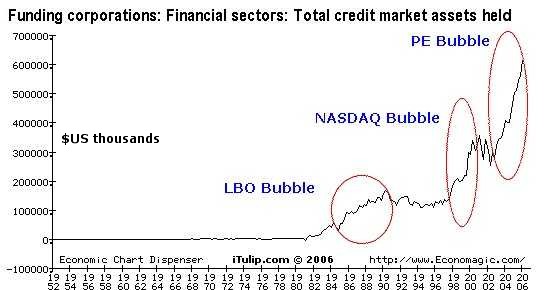
creditbubble

the chart speaks for itself / ohne worte

dank geht an die großartige seite itulip. http://www.itulip.com/

story relatet to chart. http://www.itulip.com/forums/showthread.php?t=674


größer/bigger http://www.itulip.com/images/creditbubbles.jpg

Labels: , ,