Thursday, May 08, 2008

Bankruptcies And Defaults Gather Pace

And the "official" recession hasn´t even started yet......

Und das obwohl die "offizielle" Rezession noch nicht einmal begonnen hat.......

Bankruptcies and defaults gather pace FT
The number of companies defaulting on their junk-rated debt and filing for bankruptcy in North America is running at its fastest pace in five years amid the slowing economy and contraction in credit markets.

So far this year, 28 “entities” have defaulted, according to Standard & Poor’s. The defaulted debt of the one Canadian and 27 US companies totals $18.4bn and exceeds the 17 defaults in the US for all of last year

As economic conditions deteriorated...and volatility in the financial markets protracted, corporate casualties began to emerge at a rate unseen in years,” said Diane Vazza, head of S&P’s Global Fixed Income Research Group. “The surge of defaults in the early months of 2008 is the first leg of an extended period of high default occurrences that will characterise the rest of 2008 and 2009.”
> and much much longer......
> und wohl noch wesentlich länger......

S&P said the pace of US defaults in the first five months of the year is the fastest since 2003.

The US is leading the global default rate for companies, said Ken Emery, senior vice-president at Moody’s.

The global default rate for speculative-grade companies rose to 1.7 per cent in April, up from 1.5 per cent in March and a multi-decade low of less than 1 per cent last year, said Moody’s.

Meanwhile, in the US the default rate rose from 1.8 per cent in March to 2.1 per cent in April. Moody’s expects the global default rate to reach 4.98 per cent by the end of the year, with defaults in the US reaching 5.7 per cent. In Europe the default rate is currently 0.7 per cent.
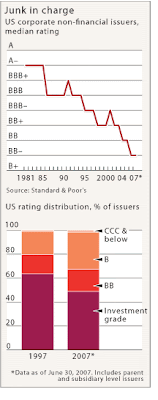
> I assume that we no way near the peak........ Especially when you look at the following table..... The market share of junk in 2007 was even more depressing.....
> Bin mir ziemlich sicher das die aktuellen Zahlen den USA nicht das Ende der Fahnenstange sind.... Das gilt besonders dann wenn man sich die nachfolgende Tablle ansieht...... Für das Jahr 2007 sah das ganze sogar noch depresseiver in Sachen Junkmarktanteil aus......
This week the latest Federal Reserve Senior Loan Officer survey highlighted tougher lending conditions from banks to lower-rated corporate borrowers. In spite of the recent rally in credit markets, the number of junk-rated companies trading at highly elevated levels remains well above normal.

“This increases the risks to the weakest links, entities rated B minus or lower,” said S&P. Weak links, which are three times more likely to default than the rest of the speculative grade market, rose to 101 entities in April. This was compared with 78 at the end of 2007 and a 10-year low of 64 in July.

“If the recession is deeper and longer than expected and lending constraints worsen more markedly, the default rate could be significantly more pronounced and severe, possibly reaching 8.5 per cent,” said S&P. Such a rate would reflect 136 defaults.

AddThis Feed Button

Labels: , , ,

Sunday, December 02, 2007

Credit Quality in a Freefall

I assume that lthe majority of these distressed companies have bought back shares during the past few years....

Ich gehe jede Wette ein das die Mehrzahl der jetzt betroffenen Firmen in den letzten Jahren fleißig Aktien zurückgekauft haben.....

Credit Quality in a Freefall / CFO.com
The distressed-debt ratio quadruples in a month's time though some signs point to a light at the end of the tunnel.

Credit quality deteriorated steeply from mid-October to mid-November despite the recent actions by the Federal Reserve to stimulate credit markets.

As of Nov. 15, $36.2 billion worth of debt was in distressed issues, more than four times the $8.6 billion reported a month earlier, according to Standard & Poor's. Distressed debt as a percentage of total debt recorded its largest monthly increase in five years, more than doubling to 4.9 percent from 2.3 percent. The ratio was as low as 2.1 percent 12 months ago.

Distressed credits are defined as speculative-grade-rated issues that have option-adjusted spreads of more than 1,000 basis points relative to Treasuries.

Other metrics also suggest that the credit crunch continues to impact the overall credit markets. For example, the non-distressed speculative-grade bond spread widened to 502 basis points in mid-November from 392 basis points a month earlier, according to S&P.

In addition, the total number of rated companies with issues trading at distressed levels ballooned to 224, almost double the 120 in October, according to the report.

S&P noted that of the 224 companies on this month's distressed list, half had either negative outlooks or ratings on CreditWatch with negative implications. The outlooks on 39 percent of the companies were stable, 7 percent were positive, and 4 percent were developing.

Of the 52 companies listed at the 1,000 bps level, 27 were rated "B-" or lower, and 39 were on CreditWatch with negative implications or had negative outlooks.

Not surprisingly, financial issues are suffering the most. Of the $36.2 billion of distressed issues, finance companies had the largest exposure, constituting 45 percent of the total debt affected, according to S&P. Next came media and entertainment at just over 20 percent.

Brokerage and finance companies displayed the highest distress rates as a share of total speculative-grade-rated issues, at 20 percent and 13.6 percent, respectively.

Not all of the news was bad. S&P pointed out that the U.S. speculative-grade default rate — typically the last indicator of stress within a credit cycle — hit an all-time low of 0.98 percent at the end of October, down from a previous low of 1.13 percent in September.

"Though default risk is rising, this year's default count continues to be constrained in part because of limited refunding needs, as well as structural concessions that avert payment default," S&P said in its report.

Year to date, the U.S. has recorded 13 defaults. "The U.S. speculative-grade default rate remains suppressed and is likely to post a year-end 25-year low of close to 1 percent,” S&P predicted.

> This low defalut rates ratios will dramatically spike during the years to come....

> Diese paradisischen niedrigen Ausfallraten dürften für lange lange Zeit Geschichte sein.....

AddThis Feed Button

Labels: , , , , ,

Thursday, October 11, 2007

Credit Cards & Junk Default Rates

Pimco is out with a new report A Hard Day’s Knight: The Global Financial Market Confronts Uncertainty, Not Just Risk (and the Difference is Important) I have taken the two charts out of context to point to two post i have done in the past few days.

Pimco hat einen neuen Report herausgebracht. Ich habe hier mal 2 Charts aus dem Post zum Anlaß genommen um meine Posts aus den letzten Tagen zu ergänzen. A Hard Day’s Knight: The Global Financial Market Confronts Uncertainty, Not Just Risk (and the Difference is Important)

Topic One "Credit Cards"

I think it is safe to say that the credit card spread will "adjust" sooner than later.......

Ich denke man braucht kein Hellseher zu sein um vorherzusagen das der Spread für die Kreditkarten sich demnächst wohl "anpassen" wird....

Topic Two "Junk-Grade Defaults"

Keep in mind that over 50% of US bonds issuance was junk in 2007. Compare this table with the precitction for defaults from Moody´s .....

Behaltet bei Betrachtung dieser Tabelle im Hinterkopf das im Jahr 2007 über 50% aller US Anleihen die begeben worden sind in die Kategorie "Junk" fallen. Vegleicht die Tabelle mit der Prognose der Ausfälle von Moody´s .....

AddThis Feed Button

Labels: , , , , , ,

Tuesday, October 09, 2007

Junk-Grade Defaults ‘More Likely’ / FT

I´ll bet that we will see much higher default rates than the agencies are forecasting. When you look at the spreads (chart Bespoke) there is much more room to the upside. Especially when you keep this in mind

Ich bin mir ziemlich sicher das wir in der Zukunft noch deutlich höhere Ausfallraten sehen werden als jetzt vorhergesagt werden. Hier ein Spreadchart via Bespoke der sehr anschaulich zeigt das hier noch "Luft ist". Das gilt insbesondere wenn einige Details näher beleuchtet werden.

More securities than ever have the lowest rankings, with CCC ratings assigned to 26.5 percent of the new debt, according to New York-based Fitch Ratings. That compares with 15 percent in 2006 for debt that itch says has a ``high default risk.''

Bonds that allow companies to pay interest in extra securities instead of cash, including toggle notes, accounted for almost 9 percent of high-yield debt sold this year, compared with less than 1 percent three years ago


Junk Grade Defaults More Likely / FT
Moody’s Investors Service said last month that company default rates in the junk-grade sector would rise by nearly 300 per cent as the credit squeeze hit the wider economy.

The agency predicted that the global speculative-grade default rate would rise from 1.4 per cent now, meaning only 1.4 per cent of the companies rated have defaulted in the past year – to 4.1 per cent in a year’s time and 5.1 per cent in two years’ time.

> Compare the prognosis (dotted chart-line) from the beginning of 2007 with the latest estimate. They had "calculated" roughly a 36% lower default rate. Here is another number that is hinting that the models from the rating agencies one more are outdated.....

> Vergleicht die Prognose im Chart von Anfang 2007 mit den aktuellen "Erwartungen". Hier noch eine weitere Hausnummer die darauf deuten läßt das die Modelle der Ratingagenturen in guten wie in schlechten Zeiten Ihren Zweck evtl. nicht erfüllen......

Distressed Bonds Increase Most Since 2003 / Bloomberg

The corporate bond market's favorite securities last year, so-called distressed debt, yield at least 10 percentage points more than Treasuries. Since June, the amount of distressed bonds has risen more than fivefold to $24.8 billion, according to an index Merrill Lynch & Co. began compiling in 1997.

AddThis Feed Button

Labels: , , , ,

Tuesday, August 07, 2007

Plenty Of Houses On The Balance Sheet.....

How severe the picture for some banks already is shows the Countrywide Foreclosures Blog from Dimitris. If this trend continues they should consider to become a REIT ...... :-)

Wie ernst die Lage inzwischen bei einigen Banken ist wird hier wunderbar von am Beispiel von Countrywide von meinem Bloggerkollegen Dimitris aufgezeigt. Wenn dieser Trend anhält sollten die ernsthaft in Überlegung zeiehn sich ein einen REIT umzuwandeln ......... :-)

Taken from the WSJ Housing Market WeakensAs Mortgage Industry Takes Cure

Moody's Economy.com has estimated that 2.5 million homeowners will default on their mortgage loans this year and next. Some will be able to keep their homes, through "loan modification" agreements that reduce payments or through various refinance packages offered by lenders and state rescue programs. But about 1.7 million of them will lose their homes to foreclosure, the research firm projects.
> Help is underway.....
In a speech scheduled for this morning in New Hampshire, Mrs. Clinton is to propose providing $2 billion in federal money to help “at risk” homeowners avoid foreclosures and to assist state and local governments build rental properties and other housing for families in need.
The U.S. housing boom over the past decade turned about five million renters into homeowners. But many of the loans that made that possible have proved unsustainable. Dr. Wheaton expects about two-thirds of those people to go back to renting.
Disclosure: Short KBW Mortgage Finance Index (including Countrywide)
AddThis Feed Button

Labels: , , ,

Thursday, July 26, 2007

Number of the Day.....Levereged Loans

They will hit the wall like the subprime borrowers in the housing sector. Should be fun to watch when the ultralow default rate will also spike at the same time. Time to hire staff for the distressed debt division.......

Denen wird ein ähnliches Schicksal wie den Subprimeschuldnern momentan blühen. Besonders spaßig dürfte es dann werden wenn zur selben Zeit die Anleiheausfälle zunehmen. Höchste Zeit die Abteilungen für notleidende Kredite massiv aufzustocken......

Hat tip to wmbz!
Junk-rated companies that have tapped generous loan markets in recent years could soon face funding difficulties, according to Fitch.

A report by the rating agency published on Thursday predicts that more than half of the $1,300bn leveraged loans market in the US will need to be refinanced in the next three years.

Companies that have low credit ratings have increasingly turned to the loan market for funding at a time of unprecedented liquidity from hedge funds and other non-traditional investors.

The report shows that about $680bn of loans will mature between 2008 and 2011 compared with only $180bn of maturing high-yield bonds.
AddThis Feed Button

Labels: , , , , ,

Friday, July 20, 2007

Tribune Debt Default Risk Tops 50 Percent, Swaps Show

WOW! No wonder spreads are spiking across the board.... SCHADENFREUDE!

Kein Wunder das einige in heller Aufregung sind....... SCHADENFREUDE!

July 20 (Bloomberg) -- Tribune Co. has a 50-50 chance of missing interest payments on some of the $13 billion in debt it will have after real estate investor Sam Zell buys the company, trading in the company's credit-default swaps shows.

Prices of the swaps, financial contracts used to speculate on a company's ability to repay debt, have jumped $331,000 since the first step in the sale was completed in May. It costs $770,000 to protect $10 million of Tribune bonds for five years, according to CMA Datavision, indicating a more than 50 percent risk of default. That's up from 32 percent on May 24, based on a JPMorgan Chase & Co. pricing model.

Investor unease is being fed by a deepening advertising slump at Tribune, owner of 11 metropolitan newspapers including the Los Angeles Times. That newspaper had ``one of the worst quarters ever experienced,'' in the second quarter and Tribune publishing results generally were ``worse than the industry,'' Publisher David Hiller wrote in a July 13 memo.

``If you were unsure about a deal before, it's much worse now,'' said Dave Novosel, an analyst at Gimme Credit Publications Inc. in Chicago who rates Tribune bonds ``sell.''

Tribune revenue fell 11 percent in May, the company said June 20, and was down 5.6 percent for the year to $2.02 billion. The company reports second-quarter results on July 25.

Tribune swaps prices imply investors consider the company the fourth-riskiest debt issuer among the almost 1,200 worldwide whose credit-default swaps were quoted this week by London-based CMA.

`At Risk'
``Their capacity to service their obligations could certainly be at risk,'' said Mike Simonton, a credit analyst at Fitch Ratings in Chicago

Tribune has said in filings it will slash capital spending, eliminate dividends and use an employee-ownership structure to avoid taxes, conserving cash to make interest payments that New York-based Benchmark Co. analyst Edward Atorino estimated at $1.08 billion.

The company will earn $1.09 billion to $1.18 billion before interest, taxes, depreciation and amortization this year, estimates Deutsche Bank newspaper analyst Paul Ginocchio in New York. While the deal is ``more likely than not'' to be completed, ``there may be some unhappy lenders in the end,'' he wrote in a July 1 report. .... On May 24, Tribune bought back 126 million shares, using more than $4 billion borrowed from four banks, including Citigroup Inc. and JPMorgan Chase. Tribune plans to borrow another $4.2 billion by year-end to buy its remaining stock.

> I would like to hear what the bondholders are saying to the buybacks.......

> Würde gerne wissen was die Gläubiger zu diesen Rückkäufen sagen.......
AddThis Feed Button

Labels: , , , , , ,

Friday, July 06, 2007

Public v private equity / Economist

What a great cover! The Cover was originally related to the story the trouble with private equity but it is too great to not put it up. The Economist does a good job of pointing to a view points like pensions etc that havn´t been discussed in the past. It might be true that private equity or as Rodger Rafter would say "pirate equity" has done a good job in the past and has delivered great returns. But i´ve learned that the most important point is to buy cheap and sell high. When i look at the multiples at the deals in the past year and especially in the past 90 days i have the feeling their is a need/rush to "invest" and i doubt that lots of deals will work out to be profitable in the future.

Geniales Cover! Das Titelbild gehört ursprünglich zu der oben verlinkten Geschichte, war aber zu gut um es nicht zu bringen. Der Economist betrachtet hier einige gute Punkte wie z.B. was im die Pensionsverpflichtungen usw angeht die bisher wenig diskutiert worden sind. Es mag ja sein das Private Equity oder wie Rodger Rafter sagen würde "Pirate Equity" in der Vergangeheit gute Ergebnisse erzielt hat, aber ich habe mal gelernt das der Gewinn maßgeblich von einem günstigen Einkauf abhängt. Wenn ich mir die Deals des letzten Jahres und besonders im letzten Quratal ansehe habe ich eher das Gefühl das hier auf Krampf "investiert" wird. Ich denke das die Mehrheit der Deals unterm Strich in der Zukunft als nicht so "smart" angesehen" werden.

BACK in the late 1980s, the Financial Times carried a spoof story about a planned buy-out of General Motors. Nowadays the sale of such a giant would not be regarded as a joke. Every day yet another company seems to succumb to the clutches of private equity. And this week saw what could be the biggest deal ever: a $48.5 billion offer by a consortium of investors for BCE, a Canadian telecoms group. It was swiftly followed by a potential $22 billion bid for Virgin Media, a British cable-television company, and the $26 billion purchase of Hilton Hotels.
Even after those deals, the private-equity titans have plenty of firepower left. According to Private Equity Intelligence, a research group, the industry raised $240 billion in the first half of this year, leaving it well placed to surpass last year's record of $459 billion. That compares with less than $10 billion raised in 1991. In the process, private equity's share of mergers and acquisitions has grown massively (see chart). .....
Public tedium
Life is no longer much fun in a publicly quoted company. Executives have to suffer the slings and arrows of intrusive media coverage, the oppressive tedium of “box-ticking” corporate-governance codes, the threats of activist investors and short sellers, and the scrutiny of single-minded political campaigners.

And what do companies get in return? Traditionally they have had three main reasons to list their shares on a stockmarket. The first is to raise capital, either to expand the business or to allow the founders to realise their wealth. The second is to help retain staff, who can be offered share options as an incentive to stay and work hard. The third involves prestige; customers, suppliers and potential employees may be reassured (and attracted) by the apparent seal of approval given by a public listing. However, all three reasons seem to be less compelling than they used to be.

Historically companies have got their equity capital from four sources: pension funds, insurance companies, mutual funds and retail investors. The first three groups faced legal or regulatory impediments to buying unquoted shares, while the public naturally valued the liquidity a stockmarket listing could bring.

In the absence of a public quote, companies often had only one financial alternative: the banks. In some areas of the world this worked quite well. Banks were reliable partners to Germany's Mittelstand of unquoted companies and to Japan's industrial empires. But in the Anglo-Saxon economies companies often felt nervous about being in hock to the banks. A change in lending policy, due to new management or an economic downturn, could lead to the sudden withdrawal of credit.

Nowadays companies have many more options when it comes to raising money. Banks are much less important as a source of lending; they have been “disintermediated” by capital markets.
Banks might arrange loans, but they quickly offload them to outside investors such as hedge funds. Bond markets are much more liquid than they used to be, and thanks to high-yield products even companies with a poor credit-rating can tap them.
> indeed..... in der Tat....
More securities than ever have the lowest rankings, with CCC ratings assigned to 26.5 percent of the new debt, according to New York-based Fitch Ratings. That compares with 15 percent in 2006 for debt that itch says has a ``high default risk.''
Bonds that allow companies to pay interest in extra securities instead of cash, including toggle notes, accounted for almost 9 percent of high-yield debt sold this year, compared with less than 1 percent three years
ago

Then, of course, there is private equity. It can provide finance at an early stage (venture capital) or as an attractive alternative for companies that have a public quote (the leveraged buy-out). Whereas pension funds will be reluctant to hold a direct stake in an unquoted company, they are willing to pay hefty fees to private-equity firms to invest money on their behalf. .....
> sarcasm?

Mr Motivator
In the 1990s it seemed as though everybody in America had a neighbour or a relation who was about to become a millionaire through their stock options. Companies were handing them out like free newspapers on Piccadilly. Company boards were happy to offer options since accounting rules allowed them to pretend they had no cost. ....

And now that options are properly accounted for, companies are just as happy to hand cash over.
Besides, partnerships such as lawyers and accountants (not to mention hedge funds) have historically managed to offer very generous rewards to their top employees without the need for a stockmarket quote. And private-equity groups have also been successful at retaining important staff by offering them potentially lucrative stakes. Indeed, top executives may prefer the private sector. For a start, private-equity bosses can keep what they earn secret, while chief executives of quoted companies find themselves the subject of impertinent comments from the media and activist shareholders.

Perhaps as a result, managers can earn a lot more in the unquoted sector. The most famous example is Dave Calhoun, a top GE executive who turned down jobs at S&P 500 companies for the chance to run privately owned VNU, a Dutch media group, for a reported $100m package
There is another problem, identified by Professor Jensen almost two decades ago. The structure of a public company creates an inherent conflict between investors and the managers they hire to run the business. The main problem is what to do with free cashflow, the money left over after all profitable investment projects have been funded. In theory this money should be returned to shareholders, but managers may be reluctant to do so. Holding on to cash means they do not have to go cap in hand to capital markets.

Professor Jensen argued that borrowing imposed discipline on executives. They needed to generate cash to meet interest payments. And, if they wanted to finance a project, they would have to convince investors that it was worthwhile. The result ought to be fewer unprofitable projects because cash is no longer left burning a hole in managers' pockets.

Private-equity firms apply this lesson in spades. They gear up the balance sheets of companies they buy with more debt than public firms are willing to accept. Nearly 20 years of economic stability have led some to believe that even notoriously cyclical businesses, such as carmaking, can now bear higher levels of debt. ....
> Some of the latest deals like Hilton, Huntsman etc are already at a double digit multiple...... In the case of Huntsman the bidding company Hexion /Apollo has had a negative cashflow last year and is in debt up to $ 5 billion. When they will get Huntsman they have to take on another $ 10 billion (via Handelsblatt)....... It should be clear that both bidders for Huntsman are rated as junk....


> Einige der letzten Deals (Hilton, Huntsman etc) sind bereits für einen zweistelligen Cashflowbetrag über die Bühne gegangen.......Hier ein paar mehr Fakten zum dem Hexion/Apollo Gebot für Huntsman aus dem Handelsblatt " Hexion wies für das abgelaufene Jahr einen negativen Cashflow und ein Ebitda von gerade mal 439 Mill. Dollar aus. Dem stand eine Verschuldung von fast fünf Mrd. Dollar gegenüber. Je nachdem, wie viel Eigenkapital Access in die Transaktion steckt, müsste das Unternehmen weitere Schulden von bis zu zehn Mrd. Dollar schultern. " .....Es sollte klar sein das beide Bieter für Huntsman bereits al Junkschuldner "ausgezeichnet" sind.......

Workers do have a legitimate concern about the security of their pensions. When a company takes on a lot of debt it undoubtedly makes the “covenant” between a company and its pensions scheme less secure. For a start, it increases the risk that a company may go bust, and so may not be making contributions into the scheme in future. And in the short term executives will concentrate on paying down debt rather than making additional payments to close a pension deficit.

It may well be that the shift away from quoted companies turns out to be detrimental to workers' pensions rights. However, those rights were already being eroded, with many quoted-company schemes being closed to new members or to future accruals for existing employees. Private equity is not the main, or even a leading, cause of the pensions crisis.

The conglomerate model
Another potent criticism of private equity is the parallel with the conglomerates of the 1970s and 1980s, such as ITT, BTR and Hanson. Like private-equity firms, the conglomerates used their financial muscle (in their case, highly rated shares rather than borrowed money) to construct diverse industrial empires. They argued, just as private equity does today, that they could improve the companies they owned through superior management.

Eventually, those empires fell apart. Like a shark compelled to keep swimming forward to catch its prey, they needed ever-bigger acquisitions to make progress. Investors concluded that they could diversify on their own, by buying shares in different sectors. They did not need a conglomerate to do the job for them.

Private-equity groups insist they will not run into the same problem. “We don't hang on to the businesses,” says the leader of one. But that creates another potential problem: investing for growth. If a business is going to be sold within, say, five years, what incentive is there to approve the financing of projects that may take a decade or more to pay off?

Private-equity bosses maintain that it is not in their interest to ruin the companies they buy, because they want to sell them again. And it is also the case that the executives of publicly quoted companies can sometimes skimp on capital expenditure, given that they are often under pressure to meet quarterly profit targets.

Superior returns?
..... One much-cited study** found that average returns, net of fees, were roughly equal to that produced by the S&P 500 index between 1980 and 2001. That implies that private-equity firms do improve the businesses they own, since gross returns outperform the market. But investors do not seem to benefit. “Overall, returns have not been that special, especially if you adjust for risk,” says Richard Lambert, director-general of the Confederation of British Industry, Britain's main business lobby-group. ....

Going private
In addition, private-equity firms need an exit route to sell their investments. Although there is a growing trend for secondary deals, where one group sells a firm it has bought to another, there must be a limit to which further efficiencies can be squeezed out of any particular business. In the end, a public market will be needed for someone to realise their profit.

Indeed, the need for an exit route was neatly demonstrated by the recent flotation of Blackstone, one of the largest private-equity groups, on the New York stockmarket and the decision this week by Kohlberg Kravis Roberts, another of the industry's titans, to follow suit. It does seem a bit hypocritical for these firms, who regularly tout the benefits of the private model, to head for the public markets—but what other route could they take? They could hardly agree to be bought by each other.

A bigger role for private equity might make the economy more vulnerable. Historically, recessions have often occurred when rising interest rates have cut into corporate profits, causing firms to slash employment and capital expenditure. In a world where most companies carried private-equity-style debt levels, companies would be much more vulnerable and recessions might become much more frequent. Monetary policy would become more difficult, with even small changes in interest rates having the potential to cause massive damage to business. And government revenues might be affected if large portions of industry were financed by tax-deductible debt.
But private equity still accounts for only a small proportion of corporate ownership. Much of the industry's activity is among small and medium-sized companies. There is still plenty of scope for private-equity firms to expand.

It may well be, however, that the peak of the cycle is close at hand. Private equity is inevitably a “feast and famine” business: when one fund can raise a lot of capital, they all can. Competition to buy companies then pushes up the price of doing deals, increasing the interest burden and reducing the returns for equity holders. More deals will be done this year, but they may not deliver the kind of returns that investors are hoping for, just as the late 1980s buy-out of RJR Nabisco, the emblematic deal of the era, proved a disappointment.

Since 2003 conditions have been almost ideal for private-equity firms, with low interest rates, lots of liquidity and rising asset prices. But recent events have been moving against them. Bond yields have been rising, making takeovers (which replace equity with debt) more expensive. The high level of corporate profits suggests that there may not be much more to be wrung out of businesses. And the relentless campaign against private-equity tax privileges has made the groups look like easy targets for finance ministers. It may be symbolic that Blackstone's shares quickly slid below the offer price.
Bad debts
Investors also seem to have woken up to the potential risks, perhaps alerted by the losses being suffered in another part of the credit universe—subprime mortgages. They had previously been happy to extend credit on easy terms, such as “covenant-lite” loans (debts with few checks on operating performance) or payment-in-kind notes, where borrowers can substitute more debt for interest payments. Now they are starting to turn down deals where private-equity firms push their luck too far. Banks are getting reluctant to provide the “blank cheques” that private-equity groups were demanding for the bridge financing of deals. In addition, exits may be becoming more difficult: the sale of New Look, a British retailer, collapsed when the last two remaining bidders pulled out.
AddThis Feed Button


Labels: , , , , ,

Monday, June 25, 2007

Who Cares ? / Minyanville

Not a pretty picture. Especially the credit markets are not on a stairway to heaven.....Click on the headline to read the other 3 things you need to know.

Ein trübes Bild. Beosnders die Kombination im Kreditmarkt sieht nach einem in Stein gemeißelten Desaster aus. Klickt bitte auf die Überschrift um den kompletten Bericht zu lesen.

Who Cares? Part I
Jon Markman on the Minyanville Buzz and Banter this morning pointed out a Gallup Poll showing that the general public is more pessimistic about the future today than at any time in the last 15 years.
In a poll last week asking, "In general, are you satisfied or dissatisfied with the way things are going in the U.S. at this time?" a whopping 74% reported dissatisfaction, while only 24% reported satisfaction.

Who Cares? Part II

Question: Why is it lenders don't really seem to care about anything - subprime mortgage woes, potential derivatives dislocations, Bear Stearns?

Answer: Because of a seemingly endless supply of cheap money.

This is generally what is meant when someone says "excess liquidity."

What does such availability of money look like? How does it influence asset prices?

Consider the following from a recent Wall Street Journal Op-Ed piece written by Steven Rattner, managing principal of the private investment firm Quadrangle Group LLC: In 2006, a record 20.9% of new high-yield lending went to weak borrowers with at least one rating starting with a "C." So far this year, that figure is at 33%.

In recent months, lower credit bonds have traded at a smaller risk premium (as compared to U.S. Treasuries) than ever before in history, Rattner wrote.

America's general mood aside, it helps that "money" today is available in quantities, and at prices, never before seen in the modern-day history of financial markets.

Of course, as Rattner pointed out, a mere 0.8% of high-yield bonds defaulted last year, the lowest in modern times.

And so far this year there has been only three defaults.

By comparison, high-yield default rates have averaged 3.4% since 1970.

The result is a familiar cocktail: increased competition among lenders for business resulting in cheaper loans and increasingly relaxed lending standards.

Hmmm. Where have we tasted that combination before?


AddThis Feed Button

Labels: , , , , ,

Tuesday, May 15, 2007

Junk Bonds May Repeat Crash of 2002 on Increasing LBO Credits

"toggle" bonds...bring on another credit innovation to keep the game going......this is even more crazier than the option arm for individuals........the end must be near........

"toggle" anleihen. endlich mal wieder ne neue innovation die die kreditblase weiter aufpumpen kann...das ist noch verrückter als die kredite mit negativer tilgung bei den immobilenfinanzierern...das ende dürfte nicht mehr weit weg sein......

May 15 (Bloomberg) -- Never have so many made so much money from junk bonds, and that worries Dan Fuss.

Fuss, whose $10.7 billion Loomis Sayles Bond Fund has been the best performer among its peers the last 10 years, says high- yield, high-risk securities are showing unmistakable signs of a bubble. Yields are near record lows relative to government securities even though sales of the riskiest bonds increased 39 percent from last year, debt has grown faster than earnings and the economy is expanding at the slowest pace in five years.

``I haven't felt this nervous about a market ever,'' said Fuss, vice chairman of Loomis Sayles & Co. in Boston, who's been working in the banking and securities industries since he joined Wauwatosa State Bank in Wisconsin in 1958. His fund has returned an average 9.91 percent a year for the last decade, the best of 45 funds with similar investment rules, according to Lipper, the mutual fund research firm.

Martin Fridson, head of high-yield research firm FridsonVision LLC, and Mariarosa Verde, managing director of credit market research at Fitch Ratings, say sales of junk bonds and the record $366 billion of leveraged buyouts may lead to the worst bear market for bondholders.

The last time junk bonds tumbled was in 2002, when companies defaulted on $166 billion of their securities, according to Moody's Investors Service. Merrill Lynch & Co.'s High Yield Master II Index fell about 2 percent that year as yields on the securities rose to a record 11.2 percentage points over Treasuries. Speculative grade, or junk, bonds are rated below Baa3 by Moody's and BBB- by Standard & Poor's.

Severe Downside
``The downside is likely to be very severe,'' Fridson, who led Merrill's high-yield strategy group until he left in 2003 to start his own firm, said in an interview from his office in New York.

Fridson predicts that in the next few years the default rate may reach or surpass the 2002 level, when WorldCom Inc. in Jackson, Mississippi, and Adelphia Communications Corp., then based in Coudersport, Pennsylvania, filed for bankruptcy.

About 1.5 percent of junk-rated companies have defaulted on their debt this year, near the lowest in a decade, Moody's says.

``Defaults are almost non-existent today and, well, we know that doesn't hold forever,'' ..

``When the economy goes bad, defaults will spike up from 1 percent into the 9 percent level,'' Lee said at the Milken Institute Global Conference in Los Angeles on April 25. ``If that happens then the financing part grinds to a halt'' for LBOs, he said.


`Fantasy Land'
More than half of the junk bonds sold this year were used to pay for leveraged buyouts and mergers and acquisitions, according to Barclays Capital. Money is so easy to come by that for the first time some investors agreed to let borrowers choose to make interest payments in cash or in additional bonds.


``This is fantasy land for corporate treasurers,'' .... They ``are smiling like Cheshire cats'' and borrowing conditions ``entice them to increase their leverage.''

Univision Communications Inc., the Los Angeles-based Spanish-language broadcaster, and real estate broker Realogy Corp. of Parsippany, New Jersey, financed their takeovers in part with so-called toggle bonds that give the issuer the option to pay interest with more bonds.
Univision, Realogy
Univision sold $1.5 billion of toggle notes on March 1 that are rated B3 by Moody's and CCC+ by S&P. The notes pay cash interest of 9.75 percent and a pay-in-kind coupon rate of 10.5 percent. Realogy sold $550 million of the securities on April 5 with an 11 percent cash coupon and an 11.75 percent rate if paid in extra notes. They are rated Caa1 by Moody's and B- by S&P...

There have been 10 sales of toggle bonds this year, amounting to $5.14 billion, the most ever, according to S&P's Leveraged Commentary and Data unit. There were five sales totaling $4.05 billion completed in November and December of last year. Before that, only luxury retailer Neiman Marcus Group had issued the securities, in September 2005.

A Losing Game
....Betting against corporate bonds has been a losing game. The debt has returned 4.47 percent this year, Merrill data show. U.S. Treasury bonds have gained 1.80 percent and corporate bonds with investment-grade ratings have returned 2.21 percent in the same period, Merrill data show.

Investors get an extra 2.63 percentage points in yield on average to own junk bonds rather than Treasuries, down from 3.73 percentage points at the start of 2005 and more than 10 percentage points in 2002, according to Merrill data.

No `Catalyst'
JPMorgan Chase & Co. analyst Peter Acciavatti, the top- ranked high-yield analyst in Institutional Investor magazine's annual poll the past four years, lowered his default forecast for the end of this year to 1.25 percent from 2 percent on a dollar-weighted basis, in part because issuers have taken advantage of low rates to refinance and extend maturities.

``Companies just don't have payments they need to worry about for the next couple of years,'' Acciavatti said in New York. ``It all goes back to the liquidity we're seeing. I don't see the catalyst for rising defaults except for the economy. If the economy gets worse from here it will eventually start to have a toll on earnings and leverage.''

>with gdp growth only 1,3% ( and probably revised lower to under 1% ) this argument makes sense..............

> bei einem wirtscahftswachstum von nur noch 1,3% in q1 das wahrscheinlich auf deutlich unter 1% reduziert wird eine "mutige" aussage


"you should relax lex!"


The average B rated company borrows at a yield premium of 2.61 percentage points above Treasuries, near the lowest since 1997 and about one percentage point less than it cost BBB rated companies to borrow at the end of 2002, according to Merrill. .....

Risks Building
....Companies are piling on debt even as the economy slows. The total debt for about 300 companies rated BB and B expanded by 16 percent last year, double its growth in 2005, according to Fitch.

Debt strategists at New York-based Morgan Stanley, the world's second-biggest securities firm, calculated in a report last month that leverage is rising for eight of the 15 high- yield industries it covers, the first ``meaningful'' increase since 2002.

Ford Motor Co. lost $282 million in the first quarter and is $23 billion deeper in debt than it was a year ago. The Dearborn, Michigan-based company's $3.7 billion of 7.45 percent bonds due in 2031 trade at a yield premium of 4.63 percentage points, down from 5.38 a year ago, according to Trace, the bond- price reporting system of the NASD. Ford is rated Caa1 by Moody's.

Recovery Rates
Credit quality ``is moving in a less desirable direction,'' said Fitch's Verde, who is based in New York.

Bond investors should also worry because companies are adding more senior secured loans, which rank ahead of junk bonds in a bankruptcy, Verde said. A record $686 billion of high-yield loans were made last year, Bloomberg data show.

The average recovery rate for unsecured bonds may fall by as much as 10 percent from its historical average of 40 cents on the dollar because of the rise in loans, according to Fitch.

``Structural risks are rising,'' Fitch's Verde said. ``They're simply being masked by the low default rate.''

More than $108 billion of so-called covenant-lite loans, or those that don't hold borrowers to limits on quarterly debt, have been completed this year, compared with a total of $36 billion in the previous 10 years, according to S&P's LCD.

Labels: , , , , , ,

Monday, March 19, 2007

Corporate Bond Risk Premiums Surge on Subprime Mortgage Fallout

looks like the business week cover story from 9th februrary was "just in time" to markt the top........ http://tinyurl.com/yvmze2 :-)

sieht so aus als wenn mal wieder ein cover einer großen zeitung es geschafft hat das top auszurufen. seit dieser geschichte hat sich einiges geändert..... :-)


March 19 (Bloomberg) -- Risk premiums on investment-grade corporate bonds rose to their highest level in more than three months on concern rising delinquencies by subprime borrowers will slow the economy.


The extra yield, or spread, above Treasuries investors demand to own investment-grade bonds widened to 93 basis points last week from 86 basis points on Feb. 26, the day before the Standard & Poor's 500 index of stocks fell by the most in almost four years, according to Merrill Lynch & Co. index data. High- yield, high-risk bond spreads widened to 288 basis points from 258 basis points in the same period, Merrill data show. ....

``There is this elevated level of uncertainty that warns of a worsening of the situation in housing that would doubtless affect the economy at large and weaken profitability and cash flow by enough so that we would see a materially diminishing corporate creditworthiness,'' John Lonski, chief economist at Moody's Investors Service, said in an interview from his New York office.

Moody's forecasts the speculative-grade default rate will rise to 2.7 percent by year-end and 3.2 percent by the end of February 2008 from 1.6 percent. Last month was the first in more than nine years when all high-yield issuers made all their debt payments. ( in the past years their forecast was too conservative, if the trend turns it might be that even the new estimate is too low/in den letzten jahren war moody´s zu pessimistisch (was ich gut nachvollziehen kann), sollte der trend jetzt kippen kann ich mir sehr gut vorstellen das auch diese recht hohe schätzung ebenfalls von der realität eingeholt wird. dieses mal dann allerdings auf der unfreundlichen seite...)
Corporate bond spreads may widen further as companies report their earnings for the first quarter, Lonski and Marrinan said. Investment-grade bonds yield 5.54 percent on average, Merrill data show, compared with 5.58 percent on Feb. 26. ....

Marrinan cut his recommendation on investment-grade corporate bonds to ``neutral'' from ``overweight'' on March 2 on expectations the subprime turmoil will push spreads wider.
Investors take a ``neutral'' position on corporate bonds by owning the same percentage of the debt in their portfolio as is contained in their benchmark index.
Yield premiums on junk bonds, those rated below Baa3 by Moody's and BBB- by S&P, may surge as corporate profit growth slows, Lonski predicts.

``If there's any sector that deserves a selloff, the high- yield market still seems to be overpriced, especially when you look at the lower rated high-yield bonds,'' said Lonski. ``Credit risk appears to be underpriced.''

Lonski is sticking to his November forecast that high-yield spreads will increase to as much as 400 basis points this year.

Labels: , ,

Tuesday, March 13, 2007

CDOs May Bring Subprime-Like Bust for Buyouts, Junk-Rated Debt

......like falling dominoes. everybody who thinks that the events in the subprime sector are isolated must either be naive, a perma bull or has a show called "mad money" on cnbc...... :-)

....man kann förmlich erkennen wie nach und nach ein domino nach dem anderen fällz. jeder der meint das die probleme im subprimesektor isoliert zu betrachten sind wird wohl eines besseren belehrt.


March 13 (Bloomberg) -- Bond investors rattled by mounting losses in subprime U.S. mortgages say trouble is brewing in collateralized debt obligations, the same securities that fueled the boom in leveraged buyouts and cut-rate finance.


Sales of CDOs, which package loans, bonds and derivatives into new securities, rose by almost half to $918 billion last year, .... Demand for investments to use in CDOs has helped push risk premiums lower for everything from home loans to high-yield, high-risk bonds, forcing managers to borrow ever more money to maintain returns and stand out from the competition.

``There will ultimately be a shakeout,'' said ... ``Many'' new managers ``lack the pedigree, or at a minimum the track record. Many have not managed'' in a downturn, he said.

Managers of CDOs backed by speculative-grade loans are borrowing as much as 13 times the amount they raise in equity from investors, up from nine to 10 times as recently as late 2005, according to Wriedt. Forty-one percent of the 142 CDOs backed by corporate loans and rated by Moody's Investors Service last year were set up by first-time issuers.

Subprime Parallels
``There certainly is potential for some excesses and that could turn into some performance issues,'' .....
CDOs are financing a record number of loans to low-rated borrowers that forego standard investor protections, such as quarterly limits on the amount of debt relative to earnings. Some $36 billion of the loans were made this year, more than the previous 10 years combined, New York-based Morgan Stanley found.

Individuals with poor credit histories who borrowed for home loans obtained similar easy terms. Many of those subprime loans also have ended up in CDOs.
As of Dec. 31, about 10 percent of subprime loans in securities were either delinquent by at least 90 days, in foreclosure or turned into seized property, the most in at least seven years, ....
`Toxic Waste'
``When you talk about no documentation loans, you can't have any less of a standard than that,'' .... The lenders ``lower their standards and say `Well, we can put them into CDOs.' Like that's somehow burying that it's toxic waste.''


About $173 billion of CDOs backed mainly by U.S. subprime mortgage bonds and related derivatives were created last year, according to New York-based JPMorgan. Yield premiums for BBB rated bonds issued by CDOs that hold some of the riskiest mortgage debt have soared to 6 percentage points over benchmark rates from 3.65 percentage points this year, JPMorgan found. (still a joke but a start..../ immer noch witz aber immerhin ein beginn.....)

Investors ``need to worry a good bit'' about subprime delinquencies spilling over into the CDO market,... ``The scenario where the BBBs all blow up is a reasonably possible scenario,'' ...

Bankers bundle what is often speculative-grade securities into a CDO, dividing it into pieces with credit ratings as high as AAA. The riskiest parts have no rating, and are known as the equity tranches because they are first in line for any losses. Investors in the equity portion expect to generate returns of more than 10 percent. ....

Better than GE
CDOs with loans and AAA ratings yield 23 basis points over benchmark rates, according to JPMorgan. That's 10 basis points more than top-rated regular corporate bonds sold by Fairfield, Connecticut-based General Electric Co., Merrill Lynch data show.

The Dallas Police and Fire Pension Fund invested in its first CDO about two years ago to boost returns, according to Richard Tettament, administrator of the $3.2 billion fund.

``We were beefing up our risk and we were hoping for a greater return,'' Tettament said in an interview from his Dallas office. ``We have an unfunded liability to pay off.''


Tettament said he isn't sure what type of collateral backs the CDO, though he thinks returns exceeded 20 percent last year.
read this statement twice! / bitte zur not zweimal lesen!

Buyout firms from Kohlberg Kravis Roberts & Co. to Blackstone Group LP have been among the biggest beneficiaries of CDOs. High-yield, or leveraged, loans financed 57 percent of the record $1.55 trillion of mergers and acquisitions last year, the most in seven years, according to S&P.


`Credit Amnesia'
About $154 billion of CDOs that focus mainly on loans were created in 2006, up from $68.2 billion in 2005, according to data compiled by Morgan Stanley. The demand has allowed companies rated four or five levels below investment-grade to pay just 2.12 percentage points more than benchmark rates this month to borrow, an all-time low, S&P says.

``We think there is a kind of a credit amnesia that is going on,'' said William Chew, managing director at S&P in New York. LBO loans the last two years ``had a record number of the deals at the lower end of the credit spectrum. .....


Little Worry
....Investors in CDOs have had little to worry about. February was the first time in more than nine years that no speculative- grade companies defaulted, Moody's said last week. ( can it get any better.....? even mody´s is estimating higher defaults and (surprise) was too early and pessimistic....kann es noch besser werden.....selbst moody´s prognostiziert höhere ausfälle und zu meiner überraschung war mal zu früh dran und pessimistischer.....)


Competition among CDO managers is so fierce that GoldenTree took 11 months to find enough attractive loans for a $750 million fund created two weeks ago, about double the amount of time it took to collect collateral in 2002, Wriedt said. ....

UNC Stays Away
The University of North Carolina at Chapel Hill, which invested in one CDO backed by loans in 2002, isn't buying any now, .....

``We have historically only invested in the equity tranche and today those equity tranches are yielding between 10 and 13 percent,'' ... ``Given the level of risk we feel we're taking in those pieces of paper we don't feel we're being compensated.'' ...

Labels: , , , , ,

Saturday, March 10, 2007

Crisis Looms in Mortgages / NYT

good summary. too bad that most of the newspaper havn´t done stories like this one in advance. so it is only good reporting but they should have done better ......

when you want more infos please click on the labels at the end of the post. skip the first (this) article and you get older post on the topic

gute zusammenfassung. warum ´die story nicht in den letzten jahren erzählt worden ist muß man die journalisten fragen.

wenn ihr mehr zu den einzelnen punkten lesen wollt bitte am ende des post auf die labels klicken und den ersten (diesen) bericht ignorieren und zum 2. scrollen.


On March 1, a Wall Street analyst at Bear Stearns wrote an upbeat report on a company that specializes in making mortgages to cash-poor homebuyers. The company, New Century Financial, had already disclosed that a growing number of borrowers were defaulting, and its stock, at around $15, had lost half its value in three weeks.

What happened next seems all too familiar to investors who bought technology stocks in 2000 at the breathless urging of Wall Street analysts. Last week, New Century said it would stop making loans and needed emergency financing to survive. The stock collapsed to $3.21.


The analyst’s untimely call, coupled with a failure among other Wall Street institutions to identify problems in the home mortgage market, isn’t the only familiar ring to investors who watched the technology stock bubble burst precisely seven years ago. (looks like this cartoon is proven wrong..../ sieht ganz so aus las wenn dieser cartoon überholt ist.....)

thanks to http://www.wallstreetfollies.com/

Now, as then, Wall Street firms and entrepreneurs made fortunes issuing questionable securities, in this case pools of home loans taken out by risky borrowers. Now, as then, bullish stock and credit analysts for some of those same Wall Street firms, which profited in the underwriting and rating of those investments, lulled investors with upbeat pronouncements even as loan defaults ballooned. Now, as then, regulators stood by as the mania churned, fed by lax standards and anything-goes lending.

Investment manias are nothing new, of course. But the demise of this one has been broadly viewed as troubling, as it involves the nation’s $6.5 trillion mortgage securities market, which is larger even than the United States treasury market. ....


“The regulators are trying to figure out how to work around it, but the Hill is going to be in for one big surprise,” .... “This is far more dramatic than what led to Sarbanes-Oxley,” he added, referring to the legislation that followed the WorldCom and Enron scandals, “both in conflicts and in terms of absolute economic impact.”

While real estate prices were rising, the market for home loans operated like a well-oiled machine, providing ready money to borrowers and high returns to investors like pension funds, insurance companies, hedge funds and other institutions. Now this enormous and important machine is sputtering, and the effects are reverberating throughout Main Street, Wall Street and Washington.

Already, more than two dozen mortgage lenders have failed or closed their doors, and shares of big companies in the mortgage industry have declined significantly. Delinquencies on loans made to less creditworthy borrowers — known as subprime mortgages —recently reached 12.6 percent. Some banks have reported rising problems among borrowers that were deemed more creditworthy as well. ....

“I guess we are a bit surprised at how fast this has unraveled!....

Even now the tone accentuates the positive. In a recent presentation to investors, UBS Securities discussed the potential for losses among some mortgage securities in a variety of housing markets. None of the models showed flat or falling home prices, however. ( can you believe this?!?, nicht zu fassen!?!, no wonder ubs also upgraded new century.....)


The Bear Stearns analyst who upgraded New Century, Scott R. Coren, wrote in a research note that the company’s stock price reflected the risks in its industry, and that the downside risk was about $10 in a “rescue-sale scenario.” According to New Century, Bear Stearns is among the firms with a “longstanding” relationship financing its mortgage operation. ....( he is not alone.....)

Like worms that surface after a torrential rain, revelations that emerge when an asset bubble bursts are often unattractive, involving dubious industry practices and even fraud. ( i think the worms may look like this one.../ die würmer sehen wohl aus wie....)
In the coming weeks, some mortgage market participants predict, investors will learn not only how lax real estate lending standards became, but also how hard to value these opaque securities are and how easy their values are to prop up.

Owners of mortgage securities that have been pooled, for example, do not have to reflect the prevailing market prices of those securities each day, as stockholders do. Only when a security is downgraded by a rating agency do investors have to mark their holdings to the market value. As a result, traders say, many investors are reporting the values of their holdings at inflated prices.

“How these things are valued for portfolio purposes is exposed to management judgment, which is potentially arbitrary,” Mr. Rosner said.

At the heart of the turmoil is the subprime mortgage market, which developed to give loans to shaky borrowers or to those with little cash to put down as collateral. Some 35 percent of all mortgage securities issued last year were in that category, up from 13 percent in 2003.

Looking to expand their reach and their profits, lenders were far too willing to lend, as evidenced by the creation of new types of mortgages — known as “affordability products” — that required little or no down payment and little or no documentation of a borrower’s income. Loans with 40-year or even 50-year terms were also popular among cash-strapped borrowers seeking low monthly payments. Exceedingly low “teaser” rates that move up rapidly in later years were another feature of the new loans.


The rapid rise in the amount borrowed against a property’s value shows how willing lenders were to stretch. In 2000, according to Banc of America Securities, the average loan to a subprime lender was 48 percent of the value of the underlying property. By 2006, that figure reached 82 percent.

Mortgages requiring little or no documentation became known colloquially as “liar loans.” An April 2006 report by the Mortgage Asset Research Institute, a consulting concern in Reston, Va., analyzed 100 loans in which the borrowers merely stated their incomes, and then looked at documents those borrowers had filed with the I.R.S. The resulting differences were significant: in 90 percent of loans, borrowers overstated their incomes 5 percent or more. But in almost 60 percent of cases, borrowers inflated their incomes by more than half.


A Deutsche Bank report said liar loans accounted for 40 percent of the subprime mortgage issuance last year, up from 25 percent in 2001.

Securities backed by home mortgages have been traded since the 1970s, but it has been only since 2002 or so that investors, including pension funds, insurance companies, hedge funds and other institutions, have shown such an appetite for them.
Wall Street, of course, was happy to help refashion mortgages from arcane and illiquid securities into ubiquitous and frequently traded ones. Its reward is that it now dominates the market. While commercial banks and savings banks had long been the biggest lenders to home buyers, by 2006, Wall Street had a commanding share — 60 percent — of the mortgage financing market, Federal Reserve data show. .....

The profits from packaging these securities and trading them for customers and their own accounts have been phenomenal.
The issuance of mortgage-related securities, which include those backed by home-equity loans, peaked in 2003 at more than $3 trillion, according to data from the Bond Market Association. Last year’s issuance, reflecting a slowdown in home price appreciation, was $1.93 trillion, a slight decline from 2005.

In addition to enviable growth, the mortgage securities market has undergone other changes in recent years. In the 1990s, buyers of mortgage securities spread out their risk by combining those securities with loans backed by other assets, like credit card receivables and automobile loans. But in 2001, investor preferences changed, focusing on specific types of loans. Mortgages quickly became the favorite.

Another change in the market involves its trading characteristics. Years ago, mortgage-backed securities appealed to a buy-and-hold crowd, ...... “Now it has become much more of a trading market, with a mark-to-market bent.”

The average daily trading volume of mortgage securities issued by government agencies like Fannie Mae and Freddie Mac, for example, exceeded $250 billion last year. That’s up from about $60 billion in 2000.

Wall Street became so enamored of the profits in mortgages that it began to expand its reach, buying companies that make loans to consumers to supplement its packaging and sales operations. In August 2006, Morgan Stanley bought Saxon, a $6.5 billion subprime mortgage underwriter, for $706 million. ( great timing, driving/buying looking in the rear view mirror...../ gutes timing , fahren/kaufen mit tunnelblick in den rückspiegel ist selten gesund......)


And last September, Merrill Lynch paid $1.3 billion to buy
First Franklin Financial, a home lender in San Jose, Calif. At the time, Merrill said it expected First Franklin to add to its earnings in 2007. Now analysts expect Merrill to take a large loss on the purchase.....

As prevailing interest rates remained low over the last several years, the appetite for these securities only rose. .... Mortgage securities participants say increasingly lax lending standards in these loans became almost an invitation to commit mortgage fraud. It is too early to tell how significant a role mortgage fraud played in the rocketing delinquency rates — 12.6 percent among subprime borrowers. Delinquency rates among all mortgages stood at 4.7 percent in the third quarter of 2006.


For years, investors cared little about risks in mortgage holdings. That is changing.

“I would not be surprised if between now and the end of the year at least 20 percent of BBB and BBB- bonds that are backed by subprime loans originated in 2006 will be downgraded,” ..

Still, the rating agencies have yet to downgrade large numbers of mortgage securities to reflect the market turmoil. Standard & Poor’s has put 2 percent of the subprime loans it rates on watch for a downgrade, and
Moody’s said it has downgraded 1 percent to 2 percent of such mortgages that were issued in 2005 and 2006. ( this is what it looks like when you wait for the downgrade to come. they are way behind the curve! so sieht das ganze aus wenn man auf die überfälligen downgrades wartet.)

Fitch appears to be the most proactive, having downgraded 3.7 percent of subprime mortgages in the period.

The agencies say that they are confident that their ratings reflect reality in the mortgages they have analyzed and that they have required managers of mortgage pools with risky loans in them to increase the collateral. ..... (read this!