Tuesday, January 05, 2010

"Power To The People" Iceland Edition......

I expect that hand in hand with a rising Sovereign Misery Index the times for bailing out anyone without ( hopefully non violent ) brewing tensions & extreme political backlash are at least getting tougher (outside the US ;-) ..... Needless to say that i largely agree with the following quote from Mish... Iceland has a good chance to nagotiate a much better deal after the referendum......

Ich denke das Hand in Hand mit einem steigenden Sovereign Misery Index die Zeiten der "bedenkenlosen" Bailouts ( Ausnahme selbstredend die USA ;-) ohne "größeren" öffentlichen Widerstand ( hoffentlich weiterhin gewaltfrei ) nicht mehr ohne weiteres ohne politische Folgen durchgewunken werden können... Überflüssig zu erwähnen das ich größtenteils mit dem nachfolgenden Fazit von Mish übereinstimme..... Ich jedenfalls wäre ebenfalls erbost für Kunden, die wegen eines minimalen Zinsvorteiles oftmals mit gewaltigen Summen zu Kaupthing & Co gewechselt sind, jetzt die Zeche zu zahlen...... Gehe jede Wette ein das Island nachdem das Referendum stattgefunden hat einen deutlich besseren Deal aushandeln kann und wird......

Iceland's President Effectively Tells UK "Go To Hell" - Hooray For Iceland Mish

Congratulations to Iceland for figuring out that it is better to suffer a credit rating downgrade than to torture its citizens for a decade or longer Iceland may have other problems but at least that one was resolved (hopefully), the quick and painless way.

And that should have been the model for US banks as well. The stockholders and bondholders should be the first ones wiped out.

Instead Bush started and Obama continued with a policy to punish the innocent to bail out the wealthy, leaving the average taxpayer deep in the hole, against the clear will of the majority.

Photo Gallery: Iceland's Deeply Unpopular Payback Der Spiegel

WSJ Iceland's president vetoed a bill to reimburse the U.K. and the Netherlands for bailing out depositors of a failed Icelandic bank, throwing into question the international plan to rescue the island nation's banks and casting doubts on its bid to join the European Union.

President Ólafur Ragnar Grímsson on Tuesday cited massive public opposition in his decision to reject the bill, which was approved in late December by the Icelandic parliament after months of wrangling.

Iceland's president is the head of state, but rarely wields real executive power.

The veto was only the second time since Iceland's independence from Denmark in 1944 that a president used that authority.

Under Iceland's constitution, the bill -- which calls for nearly $6 billion in repayment ( The money represents 40 per cent of the country's gross domestic product via Times Online, see also Wikipedia ) over 15 years, plus interest -- will be put to a public referendum.

Opinion polls suggest it has little chance. ( 70% against )

But without the payback, Iceland may lose or delay access to badly needed bailout money from the International Monetary Fund and Nordic neighbors. The IMF has approved $2.1 billion in

British and Dutch authorities were stern. The U.K. Treasury said Britain "expects Iceland to live up to its obligations."

"We are very disappointed about the decision," said a Dutch finance ministry spokesman. "Iceland has the obligation to pay back the money."

Almost since the onset of the financial-system collapse in October 2008, Icelanders have blamed a cadre of greedy bankers for turning a prosperous nation into an international economic pariah.

There is strong resistance to piling debt on ordinary citizens to undo the bankers' mess. The bill would have seen Iceland repay the U.K. £2.35 billion ($3.79 billion) and the Netherlands [euro €1.32 billion ($1.89 billion) over 15 years.

That amounts to nearly $20,000 for each of the 300,000 Icelanders.

The October 2008 collapse of one bank, Landsbanki Islands, triggered the trouble.

Hundreds of thousands of British and Dutch depositors, wooed by high interest rates, had placed money with Landsbanki through an Internet arm operating in those countries called Icesave

Under European financial rules, Iceland was required to maintain deposit insurance for those customers, but the collapse of all three of the island's big banks swamped the tiny insurance program. Britain and the Netherlands stepped in to cover their own citizens, and then demanded the money back from Iceland.

Eiríkur Svavarsson, a spokesman for InDefence, a group of Icelanders that organized the petition, said the country would honor its debts but would do so "in line with its economic strength."

It isn't clear how badly Mr. Grímsson's veto will disrupt the international aid on which Iceland depends. The IMF has said its funding isn't directly tied to an Icesave resolution, but notes that other lenders have made that condition, and it is reluctant to put money forward if others don't.

After the veto, Fitch Ratings cut Iceland's long-term foreign-currency credit rating to junk and said the future outlook was negative. Fitch also cut the long-term local-currency rating to BBB-plus.

NYT

But the presidential rebuke is being described as a momentous decision for Iceland. It also highlights a widening rift between European governments — pressed by bond investors, ratings agencies and the International Monetary Fund to cut budgets and shrink deficits — and their recession-battered citizenry.
Late last month, the constitutional court in Latvia vetoed a move by the government there to cut pensions in line with an I.M.F.-sponsored austerity package. That development threatens the I.M.F. agreement and the country’s ties with foreign creditors.

Governments in Ireland, Greece and even Britain are also finding it difficult to satisfy both bond investors and voters

> I highly recommend to read the official declaration..... Well said!

> Empfehle sich die offizielle Deklaration im Wortlaut durchzulesen..... Klasse und einleuchtend logisch!

Ice Land Declaration


> Here a very good clip how from 2008 how Iceland got into deep deep troubles.....

> Hier ein sehenswerter Clip aus dem Jahr 2008 der schön aufzeigt wie Island in den Abgrund stürzen konnte.....

> I just couldn´t resist to post this Kaupthing Bank commercial..... You cannot make this up...... Enjoy if you are not an Icelander.....

> Kann mir nicht verkneifen nochmal die inzwischen berühmte Werbung der Kaupthing Bank zu bringen..... Tragisch genial! Für alle die nicht Isländer sicher ein Vergnügen......


H/T Ultimi Barbarorum

Labels: , , , , , , , ,

Tuesday, December 15, 2009

Sovereign Misery Index

One important reason why i like gold long term regardless of the US$ direction ( especially when you take a look at the "off balance sheet chart" )........

Einer der Hauptgründe die leider noch auf lange Zeit unabhängig von der Entwicklung des US$ für Gold sprechen ( gilt erst Recht wenn man sich den "Off Balance Sheet Chart" und die damit verbundene Aussage genauer ansieht ) .....

Anothery misery index - Moody's

FT Alphaville

Moody’s has compiled a 1970s-style ‘Misery’ index. But instead of showing inflation and unemployment rates, it shows the fiscal deficit and the unemployment rate.
Theme 1 Aaa countries will probably not have the luxury of waiting for the recovery to be secured before announcing credible fiscal consolidation plans.

Theme 4 Most governments cannot afford another financial crisis. Attempting to ring-fence balance sheets from contingent liabilities will keep policy makers busy.

Theme 5 Very large public debt and low economic vitality will prompt unprecedented questions about how governments can discharge their obligations without changing the rules of the game.

One way of looking at this is to realize that governments are more willing to default on social obligations – such as changing the retirement age – than on financial obligations

Theme 10 Debt hang-hover will test social and political cohesiveness.

In several countries – including some highly advanced ones like Iceland or Ireland, but also Latvia or Hungary, as well as in some much poorer countries like Jamaica – a great sacrifice is required from the respective populations. Cohesive and/or very enduring societies like the Baltic countries, Iceland or Ireland have accepted sacrifices (salary cuts, public spending cuts, etc.) that would have seemed unimaginable a few years ago and continue to seem hardly replicable in comparable societies.
Moodys Sovereign


At least some "Enron-esque characteristics" are difficult to deny......

Böswillig könnte bzw. müßte man sagen das "Enron-esque characteristics" nicht zu leugnen sind....

larger/vergrößerte Version

Credit's Golden Age? WSJ

[CREDITHERD]

We all can thank the regulators, accounting stunt experts, central banksters & the politicans that after trillions of worldwide banking bailouts the banks are now "well capitalized"( proven by yesterdays news like $38 Billion Tax Break Granted to Citigroup to Help Improve the TARP Results & Fannie Freddie May Need Another $400 Billion Taxpayer Assistance & ECB Said to Start Consulting Banks, Investors on Collateral .... No kidding, they are STARTING NOW ! , etc > compare this kind of number with the haggling about the pay for the climate bill.). & strong "regulation" ( Banks Said to Get More Time to Implement Stricter Capital Rules ( Update MEA CULPA! ): & Solving Everything but the Problem ) without loopholes is on the way ..... ;-)

Immerhin sind die Banken ja nachdem weltweit Billionen für die Bankenbailouts geflossen sind jetzt "well capitalized" ( wie gestrige Nachrichten wie $38 Billion Tax Break Granted to Citigroup to Help Improve the TARP Results & Fannie Freddie May Need Another $400 Billion Taxpayer Assistance & ECB Said to Start Consulting Banks, Investors on Collateral .... beruhigend zu wissen das bereits JETZT damit angefangen wird...usw. eindrucksvoll belegen > Richtig gute Laune bekommt man dann wenn man sieht wie verbissen um die Verteilung der Lasten zur Klimarettung verhandelt wird..... Da droht der Gipfel wegen einiger weniger Mrd zu scheitern..... ) & die Schlupflöcher durch die gewohnt "strenge" Regulierung ( z.B. Banks Said to Get More Time to Implement Stricter Capital Rules (Update:MEA CULPA! ) & Solving Everything but the Problem ) geschlossen .. ;-)

There has been a lot of bubble talk ( see Gold: A Contrarian's Dilemma ) when it comes to recent performance of gold. The following chart from Todd Harrison / Minyanville via Pragmatic Capitalist puts things into perspective.....

Gerade in letzter Zeit ist im Angesicht der Outperfmance von Gold immer öfter der Begriff "Bubble" ( siehe Gold: A Contrarian's Dilemma ) gefallen. Da kommt der nachfolgende Chart von Tod Harrison via Pragmatic Capitalist gerade rechtzeitig.....

larger/vergrößerte Version

`There’s no bubble in gold,’ CIBC says Ft Alphaville

Labels: , , , , , , , , , ,

Tuesday, October 27, 2009

Yes, We Can´t..... GMAC Scores Bailout Hattrick.....

This kind of taypayer generosity / backstop is one of the main reasons ( add to this ZIRP & QE ) the "smart money" has increased the risk appetite to the highest point since April 2006 ( just in time after one of the biggest rallies ever .....without any meaningfull pullback) , so far they have almost perfectly manage to go "ALL IN"close to the recent market top, with cash levels at the lowest point since Jan 2004! not an overstatement, taking the latest market action into account the post is looking better on a daily basis..... )..... Stories like this are one of many reasons why i´m bullish on GOLD......

Denke das genau diese Art der "Problemlösung" zu Lasten der Steuerzahler einer der entscheidenden Gründe ( neben Nullzinspolitik und "Quatitive Easing" ) ist das weltweit die professionellen Investoren Ihren Risikoappetit auf den höchsten Stand seit April 2006 hochgefahren haben ( gerade noch rechtzeitig nachdem die Märkte einen der größten Kursanstiege der Geschichte ( ohne eine nennenswerte Korrektur ) hingelegt haben, aktuell sieht es so aus als wenn Die "Profis" es fast punktgenau geschafft haben zum Markettop "All In" zu gehen, oder wie sonst soll man es bezeichnen wenn man bedenkt das die Cashlevels auf dem niedrigsten Stand seit Januar 2004! sind, mir persönlich bereitet besonders dieser Link tagtäglich mehr "Freude") ..... Erinnere im Angesicht solch "dollen" Meldungen noch einmal an mein gestriges Posting zum Thema Gold.....

GMAC Asks for Fresh Lifeline WSJ
The U.S. government is likely to inject $2.8 billion to $5.6 billion of capital into the Detroit company, on top of the $12.5 billion that GMAC has received since December 2008, these people said.
The latest infusion would come in the form of preferred stock. The government's 35.4% stake in the company could increase if existing shares eventually are converted into common equity.

Federal officials also are moving to shore up GMAC's ability to fund its daily operations, with the Federal Deposit Insurance Corp. telling the company Tuesday the agency will guarantee an additional $2.9 billion in debt, according to people familiar with the discussions. The FDIC guarantee will make it easier for the company to sell debt to investors. The FDIC backed $4.5 billion in GMAC-issued debt earlier this year.
The FDIC approval came just four days before the expiration of the regulator's program that guarantees debt issued by certain banks. It ended months of tense negotiations between GMAC and regulators.

At GMAC, the likelihood of a third infusion increased when the government's stress-test results were released in May. The tests were conducted to determine whether banks would need more capital to continue lending if the economy deteriorated in 2009 and 2010. The test concluded GMAC needed $11.5 billion in common equity to continue lending in a stressed economy.

GMAC raised some of the money directly from the government, but a significant hole remains. The company hasn't been able to attract much capital from private investors because it isn't listed as a public company, forcing GMAC to begin negotiating with the government to find the remaining funds. GMAC and Treasury officials are now negotiating about exactly how much capital the company needs.

People close to GMAC said they don't expect the government to call for changes in management as a result of the likely infusion. The company posted a second-quarter loss of $3.9 billion amid rising loan delinquencies and the continued U.S. auto slump. It expects to release third-quarter earnings next week.

Mr. de Molina's search for capital brought him to the government's door.
The Fed awarded GMAC status as a bank-holding company and Treasury injected $5 billion in December 2008. It came back with an additional $7.5 billion on May 21. The Fed also waived rules to allow the bank to pass assets down into its bank division, and the FDIC reluctantly agreed to issue "up to" $7.4 billion in government-backed debt. The FDIC approval issued Tuesday brings GMAC to the full amount authorized in May.

[Helping Hand]

In May, GMAC also launched a new brand for its online bank, called Ally Bank. Its pursuit of deposits at high rates became a key leg of its strategy, since deposits provide a cheap form of funding, but the taxpayer-assisted approach rankled competitors and the FDIC.

The dispute nearly cost GMAC its chance at the final $2.9 billion in FDIC debt guarantees. The two sides were able to hammer out an agreement that requires GMAC to keep its rates at certain amounts in exchange for the support, according to people familiar with the situation.

Rolfe Winkler

Taxpayers are lending themselves money to buy cars (via GMAC). To buy houses (via Fannie, Freddie and very soon FHA). To buy anything and everything that has to be financed.

Chris Whalen : Zombie Love: Barack Obama, GMAC and Ally Bank

If Citigroup (NYSE:C) is the Queen of the Zombie Dance Party and AIG (NYSE:AIG) the King, then GMAC is certainly one of the children. In relative terms, GMAC has received far more subsidies than any other zombie and seemingly has no access to the private markets in terms of raising new equity.....

Looking at the latest 10-Q from GMAC filed with the SEC, the only question we have is why isn't GMAC already in bankruptcy?

While GMAC's total consoldiated assets are down, Ally Bank's assets have grown by nearly 25% in the past quarter, fueled by copious television advertising and federal subsidies. The term "moral hazard" comes to mind. By propping up GMAC and Ally Bank with taxpayer dollars, the Treasury is hurting sound, well-managed banks.....

Note too that as of Q2 2009, Ally Bank was funding more than 17% of its now $42 billion in assets via the Federal Home Loan Banks -- yet another subsidy and another striking indcator of growing moral harzard......

Federal bank regulations generally identify 15% as the threshold for unsafe and unsound practices with respect to the use of FHLB advances for funding, but it seems that GMAC is exempt from these rules as well.....

Mean Street: GMAC = Insanity Deal Journal

Well, we didn’t really need it, but now we have it. Today’s WSJ piece on the bailout of auto-lender GMAC is yet further proof that there is no end to the insanity of the “Great Detroit Bailout.”

We’re not just saving failed carmakers. We’re saving GMAC, the failed financier of failed mortgages and failed carmakers…for the third time.

Last winter, we had to “help” Detroit with some temporary loans. By spring, we had to “save” Detroit with tens of billions in fresh equity. By summer, we had to “kick-start” Detroit with the Cash for Clunkers. And here we are in autumn, still at it. By winter, we’ll be in a strait-jacket we can’t get out of.

And for what? To save GMAC?

This is a business that for years lent money to lots of Americans to buy homes and cars they couldn’t afford. Remember the unsustainable housing boom? GMAC.

The unsustainable Hummer and Escalade boom? GMAC. Our unsustainable economy? GMAC.

And after the boom, comes the bust — which is exactly what GMAC is.

BANANA REPUBLIC ....... ;-)

Labels: , , , , , , , ,

Tuesday, September 29, 2009

The Government Won´t Make Any Money On This Deal.......

Looks like a "Deja Vu".....Compare this with the news from July ...... They have kicked the can three month down the road ( DESPERATION when you look at the maturity schedule )....... BRAVO! Needless to say that when they received the TARP money CIT were classified as "well capitalised".......If the WSJ & Reuters are correct it is very good news that we finally see the Debt To Equity Swap in a not so small ( see CIT Analyst Presentation ) financial company ....Too bad for CIT that they are not TBTF like Citi ( see yesterdays news Citi is still using FDIC TLGP ) ......

Fühlt sich wie ein Deja Vu an......Vergleicht die heutige Meldung bitte mal mit der vom Juli...... CIT hat es immerhin geschafft sich ganze 3 Monate Luft zu verschaffen ( pure Verzweiflung wenn man einen Blick auf die Fälligkeiten wirft )......BRAVO! Ganz nebenbei bemerkt war CIT zum Zeitpunkt der als die TARP Mrd flossen "well capitalized".....Sollten das WSJ & Reuters richtig liegen bleibt festzuhalten das wir endlich den ersten Debt To Equity Swap in einem nicht ganz kleinen Finanzinstitut ( ein Blick in die CIT Analysten Presentation gibt eine gute Übersicht ) zu sehen bekommen. Dumm für CIT hat sie nicht wie Citi ( siehe gestrige Meldung Citi Still Using FDIC TLGP ) in die Kategorie "Too Big Too Fail" fallen.....

CIT Readies Plan to Hand Control to Bondholders WSJ

Lender Readies Plan to Hand Control to Bondholders; Bankruptcy Filing Is an Option
The fate of CIT Group Inc. was hanging in the balance Tuesday as the large commercial lender readied a plan that would likely hand control of the company to its bondholders.

CIT is preparing a sweeping exchange offer that would eliminate 30% to 40% of its more than $30 billion in debt outstanding, said people familiar with the matter.
The plan would offer bondholders new debt secured by CIT assets, as well as nearly all of the equity in a restructured firm. The new debt would mature later than current debt, the impending maturity of which has posed a problem for CIT.

The plan sets up a potential showdown between bondholders with debt coming due soon and those whose debt does not come due for years. If the company doesn't receive enough bondholder support, it plans to execute the restructuring in bankruptcy court, the people familiar with the situation said.
While the plan is being developed by a steering committee of bondholders in consultation with CIT management, many of those involved said they didn't expect that the company could avoid seeking Chapter 11 bankruptcy protection, given competing bondholder interests.

If CIT does file, it would be the fifth-largest bankruptcy filing, by assets, in U.S. history, trailing only Lehman Brothers Holdings Inc., Washington Mutual Inc., WorldCom Inc. and General Motors Corp. CIT would continue operating under creditor protection, although other financial businesses have struggled to remain viable in bankruptcy.
CIT declined to comment. The people familiar with the matter cautioned that talks remained fluid and many details remained to be determined, including the amount of debt CIT needed to extinguish to avoid a bankruptcy filing.

Having run out of funding options this summer, given its "junk" credit rating, CIT faced the looming need to roll over debt that was maturing. The firm teetered on the verge of a bankruptcy filing before it got a rescue package in late July.

CIT had sought relief from federal regulators and last December did receive $2.3 billion under the Treasury's Troubled Asset Relief Program.
In 2009, however, federal regulators declined further aid, having determined that a failure by CIT wouldn't severely harm the economy. That left the lender scrambling to right a balance sheet burdened by bad real-estate and commercial loans.

CIT avoided a bankruptcy filing in late July when a group of large bondholders such as Pimco, Oaktree Capital and Silver Point Capital infused $3 billion in last-minute financing. The money acted like a "bridge" for CIT to prepare a debt-exchange offer.

UPDATE via Zero Hedge ( couldn´t resist )

[CIT in Last-Ditch Rescue Bid]

Citi and CIT Are Primed for Upside, by Jim Cramer 9/29/2009, 1:54 PM EDT

....I put both of these up there as examples of companies that won't die, and because they won't die, they live. I know that seems a little circular in reasoning, but because Citigroup never suffered a run like Wachovia and Washington Mutual did, it made it and as our flagship site mentioned, it is safe. If it is safe, it can go higher. Because no one forced CIT into bankruptcy, it can live to play again, and when I read in the New York Post that Paulson owns CIT debt, I realized that he's powerful enough to save this company, particularly because he is one of the investors in IndyMac and knows his way around the bottom of the debt barrel.

These two stocks represent lottery tickets that are no longer rip-ups because they have made it out of the "critical care" stage and are recovering. I would buy them both.

> Nice timing Jim..... Add this expertise to his "Ten Trillion $ Worth Of Good Calls"..... ;-) But after watching the other ZOMBIE stocks ( AIG, FRE, FNM ) spiking higher & considering the market rationale these days it would not surprise me to see the stock move higher..... Stock closed down 45 percent.....

> Autsch......Gelungenes Timing..... Denke dieser Expertenrat reiht sich nathlos an die Reihe der "Ten Trillion $ Worth Of Good Calls" ein..... ;-) Nachdem was ansonsten mit anderen ZOMBIEAKTIEN ( AIG, FRE, FNM, Arcandor, Hypo Real Estate usw ) geschehen ist bzw man die aktuelle Risikobereitschaft berücksichtigt ist nicht ausgeschlossen das selbst diese Meldung noch zu Kurssprüngen führt... Aktie reagiert überraschenderweise mit einem "Abschlag" von 45% vollkommen rational....

Labels: , , , ,

Sunday, September 27, 2009

We're Speaking Japanese Without Knowing It - John Hussman

Good reminder from Hussman that we still havn´t make any meaningful progress with the main issue of all the toxic debt & the impaired bank balance sheets ( click here & here for just a few example )..... He is spot on that it is a scandal that so far the bondholders have been "protected"at the expense of the taxpayer ( rip off still expanding on a daily basis / see The Talf that keeps on taking (CMBS) ,Let’s say RIP to PPIP , Spain to approve EUR 64bln of guarantees for bank debt sales & "Today I Think Of Myself As A Government Contractor......" etc.) ...... The Great "Cover-Up" is still in full force without significant consequences for the "participants"........" Where is the debt to equity swap ?"

Schön zu sehen das es zumindest noch einzelne Rufer in der Wüste wie Hussman gibt die sich erlauben darauf hinzuweisen das der wichtigste Punkt der Krise, die sich unter Wasser befindlichen Bankenbilanzen, noch immer nicht mal ansatzweise gelöst worden ist ( Hier & hier nur einige Beispiele ). Unglücklicherweise ist die Lage in Deutschland ebenfalls nach wie vor "instabil" siehe Oppenheim verpfändet Aktien & Neues Milliardenloch bei LBBW ) ........ Es ist gelinde gesagt ein Skandal das praktisch weltweit die Politik in Verbindung mit den Notenbanken entschieden hat die Anleiheinvestoren zu schützen und stattdessen den Steuerzahler in Risiko gehen zu lassen ( verweise stellvertretend auf The Talf that keeps on taking (CMBS) , Let’s say RIP to PPIP, Spain to approve EUR 64bln of guarantees for bank debt sales & "Today I Think Of Myself As A Government Contractor......" usw.)..... Es sieht ganz so aus als wenn bis auf weiteres The Great "Cover-Up" ohne größere Konsequenzen für die "Beteiligten" auszugehen scheint..... Habe zu diesem Thema unter dem Label "Where Is The Debt To Equity Swap" bereits öfter meinem "Unverständnis" Luft gemacht.....


H/T Option ARMageddon / R. Winkler

We're Speaking Japanese Without Knowing It Hussman

If one seeks analysis about the recent financial crisis, and what most probably lies ahead, it would be wise to place particular weight on the views of economists who saw it coming (and ideally those who provided careful analysis rather than hyperbole

.....At a speech at the Princeton Club last week, economist Carmen Reinhart eiterated that by propping up unhealthy banks, the U.S. is unwittingly committing the same mistakes as the Japanese did in their decade-long stagnation, saying, “These are not zombie loans. They're just non-performing. We're speaking Japanese without knowing it.”

Historically and across countries, according to the IMF, 86% of systemic banking crises have ultimately required government restructuring plans that included closing, nationalizing and merging banks.

Yet the policy response of the U.S. has been akin to putting a band-aid on an untreated infection. Worse, not only has the underlying infection been overlooked, but thanks to the easing of FASB mark-to-market rules early this year, we have at least temporarily stopped reporting on the status of that infection.
After the bubble burst in Japan in 1990, Japanese banks were not compelled to properly disclose their losses either. The predictable result is that the problems resurfaced later, but worse, because they had not been addressed.

This sort of “regulatory forbearance” – setting aside requirements for large loan loss reserves and timely loss disclosure - was helpful during the Latin American debt crisis of the 1980's, but largely because it allowed time for negotiations with countries to restructure debt, first by rescheduling payments, and then ultimately through debt-equity swaps, exit bonds, and other major debt restructuring under the Brady Plan.

Forbearance only works, however, if you're buying time to do something to restructure debt. Instead, we've celebrated bailouts and the easing of reporting requirements as if they are a substitute for restructuring. In my view, this is a mistake that will haunt us.
Our response to the recent crisis has thus far repeated the mistakes made during the Japanese and S&L debacles.

The continued urgency of debt restructuring

With the financial markets cheerily celebrating the end of the recession, credit spreads back to 2007 levels, and analysts referring to the mortgage crisis as largely a thing of the past, it is natural to ask why I would start pounding the tables again about debt restructuring. Old news. Problem solved. Why even bring it up?

The simple answer is that we have not solved the mortgage mess. We have temporarily buried it under a pile of public money, bailing out bank bondholders at public expense. As I've noted before, the best time to panic, in the financial markets, is before everyone else does
Similarly, the best time to consider responses to credit strains is before they surface.

My sincere hope is that if, and I believe when, financial trouble resurfaces, we will be wise enough as a nation to prevent policy makers like Geithner and Bernanke from making the same bailout mistakes twice, protecting irresponsible lenders, and further burdening the nation with debt in the process.
With regard to the banking system, we still have no mechanism by which large undercapitalized banks would be able to absorb large losses with their own balance sheets, in lieu of going into receivership or default. The problem is that there is too much on the balance sheets in the form of debt, and not enough in terms of equity. Citigroup, with about $2 trillion in assets, continues to fund about $600 billion of that through debt to its own bondholders. Customers would never be at risk of loss in the event that Citigroup was to “fail.” The bondholders would.

But we have chosen to defend the bondholders. A cushion on the balance sheet that can't be touched is no cushion at all.

The proper solution is not to bail out the banks, but to create a regulatory structure that allows losses to be absorbed from the capital of bondholders.

UPDATE:

Andy Xie: Why One Bubble Burst Deserves Another Caijing

The lesson from the Lehman collapse seems to be, "Take whatever you can and, when it crashes, you get to keep it." How governments and central banks have dealt with this bubble will encourage more people to join bubble making in the future.
Chris Whalen: The Global Carry Trade And The Crimes Of Patriots via ZH

Since the October 1987 financial crisis, the Federal Reserve System has not denied the Street either liquidity or collateral. The objective goal of policy, it seems, has been to keep the ability of Congress to issue debt intact all the while keeping the casino part of the banking system operating at full steam regardless of the impact on inflation and, more important, investor behavior.....

The EU also has killed any entrepreneurial activity in private banking as well. There is virtually no private capital inflows into the EU banking sector and, in many markets, private and public sector EU banks mostly are insolvent. The EU member states now are the last redoubt for entire nations when it comes to credit.

One wonders how the EU will participate in the stated intention of the G-20 to raise bank capital for riskier activities when many EU banks cannot meet current capital requirements and are facing losses that are equally as large as those unrealized losses facing US banks.

Janet Tavakoli : Wall Street's Fraud Solutions For Systemic Peril ZH

Massive fraud damaged the U.S. economy. (Housing prices didn’t just fall; they plummeted as the fraud unraveled.) U.S. taxpayers became unwilling unsophisticated investors funding Wall Street’s bailout. The Fed uses tax dollars to keep some of our largest banks—weakened by reverse‐Glass‐Steagall mergers with troubled entities—from collapsing under heavy loan losses.

Wall Street’s huge bonus payments were based on suspect accounting. Failure should not result in fortune. Yet, Wall Street once again proposes to pay out exorbitant bonuses.

Many banks’ current illusion of profitability is only made possible by taxpayers’ enormous subsidies including low cost borrowing, higher interest payments on bank capital deposits, a credit line for the FDIC (to be repaid with banks’ subsidized profits), and continued government debt guarantees on bank debt. A large share of certain banks’ tax‐subsidized profits is due as reparation to unsophisticated investors, the U.S. taxpayers.

Troubled financial entities should be put into receivership and restructured. Old shareholders will be wiped out. Debt‐holders will take a haircut (discount) along with a debt for new equity swap to recapitalize the entity.

But the job won’t be complete until we separate high risk activities from traditional banking in a return to a Glass‐Steagall like structure with regulators that indict fraudsters, snuff out systemic fraud, and allow honest bankers to prosper.

Volcker to Banks: Stop Trading with Taxpayer Money WSJ
....the fact that commercial banks that have taken billions in government assistance and whose deposits are now insured by the federal government, continue to take trading risks that Volcker finds unacceptable.

Commercial banks “lend money to businesses, and that’s still a very important function….And that’s why we protect them. I don’t want to see those banks, however, taking a lot of unnecessary risk. It’s risky enough lending money. They don’t have to do a lot of trading on speculative reasons,’’ Volcker says in an interview on “Charlie Rose,”

In other words, Volcker said banks should not be allowed to act like hedge funds trading everything from commodities to debt instruments

The problem is that proprietary trading is a major revenue generator for many commercial banks today. On some levels this could be good for taxpayers because the banks can use their trading profits to help pay back government bail out funds.

Not surprisingly, Volcker admitted during the interview with journalist Charlie Rose, which will be rebroadcast by Bloomberg TV, that he hasn’t found any takers in the Obama administration for his call to separate commercial banking from trading.
In Harsh Reports on S.E.C.’s Fraud Failures, a Watchdog Urges Sweeping Changes
Many on Wall Street and in Washington were surprised that some of Mr. Kotz’s proposals, like recording interviews with witnesses and creating a database for tips and complaints, were not already part of the S.E.C.’s standard practice.
Too Big To Jail :-)

Labels: , , , , , , , , , , ,

Monday, August 24, 2009

Bernanke Sees A Recovery - How Would He Know? Hussman

Just in time for the reappointment of Bernanke.......I´ve put some updates to the original Hussman piece..... "Yes, We Can´t".....

Paßt hervorragend zur Wiederernennung von Bernanke.....Habe ein paar Updates zum ursprünglichen Hussman Artikel hinzugefügt...."Yes, We Can´t...."


Bernanke Sees A Recovery - How Would He Know? Hussman

“Our forecast is for moderate but positive growth going into next year. We think that by the spring, early next year, that as these credit problems resolve and, as we hope, the housing market begins to find a bottom, that the broader resiliency of the economy, which we are seeing in other areas outside of housing, will take control and will help the economy recover to a more reasonable growth pace.”
Ben Bernanke, Federal Reserve Chairman
On Friday, investors took great cheer in an optimistic statement by Ben Bernanke suggesting good prospects for economic growth ahead.

We might be inclined to place a sliver of credibility in Chairman Bernanke's assessment – if not for the fact that the quote above wasn't from last week at all, but rather, hails back to November 8, 2007, just before the recent recession began.
> I have also found this ( see What? Did Bernanke Really Say This ? ) from Nov 2007..... UPDATE: OECD June 2007 Outlook via Mish...... Suddenly Bernanke is looking less "dumb"......

> Habe im "Blogarchiv" noch dieses Sahnestück ( siehe What? Did Bernanke Really Say This ? ) von Bernanke gefunden..... UPDATE: Verhlichen mit dem OECD June 2007 Outlook könnte man sogar behaupten das Bernanke unter den Einäugigen König ist......

You might recall that the S&P 500 was pushing 1500 at the time. The implosion of the global credit markets was still just a slight rumble

Solving economic problems, to our Fed Chairman, is as easy as throwing money out of helicopters. Not surprisingly, throwing money out of helicopters has been the basic core of his strategy during this crisis.

This does not involve complex thought about debt restructuring, moral hazard, incentives, equitable distribution of resources, or other factors.

All it requires is the three second tape playing in Bernanke's head - "We let the banks fail in the Great Depression, and look what happened." And then the tape repeats.

Never mind that the cause of the upheaval was not the failure of banks per se, but the disorganized Lehman-style failure of banks. The tape isn't long enough to encompass such nuances.

Ben Bernanke (like Tim Geithner and his predecessor Hank Paulson), shows no hesitation in diverting the real resources of the American public to defend and compensate the bondholders of mismanaged financial companies who made reckless loans and who should have (and equally important, could have) been expected to write down principal or swap debt for equity as an alternative to receivership.

This is not decisiveness. It is timidity and poor stewardship. Worse, the underlying problems are not healed - only band-aided temporarily by a flood of public money.

Unfortunately, the resources used in the recent bailout were not just free money tossed out of a helicopter. Only a partial-equilibrium economist thinks that way.

No, this was an allocation of trillions of dollars of real resources that could be spent improving access of poor families to health care, finding cures for life-changing diseases, providing better education, and reversing the crowding-out of productive private investment.

A public servant willing to act this carelessly with the resources entrusted to him, and so strongly in defense of fellow bankers, frankly does not deserve the job. Most likely, we will face the same credit issues a few quarters from now, given that the lull in the adjustable-rate reset schedule is near its end. We continue to expect a fresh acceleration of credit losses as we enter 2010. It would be best if we faced these challenges with more thoughtful leadership.

> Another Bernanke quote via Rosenberg

Then again, he told us in June 2008 that “although downside risks to growth remain, they appear to have diminished somewhat, and the upside risks to inflation and inflation expectations have increased.”

Nice call. Those supporting Mr. B's reappointment should take this forecast into consideration. It's not quite like Chamberlain's “peace in our time”, but it's not that far off either.

> I have never heard the usually calm Farrel ranting...... I like it......

> Habe den ansonsten besonnene Farrel bisher nicht mal im Ansatz so "explodieren hören"......

Dismantle Bernanke's 'Happy Conspiracy' ... now! Paul B. Farrell

(MarketWatch) -- At last week's annual Jackson Hole meeting of Fed execs, Boss Ben Bernanke's braggadocio about saving the world from another Great Depression had the feel of an egomaniacal dictator trying to cement his legacy in history.

Any good behaviorist would tell you Bernanke's got some dangerous biases isolating him from reality (remember two years ago when he was denying the meltdown). His brash claims and radical, secretive policies present a grave danger to American capitalism and democracy.

The Case Against Ben Bernanke Stephen Roach via Kedrosky

He argues three points about the pre-Lehman incarnation of Bernanke:

He was deeply wedded to the philosophical conviction that central banks should be agnostic when it comes to asset bubbles.

He was the intellectual champion of the “global saving glut” defence that exonerated the US from its bubble-prone tendencies and pinned the blame on surplus savers in Asia.

He is cut from the same market libertarian cloth that got the Fed into this mess.

Finally, and this is a broader point, Roach argues that it is too soon to grant Bernankeas having saved the day: “It would be the height of folly to reward Mr Bernanke for the recovery that never stuck. “

6 Bad Calls By Ben Bernanke Clusterstock Slideshow

Dean Baker via Tim

"Reappointing Ben Bernanke because of how he has dealt with the crisis is like giving another command to the captain of the Titanic, based on how effectively he got people into the life boats".

Rolfe Winkler

That said, I think Fed policy under Bernanke has been terrible. The Greenspan interventions he supported inflated the largest credit bubble in 80 years; the de-leveraging that needs to happen to correct the damage has been delayed indefinitely by Bernanke’s own interventions.

His supporters say he averted a second Great Depression. I disagree. He’s merely delayed it.

The liabilities of the financial and consumer sectors haven’t gone away, they’ve merely been absorbed by the public balance sheet. This is as much Hank Paulson’s and Tim Geithner’s fault as it is Bernanke’s. I’m not thrilled with their leadership either.

> I agree....

> Hätte es besser nicht sagen können......

Labels: , , , , , , , , , ,

Wednesday, August 12, 2009

Joke Of The Day "Well Capitalized......”

Stories like this explain my "GOLD addiction"........This Cartoon from Jesse ( see "The Emporer Has No Clothes, But Who Dares To Say It" ) nails it.....

U.a. dank solcher Geschichten bin ich ein großer Anhänger von GOLD...... Dieser Cartoon von Jesse ( siehe "The Emporer Has No Clothes, But Who Dares To Say It" ) ist spot on......


Next Bubble to Burst Is Banks’ Big Loan Values: Jonathan Weil
Aug. 13 (Bloomberg) -- It’s amazing what a little sunshine can accomplish.

Check out the footnotes to Regions Financial Corp.’s latest quarterly report, and you’ll see a remarkable disclosure. There, in an easy-to-read chart, the company divulged that the loans on its books as of June 30 were worth $22.8 billion less than what its balance sheet said. ( see Regions Form 10-K via Zero Hedge)

The Birmingham, Alabama-based bank’s shareholder equity, by comparison, was just $18.7 billion.

So, if it weren’t for the inflated loan values, Regions’ equity would be less than zero. Meanwhile, the government continues to classify Regions as “well capitalized.”

> I must admit that i´m somewhat surprised to see that John Paulson purchased 35 million shares of Regions Financial Corp. He is one of the best Hedge Fund mangers out there...

> Ich muß gestehen das ich doch sehr "überrascht" bin das ausgerechnet einer der besten Hedgefondmanger überhaupt sich ausgerechnet in diese Aktie eingekauft hat ( siehe John Paulson purchased 35 million shares of Regions Financial Corp )

While disclosures of this sort aren’t new, their frequency is. This summer’s round of interim financial reports marked the first time U.S. companies had to publish the fair market values of all their financial instruments on a quarterly basis. Before, such disclosures had been required only annually under the Financial Accounting Standards Board’s rules.

The timing of the revelations is uncanny. Last month, in a move that has the banking lobby fuming, the FASB said it would proceed with a plan to expand the use of fair-value accounting for financial instruments. In short, all financial assets and most financial liabilities would have to be recorded at market values on the balance sheet each quarter, although not all fluctuations in their values would count in net income. A formal proposal could be released by year’s end.

Recognizing Loan Losses

The biggest change would be to the treatment of loans. The FASB’s current rules let lenders carry most of the loans on their books at historical cost, by labeling them as held-to- maturity or held-for-investment. Generally, this means loan losses get recognized only when management deems them probable, which may be long after they are foreseeable. Using fair-value accounting would speed up the recognition of loan losses, resulting in lower earnings and reduced book values.

While Regions may be an extreme example of inflated loan values, it’s not unique. Bank of America Corp. said its loans as of June 30 were worth $64.4 billion less than its balance sheet said. The difference represented 58 percent of the company’s Tier 1 common equity, a measure of capital used by regulators that excludes preferred stock and many intangible assets, such as goodwill accumulated through acquisitions of other companies.

Wells Fargo & Co. said the fair value of its loans was $34.3 billion less than their book value as of June 30. The bank’s Tier 1 common equity, by comparison, was $47.1 billion.

Widening Gaps

The disparities in those banks’ loan values grew as the year progressed. Bank of America said the fair-value gap in its loans was $44.6 billion as of Dec. 31. Wells Fargo’s was just $14.2 billion at the end of 2008, less than half what it was six months later. At Regions, it had been $13.2 billion.

Other lenders with large divergences in their loan values included SunTrust Banks Inc. It showed a $13.6 billion gap as of June 30, which exceeded its $11.1 billion of Tier 1 common equity. KeyCorp said its loans were worth $8.6 billion less than their book value; its Tier 1 common was just $7.1 billion.

When a loan’s market value falls, it might be that the lender would charge higher borrowing costs for the same loan today. It also could be that outsiders perceive a greater chance of default than management is assuming. Perhaps the underlying collateral has collapsed in value, even if the borrower hasn’t missed a payment.

The trend in banks’ loan values is not uniform. Twelve of the 24 companies in the KBW Bank Index, including Citigroup Inc., said their loans’ fair values were within 1 percent of their carrying amounts, more or less. Citigroup said the fair value of its loans was $601.3 billion, just $1.3 billion less than their book value. The gap had been $18.2 billion at the end of 2008.

> Unfortunately the same cannot be said about Citi’s dirty pool of assets .....

> Dummerweise gilt das bei City nicht wenn man sich die anderen Papiere ansieht ( siehe Citi’s dirty pool of assets .....

Arbitrary Accounting

If nothing else, today’s fair-value gaps highlight the arbitrariness of book values and regulatory capital. Banks already have the option to carry loans at fair value under the accounting rules. For the vast majority of loans, most banks elect not to, on the grounds that they intend to keep them until maturity and hope the cash rolls in.

Consequently, the difference between being well capitalized and woefully undercapitalized may come down to nothing more than some highly paid chief executive’s state of mind.

Fair-value estimates in the short-term can be a poor indicator of an asset’s eventual worth, especially when markets aren’t functioning smoothly.

The problem with relying on management’s intentions is that they may be even less reliable.

At least now we’re getting some real numbers, even if you have to dig through the footnotes to get them.

> REGIONS FINANCIAL CORPORATION / Shareholder Information

UPDATE:

Elizabeth Warren "We Have A Real Problem Coming" via Zero Hedge

William Black goes in depth on the biggest theft in world history


Fun commercial real estate figures and charts Agnes Crane/Reuters

Toxic Loans Topping 5% May Push 150 Banks to Point of No Return Bloomberg

Bad, Bad Assets Floyd Norris / NYT

America’s Japanese banks Rolfe Winkler

Labels: , , , , , , ,

Saturday, July 04, 2009

Hussman "High Loan-to-Value + Trigger Event (Unemployment) = Default"

As predicted..... The comeback of the retail investor has marked the top..... Time for Abby Joseph Cohen to adjust her S&P 500 target of 1050 ( Quote Cohen "Fair value based on recession earnings" ). Wouldn´t surprise me if she will revise it upwards.....Maybe this time her model is based on some Goldman insights of the very strange "Robotrading" ( see also a very disturbing "Robotrading" Chart / WSJ ) accounting for well over 50% percent of overall US equity trading volume lately...... This would be as credible as her/Goldman recession proof earnings call.....;-)

For a "slightly" less optimistic ( aka realitic ) view use your common sense, read a link on my blogroll or just take a look at Doomsville via FT Alphaville..... For a daily dose of excellent "ANTI SPIN" i highly recommend to subsribe to the free daily update from David Rosenberg!!! ( Here are some examplesvia Zero Hedge ). I´m taking a much needed break. So posting on this blog will be very light during the next few weeks.

Wie bereits befürchtet hat zumindets in den USA die Rückkehr der Kleinanleger erneut das Top markiert. Wenn man über Wochen halt jeden Tag vermeintliche "Green Shoots" , lächerliche "Stresstest", astronomisch hohen S&P 500 Ziele, aberwitzige Gewinnausweise die mit GAAP nichts zu tun haben, ein Markt der zu über 50% durch computergestützes Handelssysteme kontrolliert wird ( siehe "Robotrading" bzw. einen wenig vertrauenserweckenden "Robotrading" Chart / WSJ ) usw. vorgesetzt bekommt fällt es einigen Anlegern oftmals schwer den gesunden Menschenverstand walten zu lassen bzw den Überblick zu behalten...... Freue mich jetzt schon auf die Revision von Abby Joseph Cohen und Ihrem S&P 500 Ziel von 1050..... Nur gut das bereits dieses Ziel den Fair Value anhand von Rezessionsgewinnen ermittelt hat. ( Zitat Cohen "Fair value based on recession earnings" ) .

Für einen etwas weniger optimistischen ( andere würden auch sagen realistischeren ) Ausblick empfehle ich wahlweise mehr auf den gesunden Menschenverstand zu hören, einen der Links auf meiner Blogroll oder Doomsville via Ft Alphaville. Wer die momentan wohl beste tagtägliche Analyse frei Haus geliefert haben möchte der sollte sich hier registrieren lassen!!!! David Rosenberg unterscheided sich nicht erst seit seinem Wechsel von Merrill Lynch zu Gluskin Sheff wohltuend von den üblichen Verdächtigen ( siehe Cohen ). Hier einige Beispiele via Zero Hedge. Ich werde mir die nächsten Wochen eine dringend benötigte Auszeit nehmen. Die Postingfrequenz wird also stark zurückgehen.

Hussman

It is very important to recognize that the increasing unemployment rate is likely to exert a different dynamic in this economic downturn than it has in prior downturns, because of the high ratio of household debt-to-income, and the high ratio of mortgage loan-to-value at present.

In normal downturns, unemployment does trigger a certain amount of loan losses, but the general tendency is for unemployment to behave as a lagging indicator.

In the current cycle, high debt-to-income and loan-to-value ratios create a situation where unemployment can easily be the trigger event for further defaults, and could therefore create a tendency for job losses to lead economic weakness (rather than just lagging it).
> Especially when this time the job picture is looking like this.... And lets not forget these already ugly numbers are based on the (Black Box ) BLS numbers.....

> Besonders dann nicht wenn der Arbeitsmarkt im Vergleich zu anderen Rezessionen so aussieht...... Möchte nur noch darauf hinweisen das slebst dieser Blick noch geschönt ist ( da diese Daten auf den teilweise aberwitzigen Statistiken des BLS basieren )......

bigger / größere Version H/T Calculated Risk

I don't think that the feedback will be strong enough to lead to a self-reinforcing collapse, but I do think that it is naïve to expect that the economy will just “shake off the blues” and roar ahead.

At the same time, bank chargeoffs continue to lag the deterioration in credit. The FDIC notes “The high level of chargeoffs ($37.8 billion) did not stem the growth in noncurrent loans in the first quarter. On the contrary, noncurrent loans and leases increased by $59.2 billion (25.5 percent).
The percentage of loans and leases that were noncurrent rose from 2.95% to 3.76% during the quarter. The noncurrent rate is now at the highest level since the second quarter of 1991. The rise in noncurrent loans was led by real-estate loans, which accounted for 84 percent of the overall increase.”

> Click through some of the charts/tables from T2 Partners or just take a look at this chart showing the crash in CRE and it should be clear that the entire US banking system is insolvent. Very frustrating to see that after 12-18 month into the crisis & trillions of taxpayers money wasted that still no progress ( outside of Goldman Sachs...... ) has been made. But with Bernanke, Geithner & Summers in charge...... Unfortunately the situation in Germany & others parts like China, Europe / Emerging Europe, Dubai / Middle East, Japan etc of the world isn´t much better....... Wouldn´t surprise me if the Depression Index will be quite popular in the coming years...

> Klickt Euch wahllos durch die nachfolgende exzellente Präsentation von T2 Partners oder schaut Euch diesen Chart zum Thema gewerbliche Immobilien an und es dürfte klar sein das trotz aller PR, Spinversuche & Bilanzierungsverrenkungen das gesamte US Bankensystem noch immer heftigst insolvent ist. Das mit Billionen von Steuergeldern bisher nicht mehr erreicht worden ist haben wir in erster Linie Bernanke, Geithner und Summers zu verdanken. Leider spielt Obama ebenfalls eine wesentliche Rolle in diesem Drama. Wer trotz desaströser Vergangenheit dieser Leute weiterhin Vertrauen in die Mitarchitekten der Misere setzt macht sich "strafbar".... Da besonders wir hier in Deutschland aber im Glashaus sitzen und es in anderen Teilen der Welt wie z.B. China Europa / Osteuropa , Dubai / Mittlerer Osten , Japan usw. nicht viel besser aussieht dürfte das Wort der "Depression" früher oder später in starker Konkurrenz zur "Rezession" stehen......Unglücklicherweise besteht dieses Mal eine recht große Chance das der Depression Index zukünftig längere Zeit stark erhöht sein wird......T2 July 3 Whitney Tilson: Why There Is More Pain To Come


> Back to Hussman

Now, note that the $59.2 billion figure is the increase, not the total value, of noncurrent loans for the first quarter alone. In a banking system where total capital only represents 10% of total assets (and even that level only thanks to TARP infusions), 3.76% of total loans in the noncurrent category is not a small figure.
> Time for another accounting change......

> Höchste Zeit für eine neue Bilanzierungsregel......

Labels: , , , , , , , , , ,

Monday, May 18, 2009

The Destructive Implications of the Bailout - Understanding Equilibrium - Hussman

Nothing really new on the "War On Taxpayers" but when Hussman is almost ranting ( by his standarts ) it should be worth a few minutes of your time... If you want to hear his comments on the “cash on the sidelines” myth go and read the entire link .....

Nichts wirklich neues in dem von mir bezeichneten "War On Taxpayers" aber wenn einer wie Hussman einen für seine Verhältnisse fast schon bemerkenswerten "Gefühlsausbruch" zeigt ist das allemal einen zweiten Blick wert..... Empfehle zudem den kompletten Link. Der beinhaltet u.a. noch den ein oder anderen Kommentar zu dem täglich neu verbreiteten Mythos das es haufenweise “cash on the sidelines” gibt.......


The Destructive Implications of the Bailout - Understanding Equilibrium
One of the features that has enabled the bureaucratic abuse of the public during the past year has been the frantic, if temporary, flight-to-safety by investors. The Treasury has issued an enormous volume of debt into the frightened hands of investors seeking default-free securities. This has allowed the Treasury to finance a massive and largely needless transfer of wealth to bank bondholders so easily over the short-term that the longer-term cost has been almost completely obscured.
But by transferring wealth from those who did not finance reckless loans to those who did – providing monetary compensation without economic production – the bureaucrats at the Treasury and Federal Reserve have crowded out more than a trillion dollars of gross investment that would have otherwise have been made by responsible people in the coming years, shifted those assets to those who have proven themselves to be irresponsible destroyers of capital, and have planted the seeds of inflation that will cut short any emerging recovery.

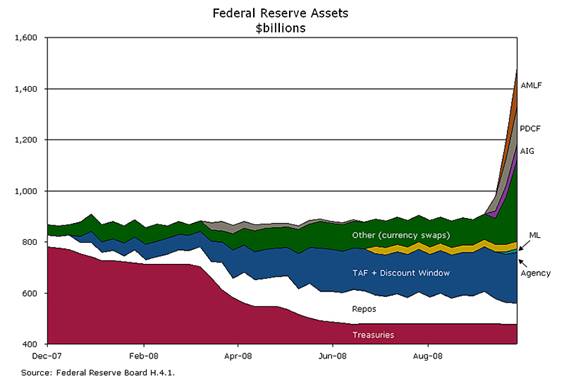
The Fed has turned its balance sheet into a garbage dump, in order to accommodate all of the additional Treasury issuance required to finance the rescue of bank bondholders. UPDATE: SPEAKING OF GARBAGE....... Fed to Add Older CMBS to TALF in July, Allow More Ratings Firms

http://www.frbatlanta.org/econ_rd/macroblog/100708c.jpg

The bottom line is that the attempt to save bank bondholders from losses – to provide monetary compensation without economic production – is not sound economic policy but is instead a grand monetary experiment that has never been tried in the developed world except in Germany circa 1921.
This policy can only have one of two effects: either it will crowd out over $1 trillion of gross domestic investment that would otherwise have occurred if the appropriate losses had been wiped off the ledger (instead of making bank bondholders whole), or it will result in a stunning and durable increase in the quantity of base money, which will ultimately be accompanied not by a year or two of 5-6% inflation, but most probably by a near-doubling of the U.S. price level over the next decade
As I've noted previously, the growth rate of government spending is better correlated with subsequent inflation than even growth in money supply itself, particularly at 4-year intervals.
Regardless of near-term deflation pressures from a continued mortgage crisis, our present course is consistent with double digit inflation once any incipient recovery emerges.

> Thanks to the commercial real estate, credit card & corporate debt crisis & massive overcapacity etc i think the recovery leading to rampant (CPI ) inflation is still at least 24-36 months away.... As long as the US $ is not weakening significantly.......

> Dank der zusätzlichen Krisen in allen Lagen der Kreditvergabe ( gewerbliche Immobilien, Kreditkarten, Unternehmen, massivste Überkapazitäten usw ) denke ich das trotz der verantwortungslosen Bailouts die Phase extremer Konsumentenpreisinflation noch mindestens 24-36 Monate entfernt ist..... Bin mir bei den Amis allerdings nicht ganz so sicher..... Ein schnell fallender US$ könnte allerdings den Zeitplan gewaltig durcheinanderwirbeln....

Labels: , , , , , , ,

Tuesday, May 05, 2009

The Chuzpah Is Staggering.......

But not unexpected and somehow admirable.....As predicted earlier the Fed & Treasury have "decided" that converting preferred to common equity is equal to "adding" capital.... Read "Redefinition Accomplished" Spin Continues....."Preferred To Common Equity Edition" with straight talk from Barry, Kasriel & Winkler why this is "bogus"...... Let´s hope that the banks that have passed the test are able to attract as much "smart money" as fast ( window of opportunity probably short lived ) as possible...The taxpayer needs a break..... Update: Wells Fargo, Morgan Stanley Boost Capital After Stress Test

Die Dreistigkeit der Fed und des Finanzministeriums ist schon fast wieder bewundernswert..... Wie bereits früher prognostiziert wird ein Großteil der Mrdlücken die der eh schon realtiv stressfreie Stresstest zu Tage führen wird lediglich durch eine Form der Bilanzakrobatik "bereinigt"..... Empfehle den nachfolgenden Link "Redefinition Accomplished" Spin Continues....."Preferred To Common Equity Edition" der für jedem mit gesundem Menschenverstand aufzeigt das diese Art der Rekapitalisierung nicht gerade "vertrauenserweckend" ist.....Bleibt zu hoffen das zumindest die Banken die den Test bestanden haben in der Lage sind genügend "Smart Money" schnell genug ( befürchte das die Bedingungen nicht dauerhaft so gut sein werden ) einszusammeln.... Der Steuerzahler kann dringend etwas Hilfe gebrauchen..... Update: Wells Fargo, Morgan Stanley Boost Capital After Stress Test


Bank of America Said to Need About $34 Billion in New Capital
May 6 (Bloomberg) -- Regulators have determined that Bank of America Corp. requires about $34 billion in new capital, the largest need among the 19 biggest U.S. banks subjected to stress tests, according to a person familiar with the matter.

Citigroup Inc.’s shortfall is more limited because the company already plans to convert government preferred shares to common stock
, people familiar with the results said. JPMorgan Chase & Co. doesn’t need a deeper reserve against losses, according to people familiar with that company’s result.

The banks may outline their strategies to add capital, or in other cases buy out government stakes, after the Federal Reserve publishes the stress tests results tomorrow.
Firms requiring more capital could raise all the funds through conversions of preferred shares
if they choose, according to people familiar with the matter.

“To the extent that there are banks that need capital, our hope is that many of them will be able to raise that capital through either private equity offers or through conversions and exchanges of existing liabilities,” Federal Reserve Chairman Ben S. Bernanke
told lawmakers at a hearing in Washington yesterday. “The data we have are accurate reflections of the financial conditions of those banks.”

Banks that want to return money injected by the Treasury since October must show they can borrow from private investors without a Federal Deposit Insurance Corp. guarantee,according to people familiar with the matter.
> This will be the real stress test for Goldman ( Goldman Sachs has sold $18.6 billion of debt under the TLGP program, the sixth-highest amount among banks ) & Co ...... This would be a real sign of confidence when they are able to fund themselves completely without FDIC backed funding..... The latest bond yielded 410 basis point higher than Treasuries ( Goldman Sachs Sells $2 Billion of Notes Without FDIC Guarantee .... No wonder when you take a closer look at the "quality" of earnings ( see A Few Goldman Highlights........)

> Denke das wird der echte Stresstest aus Sicht der Banken und insbesondere Goldman Sachs ( haben momentan 18,6 Mrd an besicherter Anleihen ausstehen ).... Sollte Goldman in der Lage sein zukünftig darauf zu verzichtn wäre dies in der Tat auch ein von mir anerkanntes Signal der Stärke. Die letzte Anleihe ohne Garantie würde mit einem Spread von 410 Basispunkten gegenüber Staatsanleihen gepreist. Keine wirkliche Überraschung wenn man sich die Zusammensetzung der letzten Ergebnisse mal etwas genauer ansieht ( siehe A Few Goldman Highlights........)

> I´ll close with this comment......

> Verasbschiede mich mit dieser Bemerkung......

U.S. Banks' Not-So-Stressful Test WSJ
Finally, the government has effectively said it wants banks to have Tier 1 common stock equivalent to 4% of risk-weighted assets. First, investors have to decide whether they have confidence in the risk weightings.

Then they must decide whether 4% -- which still translates into 25-to-1 leverage -- is safe for the unpredictable environment we are in.

Labels: , , , , , , , ,

Wednesday, April 29, 2009

"Redefinition Accomplished" Spin Continues....."Preferred To Common Equity Edition"

Really an excellent way to boost confidence ( will probably work for CNBC :-)...... After news that Stress test pass rate is 68% ( still hyperinflated & from a almost "stress free test" ) and no chance that private capital will cover the capital shortfall the spin attempt from the Geithner & Bernanke is that the convertion from preferred to common equity will do the trick ........

Wirklich ein fantastischer Weg um das immer noch nicht vorhandene Vertrauen zurückzugewinnen..... Nach der Neuigkeit das immerhin beachtliche 68% der Institute den Strest Test bestanden haben ( unter realen Bedingugen läge die Quote wohl unter 10% ) und unter der realistischen Annahme das sich kein privater Invetor finden wird der in die durchgefallen Institute investieren würde haben sich Geithner und Bernanke einen neuen Taschenpielertrick ausgedacht. Man nehme einfach die mit Tarpmitteln erworbenen Vorzugsaktien und tausche diese in normale Aktien um..... Schon ist der Kapitalbedarf gedeckt...... Hört sich unlogisch an und erinnert eher an Enron & Co ......... Herzlichen Glückwunsch: Der gesunde Menschenverstand ist bei Euch noch nicht abhanden gekommen....


April 29 (Bloomberg ) —

At least six of the 19 largest U.S. banks require additional capital, according to preliminary results of government stress tests, people briefed on the matter said.

While some of the lenders may need extra cash injections from the government, most of the capital is likely to come from converting preferred shares to common equity, the people said.

The Federal Reserve is now hearing appeals from banks, including Citigroup Inc. and Bank of America Corp., that regulators have determined need more of a cushion against losses, they added.

By pushing conversions, rather than federal assistance, the government would allow banks to shore themselves up without the political taint that has soured both Wall Street and Congress on the bailouts. The risk is that, along with diluting existing shareholders, the government action won’t seem strong enough.


Now on to the common sense view.....

Nachfolgend ein paar Meinungen die aus der Abteilung "gesunder Menschenverstand" kommen.....

Option Armageddon

As for converting preferred to common, yeah that will boost TCE, but it doesn’t actually ADD any capital to banks’ balance sheets. 67¢ cents of preferred equity + 33¢ of common equity = $1 of total shareholder equity. Convert all the preferred to common and you still have only a $1 of total equity. There’s no extra capital on the balance sheet to absorb losses.

Barry Ritholtz
And, now that some of the results are coming in, the cure for inadequate capital is not more capital, but an accounting trick — converting preferred stock to common

US banks are suffering a solvency problem, and what they need is more capital, not an accounting sleight of hand. Yet that is precisely what they are getting — the same clever financial engineering that led to the crisis in the first place.

Paul Kasriel including some simple example that even Geithner & Bernanke should understand...... :-)

Treasury will just convert $5 of the preferred shares it owns in Gotham to $5 of common equity. This is shown in Balance Sheet Two. Now Gotham is well capitalized, right? Wrong. The depositors and the bond holders always were in line in front of the preferred shareholders in case Gotham had to be liquidated. So, moving $5 from the preferred equity category to the common equity category does not make the depositors and bond holders any better off.

In sum, Treasury's plan to enhance the capitalization of some financial institutions by beating preferred equity shares into common equity shares is accounting alchemy.

I´ll finish with a rant on "Paulson, Timothy “turbo tax override deductions” Geithner & “Helicopter” Ben Bernanke" from Pigpen via The Barricade :-)

Denke der gelungene Abschluß für dieses Posting ist ein "netter" Kommentar über "Paulson, Timothy “turbo tax override deductions” Geithner & “Helicopter” Ben Bernanke" von Pigpen via The Barricade :-)

Labels: , , , , , , , , ,