Thursday, December 06, 2007

What's a C.D.O.?

I second what FT Alphaville has to say. Maybe they should send the link to all the "smart money" guys that are holding all this stuff so that they finally understand what they are holding.....

Ich kann mich nur FT Alphaville anschließen. Man sollte diesen Link all denen schicken die Besitzer dieser Papiere sind damit Sie endlich begreifen was für eine halsbrecherische Konstruktion den Weg in die Bücher gefunden haben und warum es täglich vorkommen kann das aus AAA über Nacht Junk werden kann. Ich denke da ganz besonders an ein paar deutsche Landesbänker......

Far and away one of the best graphics we’ve seen. Kudos to Felix Salmon and the people at Portfolio


Make sure you click here to start the interactive beauty!

Laßt euch dieses Schmuckstück nicht entgehen und klickt hier um die interaktive Schönheit zu betrachten.

It remains to be seen if the write down from Royal Bank Of Scotland is enough.... Maybe the age of the CDO portfolio is an explanation why they still value the mezzanine tranche with 70 percent..... The same CDO in 07 would be definitley close to zero....

Bin gespannt ob die Abschreibung der Royal Bank Of Scotland genug sein wird.....Evtl. ist ads bereits fortgeschrittenen Alter des CDO Portfolios ja die Erklärung dafür das die Mezzanine Tranche immer noch mit 70% bewertet wird. Ein CDO mit Baujahr 2007 würde wohl eher bei null notieren......

At 30 November, GBM's exposure to these super senior tranches, net of hedges and write-downs, totalled £1.1 billion to high grade CDOs which include commercial loan collateral as well as prime and sub-prime mortgage collateral, and £1.3billion to mezzanine CDOs based predominantly on residential mortgage collateral. The CDOs are largely based on ABS issued between 2004 and the firsthalf of 2006

And with news like this Surge in Auto-Loan DelinquenciesIs Latest Trouble for the Economy via the WSJ it should be clear that the problem is spreading to all parts of securitisations.

Und mit Meldungen wie diesen Surge in Auto-Loan DelinquenciesIs Latest Trouble for the Economy dürfte auch bald der nächste Pfeiler der Verbriefungskredite mehr als nur leichte Schlgseite bekommen....

First came housing loans and the subprime-mortgage crisis.

Now, signs of stress are creeping into another key consumer area: auto loans.

Delinquencies in the auto-loan market are ticking up to their highest level in several years. Lenders are tightening terms in some cases, and interest rates have risen from the rock-bottom levels of a few years ago. About $575 billion in loans for new and used cars are made annually, according to the National Automotive Finance Association.

About 4.5% of auto loans made in 2006 to top-rated borrowers were at least 30 days delinquent as of the end of September, up from 2.9% the previous month,according to a Lehman Brothers survey of companies servicing these loans. That is the biggest one-month jump in at least eight years. Lehman says 12% of subprime borrowers, who have poorer credit records, were delinquent on their 2006 auto loans as of September. That is the highest level since 2002 and up from 11.1% the previous month.

AddThis Feed Button

Labels: , , , , , , , ,

Tuesday, November 20, 2007

Jim Rogers On "Phony Mae and Fraudie Mac"

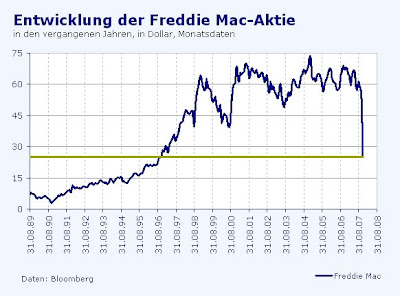
Make sure you hear the "amusing" Bloomberg Interview with one of my heros Jim Rogers. Here my take from yesterday Freddie Needs Fresh Capital...... It´s funny to see how the reporter tries to defend Freddie & Fannie.... But he is by far better than this must see example from FOX Business News. They even make Mark Haines look smart......

Hier das extrem amüsante Bloomberg Interview mit einem meiner Helden Jim Rogers sowier mein gestriges Post zu diesem Thema Freddie Needs Fresh Capital...... Man kann fast das Gefühl haben das der Reporter sich vor Angst fast überschlägt. Aber in jedem Fall besser als dieses Beispiel vom angeblichen Wirtschaftssender FOX Business News

Freddie, Fannie Shares Will Continue to Slide, Jim Rogers Says
Nov. 20 (Bloomberg) -- Freddie Mac, which today dropped the most ever after posting a record loss, and rival mortgage lender Fannie Mae will continue to tumble because of bad home loans, investor Jim Rogers said.

``I'm still short those companies, they both have a long way to go as far as I'm concerned,'' Rogers said in an interview. ``Neither one has a clue what's on their balance sheets.''

Freddie Mac, the second-largest U.S. mortgage company, warned of a possible cut in the dividend and the need for additional capital. The worst housing slump in 16 years caused ``significant deterioration'' in the third quarter that will continue through year-end, Freddie Mac said after reporting a net loss of $2.02 billion, or $3.29 a share, three times what some analysts estimated.

Rogers, who predicted the start of the global commodities rally in 1999, advised in a Nov. 5 interview with Bloomberg that investors should avoid financial stocks. In March 2006, he said Fannie Mae shares would decline.

Make sure you read Drilling Deeper into the Freddie Fiasco from Greenberg!

Laßt Euch auf keinen Fall Drilling Deeper into the Freddie Fiasco von Herb Greenberg entgehen!

Thanks to Rodger Rafter for the term "Phony Mae and Fraudie Mac"

AddThis Feed Button

Labels: , , , , , ,

Tuesday, November 06, 2007

IndyMac Increases Credit Reserves 47 Percent to $1.39 Billion

This number from the top Alt-A originator ( 14 percent) gives a hint how ugly the situation has become beyond subprime.

That might give a hint how bad the situation for several other players is that have bought back shares hand over fist during the past years and are more involed in subprime, havn´t sold their originations etc......

bigger / größer via Calculated Risk
Forecasted Home price depreciation ranging between 6% and 10% is factored into our loss expectations that drive valuation and reserves – average HPI declines expected to be around 9%

Diese Zahlen von dem Top Alt-A Kreditgeber ( 14 %) geben ein paar klare Indizien das neben Subrpime auch andere Segmente massiv an Qualität verlieren.

Das läßt erahnen wie übel es für andere Institute aussehen muß die im Gegensatz zu IndyMac in den letzten Jahren haufenweise Aktien zurückgekauft havben und sinnlose wertvernichtende Übernahmen getätigt haben aussehen mag. Ganz zu schweigen von denen die Ihre Riskiken nicht weiterreichen konnten und noch stärker im Subprime Sektor engagiert waren.....

We Hold Direct Credit Risk On $19.02 Billion Of Total Single Family Loans Serviced In Our Whole Loans And In Non-Investment Grade And Residual Securities


> Watch the large percentage of homebuilder credit costs....

> Man beachte den gewaltigen Anteil der Rückstellungen für die Homebuilder.....


In the call they said that they had claer signs in 2005 that the market for builders has peaked, but they have ignored it. Now they are paying a high price. They have stopped making any loans to builders and have no intend to re-enter the market soon.

Im CC hat das Management zugegeben das bereits Ende 2005 ganz klare Anzeichen für Probpleme bei den Buildern zu erkennen waren. Dummerweise wurden diese ignoriert und es wirde munter weiter verliehen. Nun kommt die Rechnung. Immerhin haben Sie versprochen dieses Segment nicht weiter zu bedienen und bis auf weiteres keine neuen Kredite zu begeben.


IndyMac Bancorp Reports Third Quarter Loss of $202.7 Million, ($2.77) Per Share

  • Total pre-tax credit costs were $407.7 million (versus $103.5 million in the second quarter of 2007), or a negative impact on earnings per share (“EPS”) of $3.40.
  • Spread widening in the private-label (non-GSE) mortgage secondary market resulted in a loss of gain on sale and MBS securities revenue estimated at $167.2 million pre-tax for the third quarter, or a negative EPS impact of $1.39.
  • After surviving the global liquidity crisis in 1998 as a REIT, we purchased a federally chartered thrift and put our entire business inside the thrift, with the result that we have no liquidity issues today, while many mortgage companies have gone bankrupt or recorded massive losses due to liquidity shortfalls.
  • We protected and bolstered our capital by not repurchasing any shares since 2002 and, in fact, raised a substantial amount of capital in 2007.
  • We held virtually no subprime, closed-end seconds or HELOCs for investment purposes ($112 million, or 0.3 percent of total assets at September 30, 2007).
  • We were not a major subprime lender, ranking 32nd among subprime lenders (according to the National Mortgage News 2006 survey). Our subprime volume in 2006 was $2.7 billion, or 0.39 percent of the total subprime market.
  • While we originated $43 billion of Option ARMs from 2005 through Q3-07, we sold all but $1.0 billion (held for investment) and $2.6 billion (held for sale), and we retained no non-investment grade or residual securities related to these loans.
  • We laid off virtually all Alt-A 2005/2006 credit risk into the secondary market, retaining only $7.0 million in non-investment grade and residual securities from this production.
  • We hold no investments in collateralized debt obligations (CDOs) or structured investment vehicles (SIVs) and only hold mortgage backed securities (93.5 percent of the investment grade MBS are rated AAA and AA, none of which have been downgraded).
  • We made one of the only successful acquisitions this decade in the mortgage business – Financial Freedom, the largest reverse mortgage lender in the nation – while virtually all other significant acquisitions have produced very poor results.
> Almost all of the new liquidity is coming from the Federal Home Loan Banks ......

> Fast die ganze zusätzliche Liquidität kommt von Seiten der Federal Home Loan Banks ......

Our operating liquidity is at an all time high of $6.3 billion at 9/30/07, up 54% from $4.1 billion at 6/30/07, and we have no reverse repurchase borrowings or extendable assetbacked commercial paper…95% of our borrowings are deposits, FHLB advances and long-term debt

> the next slide shows a nice Level 3 aka "Mark-to-Make-Believe Gains" etc gain. Wonder why they havn´t used an assumption that would have cover the entire loss from the credit costs.......... Maybe they are conservatice.......

> Nebenbei bemerkt zeigt die nächste Grafik das auch hier mal wieder ein nicht ganz unerheblicher Level 3 aka Mark-to-Make-Believe Gains etc Gewinnbestandteil. Schon erfreulich das Sie nicht gleich eine Berechnungsgrundlage berechnet haben die gleich die gesamten Verluste im Zusammenhang mit den Kreditkosten abdeckt...... Evtl. ist IndyMac ja betont konservativ......


I want to highlight the IndyMac Presentation / pdf that is full of details about every aspect of the mortgage market

Ich möchste Euch in diesem Zusammenhang die IndyMac Präsentation / pdf ans Herz legen die vollgepackt mit Details zur aktuellen Verfassung der Hypothekenmärkte ist.


AddThis Feed Button

Labels: , , , , , , , , , ,

Tuesday, September 11, 2007

GMAC Gets $21 Billion in Citigroup Funding for Auto, Home Loans

This sounds to me like "throwing good money after bad money". Ceberus and GMAC must be in big big trouble. Too bad that they didn´t disclose the loan terms. But when a "smart" investor like Ceberus bought several subprime lender during the past 2 years and therefore has shown their brilliant expertise i assume the terms of the loan should be far from brutal (sarcasm off...). The clearest sign if the terms are "risk priced" will come to light when Citigroup fails to unload/syndicate them. No wonder Ceberus & Co are launching multi billion vulture funds...... Maybe they can ask Citigroup to invest when they buy some of the loans with a discount.. ;-). And after viewing this Rescap presentation / pdf from August the vultures are probably already rotating......

Das ganze klingt ein wenig nach der wenig erfolfversprechenden Formel "gutem Geld schlechtes hinterherwerfen". Ceberus und GMAC stecken wohl in existensziellen Schwierigkeiten. Was würde ich geben um die Kreditbestimmungen einsehen zu können. Nachdem Ceberus seine überragende Expertise dank der diversen Käufe im Subprimesektor binnen der letzten 24 Monate eindrucksvoll nachgewiesen hat sollten die Bedingungen aber milde ausfallen (Sarkasmus). Wir werden wohl erst erahnen können ob die Bestimmungen dem Risiko angemessen sind wenn Citiroup es schaffen sollte den Kredit zu syndizieren. Bei solchen Meldungen wundert es nicht das Ceberus & Co. gleichzeitig momentan Mrd für sogenannte "GeierFonds" einsammeln die in Schwierigkeit geratenen Kredite für einen Bruchteil des Nennwertes einsammeln. Evtl. kann Ceberus Citigroup ja in einem Jahr um ein Investment fragen ..... ;-). Und nachdem man sich diese Rescap Presentation / pdf vom August angesehen hat sind sicher schon einige Geier am kreisen....

Sept. 12 (Bloomberg) -- GMAC LLC, the lender that reported more than $1 billion of mortgage losses after General Motors Corp. sold a controlling stake last year, is getting as much as $21.4 billion in additional credit from Citigroup Inc. for auto and home loans.

Citigroup, the biggest U.S. bank, will make $14.4 billion available immediately and as much as $7 billion more if GMAC meets certain conditions, GMAC said in a regulatory filing yesterday. The agreement replaces a $10 billion asset-backed funding facility that Citigroup provided GMAC in August 2006. Detroit-based GMAC didn't disclose the terms of the financing.....

GMAC last month moved to inject $775 million into its Residential Capital LLC mortgage unit, known as ResCap, after rival lenders lost access to short-term financing amid the worst U.S. housing slump in 16 years.

The analysts said five-year GMAC credit-default swaps narrowed by 50 basis points to 520 to 545, signaling that investors now consider the company at less risk of defaulting on its debt.

Citigroup Ties
New York-based Citigroup is more than a lender to GMAC. It was part of the group led by Cerberus Capital Management LP that bought a 50.1 percent stake in GMAC last year from GM. Michael Klein, co-head of Citigroup's investment banking and trading group, is a member of GMAC's board.

Minneapolis-based ResCap ranked as the ninth-largest U.S. mortgage lender in the first half of this year, with $41 billion in new loans, according to industry newsletter Inside MBS & ABS. The unit reported losses of $1.15 billion in the past two quarters as defaults on subprime loans made to borrowers with low credit scores accelerated.

``We view today's disclosure as added evidence that GMAC is making an effort to provide funding support to its troubled mortgage operation,'' Kathleen Shanley, a fixed-income analyst at Gimme Credit LLC, wrote in a report to clients yesterday.

`Prudent' Funding
``With the current global credit market, the company decided this funding was prudent,'' said Gina Proia, a spokeswoman for GMAC. ``This gives us additional liquidity. It bolsters our financial flexibility.''

Countrywide, the biggest U.S. mortgage company, was forced to tap $11.5 billion of emergency financing last month to avert a cash shortage. Bank of America Corp. then stepped in with a $2 billion investment on Aug. 22, easing concern that Countrywide might end up in bankruptcy.....

The new credit, which Citigroup may syndicate out to other lenders, has a one-year term, compared with a three-year term for the previous facility, Proia said. A majority of the funds are earmarked for car loans and related securities, Proia said.

ResCap was borrowing $12.3 billion as of June 30 through an affiliate that issues asset-backed commercial paper, according to a presentation on its Web site ( see Rescap presentation link above)

`Good for GMAC'
``It's really good for GMAC,'' said Thomas Flaherty, who owns GMAC's 8 percent bonds due in 2031 as part of the $25 billion he manages at Aberdeen Asset Management in Philadelphia. ``This is a very difficult environment, a very tough market.''

"He´s in fine as long as i take my medication"

Cerberus, the New York-based buyout firm and hedge fund manager, led the $14.4 billion purchase last year of a 51 percent stake in GMAC. GM later injected $1 billion of capital into GMAC to make up for writedowns on mortgage assets at ResCap.

AddThis Feed Button

Labels: , , , , , , ,

Thursday, August 23, 2007

ANGST Backed Securities / Economist

Here we go...... I don´t know how the the Economist got to this number( see new link Asia Times further down). But if this is true it is clearly a form of a bailout......And this would explain in some part why the window is tapped from Citi, JPM & Co.... If this is true I think we will see much more during the next days especially from weaker players......At least they are now channeling the liquidity where it is needed....

Es geht los......Ich habe keine Ahnung wie der the Economist zu dieser Annahme kommt ( siehe neuer Link von der Asia Times weiter unten). Sollte sich das als wahr herausstellen erfüllt das für mich den Tatbestand eines "Bailouts". . Das würde auch zum Teil erklären warum Citi, JPM & Co.... dieses Fenster so intensiv genutzt haben. Sollte das den Tatsachen entsprechen gehe ich jede Wette ein das wir hier in den nächsten Tagen besonders von den schwächeren Marktteilnehmern haufenweise Transaktionen sehen werden..... Immerhin sollte so die Liquidität zielgerichtet erhöht werden....

The Fed has been offering 85% of face value for AAA-rated paper presented at its discount window, even collateralised-debt obligations stuffed with subprime mortgages (as long as they are not—yet—impaired).
Thanks to Solvent Celt !
Hat tip to Professor Bear for provinding this link
‘Chairman Bernanke has now summoned his own clean-up team into action. The Fed hopes that by assuring banks that they can now access cash on less punitive terms from the Fed discount window, collateralized by the full “marked to model” face value of mortgage-backed securities, rather than the true
distressed value as “marked to market”, for which they could find no buyers at any price in recent weeks as the market for such securities has seized up,
it can jumpstart market seizure for mortgage-backed commercial paper and securities.’
Here is a another view from iTulip
Central banks struggle to restore calm without breeding complacency
....Some commercial paper is easy to understand: a big company sells an IOU, which it repays in, say, 90 days. This stuff got the American financial system into trouble in 1970, when Penn Central Railroad defaulted on $82m-worth. The recent problems stem from a different brand of paper, backed not by the good name of a big company, but by assets, such as mortgages or credit-card receivables. Mostly held off-balance-sheet by bank-sponsored “conduits”, this market has boomed in recent years. It now accounts for roughly half of the more than $2 trillion of commercial paper outstanding. But issuers have been caught out by a cashflow mismatch, says Louise Purtle of CreditSights, a research firm. Funding is short term but the proceeds are invested in longer-term assets, leaving issuers vulnerable when investors start to doubt the quality of those assets and want out.

That is what happened at the start of this week as money-market funds sold these IOUs, causing rates to spike as never before (see chart). This paper suffered from two main layers of mistrust. First investors are worried that the banks won't always be able to support the conduits.
The second worry, about the mortgage collateral, is particularly stark. Rating agencies badly misjudged default rates in subprime mortgages and are now having to downgrade reams of securities linked to them. With the credibility of ratings in tatters (there have even been calls for Warren Buffett to take over Moody's), investors have been left without a compass. For the time being, many would rather pull back than trust in their own analysis of credit risk. They are staying on the sidelines because they can't work out what securities are worth, not because they don't have the money to buy them.

Ratings may be in doubt, but they remain powerful. The Fed has been offering 85% of face value for AAA-rated paper presented at its discount window, even collateralised-debt obligations stuffed with subprime mortgages (as long as they are not—yet—impaired). Josh Rosner, a critic of the rating agencies, thinks it extraordinary that, despite their obvious flaws, they “continue essentially to regulate the behaviour of even the central bank”.

Home truths
Even if stability returns to markets, the repricing of risk is likely to continue. How far it goes will depend largely on the state of the mortgages that serve as collateral for many of the newfangled instruments that were, until recently, hawked with glee on Wall Street. The outlook is not good. Not only do subprime delinquencies continue to rise, but defaults on prime and Alt-A loans (those to good- or middling-quality borrowers) have started to climb too. Figures released this week showed foreclosures in July up by 9% compared with June, and by 93% over the year before. ....

A jam in the flow of credit to homebuyers threatens an already vulnerable economy. If consumers seek to pay down debt in response to falling house prices, spending will suffer, especially with unemployment creeping up. ...
got gold..... ?
AddThis Feed Button

Labels: , , , , , , , , , , , , ,

Wednesday, March 28, 2007

Kass: Harley Hogs Feed at the Subprime Trough

kass makes a very good point and this is just one more example how widespread the addiction of debt is especially in the us. anybody (including bernanke....) who thinks that the housing subprime mess is an isolated event that won´t infect other sectors will be in for a nasty surprise.


kass trifft es mal wider auf den punkt. harley ist nur einbeispiel von vielen das zeigt wie weit speziell das us wirtschhftswesen mit der versorgung von immer mehr krediten verwoben ist. jeder (schließe da bernanke mit ein) der meint das die subprimeprobleme im immobiliensektor isoliert bleiben wird wohl noch ne weniger schöne überraschung erleben.

Judging by the commentary and the virtual invulnerability of worldwide equity prices, most see only a speed bump in the recent subprime scare. There is still a general belief on the part of the investment community that the mess is a containable fluke.

thanks to http://www.coxandforkum.com/

I have stressed the likelihood of a subprime contagion. After all, subprime is subprime and credit is correlated. Lower-quality, more-levered lending (with less collateral) is not confined to consumer loans, credit cards, homes, recreational vehicles and autos -- as investors might soon find out.

Even motorcycle (loans) are hitting potholes!

Indeed, it appears growing credit losses and delinquencies are beginning to render Harley-Davidson's motorcycle loans, well, increasingly like hogs.

Thirty-day delinquencies (and loss trends) in Harley-Davidson's receivables book offer a clear picture that credit-quality issues are broadening as HOG's receivables experience has begun to trace a pattern of deterioration that we first began to see in subprime mortgage loans during the first half of 2006
Harley-Davidson's 30-Day Delinquencies
4Q20065.18%
3Q20064.46%
2Q20063.61%
1Q20063.69%
4Q20054.83%
3Q20054.07%
2Q20053.66%
1Q20053.60%

As I have mentioned previously, Harley's finance subsidiary (HDFS) funded almost half of Harley-Davidson's motorcycle loans. Like subprime mortgage loans, HDFS' hog loans are pooled and securitized to institutional buyers. Unfortunately -- in credit trends and terms -- HDFS is also beginning to look more and more like New Century ......
In 2006-07, 28% of HDFS loans in its securitized pools had FICO scores below 650, which is considered subprime, which is very close to the 21% subprime market share of total mortgage loans made the previous year.

During the company's investor day on Feb. 28, Harley acknowledged that several of the securitization pools had breached their credit-quality metrics -- like subprime, the most recent pools' credit losses and delinquencies are rising faster than expected and more rapidly than earlier pools.

This is beginning to force Harley-Davidson to fund additional cushion reserves in the triggered securitization pools, much in the same way subprime mortgage originators have had to buy back bad loans. This takes a hefty bite out of HDFS' profitability by reducing its net interest margin.

Should the recent trend of rising credit losses and delinquencies in Harley-Davidson's loan-receivable book and in the securitization pools of their financial subsidiary (HDFS) continue, tighter lending practices likely will be instituted, and institutional buyers will be less receptive to buying HDFS' securitized pools. This could serve to reduce Harley-Davidson's sales growth and profitability.
> surprisingly harley has almost performed as bad as countrywide.....
> es ist wirklich erstaunlich das das harley fast so schlecht wie countrywider (der größte us hypothekenfinanzierer abschneidet )


Sound familiar?
It is beginning to look like the motorcycle lending markets are no longer "born to be wild." And, not surprisingly, I am still short Harley-Davidson.

More importantly, the fungus of subprime is beginning to spread into asset classes other than housing and mortgages. Don't believe for a moment that Harley-Davidson's dealers or the parent company were any less reluctant than the mortgage brokers to serve up loans for their product.

And last time I looked, a motorcycle is a discretionary item that is far less secure and stable than a home.


disclosure: short cfc and since visiting the "harley days" in hamburg a big harley fan

Labels: , , ,

Wednesday, February 28, 2007

U.S. Subprime Auto ABS Indexes Weaker

no surprise that the subprime mess is spreading. to be honest i was surprised that the delinquency rate is still so much lower than in the real estate backed securities (see graph). but i´m pretty sure that this will change very soon. the real job related fall out will lead to a big hit in this segment. and it is no wonder that the "bank´s willingness to make consumer loans" (graph 2)is falling fast......

keine überraschung das die probleme im suprimesegment nicht isoliert bleiben. ich persönlich hätte erwartet das die "problemkredite" deutlich näher an den der immogedeckten hängen (s. grafik). gehe jde wette ein das sich das in ganz naher zukunft ändern und angleichen wird. der negative arbeitsmakteffekt des immogetriebenen abschwungs wird diese jahr eintreten. kein wunder also das die banken in sachen konsumentenkredite ( 2.grafik) rapide fällt......


but i think that gm, ford, chrysler etc have no choice but to lend to everybody with a pulse......to sell their cars/suv´s

will be interesting to see how long the investors are picking up the auto abs and when/if we will see a similar problems like the ones in the mortgage mbs. http://immobilienblasen.blogspot.com/2007/02/no-worries-loan-loss.html

dumm nur das gm, ford, chrysler etc wohl keine andere wahl haben als weiter an jeden noch so schwachen kreditnehmer kredite zu verteilen.....um überhaupt noch autos und suv´s zu verkaufen.

spannend bleibt die frage wann und ob der markt genauso implodieren wird wie das mit immobilien hinterlegte mbs segment. (link oben)


thanks to realist and russ winter http://wallstreetexaminer.com/blogs/winter/?p=477#comments

NEW YORK, Feb 28, 2007 (BUSINESS WIRE) -- Subprime delinquencies for US auto loans rose 4.1% in January versus December 2006, while the annualized net loss (ANL) index spiked 31.4%, ...

'Approximately 70% of the transactions in the subprime ANL index recorded higher loss levels in January as the index hit its highest level in nearly three years"....


The subprime ANL jumped to 8.67% in January from 6.60% in December 2006, and on a year-over-year basis, the index was 24.2% higher versus January 2006. However, the spike in ANL may have been exaggerated slightly by one subprime issuer included in the index.

This issuer implemented a change in their servicing policy resulting in a spike in their ANL. ...... The subprime delinquency index was at 2.82% in January, slightly higher than the 2.71% recorded in December 2006.


In the prime sector, 60+ days delinquencies were at 0.58% in January, 9.4% higher versus December 2006 and 3.3% lower on a year-over-year basis.

Prime ANL were 0.89% in January, 7.2% higher than in December. This is the highest level the index has hit since February 2006. However, ANL remain down on a year-over-year basis by 17%.

Auto ABS issuance was quite healthy in January with $3.47 billion coming to market in four transactions, namely two subprime, one prime, and one motorcycle loan transaction. Issuance in early-to-mid February was active with over $8.0 billion issued through the first three weeks of February; $12.37 billion was issued in February 2006.

Labels: ,