Monday, December 10, 2007

China Inflation Surges to 11-Year High

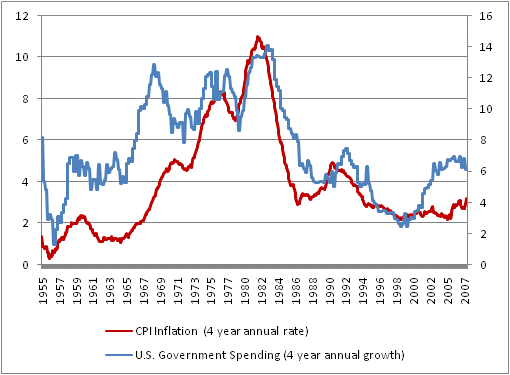
Beijing, we have a problem...... It looks like the officials now have to pay the price for all the baby steps during the past years. Thanks to Russ Winter for this interesting chart that could signal some "trouble" for the powerful....

Peking, wir haben ein Problem....... Es sieht immer mehr danach aus als wenn nun der Preis für die laxe Einstellung und den damit verbundenen Babysteps zu zahlen ist. Dank an Russ Winter für den interessanten Chart der noch zu einem ernsten Problem für die "Mächtigen" werden könnte..... Hier die deutsche Version vom Spiegel Lebensmittelpreise in China steigen um über 18 Prozent

Dec. 11 (Bloomberg ) -- China's inflation accelerated at the quickest pace in 11 years and the trade surplus swelled, adding pressure on the central bank to raise interest rates or let the currency appreciate faster to cool the economy.
Consumer prices rose 6.9 percent in November from a year earlier after climbing 6.5 percent in October, the statistics bureau said today. That was more than the 6.5 percent median estimate of 21 economists surveyed by Bloomberg News.

Surging food and fuel costs and a surplus that climbed to a record $238 billion in the first 11 months have prompted the government to name inflation and overheating as its biggest concerns. U.S. Treasury Secretary Henry Paulson, who's in Beijing for economic and trade talks, recommends currency appreciation as a remedy.

The central bank will respond with ``strict control on bank lending, further withdrawal of liquidity, one more rate hike before the end of this year and allow a faster pace of currency appreciation in 2008,'' said Liang Hong, a senior economist at Goldman Sachs Group Inc. in Hong Kong.

The yuan rose by the most in a month against the dollar on speculation rates will rise. The currency gained 0.18 percent to 7.3817 as of 10:55 a.m. in Shanghai from 7.3952 late yesterday. It reached 7.3770, the highest since a link to the U.S. currency ended in July 2005.

The yuan has gained 12 percent versus the dollar since the fixed exchange rate was scrapped. A stronger Chinese currency would lower import costs and slow money inflows by pushing up export prices.

Crackdown on Lending
The trade surplus rose 14.7 percent to $26.3 billion in November from a year earlier, the third-highest monthly total, the customs bureau said today. People's Bank of China Governor Zhou Xiaochuan said that the nation's currency policy will be used to help narrow the gap.

China has cracked down on bank lending and raised interest rates five times this year to curb inflation, asset bubbles and excessive investment leading to industrial overcapacity.

The one-year lending rate is at a nine-year high of 7.29 percent. The People's Bank of China last week ordered lenders to set aside more deposits as reserves for a 10th time this year.
Pork Prices Soar
Pork prices surged 56 percent in November from a year earlier on a pig shortage. Food makes up a third of the consumer price index and rising costs pose a threat to social stability, illustrated by a stampede last month at a cooking-oil sale that killed three people in the central city of Chongqing.

Overall, food climbed 18.2 percent. Non-food prices rose 1.4 percent, accelerating from a 1.1 percent gain in the previous month. Utility prices including water, electricity and gas rose 5.6 percent.

China's economy, the world's fourth largest, expanded 11.5 percent in the third quarter from a year earlier.
AddThis Feed Button

Labels: , ,

Sunday, September 16, 2007

The Fed: Magical Fairies and Pixie Dust / Hussman

There is almost no better way to start the week to focus on facts and filtering all the spin and hype that is hitting you as soon as you switch on the MSM. One of the best ways to achieve this goal is to read the weekly comment from Hussman. With the Fed decision coming this week this is more important than ever. If you have the guts ( I havn´t...)to view the panel on CNBC please compare this nonsense with what Hussman has to say. On top of this Mish is out with another outstanding post and is asking Is the U.S. printing money like mad? .

Es gibt kaum einen besseren Wochenfang als sich auf die wesentlichen Fakten abseits des ganzen Spin´s und Hype´s zu konzentrieren der einen bei jedweder Form der Berichterstattung durch die gängigen Medien (besonders ausgeprägt bei der Wirtschaftsberichterstattung) begegnet Einer der besten Wege dieses Ziel zu erreichen ist die wöchentliche Dosis von Hussman. Und mit der Fed Entscheidung vor der Brust wird das ganze wichtigen denn je. Wenn Ihr das aushaltet,ich stehe das nicht durch :-), vergleicht die Faktenlage mal mit dem "Expertenpanel" auf CNBC. Zudem möchte ich noch ein weiteres Post von Mish hinweisen indem er auf die immer wieder gestellte Frage
Is the U.S. printing money like mad?
eingeht.


“All you need is faith and trust
and just a little bit of pixie dust”

- Peter Pan


Wall Street continues to hold its breath about the upcoming decision by the Federal Reserve. There's no question that the Fed's decision will have a market impact.


This is not because Federal Reserve operations matter, but because investors believe they matter. The total amount of U.S. bank reserves affected by FOMC operations is less than $45 billion, and only the “excess” portion of that – typically about $2 billion dollars – is what determines the overnight Federal Funds Rate. Meanwhile, the total amount of borrowings through the “discount window” – though higher than in recent years – still amounts to only about $3 billion.

There is no well defined “monetary transmission mechanism” by which these minuscule amounts affect bank lending. Yes, during periods of crisis, the Fed has an important role to play in providing day-to-day liquidity so banks can meet depositor withdrawals. But aside from this short-term variation in the monetary base (which we saw, for example, around the “year 2000” turn), there is not even a slight relationship between bank reserves and total bank lending. Indeed, any remnant of that relationship was wiped out in the early 1990's, when reserve requirements were removed on all bank deposits other than checking accounts.

To believe that the Fed operations matter, you have to believe that a $13 trillion economy is controlled by a few billion dollars of reserves and discount window borrowings, none of which vary materially from year to year.

The notion of a powerful Fed is not knowledge born of analysis, but belief born of repetition. Think about it: how did you learn that the Fed is important? Not that interest rates are important (which is certainly true), but specifically, that the Fed is important. Some investors learn it in college, from the “money multiplier” theory that links bank reserves and bank lending (obsolete since the early 1990's when reserve requirements were largely eliminated). ....

> If you want to read more on this topis i highly recommend What (Really) Happened in 1995? / Aaron Krowne

> Wenn Ihr genaueres über die laxen Resrevevorschriften wissen möchsten kann ich Euch diesen Link What (Really) Happened in 1995? / Aaron Krowne empfehlen.

Correlation doesn't imply causation. We need to ask: what is the mechanism by which Fed actions have these effects? If we're convinced that the Fed matters, we can't stop at belief or argument – we need consider reasonable mechanisms, and then actually test them against data. If investors don't do this, they have nothing but superstition. They quietly equate the black cat, or the ladder, or the broken mirror, or Ben Bernanke with an outcome, without looking for any testable relationships that link cause and effect. ....


The Federal Reserve controls one monetary aggregate – the U.S. monetary base, the vast majority of which represents currency in circulation. In a nutshell, the Fed buys U.S. government debt and creates “base money” in the form of either bank reserves or currency. Of the $552.4 billion in securities purchased by the Fed since 1990, $546.3 billion – about 99% – represents currency in circulation (the pieces of paper in your pocket that have “Federal Reserve Note” printed on top).

Total U.S. bank reserves have grown by only $3.1 billion since 1990, to a total of $44.9 billion. Again, it is the day-to-day trading between banks of this amount (and actually, only of “excess reserves” – typically about $2 billion dollars) that determines the Federal Funds rate.

The Federal Reserve lowered the “discount rate” and opened the “discount window” a few weeks ago. Total borrowings from the Fed have increased from about $360 million in July, to $3.2 billion currently. While some analysts have breathlessly noted that “borrowings from the Fed have soared to the highest level in years,” the total amount of this “fresh liquidity” is about the same as the total assets of the Strategic Growth Fund.
Thanks to Wall Street Follies

In contrast to about $2 billion in excess reserves that is the basis for the Federal Funds Rate, and about $3 billion that is currently being lent at the Discount Rate, the U.S. banking system presently carries about $3.4 trillion in real estate loans, and $6.3 trillion in total loans. Gross domestic product is currently about $13.8 trillion.

While the Fed has purchased a total of $240.7 billion in U.S. government securities since 2000, mostly to create currency, foreign investors have purchased $1,185.8 billion in Treasuries alone. Indeed, foreign purchases have absorbed all of the increase in U.S. Treasury debt over the past year (and then some). It makes a great deal of sense to pay attention to foreign capital flows and the U.S. current account. In contrast, except for the psychological effect on investors, it is ridiculous to believe that Federal Reserve operations matter.

The Fed is, at best, a square-dance caller - the guy who by mutual consent gets to holler out when to swing your partner and when to do-si-do. The Fed provides coordination, but it is a mistake to think it has power. When the barn is on fire and people no longer find it in their best interests to follow along, you can bet they'll dance to their own tune (as we're starting to see in the Eurocurrency market, where LIBOR has significantly diverged from thee Fed Funds rate being "called out"). The Fed can provide a modest amount of liquidity to the banking system, but it can't provide solvency to the mortgage market. It's dangerous to believe that a reduction in the Fed Funds rate or the Discount Rate will materially change credit conditions here.

Still, we'll all be gathered there under Ben's helicopter on Tuesday, hoping for a sprinkling of magical pixie dust.

Off to Neverland! AddThis Feed Button

Labels: , , , ,

Sunday, September 09, 2007

Waiting for the Witch Doctor / Hussman

If you are a bull and still believe that rate cuts from the Fed will save this market you should stop reading.... If you want to read what Hussman has to say what is the primary cause for inflation watch this chart or click on the headline to read the entire piece.

Solltet Ihr bullish für die Märkte sein und daran glauben das die kommenden Zinssenkungen der Fed diesen Markt wirklich retten können solltet Ihr besser nicht weiter lesen.... Desweiteren hat Hussman eine erschreckend einfache Inflationsindikator ausfindig gemacht. Hier die Kurzform im Chart oder aber die längere Version wenn Ihr auf die Überschrift klickt.

Given Friday's substantially weak employment report, the universal and unrelenting topic on Wall Street is whether the Fed will ease monetary policy in its September meeting, and by how much. This is an amazing exercise in superstition. This is not to say that the Fed's actions will be unimportant. It's just that whatever the Fed does, the impact will be almost entirely psychological. I've written about superstition and the Fed before, but given the dominating focus on the Federal Reserve here, it's important to refresh those comments.

> Thanks to Wall Street Follies

There's no question that interest rates – market determined interest rates – have a substantial role in economic activity, particularly on the durable goods and housing sectors of the economy. But if you look carefully at what the Fed does, and the instruments it uses, economists and even central bankers (both at the Fed and internationally) are at a loss to describe the “monetary transmission mechanism” in any detail – that is, why the tools of monetary policy should actually exert an effect on the real economy.

The problem, as I've noted before, is that since the early 1990's when reserve requirements were removed for all bank deposits except checking accounts, there is no longer any relationship between the volume of bank reserves and the volume of lending in the U.S. banking system (see Why the Fed is Irrelevant for a more complete review of the data).

> If you want to read more on this topis i highly recommend What (Really) Happened in 1995? / Aaron Krowne

> Wenn Ihr genaueres über die laxen Resrevevorschriften wissen möchsten kann ich Euch diesen Link What (Really) Happened in 1995? / Aaron Krowne
empfehlen.

Simply put, you can draw a clear connection between Federal Reserve operations and the monetary base. You can draw a connection between the monetary base and the overnight Fed Funds rate. You can draw connections between market interest rates, bank lending, and economic activity. But what you can't do in any specific, meaningful way is to complete the diagram by drawing a cause-and-effect connection between the monetary base and the Fed Funds rate on one hand, and market interest rates and bank lending on the other. Yes, in crises, you can – briefly. If there's a bank run, the Fed has a real and essential role to play in supplying emergency liquidity. Outside of that, the monetary transmission mechanism is hypothetical at best.

It's strange that Wall Street makes such strong assumptions about the link between monetary policy and economic outcomes when there's no agreement among economists and central bankers about how changes in the quantity of the monetary base should exert an effect on the real economy. Again, there's clear agreement that market interest rates matter. There's also clear agreement that the Fed has direct control over the monetary base, and approximate control over the overnight Federal Funds rate. But that's where the agreement about fact ends and the debate about theory starts. .......

A small base of influence
Recall that the only thing that the Fed can do is to change the mix of government liabilities held by the public. When it “eases” monetary policy, it purchases Treasury securities, and recently, government backed mortgage securities, and replaces them with monetary base (currency and bank reserves).

As it happens, the vast majority of the base money created by the Fed is drawn off as currency in circulation – very little is actually retained as bank reserves. Indeed, of the $15.9 billion in monetary base the Federal Reserve has created over the past year, all of it has been drawn off as currency, leaving bank reserves about $2 billion lower than last year. That's not unusual. Total bank reserves have been gradually declining since the early 1990's. Since then, in contrast to what I used to teach my undergraduates about “money multipliers” and such, there no longer any link between the quantity of bank reserves and the volume of bank lending.

Moreover, it's unclear exactly how changes in the Federal Funds rate presumably cause changes in market interest rates – statistically, market rates lead and Fed Funds typically follow. We can of course argue that, well, the markets are anticipating the Fed. But why do we really need so badly to believe that a government entity that influences an overnight interest rate on a $41 billion pool of money (this is the entire amount of U.S bank reserves) is actually in tight control of a $13.8 trillion economy?

Think about it. The full range of variation in the U.S. monetary base (including both bank reserves and currency in circulation) typically amounts to only about $50 billion annually. Over the past year, foreign holdings of U.S. government debt have increased by $300 billion – more than six times the fluctuation in the monetary base, and over a hundred times the amount by which U.S. bank reserves have changed.

It might seem that Fed must have an effect because periods of easing are typically followed by subsequent economic recovery, and periods of tightening are typically followed by economic softness, albeit with a “long and variable lag.” But that's a lot like saying the sun comes up because the rooster crows. The Fed generally only raises the Fed Funds rate when the economy is near full capacity and continues until the economy softens. It lowers the Fed Funds rate when the economy is already weakening and continues until the economy recovers. The Fed is “effective” as surely as economic softness follows strength and strength follows softness.

Even if a round of Fed easing will eventually be followed by economic strength, we should not prefer it. By that sort of logic, a major spike in unemployment would be a great thing, because as we know, such spikes are also typically followed by economic recoveries, though with a long and variable lag.

Ultimately, what's really going on is that we in free market economies are very uncomfortable with the idea that there's nobody in control. As Voltaire said, “If there were no God, it would be necessary to create him.” And since we can be pretty sure that God's first priority isn't bailing out the mortgage market, we look to the Fed. When things are going smoothly, we understand that the economy is complex, and diffuse, and driven by millions of individual decisions. But when trouble strikes, we want to believe that there's somebody up at headquarters with their hands firmly on the controls of the entire operation.

Still, just as Pavlov's dog salivated when he rang the bell, investors have been conditioned to believe that the Fed matters. And so it does. But it's important to recognize that this effect is primarily psychological. Unfortunately, the belief that the Fed somehow has our back creates a “moral hazard” by encouraging speculative risk. One might recall that the Fed did not prevent the U.S. stock market from losing more than half its value several years ago, despite fourteen consecutive rate cuts.

What the Fed does next week will certainly have an effect on short-term market psychology. The Fed can also have an impact by maintaining liquidity in the banking system in response to short-term demands for withdrawals. But managing the day-to-day demand fluctuations in a $41 billion pool of funds will not cure the much deeper solvency issues in the trillion dollar mortgage and commercial paper markets. To believe otherwise is plain and dangerous superstition.
> Here the latest Fed view from Paul McCulley/ Pimco predicting / beggin for rate cuts

> Hier das letzte Update von Paul McCulley / Pimco die mehr oder weniger massive Zinssenkungen erwarten bzw. herbeisehnen

AddThis Feed Button

Labels: , , , ,

Thursday, May 17, 2007

America´s fear of China / Economist

here is another good take on how heated the debate in congress in from stephen roach via tim http://tinyurl.com/2b3b5s . it will be interesting to see how this plays out and i think that almost every possible outcome will effect the us markets and $ assets negatively.

im link oben könnt ihr nachlesen wie ernst die debatte um china inzwischen im kongress geführt wird. es wird extrem spannend ein wie sich das ganze entwicklet. ich bin der meinung das fast jede änderung die usa und $ anlagen negativ beeinflussen wird.

UPDATE:

China Widens Trading Band, Lets Yuan Rise Faster Against Dollar

China widened the yuan's daily trading limit against the U.S. dollar, allowing faster gains in the currency to cool the economy and cut a record trade surplus that has strained ties with the U.S. and Europe.

``Widening the band is to further improve the yuan's mechanism, but it doesn't mean the yuan will fluctuate by a lot or appreciate by a large magnitude,'' the People's Bank of China said in a statement in Beijing. The yuan will be allowed to move as much as 0.5 percent either side of a daily fixing rate against the dollar, up from 0.3 percent, the central bank said.

UPDATE 2:

China Raises Rates for a Second Time This Year to Cool Growth

China raised interest rates for a second time this year to prevent a flood of cash from surging exports from fueling a stock market bubble and excessive investment in factories and real estate.

The one-year benchmark lending rate will be raised to 6.57 percent -- the highest in more than eight years -- from 6.39 percent, starting tomorrow, the People's Bank of China said today on its Web site. The one-year deposit rate will be increased to 3.06 percent from 2.79 percent.

UPDATE 3:

China's central bank said it will raise banks' reserve requirement ratio by half a percentage point, effective June 5.


China and US trade / Lost in translation

If China sharply revalued the yuan, as American politicians are demanding, it could actually hurt the United States and help China

CHINA is being cast as the villain once again. By holding its exchange rate artificially low, it is stealing jobs and causing the United States to run a huge trade deficit. Beijing must therefore be forced to revalue the yuan. These are the arguments behind an increasingly protectionist mood in Washington. Yet they are largely flawed. A stronger Chinese currency would not much reduce America's trade deficit. Indeed, the irony is that China, not America, has more to gain from setting the yuan free. Without a more flexible exchange rate, there is a growing risk that China's sizzling economy will boil over.

America's anger at China is clearly growing. In February it filed a complaint to the World Trade Organisation (WTO) against Chinese export subsidies. In late March the Department of Commerce announced tariffs of 10-20% on glossy paper imported from China, to offset the impact of alleged government subsidies. This reversed a 23-year-old policy of not imposing countervailing duties on a non-market economy. Then in early April the Bush administration filed two more complaints: one on Chinese pirating of DVDs and CDs, and the other over restrictions on the sale of foreign films and music in China.

Although by themselves these actions are trivial, together they point to an increasing appetite for tougher action against China. The Bush administration is under increasing pressure, particularly from Congress.....

Meanwhile, the target of all this hostility looms ever larger: China's trade surplus with America increased to $233 billion last year, accounting for almost 30% of America's total deficit. China's total current-account surplus reached an estimated $250 billion, or 9% of GDP, up from only 1% in 2001. Worse still, in the first four months of 2007, its trade surplus jumped by 88% compared with the same period in 2006.

The making of myths
China officially abandoned its decade-long policy of pegging the yuan to the dollar in July 2005. Since then it has risen by only 8% against the greenback. Because the dollar itself has weakened, the yuan's trade-weighted exchange rate has barely budged. In real trade-weighted terms it is about 10% cheaper than at the dollar's peak in 2002. As a result, it is not just the usual protectionist suspects that demand action, but many mainstream American economists are now calling on China to revalue by 20% or more. Yet the standard arguments for a revaluation are based partly on a series of myths.

The first myth is that there is overwhelming evidence that the yuan is grossly undervalued. China's large bilateral trade surplus with America proves nothing.

>really? here is a good response from Brad Setser http://tinyurl.com/2hnzez

It largely reflects Asia's changing supply chain. Much of what America buys from China today once came from Japan, South Korea and Taiwan. China now imports components from these countries, assembles them and exports the finished goods to America. Knock out these and America's bilateral deficit with China shrinks by more than half. Even so, China's overall current-account surplus is also huge.

The surge in its foreign-exchange reserves, to over $1.2 trillion, also suggests that the yuan is undervalued: without those massive purchases of dollars, the currency would have risen....

The devil to measure
Economists find it devilishly hard to define the “correct value” for a currency. On purchasing-power parity (PPP), the yuan is clearly undervalued against the dollar. Perhaps by as much as 50%. But PPP is not useful for determining the optimal exchange rate between two countries of such different levels of income. It is natural for average prices to be lower in poorer countries because wages are lower. As countries get richer and their productivity rises, their real exchange rates appreciate. And although the depreciation in the yuan's real trade-weighted value since 2002 looks perverse, this follows a real appreciation of 50% between 1994 and 2001 (see chart 1).


Myth number two is that the sharp increase in China's trade surplus is due to an explosion in cheap exports. Until 2004 China's surplus was relatively modest, but it soared over the next two years (see chart 2). Jonathan Anderson, chief Asia economist at UBS, points out that export growth actually slowed between 2004 and 2006 (see chart 3). The main reason for the bigger trade surplus was a sharp slowdown in the annual real growth rate in imports, from more than 30% in early 2004 to less than 15% last year.

The entire increase in China's trade surplus since 2004 has come from trade in heavy industrial materials and equipment. China used to import increasing amounts of steel, aluminium, chemicals and machinery, but import growth collapsed after 2004 when the government started to tighten policy, causing a sharp slowdown in construction, one of the biggest importers of machinery and materials. At the same time China continued to invest heavily in metals and equipment, creating substantial excess capacity, so import growth remained relatively weak last year. Mr Anderson argues that imports should recover as overcapacity is used up.

The third fallacy is that imports from China destroy jobs and harm the American economy. It is hard to see how China can be blamed for job losses when America's unemployment rate (4.5%) is close to its lowest for decades.

>that is the downside of sugger coated employment report..... http://tinyurl.com/37qwvp schadenfeude :-)

>da paßt natürlich die geschönte us erhebeung der arbeitsmarktsituation nicht so recht in die argumentationskette.... http://tinyurl.com/37qwvp schadenfreude sei erlaubt :-)

Trade with China may affect the composition of jobs in America, but it has little impact on total employment. It is true that some workers are harmed by trade with China, just as there are some losers from all international trade. But the American economy overall is better off, so in theory there is ample room to compensate any losers.

Trade with China helps, not harms the average American. Thanks to imports from China, prices are lower and real incomes higher. Commentators often refer to the “cheap” yuan as being an unfair subsidy for Chinese exporters. But it is a moot question who exactly is subsidising whom. Not only do cheap imports subsidise American consumers, but China's large purchases of Treasury bonds also hold down American interest rates, thereby subsidising home buyers.

Suppose that overnight the yuan rose by 30%, what would happen? American interest rates would rise as China needed to buy fewer Treasury securities and prices at Wal-Mart would increase. If consumer spending and imports then collapsed, this would certainly reduce America's trade deficit, but in a much more painful way than most Americans have in mind.

Wishful thinking
The biggest myth of all is that a revaluation of the yuan would greatly reduce America's trade deficit. The real cause of the deficit is that Americans spend too much and save too little. This means that the country has to import surplus savings from abroad by running a current-account deficit. If a stronger yuan did not cause Americans to save more, it would do little by itself to reduce the trade deficit.

Another reason why even a big rise in the yuan would do little to reduce America's deficit is that there is little overlap between American and Chinese production, so American goods cannot replace Chinese imports. Instead, other countries, such as Indonesia and Vietnam, would probably replace the Chinese. Shifting purchases to higher-cost producers amounts to imposing a tax on American consumers, says Stephen Roach, chief economist of Morgan Stanley.

Even where America and China do compete, as in electronics, the high import content of China's exports blunts the impact of exchange-rate movements on export prices, because a rise in the yuan reduces input costs. About half of China's exports consist of goods that have been assembled from imported components. And domestic wages and materials account for about 30% of the cost of those re-exports. Mr Anderson estimates that a 10% rise in the yuan would increase average export prices by only 3-5%.

If a yuan revaluation encouraged other Asian economies to follow suit, the impact on America's trade deficit would be larger, but still modest. If a 10% revaluation of the yuan were matched by all other Asian currencies, the dollar's trade-weighted index would fall by 4%. Yet, the 19% decline in the dollar's trade-weighted index since early 2002 has failed to trim the deficit. .......

Chinese whispers
Many of the arguments heard in America in favour of a big revaluation of the yuan are flawed or at least exaggerated. However, many of the arguments used in Beijing for why a revaluation would endanger China's economy are equally suspect. .......

By tying the yuan closely to the dollar, China has been forced to hold its interest rates lower than is prudent: higher rates would attract more “hot money” from abroad, putting upward pressure on the currency. The real rate of interest paid on bank deposits is negative and lending rates are far too low for such a fast-growing economy. Cheap money results in excessive bank lending and poor investment decisions, which could lead to an increase in non-performing loans. Excessively low interest rates are also fuelling stockmarket and property bubbles.
News that China's real GDP surged by a breathtaking 11.1% in the year to the first quarter and that consumer-price inflation had risen to 3.3% in March (it eased to 3% in April), stoked fears that the economy is out of control. But concerns about overheating in the usual sense of excess demand are exaggerated. China's widening current-account surplus and its strong investment imply excess supply. Excluding food, the inflation rate is only 0.9%. Instead, the real concern is that excess liquidity, as a result of the surge in foreign-exchange reserves and low interest rates, is flooding into shares (see article or http://tinyurl.com/3cr24c !, http://tinyurl.com/384fwu ! ). Households are withdrawing money from low-yielding bank accounts to bet on the stockmarket. China needs much higher interest rates to cool its asset markets. To regain control over its monetary policy China needs to let the yuan rise. [shanghai-index.png]
thanks to mish !

make sure you read his story about exhuberance in china http://tinyurl.com/34zww3

A revaluation could also help the government succeed in shifting the balance of growth away from investment and net exports towards consumption. A stronger exchange rate would boost consumers' purchasing power, allowing them to buy more foreign goods. Excess saving in China is as much to blame for global imbalances as inadequate saving in America.

....The good news is that the mix of growth is starting to become more balanced: over the past year, investment has slowed while retail sales have quickened, rising by 15.5% in the year to April. In other words, consumer spending is now growing faster than GDP.

Dragonomics, a Beijing-based research firm, estimates that consumption rose from 37% to 40% of China's nominal GDP growth in 2006 and is set to rise again this year.

>here is another chart that is including houisng and services in the consumption and voila....the number is much higher

>hier eine andere erhebung die sinnvllerweise wesentliche dinge wie services und die hauskomponente miteinbezieht und siehe da....ein esentlich anderes bild.

In the long run, stronger domestic consumption could trim China's trade surplus. The government can encourage this by spending more. Its spending on health care and education rose by an average of 50% last year and it is budgeted to rise by more than 60% this year—but from such low levels that it could take years to increase social spending by enough to encourage households to save a lot less. ...

Mirror image
This turns the whole debate about China's exchange-rate policy on its head. It is China that has the most to gain from allowing the yuan to rise. If the spat between America and China were to ignite protectionism or financial instability, it could endanger the whole world economy. All the more foolish, therefore, that economic relations are based on misperceptions on both sides. America needs to stop making China a scapegoat for the failures of American policy. Only if it gets its own economic house in order, by boosting domestic saving, will its “advice” to Beijing seem credible. Likewise, China has no right to criticise American policy when its own economy remains unbalanced.

America is right that China needs to revalue, but for the wrong reasons. And arguing that a revaluation helps America's economy makes it less likely that Beijing will act. Moreover, if George Bush foolishly slapped harsh trade sanctions on China, America's economy would be the biggest loser. Likewise, China is foolish to resist a more flexible exchange rate partly because it does not want to be seen as caving in to America's demands, when it is in its own interest. If the world's two leading engines of growth remain at loggerheads, everyone will pay the price.

Labels: , , , ,

Monday, April 30, 2007

China Tightens Bank Credit Again / stocks up 2,17%

only up 2%....when the chinese officials really want to stop the excess they probably have to bundle 2 or 3 actions like a rate increase and the increase in the reserve requirements etc...

nur 2% im plus.....das bestätkt mich in meiner meinung das wenn die chinesischen offiziellen wirklich ernsthaft gegen den überschwang vorgehen wollen werden sie wohl zu ner kombinierten aktion von zinserhöhungen, erhöhung der reserveanforderungen etc greifen müssen.

The People’s Bank of China said on its Web site on Sunday that big banks would have to hold 11 percent of their deposits in reserve at the central bank beginning on May 15, up from 10.5 percent now.

The 0.5 percentage point increase, the fourth increase in reserve requirements this year and the seventh since June 2006, will tie up an estimated 170 billion yuan ($22 billion).
Over the last year, the central bank has also raised interest rates three times — most recently on March 17. Economists said the decision to raise required reserves made another increase in borrowing costs unlikely in the short term.
here is a nice rant from russ winter http://tinyurl.com/2jm2t2 !

Labels: , ,

Thursday, April 26, 2007

China - The people's republic in the grip of popular capitalism / Economist

scary stuff. if this is not a bubble......... if you want more examples how overheated the economy, investments, valuations etc are please click on the label (skip this/the first story). stunning!

wahnsinn. wenn das keine blase ist..........wer mehr belege haben möchte das einige dinge wie invenstitionen, bewertungen usw überhitzt sind den bitte ich unter den labeln zu suchen (jeweils den ersten/diesen bericht skippen). atemberaubend!


Tens of millions of Chinese are risking their shirts in a stockmarket frenzy. If it goes wrong, things could get nasty


WOULD-BE share punters, keen for a piece of China's booming stockmarket, are queuing to open accounts at a Beijing branch of China Merchants Securities. ..... Bunches of small investors, ranging from students to pensioners, crowd around computer terminals to carry out their trades, keeping an eye on the prices as they flicker across big electronic screens. China's biggest-ever stockmarket boom may be turning into a bubble—and the country's leaders are getting worried.
> why they put in question the bubble is beyond me
>wie man die blase nach diesem bericht noch in frage stellen kann entzieht sich meiner vorstellung....
thanks to michael panzer http://www.financialarmageddon.com/

If the bubble were to pop, it could have a bigger impact on social stability than any previous downturn in the stockmarket's 16-year history. There are now more than 91m accounts held by individuals at brokers or in mutual funds. Estimates for the number of investors vary widely. At the height of the last market boom, in 2001, there were 60m accounts but perhaps fewer than 10m investors. There are certainly many millions more now. New accounts at brokers are being opened at a rate of more than 200,000 a day, touching a high of more than 310,000 on April 24th. The total so far this year is more than 8m, which is around ten times as many as in the whole of 2005, when the market began to emerge from a four-year slump. ......
The Shanghai composite index for yuan and hard-currency shares is now approaching 4,000, a rise of nearly 40% so far this year after a 130% increase in 2006 (see chart).

Some economists fret that share prices are moving far ahead of companies' earnings, to a degree scarily reminiscent of Japan in the late 1980s just before its crash. With the help of new share listings, the combined market value of the Shanghai and Shenzhen exchanges has risen to some 15 trillion yuan ($1.8 trillion), 87% more than at the end of last year and surpassing that of Hong Kong.
The growing involvement of low-income groups such as students and pensioners, who were more cautious during the last bull run, could make a crash more painful. Mr Xing says 20-30% of economics and business students are playing the markets. ....

So many employees are spending their time trading stocks online that some companies have introduced fines to deter them. But many continue surreptitiously trading and sharing tips through e-mails, instant messaging and texts. Mobile-telephone users (that is, almost every adult city-dweller) can subscribe to stockmarket alerts and trade shares simply by pressing buttons on their handsets.

Another big change is the ready availability of mortgageable or pawnable assets with which to raise money to buy shares. Since the late 1990s, the privatisation of urban housing has given many people a stake in rapidly appreciating property. And with consumer-price inflation creeping up to a two-year high of 3.3% at the end of March, real interest rates have been around zero or negative this year. This has encouraged the withdrawal of savings from banks. Hou Ning, a Beijing-based analyst, says that in the countryside unlicensed moneylenders have been helping farmers into the markets with unsecured high-interest loans.
> at least they have not yet all the creative loans/instruments like in the us.......
> immerhin haben die bisher nícht die errungenschaften der kreativen finanzierung wie in den usa......

China's leaders are worried, but unsure what to do to cool the market. A string of interest-rate rises and increases in banks' reserve requirements have had little effect so far. Like their fellow communists in neighbouring Vietnam, where a similar stockmarket bubble has grown, they know that share gains keep the rising middle class contented and help the state's big privatisation programme. But if tens of millions of urban Chinese lose their shirts, they could turn their anger on the party.

Twice this year—on February 27th and April 19th—the markets have wobbled alarmingly amid rumours of tougher measures to control the flow of cash. The latest upset was caused by figures showing the economy growing even faster than expected: in the first quarter of this year, output was up 11.1% on the same period of last year. But the bulls have quickly returned. Outside the China Merchants Securities branch, a group of investors debates the market's prospects. “It's like a casino set up by the Communist Party,” says one. Another says only fools are still investing. But none has any plans to cash out

> looks like the 6th raise of the Bank Reserve Ratio in the past 10 month plus several rate hikes plus other attempts to cool things down have failed poorly. maybe they should combine a hike and the raise of the reserve ratio to gain control and respect.
>sieht ganz so aus als wenn alle versuche der chinesicshen offiziellen in den letzten monaten die lage zu beruhigen jämmerlich versagt haben. evtl. sollte sie es mal mit einem doppelschlag von zinserhöhung und der 7. erhöhung der reserveanfordeungen probieren um zumindest etwas die kontrolle zurückzuerlangen.


Shanghai-traded shares of China Citic Bank Corp. more than doubled on their first day of trading after a $5.4 billion stock sale, the world's biggest this year.
``People don't mind paying a bit of a premium'' if they are comfortable with the growth outlook, Binay Chandgothia, who helps manage $1.6 billion as chief investment officer at Principal Asset Management Company (Asia) Ltd., said today in Hong Kong. ``There's demand for new stocks.''

Labels: , , , , ,

Thursday, April 19, 2007

Salient Features of the U.S. Economy Before the Fed Eased in 1995 vs. Now

Northern Trust/Asha Bangalore does a good job in telling it like it is and is an excellent source of anti spin. keep this report in mind when you hear the bubbleheads pointing to the fed easing campaign in 1995.......click on the headline (pdf) to read all details.

Northern Trust erzählt die dinge zum glück so wie sie sind und unterscheiden sich wohltuend von dem sonstigen "goldilocks" gerede was ansonsten viel zu oft zu hören ist. kann schon jetzt die verweise auf die geglückte fed zinssenkungsrunde von 1995 auf cnbc hören. hat leider nichts mit der wirklichkeit zu tun. auf die überschrift klicken (pdf) um alle details zu ergattern.


The 1995 easing is often cited as the successful soft-landing episode. It is instructive to examine the similarities and differences between the current business cycle and the 1995 status of the U.S. economy to understand if a similar strategy is appropriate.

The Index of Leading Economic Indicators (see chart 14) is sending a stronger signal currently about slower economic growth in the months ahead compared to the signal in 1995.


Conclusion – Need we say more? The charts speak for themselves. Moreover, the exposition here excludes the ramifications of the housing market situation in 2007 and the impact of the reduction in mortgage equity withdrawals on consumer spending.

Both of these events are germane to the current business cycle only. There was nothing comparable to these developments that prevailed in 1995

thanks to machinehead! (also one of my favourite bands/ going to their concert in hamburg/june)

in addition to the Northern Trust piece i want to highlight this brilliant piece from aaron krowne

What (Really) Happened in 1995?

via itulip http://tinyurl.com/p7fa4

Labels: , ,

Wednesday, April 18, 2007

Many Savers, Few Spenders Leave South China Mall Almost Empty

wow! no wonder china is trying to cool down investment (especially when it is speculative) activity. looks like they can´t control the local governments and lots of speculative building is going on. unfortunately i couldn´t find out who the investors are.

make sure you see the slideshow from the mall! http://tinyurl.com/29fo7j

wow! kein wunder das china händeringend versucht die investitionstätigkiet (besonders wenn diese dazu noch spekulativ ist) einzudämmen. sieht immer mehr so aus als wenn das wohl auch wegen der lokalfürsten nicht gelingt. leider ist nicht ersichtlich wer die inestoren sind.

ihr solltet euch unbedingt die slideshow der mall ansehen! http://tinyurl.com/29fo7j


April 17 (Bloomberg) -- The world's largest shopping center looks almost deserted on a recent afternoon. While schoolchildren ride the sidewinder and roller coaster, there are few shoppers and fewer tenants at South China Mall in central Dongguan, a city of 6 million north of Hong Kong.

``They did this mall all wrong,'' says Stephen Liu, a Hong Kong businessman visiting clients in Dongguan who came by to see the place for himself. ``They never found out if there were enough people to fill it. All the Chinese in this town are factory workers, they can't afford to shop here.''


That's a problem for more than just the mall's owners. South China Mall stands as a symbol of China's failure to stimulate more spending by its 1.3 billion people and to curb runaway investment in real-estate projects. The results: A record $232.5 billion trade gap with the U.S. and increasing concern about unsustainable growth at home.

``Until Chinese economic growth shifts from exports and building factories and real estate to consumer spending, China's trade surplus will only grow,'' says Nicholas Lardy of the Peterson Institute for International Economics in Washington. ``That will make trade frictions and a protectionist backlash even more likely.''

Artificial River
A walk around the mall's 220 palm-tree-lined acres takes a visitor past an indoor amusement park, replicas of seven cities including Venice, Milan and Amsterdam, an 85-foot model of the Arc de Triomphe and a 1.3-mile artificial river with gondolas for hire. There's retail space for 1,500 stores, only a handful of which are leased.


The mall's developers expected to attract 100,000 visitors a day, the number it would take to keep its vast shopping areas from looking deserted, ...., more than a year after it opened, the mall gets about 10,000 a day, says spokeswoman Joanne Zhu. That leaves its open- air pedestrian streets almost empty. ...

No Shopping
Huang Xiaoyan is treating herself to a burger and fries at McDonald's, but says she won't be spending money on anything else. ``I'm just here to meet friends, not to shop,'' says the 29-year-old.

Typical of many Chinese workers, Huang doesn't spend much of the 1,500 yuan (almost $200) she earns each month doing accounting work for a local factory. She lives in a company dorm, eats in its cafeteria, sends much of her income home to her parents and saves the rest.

Huang's frugality exemplifies the challenge facing Chinese officials as they seek to quicken the pace of consumer spending relative to investment and exports. China's economy now is ``unstable, imbalanced, uncoordinated and unsustainable,'' Premier Wen Jiabao said at a Beijing press conference March 16.

Private consumption in China, the world's most populous nation and the fourth-largest economy, accounts for just 35 percent of gross domestic product, about half the share in the U.S. and ``quite possibly the lowest consumption share of any major economy in modern history,'' according to a report by Morgan Stanley.
>here is another take from UBS that paints a different picture
> hier eine andere sichtweise der UBS
Before the national accounts were overhauled in 2005, China's GDP failed to reflect many unreported services. The recast figures showed a bigger share of services in the economy, but a smaller share of consumption.

Consumption figures also exclude spending on residential housing. This has surged since the late 1990s, when China's communists first allowed households to buy their homes. Mr Anderson adds investment in homes to the consumption tally, along with much of the extra spending on services discovered in the 2005 GDP revision. He finds consumption's share of the economy today is no lower than its average of the past two decades


Eroded Security
The Chinese save about half their income. Job-cutting at state-owned companies, which once provided lifetime employment and benefits, has eroded income security. An inadequate social safety net requires Chinese to save for retirement, health care and their children's education.
``I'm getting old and I need to save for security,'' says Huang. ``There are not a lot of places to shop here, anyway. It's mostly a place for kids to play.''

Chinese reluctance to spend and eagerness to save is the mirror image of attitudes in the U.S. While China's savings rate is the highest of all major economies, the U.S. rate is negative. Until spending and savings patterns in China and the U.S. change, trade imbalances will grow worse, officials say. ...

Hundreds of Malls
Over the last few years, hundreds of malls have popped up around China, which now claims seven of the world's 20 largest. Two of those, Oriental Plaza in Foshan and Grandview Mall in Guangzhou, are within 50 miles of South China Mall.


South China Mall's 9.6 million square feet makes it more than twice the size of the biggest U.S. shopping center, Mall of America in Bloomington, Minnesota.

``It's Disneyland and Las Vegas come to China,'' says Thomas, chairman of Thomas Consultants. After his firm signed on in 2004 to assist with the mall's marketing, he realized that even this manufacturing hub, one of China's richest cities, couldn't support such a retailing behemoth.

``They rushed to build and open it,'' says Thomas. ``They honestly thought that by building it, they would come.'' ....

Away from the few stores and restaurants near the entrance, the mall's three levels of retail space are a ghost town. Aluminum shutters cover most storefronts, which appear never to have been occupied. A few, now padlocked, show signs of former tenants, with dusty cardboard boxes inside full of unsold athletic equipment, t-shirts, handbags and shoes.

An Imax cinema, meant to be a key attraction, never opened, though posters still hail a grand opening. ....

Hopes to Save
``I only spend money on food and clothes at the supermarket,'' Li says. When she begins to earn more, she says, she hopes to save some and send the rest home to her parents.

The one store with customers spending money is a SPAR hypermarket, part of Amsterdam-based SPAR International, that sells groceries and inexpensive clothing and housewares. The store, opened in November, appears to account for the majority of actual shoppers at the mall. Most load up with groceries and leave, never venturing further to take in the sights of Paris, Milan or Hollywood.


The shoppers South China Mall needs to win over are people like Li Yugun, a fashionably dressed woman munching on French fries and chatting with a friend at McDonald's. A saleswoman for an agricultural firm, she earns as much as 8,000 yuan a month (about $1,035), making her part of China's small middle class. And she has a very American attitude toward shopping.

``I spend everything I make,'' she says, laughing. ``No amount is too much.''

Yet even she doesn't shop at South China Mall: ``The stuff here is too expensive.''
> 10 years down the road the credit card industry may have changed this view........
> in 10 jahren hat die kreditkartenindustrie diese sichtweise dann wohl geändert.....


Labels: , ,

Thursday, April 05, 2007

China Raises Banks' Reserves Sixth Time in 10 Months

another baby step. but nevertheless a step. feels like they are doing something every 2 weeks now (see label)..... so far with no effects....

noch ein babyschritt. aber immerhin ein weiterer schritt in die richtige richtung.man bekommt das gefühl das die alle zwei wochen was unternehmen (siehe label).....bisher allerdings ohne jeglichen erfolg.....


China has ordered commercial banks to set aside more money as reserves for the sixth time in 10 months, in an aim to slow inflating prices and curb investments in the world's fastest-growing major economy.

The People's Bank of China raised the reserve ratio by another 0.5 percentage point to 10.5 percent, starting on April 16, the central bank said today in a statement on its Web site.

The central bank ``will continue to carry out prudent monetary policies, use multiple tools to strengthen liquidity controls to maintain liquidity at a moderate level and to prevent money supply and lending from growing too rapidly,'' according to today's statement.

Central bank Governor Zhou Xiaochuan is concerned that cash from China's record $177.5 billion trade surplus is stoking excess investment, raising the risk of accelerating inflation and boom-and-bust cycles in asset prices. The People's Bank of China last month raised interest rates for the first time in 2007, after two increases in 2006.

China's economy, the world's fourth largest, expanded at the fastest pace in 11 years in 2006. The previous increase in bank reserve ratios took effect on Feb. 25. The People's Bank lifted the benchmark one-year lending rate to 6.39 percent, the highest in almost eight years, from 6.12 percent on March 18.

The stock market has reached record highs this year, and also had the biggest drop in a decade,

underscoring government concerns about boom-and-bust cycles fueled by the cash from a trade gap that last year widened to $177.5 billion.

The trade surplus surged ninefold in February from a year earlier to $23.8 billion, the second-highest on record. Inflation accelerated to 2.7 percent from 2.2 percent in January. The central bank's target for the year is a rise in consumer prices of within 3 percent.


plus

BEIJING (XFN-ASIA) - The People's Bank of China drained 90 bln yuan from the banking system via the sale of three-year bonds and three-month bank bills in today's open market operations.

The bank said in a statement carried on its website that the yield for the 40 bln yuan worth of three-year central bank bonds sold was 3.28 pct, unchanged from the rate set at last Thursday's sale.

>can anybody see the 10% one day crash......all this action the last weeks and days didn´t stop the shanghai index from gaining over 18% in just a month since that "small" dip.......

>kann hier nich jemnad den 10% einbruch sehen......die ganzen maßnahmen der notenbanken scheinen zu verpuffen. der index hat seit seinem kleinen einbruch binnen eines monates mal eben satte 18% hinzugewonnen


It also sold 50 bln yuan worth of three-month central bank bills at a yield of 2.6648 pct, also unchanged from the rate at the previous sale.

thanks to floss

Labels: , , ,

Tuesday, April 03, 2007

India's Mortgage Borrowers Face the Big Squeeze / at least one central bank isn´t kidding.....

when you read news like this one you know that the central banks has to do something.... http://tinyurl.com/2p3e44

wenn immer man solche meldungen liest ist es nur ne frage der zeit bis die notenbanken eingreifen....

Shares of Unitech Ltd., India's largest real-estate developer by market value, soared 26,869 percent during the past three years. Anant Raj Industries Ltd., a competitor, leapt 39,548 percent


April 3 (Bloomberg) -- The Indian central bank's monetary shock therapy has left the country's newly leveraged middle class gasping for breath.

Last weekend, ICICI Bank Ltd., which commands a 30 percent share of retail lending in India, raised the benchmark interest rate on all floating-rate loans, including mortgages, by 1 percentage point to 12.75 percent.


This move came on top of a similar increase in February, and a half-percentage-point one in December. Each time, the trigger was an unexpected preemption of financial-system liquidity by the central bank.

This steep escalation in the cost of home finance is deeply unsettling. Any monetary policy that causes real, long-term rates to move so drastically can't be called a successful one.

Will it reduce demand for new mortgages? Of course it will. And once that happens, the Reserve Bank of India might even pat itself on the back for containing runaway growth in bank credit. Goldman Sachs Group Inc. yesterday said the rate of expansion in unsubsidized commercial credit in India will slow to about 20 percent from 30 percent at present.

größer/bigger http://tinyurl.com/2ljmum

Yet, the victory will come at a heavy price. ( better than a bubble.....)

A new homeowner who took out a 2 million-rupee ($46,200), 15-year variable-rate mortgage, say, two months ago was better off as a tenant. His loan's maturity, according to ICICI Bank's ``impact calculator,'' has increased by about eight years.

> why take no fixed rate?

> warum keinen festzins?

Punishment for Homeowners
To the extent the large increase in home-loan rates are a direct result of monetary tightening, one wonders why the central bank is punishing homeowners even as the government is rewarding them with juicy tax exemptions.

>same could be said to almost any other country. even in germay we have tax breaks etc.

>das argument zieht nicht. gleiches gilt für fas jedes andere land.

There ought to be a better way to contain credit growth in the economy rather than by bulldozing the hapless middle class, which doesn't have the stomach for this kind of volatility.

Mortgage lending, which accounts for about 14 percent of the total unsubsidized commercial credit, is growing at an annual rate of about 32 percent, according to the latest available data. Some Indian banks have significantly more exposure to mortgage lending than others. Home Loans account for 51 percent of ICICI Bank's $27 billion in retail assets.

Credit growth, whose pace has barely slackened from about 33 percent a year ago, has prompted the central bank to bring out the heavy artillery.

In the past four months, the Reserve Bank has mandated as many as three increases in the cash-reserve ratio, or the proportion of deposits that commercial lenders must keep with the central bank as cash. Between December and now, the reserve requirement has risen 1.5 percentage points, with the most recent 50-basis-point increase announced on March 30.

>it has worked! india is underperforming almost every other index by a wide margin.

>es hat gewirkt. indien schneidet seitdem mit am schlechtesten weltweit ab.

Removal of Liquidity
This preemption of cash has removed about $10 billion of liquidity from the banking system. As a result, lenders such as ICICI are now scurrying to woo depositors by promising them higher interest rates. The rising cost of attracting deposits is, in turn, passed on to the retail borrowers, who are getting squeezed.

Better coordination between fiscal and monetary policy could have avoided the discomfort. The Indian government gives tax breaks that knock off a significant chunk of the effective borrowing cost on home loans.

By scrapping, reducing, or at the very least, suspending the tax breaks for new mortgages, the government could have curbed demand for fresh loans without hurting existing borrowers. A 200-basis-point increase in a mortgage rate in less than two months is unbearable even in a high-wage-growth country such as India. It translates into a 20 percent jump in what a family has to pay the bank every month, according to Credit Suisse Group research.

thanks to http://www.coxandforkum.com/

No Relief
The other option, equally unpleasant, is for borrowers to increase their own equity. According to a report last month by Credit Suisse Group's Mumbai-based analyst Aditya Singhania, a prospective homebuyer who was expecting to make a 20 percent initial payment must come up with an additional 15 percent of the loan value to keep the monthly payout unchanged from what he had budgeted for before a 200-basis-point surge in the cost of capital.

To that end, they have held monthly repayments constant for existing variable-rate borrowers and increased the duration of the loans. This strategy is now reaching its limit.

With monthly installments unable to cover interest costs, banks will have to seek more cash from the borrowers, who will have to curb other household expenditure to find the extra money.

No Rate Cuts
``We estimate that the current policy-tightening cycle is likely to reduce consumer demand considerably,'' Goldman Sachs economists Tushar Poddar and Mark Tan said in their report. Even then, there's very little chance of the Reserve Bank easing up on its hawkish stance in a hurry.

>finally there is at least one central bank that isn´t kidding......

>letztendlich gibt es zumindest eine zentralbank mit der nicht zu spaßen ist......

Domestic tight-money conditions may not dissuade investments by large Indian companies, which have easy recourse to cheaper overseas borrowings. As a result, the Indian economy may grow about 9 percent for a third straight year, almost ruling out interest-rate cuts in 2007.
The end to leveraged homeowners' woes may not come soon.

here is more from bill cara http://tinyurl.com/2ytm5p and http://tinyurl.com/35nzmd via http://housingdoom.com/

Labels: , , ,