Big Investors Jumping Back Into Shaky Home Loans
nice to see that even the smart money is often dumb money......
schön zu sehen das selbst die großen oft genug danebenliegen......
 The subprime mortgage business is in tatters: loan volume is plummeting, defaults are rising and some of the biggest lenders have cut back or shut down.
So what is the smart money — private equity, hedge funds and investment banks — doing? They are swooping in and taking over those battered businesses, seeing opportunity amid the wreckage.


It is a risky proposition.
In many parts of the country, there is a glut of unsold homes. Defaults and foreclosures are rising, putting further pressure on home prices and mortgage lending. Some housing industry officials worry that the new infusion of capital may refuel aggressive and risky lending to people with poor credit, known as subprime borrowers, delaying a much needed winnowing of the business.
Cerberus acquired control of the subprime lender Residential Capital last year, when it led an investment consortium that bought a 51 percent stake in G.M.A.C., the finance arm of General Motors. And in April, Cerberus, which also owns Aegis Mortgage, a subprime lender based in Houston, announced plans to acquire Option One, the troubled mortgage subsidiary of H&R Block. Taken together, these acquisitions would make Cerberus the biggest subprime lender in the country, far ahead of large mortgage giants like Countrywide, Wells Fargo and others, according to first-quarter lending statistics from Inside Mortgage Finance.....
schön zu sehen das selbst die großen oft genug danebenliegen......
The subprime mortgage business is in tatters: loan volume is plummeting, defaults are rising and some of the biggest lenders have cut back or shut down. So what is the smart money — private equity, hedge funds and investment banks — doing? They are swooping in and taking over those battered businesses, seeing opportunity amid the wreckage.
>we will see down the road if this was "smart" money"....
>denke das wir erst in zukunft sagen können ob das wirklich alles so smart war
“There is a lot of money pent up,” said Steve Probst, national sales manager with Fairway Independent Mortgage, a lender based in Sun Prairie, Wis. “And a lot of people are betting that the market will snap back quickly.”
It is a risky proposition.
In many parts of the country, there is a glut of unsold homes. Defaults and foreclosures are rising, putting further pressure on home prices and mortgage lending. Some housing industry officials worry that the new infusion of capital may refuel aggressive and risky lending to people with poor credit, known as subprime borrowers, delaying a much needed winnowing of the business.
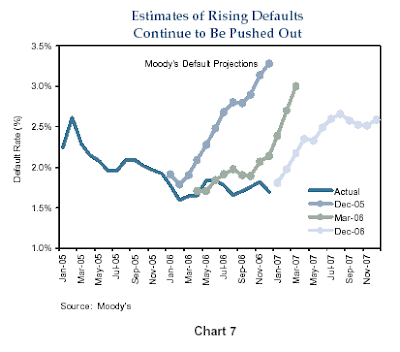
thanks to Northern Trust. more charts here from Barry Ritholtz http://tinyurl.com/3b5cle
Those dark clouds do not faze the new money in subprime. Among those making the biggest bets is Cerberus Capital Management, which first made its name investing in distressed debt. One of the country’s largest private equity firms, Cerberus has a record of making risky contrarian bets, including its recent agreement to take control of the troubled Chrysler Corporation for $7.4 billion.
Cerberus acquired control of the subprime lender Residential Capital last year, when it led an investment consortium that bought a 51 percent stake in G.M.A.C., the finance arm of General Motors. And in April, Cerberus, which also owns Aegis Mortgage, a subprime lender based in Houston, announced plans to acquire Option One, the troubled mortgage subsidiary of H&R Block.
Taken together, these acquisitions would make Cerberus the biggest subprime lender in the country, far ahead of large mortgage giants like Countrywide, Wells Fargo and others, according to first-quarter lending statistics from Inside Mortgage Finance.....“They have certainly double-downed and have bought some extremely attractive operations — companies that have dominated their space,” said Brenda B. White, a managing director with Deloitte & Touche Corporate Finance. “But now they’re faced with executing on a plan, whatever that plan might be.”
 This year, when rising mortgage defaults and a credit squeeze on Wall Street have forced many subprime mortgage companies into bankruptcy, some analysts predict that the industry might shrink by a third or more. Many industry officials acknowledged that a shakeout was necessary to cull the industry of the lenders that led in making risky loans and forcing rivals to match them or lose business.
In the last several months, however, private equity firms and others have acquired, taken stakes in or provided fresh capital to companies that wrote nearly 20 percent of last year’s $600 billion in subprime loans. It is, analysts and industry officials suggest, an unusually quick and substantial bet on a distressed business that by most indications is in the early phases of a long-term retrenchment.
Yet trying to time the bottom of a sliding market has been tricky, even for smart-money investors like Cerberus.
 For instance, rising defaults and the cost of buying back poorly performing loans from investors left Residential Capital with more than $1.5 billion in losses in the six months that ended in March and the losses are expected to continue. (In March, General Motors, which still owns 49 percent of G.M.A.C., was forced to put an additional $1 billion into the unit because of the division’s mortgage woes.)
Cerberus has insisted on a number of terms and conditions in its deal to buy Option One, suggesting that the firm has become more vigilant about not paying too much. ...
In April, Accredited Home Lender, a San Diego-based lender, raised $230 million in loans from Farallon Capital, an investment firm based in San Francisco. The mortgage company agreed to pay a 13 percent interest rate and penalties if it sought to pay off the debt ahead of time. The company also gave Farallon warrants that would allow it to increase its stake in Accredited to 19 percent, from 7 percent. The warrants allow Farallon to buy the company’s shares for $10 apiece, a discount to the stock’s $13.99 closing price yesterday.
Another hedge fund, Second Curve Capital, that bought an 8.5 percent stake in Accredited in early February when the stock was trading at $25 to $30, has increased its stake in the company to 11.2 percent as the stock has fallen.
Citadel, an aspiring financial conglomerate based in Chicago, picked up the lending business of ResMae for just $22 million. Ellington Management, a hedge fund based in Greenwich, Conn., that specializes in mortgage-backed securities, has agreed to pay an undisclosed sum for the lending business of Fremont General, which has not made a subprime loan in almost three months and has cut 2,400 jobs in its lending business.....
“There is a lot of fear that expansion starts again because liquidity is coming in,” said Stephanie Christie, a senior vice president in charge of nonprime lending at Wells Fargo Home Mortgage. “The industry needs to be very serious about prudent underwriting and make sure we don’t go back to making bad loans.”...
>read this twice...what a statement...when you double down on something it is more a sign that they bought way to early. and everybody that bought subprime in 2006 was an not lets say it politely "not smart"....
>last euch das argument nochmal auf der zunge zergehen...wenn ich lese das einer "double down" geht heisst das für mich das hier im vorwege viel zu teuer gekauft worden ist. und wer wie in diesem fall in 2006 in den subprime markt eingestiegen ist der hat gelinde gesagt "nicht clever" gehandelt.
This year, when rising mortgage defaults and a credit squeeze on Wall Street have forced many subprime mortgage companies into bankruptcy, some analysts predict that the industry might shrink by a third or more. Many industry officials acknowledged that a shakeout was necessary to cull the industry of the lenders that led in making risky loans and forcing rivals to match them or lose business.In the last several months, however, private equity firms and others have acquired, taken stakes in or provided fresh capital to companies that wrote nearly 20 percent of last year’s $600 billion in subprime loans. It is, analysts and industry officials suggest, an unusually quick and substantial bet on a distressed business that by most indications is in the early phases of a long-term retrenchment.
Yet trying to time the bottom of a sliding market has been tricky, even for smart-money investors like Cerberus.
For instance, rising defaults and the cost of buying back poorly performing loans from investors left Residential Capital with more than $1.5 billion in losses in the six months that ended in March and the losses are expected to continue. (In March, General Motors, which still owns 49 percent of G.M.A.C., was forced to put an additional $1 billion into the unit because of the division’s mortgage woes.)Cerberus has insisted on a number of terms and conditions in its deal to buy Option One, suggesting that the firm has become more vigilant about not paying too much. ...
“The investment banks that were buying last year were buying at the high,” said Mr. Burns, who is now chief executive of Vantage Score, a company that provides credit scores that lenders use to evaluate borrowers. (Both Merrill and Morgan have said they are comfortable with what they paid for their subprime acquisitions.).....
“They’re taking enormous risks here in hoping that they’ll be able to stabilize these businesses, keep them going, and get the types of regulatory approval they need to originate and service mortgages,” said Rick Antonoff, a partner in the bankruptcy and restructuring practice at the law firm of Pillsbury Winthrop Shaw Pittman. “They have put a lot of capital in already, and it’s going to take additional capital to keep these businesses going for a while.”....
In April, Accredited Home Lender, a San Diego-based lender, raised $230 million in loans from Farallon Capital, an investment firm based in San Francisco. The mortgage company agreed to pay a 13 percent interest rate and penalties if it sought to pay off the debt ahead of time. The company also gave Farallon warrants that would allow it to increase its stake in Accredited to 19 percent, from 7 percent. The warrants allow Farallon to buy the company’s shares for $10 apiece, a discount to the stock’s $13.99 closing price yesterday.
>here the anti spin from Rodger Rafter ...they are often just throwing good money after bad money.
>oder oft genug wird auch einfach gutes geld schlechtem hinterhergeworfen.wie dies klasse beipsiel von Rodger Rafter beweist.
They announced today that a hedge fund (Farallon) will loan them $200 million at 13% interest for 5 years. That interest rate is already extremely high, given the state of the corporate debt market these days, but Farallon also gets 3.3 million warrants priced at $10 and "rights to purchase additional equity securities."
Farallon has an interest in keeping LEND afloat. They bought 1,975,000 shares during Q4 of 2006, most of that was probably above $30 as they hit 1,579,349 shares (a 6.3% stake) on November 2nd. http://tinyurl.com/ysrths
Another hedge fund, Second Curve Capital, that bought an 8.5 percent stake in Accredited in early February when the stock was trading at $25 to $30, has increased its stake in the company to 11.2 percent as the stock has fallen.
Citadel, an aspiring financial conglomerate based in Chicago, picked up the lending business of ResMae for just $22 million. Ellington Management, a hedge fund based in Greenwich, Conn., that specializes in mortgage-backed securities, has agreed to pay an undisclosed sum for the lending business of Fremont General, which has not made a subprime loan in almost three months and has cut 2,400 jobs in its lending business.....
“There is a lot of fear that expansion starts again because liquidity is coming in,” said Stephanie Christie, a senior vice president in charge of nonprime lending at Wells Fargo Home Mortgage. “The industry needs to be very serious about prudent underwriting and make sure we don’t go back to making bad loans.”...
disclosure: short KBW Mortgage Finance Index
to bad that nobody can short ceberus subrpime exposure.........
Labels: accredit, catching a falling knife, ceberus, doubling down, housing data, hrb, private equity, subprime lenders, tightening credit
posted by jmf at 1:00 PM
0 comments


 Except for the odd scrap of rotting meat (mainly among car-parts makers and airlines) they have had little to sink their talons into. This has led to “category creep”.
![[buysell]](http://www.realestatejournal.com/images/buyingselling/20070330-zuckerman.gif)


![[Most Recent Quotes from www.kitco.com]](http://www.kitconet.com/charts/metals/gold/t24_au_en_usoz_2.gif)
![[Most Recent Quotes from www.kitco.com]](http://www.kitconet.com/charts/metals/gold/t24_au_en_euoz_2.gif)


