Credit derivatives - At the risky end of finance / Economist
the real "stress test" of the derivatives market will be one of the main topics. when the suprime derivatives are any guide .....
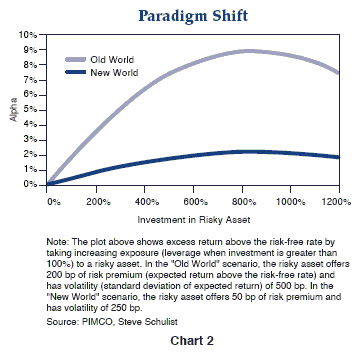
pimco has written "with innovation comes risk". http://tinyurl.com/384a2h so far the risky part of the derivatives has shown his ugly face only in the subpirme sector. we all know that leverage works both sides......
on top of this excellent report from the economist it seems very difficult to account derivatives. when even ge has problems http://tinyurl.com/2cdfhh .... and the biggest problem that is left out in the report is that hedge funds are a domnant player in this segment. what about counterpartyrisk?

der echte stress test in sachen derivaten wird wohl ein hauptthema an den märkten bleiben. sollte der auch nur annähernd so ablaufen wie im subprime segment .......... The use of credit derivatives has boomed and bemused. These new financial instruments have yet to face their biggest test
NAUGHTY or nice? The question that Father Christmas poses to every child who clamours for a present also haunts the credit-derivatives market. Are these devices a clever way to disperse risk, making the financial system safer, as their enthusiasts claim? Or are they “financial weapons of mass destruction”, in Warren Buffett's phrase, that are poorly understood and perilous boosters of credit?
So far the optimists have had the better of it. People have worried about financial derivatives for 20 years, but economies have proved remarkably resilient. These exotic instruments have not yet produced the cataclysm that Jeremiahs have long forecast. Indeed, the equity bear market of 2000-03 did not result in a banking crisis, as it might have done 30 years ago, when derivatives were still rare.
So far credit derivatives have proved a triumph of the financial sector's ingenuity. By dividing the bond market into digestible chunks, they have increased investors' appetite for corporate debt. That may well have lowered the cost of capital—good for the economy, since it should allow companies to invest more over the long run.
But credit derivatives have yet to face a really bracing test. They have grown in a time of low interest rates and narrow credit-spreads (an extra yield over government bonds to offset risk). Recent problems in America's “subprime” mortgage market (for borrowers with poor credit ratings) are a reminder that the sun does not shine for ever. What will happen when monetary policy is tighter, with interest rates increasing and spreads widening?
 The risk of default
Credit derivatives are financial instruments that “derive” their value from the bond market. They can cover any bonds that are not issued by governments—that is, where investors face the risk that the borrower may not repay.
Their rapid growth stems from three market quirks. The first is that a traditional corporate bond bundles together a whole group of risks. A bond price might fall because investors are generally demanding higher yields for all fixed-income assets (interest-rate risk), because investors prefer bonds of one maturity date to another (duration risk), or because they think the company that issued the bond will have trouble repaying it. Derivatives separate this last factor—credit risk—from the other two.

This allows investors to insure themselves against the risk of default or, alternatively, to speculate that a default will occur. The instrument that does this is a credit-default swap or CDS (see jargon guide). Hence A agrees to pay a series of premiums to B; who agrees to compensate A if the bond defaults. ....
The third quirk of credit derivatives is that they allow corporate bonds to be sliced and diced on the basis of risk. Some investors (such as banks and insurance companies) may prefer to own the highest-rated (AAA) debt for regulatory or solvency reasons. Others, such as hedge funds, may want to take more risk and earn higher returns.

Derivatives known as collateralised debt obligations (CDOs) are a clever way to satisfy every taste. They are like a mutual fund that bundles together bonds, loans or swaps. But unlike a mutual fund, a CDO has different tranches that give investors different rights over this portfolio. For example, as interest payments on the underlying bonds come in, they will first be allocated to the senior tranches. Only when these have been paid will the more junior tranches get their share. And if defaults occur, the junior tranches take the first hit.
This tailoring can turn coarse corporate cloth into investment-grade haute couture. Take a bunch of companies, with bonds rated A (not the best credit-rating, but reasonably secure). Assemble them in a portfolio and give one group of securities rights over the first 70-80% of the cashflows from the bonds (and protection against the first 20-30% of defaults). Since it is highly unlikely that 20-30% of the A-rated bonds will go bust, the rating agencies will give such securities the highest AAA appellation. In a world where very few individual companies can command such a lofty rating, this transmutation makes such instruments highly appealing.
Of course, it concentrates the risks in the rest of the portfolio. The lowest-rated securities (the last to get the cashflows and the first to bear the brunt of default) are known as “equity”. Although they are not strictly shares, they do tend to offer share-like returns of 15-20% or so. The securities in between the equity and the senior securities are known as mezzanine.
The bottom tiers of these CDOs have been called “toxic waste”. But they have been almost nourishing in recent years, thanks to the low default rate on corporate bonds. Their buyers have enjoyed the rewards without seeing much of the risks.

That now seems to be changing—in one part of the market, at least: CDOs that buy asset-backed securities and in particular those linked to subprime mortgages. These loans were bundled together and sold as residential mortgage-backed securities (RMBS); in turn those securities were bought by the issuers of CDOs. With so many subprime borrowers now behind on their payments, the pain is trickling through the system. The ABX index, which represents a basket of credit swaps on bonds tied to high-risk mortgages, fell more than a quarter in the first three months of the year.
 A study by Moody's, a credit-rating agency, of asset-backed CDOs found that, on average, slightly less than half their portfolios were invested in subprime RMBS. But in some cases, the exposure was nearly 90%. http://tinyurl.com/2j382a Losses will be magnified for investors in the junior tranches. At worst, Moody's says, the vast majority of tranches in such CDOs would be downgraded to junk-bond status.
>here you can read how late to the party the rating agencies are.
> zu dumm nur das die ratingagneturen bis vor kurzem nochn nichts in sachen ratiung gemacht haben....
"rating agencies fallen asleep" http://tinyurl.com/2wn6kp
Over the edge
Imagine a geared hedge fund owning the riskiest tranches of CDOs exposed to subprime debt. Lombard Street Research reckons that the combined gearing could reach 54-fold, implying that a 2% price drop could wipe out the entire portfolio. There are no signs, as yet, that any hedge funds have taken such a big bet; the best known casualty is a London-listed fund, Queen's Walk, which has seen its shares fall by 40% this year. Anecdotal evidence suggests many hedge funds were quick to realise the dangers of subprime lending—and to profit from the market collapse.

Yet the damage may take time to be felt. Many 2006 mortgages are not yet in default. Many CDO tranches are rarely traded, so prices may not have registered a hit. Investors may not write down holdings until the rating agencies downgrade them—which could take months.
CDOs come in a variety of forms. “Cashflow” CDOs are normally based on a portfolio of bonds.
According to the Bank for International Settlements, some $489 billion-worth were issued in 2006, a record year. Synthetic CDOs are built on swaps: the CDO vehicle insures a portfolio of bonds, doles out the premiums to investors and then deducts capital from the riskiest tranches when defaults occur. The bank says $450 billion of synthetic CDO issuance occurred last year, more than double the 2005 level. Collateralised loan obligations (CLOs) are backed by a portfolio of loans, usually those raised by private-equity groups for takeovers. This area of the market is also expanding fast.
But those are just the straightforward recipes. The ever-inventive financial sector has taken the ingredients and cooked up a bewildering alphabet soup. A CDO2 invests in other CDOs. CPDOs are constant proportion debt obligations which can borrow up to 15 times their capital to insure an index of bonds (such as the iTRAXX) against default; the result is a highly geared structure that pays up to two percentage points above cash rates and yet is given an AAA rating. Credit-derivative product companies (CDPCs) act as a kind of reinsurance company, trading swaps with CDS dealers. They gear up their capital 30 times, relying on the margin between swap spreads on investment-grade debt and the prospects of default. It may sound risky, but Tom Jasper, of Primus Guaranty, one of the sector's pioneers, says he has not suffered a credit default in the five years of the company's existence.....
Systemic risk is more of a worry. Dispersing risk ought to make the system more secure. When a bank fails because of loan defaults, depositors at other banks lose confidence; the result can be a contraction of credit in the economy. If loans are held by investors, such as hedge funds, in diversified pools, corporate defaults should have less of an effect. Each investor should lose only a fraction of its portfolio......
Widening credit spreads will hit some investors (although, of course, those on the other side of the deal will profit). But Lisa Watkinson, of Lehman Brothers, says she does not think the growth of the CDS market will suffer. “The more volatility there is, the more scope you have to express a view,” she says. “When spreads were very low, people were saying there was no need to hedge.”
 However, credit derivatives create a moral hazard. Someone has to lend money in the first place. If they know they will sell on that loan or bond within weeks, they may not worry whether the borrower will repay in five years' time. Indeed, if they get paid a fee to make the deal, they will care more about quantity than quality.
In addition, if risk is too diversified, who will monitor credit quality closely? This is the “toddler by the swimming pool” problem. If one parent is in charge, he will never take his eyes off the moppet. But if both parents and others are around, all may assume someone else is on guard. Everyone may be reading their newspapers when they hear the splash.
The holders of the equity tranches should act as the concerned parent, because they will suffer first if defaults rise. However, it may be more difficult for them to do so if they are two or three removes away from the borrower in question.

So the system may seem to have become safer, but new dangers could be in the making. Perhaps credit derivatives will alter the behaviour of investors and companies, encouraging them to take more risk. That seems to have happened in the American subprime mortgage market, where underwriting standards fell sharply in recent years, leading to a rapid rise in delinquent loans. Perhaps corporate borrowers will default more than derivative investors imagine, or perhaps investors will recover less value when they do default.
In other words, if individuals feel safer they may act less responsibly. This is the “seatbelt problem”: motorists wearing belts may drive faster knowing they are less likely to go through the windscreen if they have an accident. The overall level of risk ends up the same.
Money matters
A second, and potentially just as serious, problem could be the effect of derivatives on the global supply of credit. David Roche, of Independent Strategy, argues that derivatives have created a form of liquidity outside the control of central bankers. “It is pretty obvious that if one can buy a security that represents an asset for 3-5% of its value, an awful lot of liquidity has been freed up,” he says. “Derivatives have led to many more assets and liabilities being created. By reducing the cost of buying assets, you increase the demand.”

People tend to think of two types of money: narrow money (notes and coins) and broad money (bank accounts and other kinds of assets). Mr Roche says this structure is like an inverted pyramid, where the top layer is derivatives, worth more than nine times global GDP. Credit derivatives are only a small part of this, but already the amounts involved are staggering.
According to the Bank for International Settlements, the nominal amount of credit-default swaps had reached $20 trillion by June last year. With volumes almost doubling every year since 2000, some reckon the CDS market will soon be worth more than $30 trillion

This derivatives “money” is not being used to buy food, clothes or cars—which is why there has been no general pick-up in inflation. But it has been used to inflate asset prices, Mr Roche argues.
The danger is things might go into reverse. A rising cost of capital (perhaps from inflation worries) or a rise in risk aversion (due to a pick-up in defaults) might be the culprit. If liquidity falls throughout the system, derivatives will take the biggest hit. But the result, if derivatives have been pumping up the demand for assets, could be a sharp fall in asset prices.
That makes the naughty or nice question hard to answer. So far, credit derivatives have shown their nice side. Their explosive growth has come against a background of generally benign economic conditions, with only modest recessions and low or falling interest rates. Indeed, derivatives have helped produce those benign conditions, by removing some of the financial constraints on growth.
 But it is in the nature of capitalism to test new ideas to destruction and to use new instruments as the basis of speculative excess. As Mr Roche puts it: “Credit derivatives are like good things to the Catholic Church. If you have too much of them, they're a sin.” Nobody will be sure how robust credit derivatives are until they have been tested in a severe economic or financial downturn. And that is not something anyone should wish for.
pimco has written "with innovation comes risk". http://tinyurl.com/384a2h so far the risky part of the derivatives has shown his ugly face only in the subpirme sector. we all know that leverage works both sides......
on top of this excellent report from the economist it seems very difficult to account derivatives. when even ge has problems http://tinyurl.com/2cdfhh .... and the biggest problem that is left out in the report is that hedge funds are a domnant player in this segment. what about counterpartyrisk?
der echte stress test in sachen derivaten wird wohl ein hauptthema an den märkten bleiben. sollte der auch nur annähernd so ablaufen wie im subprime segment ..........
ich halte es da mit pimco (link oben). und wie wir alle wissen arbeitet der hebel nach beiden seiten. zudem scheint es selbst für ge schwer zu sein deriavte richtig zu verbuchen. und ein weiterer punkt der etwas zu kurz kommt ist das hedge fonds wichtige spieler sind. hätte ein ungutes gefühl wie die den großteil der gegenposition stellen.....
 The use of credit derivatives has boomed and bemused. These new financial instruments have yet to face their biggest test
NAUGHTY or nice? The question that Father Christmas poses to every child who clamours for a present also haunts the credit-derivatives market. Are these devices a clever way to disperse risk, making the financial system safer, as their enthusiasts claim? Or are they “financial weapons of mass destruction”, in Warren Buffett's phrase, that are poorly understood and perilous boosters of credit?
So far the optimists have had the better of it. People have worried about financial derivatives for 20 years, but economies have proved remarkably resilient. These exotic instruments have not yet produced the cataclysm that Jeremiahs have long forecast. Indeed, the equity bear market of 2000-03 did not result in a banking crisis, as it might have done 30 years ago, when derivatives were still rare.
So far credit derivatives have proved a triumph of the financial sector's ingenuity. By dividing the bond market into digestible chunks, they have increased investors' appetite for corporate debt. That may well have lowered the cost of capital—good for the economy, since it should allow companies to invest more over the long run.
But credit derivatives have yet to face a really bracing test. They have grown in a time of low interest rates and narrow credit-spreads (an extra yield over government bonds to offset risk). Recent problems in America's “subprime” mortgage market (for borrowers with poor credit ratings) are a reminder that the sun does not shine for ever. What will happen when monetary policy is tighter, with interest rates increasing and spreads widening?
The risk of defaultCredit derivatives are financial instruments that “derive” their value from the bond market. They can cover any bonds that are not issued by governments—that is, where investors face the risk that the borrower may not repay.
Their rapid growth stems from three market quirks. The first is that a traditional corporate bond bundles together a whole group of risks. A bond price might fall because investors are generally demanding higher yields for all fixed-income assets (interest-rate risk), because investors prefer bonds of one maturity date to another (duration risk), or because they think the company that issued the bond will have trouble repaying it. Derivatives separate this last factor—credit risk—from the other two.
This allows investors to insure themselves against the risk of default or, alternatively, to speculate that a default will occur. The instrument that does this is a credit-default swap or CDS (see jargon guide). Hence A agrees to pay a series of premiums to B; who agrees to compensate A if the bond defaults. ....
The third quirk of credit derivatives is that they allow corporate bonds to be sliced and diced on the basis of risk. Some investors (such as banks and insurance companies) may prefer to own the highest-rated (AAA) debt for regulatory or solvency reasons. Others, such as hedge funds, may want to take more risk and earn higher returns.
Derivatives known as collateralised debt obligations (CDOs) are a clever way to satisfy every taste. They are like a mutual fund that bundles together bonds, loans or swaps. But unlike a mutual fund, a CDO has different tranches that give investors different rights over this portfolio. For example, as interest payments on the underlying bonds come in, they will first be allocated to the senior tranches. Only when these have been paid will the more junior tranches get their share. And if defaults occur, the junior tranches take the first hit.
This tailoring can turn coarse corporate cloth into investment-grade haute couture. Take a bunch of companies, with bonds rated A (not the best credit-rating, but reasonably secure). Assemble them in a portfolio and give one group of securities rights over the first 70-80% of the cashflows from the bonds (and protection against the first 20-30% of defaults). Since it is highly unlikely that 20-30% of the A-rated bonds will go bust, the rating agencies will give such securities the highest AAA appellation. In a world where very few individual companies can command such a lofty rating, this transmutation makes such instruments highly appealing.
Of course, it concentrates the risks in the rest of the portfolio. The lowest-rated securities (the last to get the cashflows and the first to bear the brunt of default) are known as “equity”. Although they are not strictly shares, they do tend to offer share-like returns of 15-20% or so. The securities in between the equity and the senior securities are known as mezzanine.
The bottom tiers of these CDOs have been called “toxic waste”. But they have been almost nourishing in recent years, thanks to the low default rate on corporate bonds. Their buyers have enjoyed the rewards without seeing much of the risks.
That now seems to be changing—in one part of the market, at least: CDOs that buy asset-backed securities and in particular those linked to subprime mortgages. These loans were bundled together and sold as residential mortgage-backed securities (RMBS); in turn those securities were bought by the issuers of CDOs. With so many subprime borrowers now behind on their payments, the pain is trickling through the system. The ABX index, which represents a basket of credit swaps on bonds tied to high-risk mortgages, fell more than a quarter in the first three months of the year.
A study by Moody's, a credit-rating agency, of asset-backed CDOs found that, on average, slightly less than half their portfolios were invested in subprime RMBS. But in some cases, the exposure was nearly 90%. http://tinyurl.com/2j382a Losses will be magnified for investors in the junior tranches. At worst, Moody's says, the vast majority of tranches in such CDOs would be downgraded to junk-bond status.>here you can read how late to the party the rating agencies are.
> zu dumm nur das die ratingagneturen bis vor kurzem nochn nichts in sachen ratiung gemacht haben....
"rating agencies fallen asleep" http://tinyurl.com/2wn6kp
Over the edge
Imagine a geared hedge fund owning the riskiest tranches of CDOs exposed to subprime debt. Lombard Street Research reckons that the combined gearing could reach 54-fold, implying that a 2% price drop could wipe out the entire portfolio. There are no signs, as yet, that any hedge funds have taken such a big bet; the best known casualty is a London-listed fund, Queen's Walk, which has seen its shares fall by 40% this year. Anecdotal evidence suggests many hedge funds were quick to realise the dangers of subprime lending—and to profit from the market collapse.
Yet the damage may take time to be felt. Many 2006 mortgages are not yet in default. Many CDO tranches are rarely traded, so prices may not have registered a hit. Investors may not write down holdings until the rating agencies downgrade them—which could take months.
CDOs come in a variety of forms. “Cashflow” CDOs are normally based on a portfolio of bonds.
According to the Bank for International Settlements, some $489 billion-worth were issued in 2006, a record year. Synthetic CDOs are built on swaps: the CDO vehicle insures a portfolio of bonds, doles out the premiums to investors and then deducts capital from the riskiest tranches when defaults occur. The bank says $450 billion of synthetic CDO issuance occurred last year, more than double the 2005 level. Collateralised loan obligations (CLOs) are backed by a portfolio of loans, usually those raised by private-equity groups for takeovers. This area of the market is also expanding fast.
But those are just the straightforward recipes. The ever-inventive financial sector has taken the ingredients and cooked up a bewildering alphabet soup. A CDO2 invests in other CDOs. CPDOs are constant proportion debt obligations which can borrow up to 15 times their capital to insure an index of bonds (such as the iTRAXX) against default; the result is a highly geared structure that pays up to two percentage points above cash rates and yet is given an AAA rating. Credit-derivative product companies (CDPCs) act as a kind of reinsurance company, trading swaps with CDS dealers. They gear up their capital 30 times, relying on the margin between swap spreads on investment-grade debt and the prospects of default. It may sound risky, but Tom Jasper, of Primus Guaranty, one of the sector's pioneers, says he has not suffered a credit default in the five years of the company's existence.....
Systemic risk is more of a worry. Dispersing risk ought to make the system more secure. When a bank fails because of loan defaults, depositors at other banks lose confidence; the result can be a contraction of credit in the economy. If loans are held by investors, such as hedge funds, in diversified pools, corporate defaults should have less of an effect. Each investor should lose only a fraction of its portfolio......
Widening credit spreads will hit some investors (although, of course, those on the other side of the deal will profit). But Lisa Watkinson, of Lehman Brothers, says she does not think the growth of the CDS market will suffer. “The more volatility there is, the more scope you have to express a view,” she says. “When spreads were very low, people were saying there was no need to hedge.”
However, credit derivatives create a moral hazard. Someone has to lend money in the first place. If they know they will sell on that loan or bond within weeks, they may not worry whether the borrower will repay in five years' time. Indeed, if they get paid a fee to make the deal, they will care more about quantity than quality.In addition, if risk is too diversified, who will monitor credit quality closely? This is the “toddler by the swimming pool” problem. If one parent is in charge, he will never take his eyes off the moppet. But if both parents and others are around, all may assume someone else is on guard. Everyone may be reading their newspapers when they hear the splash.
The holders of the equity tranches should act as the concerned parent, because they will suffer first if defaults rise. However, it may be more difficult for them to do so if they are two or three removes away from the borrower in question.
So the system may seem to have become safer, but new dangers could be in the making. Perhaps credit derivatives will alter the behaviour of investors and companies, encouraging them to take more risk. That seems to have happened in the American subprime mortgage market, where underwriting standards fell sharply in recent years, leading to a rapid rise in delinquent loans. Perhaps corporate borrowers will default more than derivative investors imagine, or perhaps investors will recover less value when they do default.
In other words, if individuals feel safer they may act less responsibly. This is the “seatbelt problem”: motorists wearing belts may drive faster knowing they are less likely to go through the windscreen if they have an accident. The overall level of risk ends up the same.
Money matters
A second, and potentially just as serious, problem could be the effect of derivatives on the global supply of credit. David Roche, of Independent Strategy, argues that derivatives have created a form of liquidity outside the control of central bankers. “It is pretty obvious that if one can buy a security that represents an asset for 3-5% of its value, an awful lot of liquidity has been freed up,” he says. “Derivatives have led to many more assets and liabilities being created. By reducing the cost of buying assets, you increase the demand.”
People tend to think of two types of money: narrow money (notes and coins) and broad money (bank accounts and other kinds of assets). Mr Roche says this structure is like an inverted pyramid, where the top layer is derivatives, worth more than nine times global GDP. Credit derivatives are only a small part of this, but already the amounts involved are staggering.
According to the Bank for International Settlements, the nominal amount of credit-default swaps had reached $20 trillion by June last year. With volumes almost doubling every year since 2000, some reckon the CDS market will soon be worth more than $30 trillion
This derivatives “money” is not being used to buy food, clothes or cars—which is why there has been no general pick-up in inflation. But it has been used to inflate asset prices, Mr Roche argues.
The danger is things might go into reverse. A rising cost of capital (perhaps from inflation worries) or a rise in risk aversion (due to a pick-up in defaults) might be the culprit. If liquidity falls throughout the system, derivatives will take the biggest hit. But the result, if derivatives have been pumping up the demand for assets, could be a sharp fall in asset prices.
That makes the naughty or nice question hard to answer. So far, credit derivatives have shown their nice side. Their explosive growth has come against a background of generally benign economic conditions, with only modest recessions and low or falling interest rates. Indeed, derivatives have helped produce those benign conditions, by removing some of the financial constraints on growth.
But it is in the nature of capitalism to test new ideas to destruction and to use new instruments as the basis of speculative excess. As Mr Roche puts it: “Credit derivatives are like good things to the Catholic Church. If you have too much of them, they're a sin.” Nobody will be sure how robust credit derivatives are until they have been tested in a severe economic or financial downturn. And that is not something anyone should wish for.Labels: abx, cdo, cds, clo, cpdo, derivatives, rating agencies, subprime
posted by jmf at 10:46 PM
2 comments


 It is truly remarkable how reminiscent the current mindset is of the 1998-2000 stock mania, when every week would see hundreds of upward price-target revisions. Having said that, in my opinion the current psychology amongst so-called professionals is even loonier.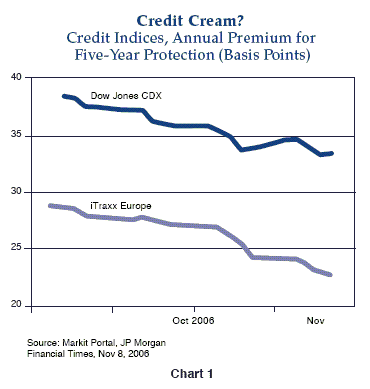
![[Most Recent Quotes from www.kitco.com]](http://www.kitconet.com/charts/metals/gold/t24_au_en_usoz_2.gif)
![[Most Recent Quotes from www.kitco.com]](http://www.kitconet.com/charts/metals/gold/t24_au_en_euoz_2.gif)


