Thursday, July 29, 2010

Clevelend Fed "One Measure Of Corporate Leverage Recently Reached A New Historical High"

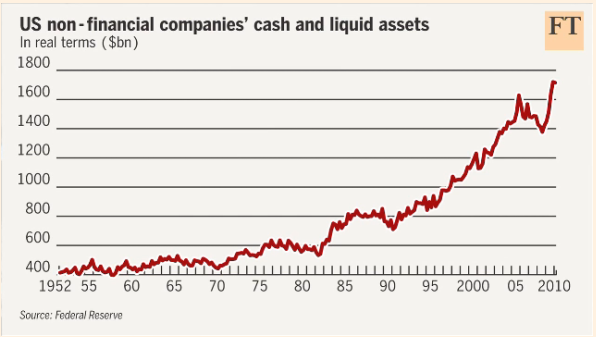
By now everybody has seen the following chart showing the very impressive cash position of corporates only waiting to be spend on dividends, buybacks, M&A, investments etc..... If you dig a little bit deeper it seems outside a few very strong companies ( mainly tech ) the overall "breath" isn´t quite as strong as reported...... On top of this to my knowledge a not insignificant percentage of the cash is "trapped" outside the US.... Without a special "tax holiday" there is only a very small chance that this money can be used freely..... See 2nd. UPDATE at the end of the post.....

Ich denke jeder hat den nachfolgenden Chart, der die starke Cashposition der US Unternehmen zeigt, inzwischen irgendwo gesehen bzw davon gelesen ( wird ja fast gebetsmühlenartig tagtäglich wiederholt )... Hoffnung der Märkte ist das dieser gigantische Batzen entweden in Form von Investments, Dividenden, Aktienrückkäufen oder Übernahmen den Weg zurück in die Kassen der Anleger und den Wirtschaftskreislauf findet.... Wenn man etwas genauer hinsieht ist ausserhalb einiger extrem starker Unternehmen ( hauptsächlich Technologie ) in der "Breite" nicht alles so rosig wie man allgemein vermuten könnte..... Darüberhinaus ist nach meinem Kenntnisstand ein nicht unerheblicher Teil der Gelder ausserhalb der US "gefangen"..... Ohne eine besondere Steuererleichterung wird keine der Firmen ohne extreme Nachteile ( glaube ca. 30%) über diese Gelder verfügen können.... Habe hierzu noch ein zweites Update am Ende des Postings gemacht.....
US corporate cash FT LEX

American companies are supposedly flush with cash. Therefore, the optimists say, we should own stocks instead of bonds. Bulging balance sheets should lead either to a mergers and acquisitions boom or, less interestingly, companies can always buy back their own stock. Either way, stocks win.

There is one big problem with this argument; in fact, judged in aggregate, corporate USA’s books are in bad shape. The error is looking at gross cash positions only, ignoring the near doubling in non-financial companies’ leverage since 1982.

Some sectors, such as technology, are genuinely cash rich: the members of the Bloomberg World Technology index have a net $260bn salted away, or 12 per cent of their total market capitalisation.

But, in aggregate, non-financial companies’ cash only covers about 25 per cent of the interest-paying debt on their balance sheets, in line with the norm for the past 40 years.

In the 1950s, companies’ cash covered more than half of their debt.

Corporate Cash: Top 20 Firms = $635 Billion Barry Ritholtz

We found that 3,000 non-financial firms have $1.641 trillion dollars in cash and equivalents.

Other details:

-The top 50 firms are over half of this dollar amount, accounting for $823.642 billion dollars.

-The top 20 firms, ranging from Berkshire to United Health Group account for most of this — $635.386 billion dollars.

-The automakers are another anomaly — Ford (at #3) is showing $46.67 billion dollars in cash — but its against $66.668 billion in liabilities. Even GM’s bankrupt stub Liquidation Motors (# 17) is showing $14.194 billion in cash against $73.934 billion in debt.

-I’m not sure if we should exclude Berkshire Hathaway or GE as financials, but they accounted for $146.644 and $111.176 billion dollars respectively.

Is Debt Overhang Causing Firms to Underinvest? Fed Of Clevelend
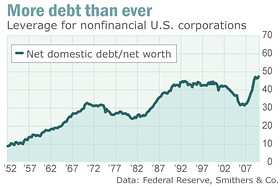
One measure of corporate leverage, the ratio of firms’ credit market debt to assets, recently reached a new historical high (see figures 1 and 2).

I assume when you include the pension liabilities / funding levels & "Stresstest the Goodwill" the picture isn´t getting better....

Tippe mal darauf das wenn man die massiv unterfinanzierten Pensionskassen miteinbezieht sowie den Goodwill einem Stresstest unterzieht verbessert sich das Bild nicht merklich.....

UPDATE:

Ending The "Cash On The Sidelines" Fallacy (Redux) ZH


iStockAnalyst


The Biggest Lie About U.S. Companies Brett Arends
American companies are not in robust financial shape. Federal Reserve data show that their debts have been rising, not falling. By some measures, they are now more leveraged than at any time since the Great Depression.
MW-AF721_domest_MD_20100802154926.jpg

S&P 500 Full Year Sources And Uses Of Cash ZH
Yet despite consistent claims that companies have massive deleveraged, just $635 billion of debt was repaid, meaning only $35 billion of debt was actually retired! What the flow was used for, however, was to extend maturities, and to shift debt across different sections of the S&P500's balance sheet, lowering the debt cost of capital
I think the charts are showing a nice confirmation that the "breath" is unfortunatley not as strong as would be desirable....

Ich denke diese Charts zeigen leider recht deutlich das die "Breite" leider nicht wie wünschenswert gegeben ist....

2nd Update

Floyd Norris

It was called the “Homeland Investment Act,” and was sold to Congress as a way to spur investment in America, building plants, increasing research and development and creating jobs. It gave international companies a large one-time tax break on overseas profits, but only if the money was used for specified investments in the United States.

The law specifically said the money could not be used to raise dividends or to repurchase shares.

Now the most detailed analysis of what actually happened — using confidential government data as well as corporate reports — has estimated what happened to the $299 billion companies brought back from foreign subsidiaries.


About 92 percent of it went to shareholders, mostly in the form of increased share buybacks and the rest through increased dividends.

There is no evidence that companies that took advantage of the tax break — which enabled them to bring home, or repatriate, overseas profits while paying a tax rate far below the normal rate — used the money as Congress expected.

“Dell was a great example,” she added, referring to Dell Computer. “They lobbied very hard for the tax holiday. They said part of the money would be brought back to build a new plant in Winston-Salem, N.C. They did bring back $4 billion, and spent $100 million on the plant, which they admitted would have been built anyway. About two months after that, they used $2 billion for a share buyback.”

From the B.E.A. data, the researchers were able to calculate that $300 billion in overseas profit was repatriated by American companies in 2005, when they had to pay a tax rate of just 5.25 percent, rather than the normal corporate tax rate of 35 percent. The amount was five times the normal amount of repatriations.

Mmhhh.... After this "spectacular" outcome last time the chances for another tax break are probably not "overwhelming"...

Uh....Nachdem die Ergebnisse beim letzten Mal höflich formuliert "dürftig" waren stehen die Ampeln auf eine ähnlich gelagerte Steuererleichterung nicht gerade auf Grün....

Labels: , , , , ,

Tuesday, November 11, 2008

Debt Pile Looming Over European Firms

I´ll bet that some will damm their debt financed aquisitions & stock buybacks ( for some "amusing" examples see "I Want My Buyback Back" ) ........ I assume that during the coming at least 2 years it won´t be the earnings that will dominate the stockprice .... It will be all about the balance sheet....... The management will be forced from a shareholder value oriented mood to "serve" their new masters aka the bondholders.......

Kann mir gut vostellen das einige inzwischen Ihre schuldenfinanzierten Übernahmewahn & die Aktienrückkäufe bereuen ( einige "amüsante" Beispiele gibt es hier zu bewundern "I Want My Buyback Back" ) ...... Bin mir ziemlich sicher das zumindest auf Sicht von 2 Jahren weniger die Gewinnsituation als die Bilanzqualität das beherrschende Thema der Aktienmärkte sein werden..... Das Management wird zukünftig nicht mehr die Aktionäre sondern die Bondholder in den Mittelpunkt Ihrer "Bemühungen" stellen......

[eu debt]

> The trouble is getting even greater when you combine the graph with the
spread charts via Mish

> Wie prekär die momentane Lage ist zeigt mehr als eindrucksvoll wenn man die o.g. Grafik mit den nachvolgenden Charts kombiniert Unternehmensanleihen auf Tauchstation via Zeitenwende/Mish

WSJ European companies, already in the middle of an economic downturn, face another uphill struggle as they seek to refinance $242.6 billion of maturing debt over the coming year, according to credit-ratings firm Standard & Poor's.

"Funding pressures in Europe have escalated sharply since September as stress in the global financial system accelerated," the report said.

According to the report, European companies will be forced to pay back or refinance $586.3 billion through 2011, with more than 40% of that debt coming due over the next year.
French nonfinancial corporate issuers account for the largest portion of debt to be refinanced, with 26%, followed closely by the U.K., Germany, Netherlands and Italy, which have a combined share of 79%.

No company rated below single-A has managed to access the bond market in recent months, offering little hope for companies further down the ratings scale

The report examined all debts rated by S&P including bank loans, notes and bonds.

>The banks will have to pray that the companies manage the refinancing of the debt... Otherwise they are forced to tapp corporate bank lines .....

> Die Banken dürften bereits jetzt anfangen zu beten das es möglich sein wird diese fälligen Anleihen zu refinanzieren...... Ansonsten bleibt den Firmen nichts anderes übrig als die bestehenden Kreditlinien der Banken anzuzapfen...... Sicher nicht der glücklichste Umstand wenn nahezu alle Banken dringend auf Ihre Kapitalstärke achten müssen......

Credit terms increasingly tied to risk FT Alphaville - US and European companies renewing short-term credit facilities are being forced to accept terms that link interest payments to their creditworthiness. In recent months, AT&T, Wal-Mart, Caterpillar, Halliburton, Nokia and Novartis have all renewed their short-term financing arrangements, including revolving credit facilities, and found that “relationship pricing” is no longer available. Instead,

companies are finding that banks - which had offered cheap loans to top corporate clients - now price these facilities based on measures of credit risk. In most cases, credit default swaps are being used.

The first deal for this new type of pricing for revolving loans, totalling an estimated $6,000bn worldwide, was done in April

Since then, such terms have become widely used. Banks hope this will discourage companies from tapping these credit lines unless they absolutely need to. Already, at least 20 such deals for 364-day revolving credit facilities – a type of overdraft for companies to ensure access to funds in case markets shut down – have been completed and at least as many are in the pipeline.

Update via Bloomberg Borse Dubai May Refinance $4.2 Billion of Loans at Higher Costs

Borse Dubai Ltd., the Gulf emirate's state-owned operator of exchanges, is in talks to refinance $4.2 billion of loans at interest rates tied to the price of credit- default swaps, raising the cost of the debt, said three bankers with knowledge of the transaction.

The new debt may pay interest of as much as 6 percentage points over the London interbank offered rate on loans for three years, said the bankers, who declined to be named because the negotiations are private. That compares with a margin of 1.1 percentage points on the existing loans, which were used to buy Sweden's OMX AB last year


AddThis Feed Button

Labels: , , , , ,

Thursday, June 21, 2007

Leveraged Loan Market The Future Supbrime ?

The Story is mainly about the Bear Sterns drama (click headline). i´ve singled out the last paragraph. i suggest to read this from Calculated Risk about the "covenant lite"

http://tinyurl.com/2up7mk

Die ursprüngliche Geschichte behandelt in erster Linie die Probleme von Bear Stearn (Überschrift klicken). Ich finde den letzten Absatz am interessantesten. Zudem solltet ihr unbedingt den link von Calculated Risk lesen

But perhaps the most worrying thing for financial institutions holding mortgage-backed paper is not the subprime market itself, but the unnerving parallels with an even bigger one to which they are also exposed: leveraged loans to companies.

As Daniel Arbess of Xerion Capital Partners points out, corporate lending's giddy leverage echoes the high loan-to-value ratios in subprime; the explosion of “covenant-lite” deals and payment-in-kind notes mirrors that of interest-only and negative-amortisation mortgages; and leveraged buy-outs have their own form of mortgage refinancing in the so-called dividend recapitalisation. Subprime, says Mr Arbess, might well be “a dress rehearsal for something bigger and scarier.”

AMEN


>here one more example on what path corporate lending is....how about toggle bonds......

>hier ein Beispiel mehr auf welchen Pfadedn sich die Kreditvergabe inzwischen bewegt....


`Fantasy Land'More than half of the junk bonds sold this year were used to pay for leveraged buyouts and mergers and acquisitions, according to Barclays Capital. Money is so easy to come by that for the first time some investors agreed to let borrowers choose to make interest payments in cash or in additional bonds.

``This is fantasy land for corporate treasurers,'' .... They ``are smiling like Cheshire cats'' and borrowing conditions ``entice them to increase their leverage.''

Univision Communications Inc., the Los Angeles-based Spanish-language broadcaster, and real estate broker Realogy Corp. of Parsippany, New Jersey, financed their takeovers in part with so-called toggle bonds that give the issuer the option to pay interest with more bonds. http://tinyurl.com/23l9dc

Labels: , , , , ,

Thursday, December 14, 2006

"capitalism, china´s way / economist"

very oldfashioned. looks like lots of business for the investmentbanks for years to come. one thing is for sure. they will always find a "creative" or "innovative" way to make financing possible........
noch ziemlich altmodisch. betonung liegt auf noch.... da liegt ne menge geschäft auf sicht von jahren für die investmentbanken auf der straße. und ein ist ziemlich sicher. die haben bisher immer wege gefunden finanzmittel zu verfügung zu stellen........
........ By the end of 2006, ... a record 21% of funding for Chinese companies will have come through the country's share and debt markets (the banks themselves have been the biggest share issuers). As the chart shows, funding from outside the banking system will have grown sixfold since 2002, to 806 billion yuan ($103 billion).

Labels: ,